Predict the Topic From Fiction and Nonfiction Titles
Written by Adi Ackerman, Head Teacher
"Predict the Topic From Fiction and Nonfiction Titles" is written for 2nd Grade (Ages 7-8). If your little one is a year younger but already steady on comprehension exercises, the page still works. You may just need to read the instructions out loud. And if they are older and prediction worksheets never quite stuck, this is a short review rather than busywork.
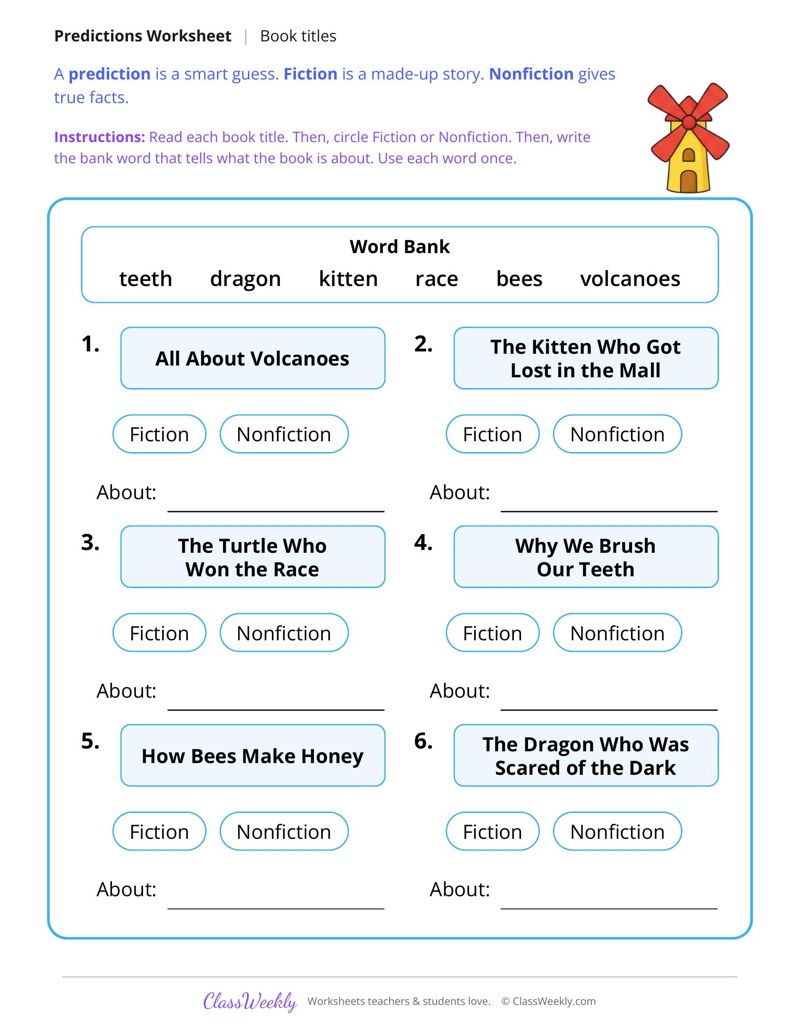
2nd grade reading worksheet: sort 6 titles like All About Volcanoes as fiction or nonfiction and write each topic word. Answer key included. Part of our prediction worksheets comprehension exercises collection.
How do I use this worksheet?
Begin with a shared reading or oral warm-up that highlights prediction worksheets so students hear and see the skill in context before practicing it independently. Have students work through it independently after a quick group example, checking in with a partner if they get stuck, especially for phonics-based tasks where saying an answer aloud first helps. After completing the worksheet, use one or two examples from the page to start a discussion: "Where else have you seen this in your reading?" These prediction worksheets worksheets are ideal for use during small group reading time, as independent center work, or as a homework activity.
What students will practice
- Students will read 6 book titles and tell fiction, a made-up story, from nonfiction.
- Students will circle Fiction for The Turtle Who Won the Race and Nonfiction for How Bees Make Honey.
- Students will write the word bank topic of each book, such as teeth, bees or dragon.


Curriculum Links
Find this in the curriculum
Browse the grade, subject, and topic this belongs to.
FAQ
How do I use this prediction worksheets worksheet?
⌄
Begin with a shared reading or oral warm-up that highlights prediction worksheets so students hear and see the skill in context before practicing it independently. Have students work through it independently after a quick group example, checking in with a partner if they get stuck, especially for phonics-based tasks where saying an answer aloud first helps. After completing the worksheet, use one or two examples from the page to start a discussion: "Where else have you seen this in your reading?" These prediction worksheets worksheets are ideal for use during small group reading time, as independent center work, or as a homework activity.
What does this worksheet teach?
⌄
Sort 6 titles like All About Volcanoes as fiction or nonfiction and write each topic word. A prediction is a smart guess. Fiction is a made-up story. Nonfiction gives true facts. The directions on the page read: Read each book title. Then, circle Fiction or Nonfiction. Then, write the bank word that tells what the book is about. Use each word once. An answer key is included.
Can I use this prediction worksheets worksheet for homeschool or classroom?
⌄
Yes, both. We made it for 2nd Grade comprehension exercises, and the page works the same whether it lands on a kitchen table or a center rotation. At home, most families go through it together and talk the answers out loud, and that talking is where most of the learning happens with prediction worksheets. In class it runs well as independent work while you pull a small group. Print one copy or thirty, whichever the day needs.
How do 2nd graders make a prediction?
⌄
They put clues from the text together with what they already know. In Jada's Tall Tower, Pepper the cat crouches low, wiggles her back legs and points her ears at the tower, so she will most likely jump and knock it down.
How can a book title help predict what a book is about?
⌄
A title holds clue words. How to Build a Birdhouse points to steps for making a home for birds, and Ten Ways to Save Water points to tips for using less water.
Is a prediction wrong if the story ends another way?
⌄
No. A good prediction follows the clues, even when an author surprises the reader. On the finish the story pages, any ending that follows the clues is accepted.
Is there an answer key?
⌄
Yes. All 5 sheets have an answer key, with sample clues and a sample ending for the written questions.
What reading comprehension skills do 2nd graders learn?
⌄
They ask and answer who, what, where, when and why questions (CCSS RL.2.1, RI.2.1), describe how characters respond to events (RL.2.3), tell how a story begins and ends (RL.2.5), find the main topic of a passage (RI.2.2), connect causes and effects (RI.2.3) and name an author's purpose (RI.2.6).
Should 2nd graders look back at the passage to answer?
⌄
Yes. Many sheets print the passage on page 1 and the questions on page 2, and their answer keys point to the paragraph that holds each answer. Going back to find proof is a reading skill to practice, not cheating.
Do these sheets use stories or nonfiction?
⌄
Both. Nonfiction sheets include Main Idea and Details About Owls, Cause and Effect When Snow Melts in Spring and Fact or Opinion About Dolphins. Stories include Plot of the Wagon Race Story and Characters at the Chess Club.
Ratings & Reviews
No reviews yet. Be the first to share what you think.
Reviews are for ClassWeekly members.
Make a Request
Spotted something to fix, or want a worksheet we don't have yet? Tell us and we'll make it.
Worksheet Details
| Grade | 2nd Grade |
| Subject | Reading |
| Topic | Comprehension Exercises |
| Pages | 1 page |
| Difficulty | Medium |
What is ClassWeekly?
ClassWeekly offers free worksheets and printable learning resources for kids in preschool to grade 5. All worksheets are aligned to Common Core, NGSS, and C3 Framework standards and designed by educators. Become a member to access the full library and download unlimited PDFs.