Sequence the Steps in Baking Bread With Grandpa
Written by Adi Ackerman, Head Teacher
"Sequence the Steps in Baking Bread With Grandpa" is written for 3rd Grade (Ages 8-9), and it covers Common Core RL.3.3. If your little one is a year younger but already steady on comprehension exercises, the page still works. You may just need to read the instructions out loud. And if they are older and sequencing never quite stuck, this is a short review rather than busywork.
2 pages in this set
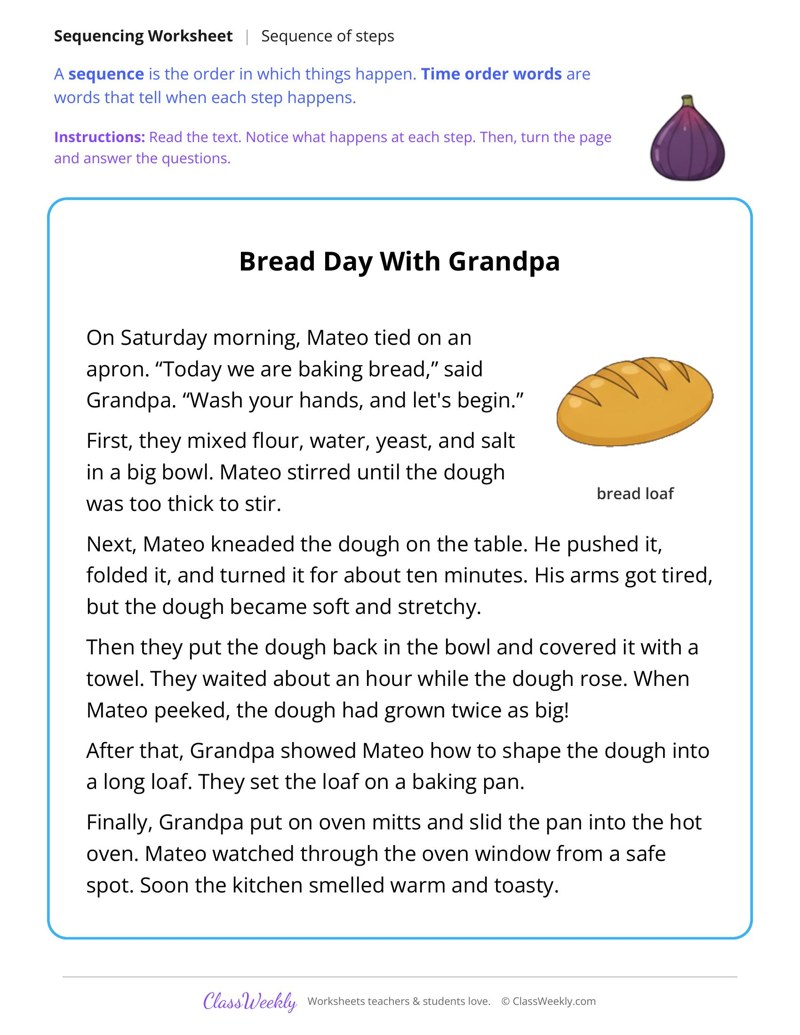
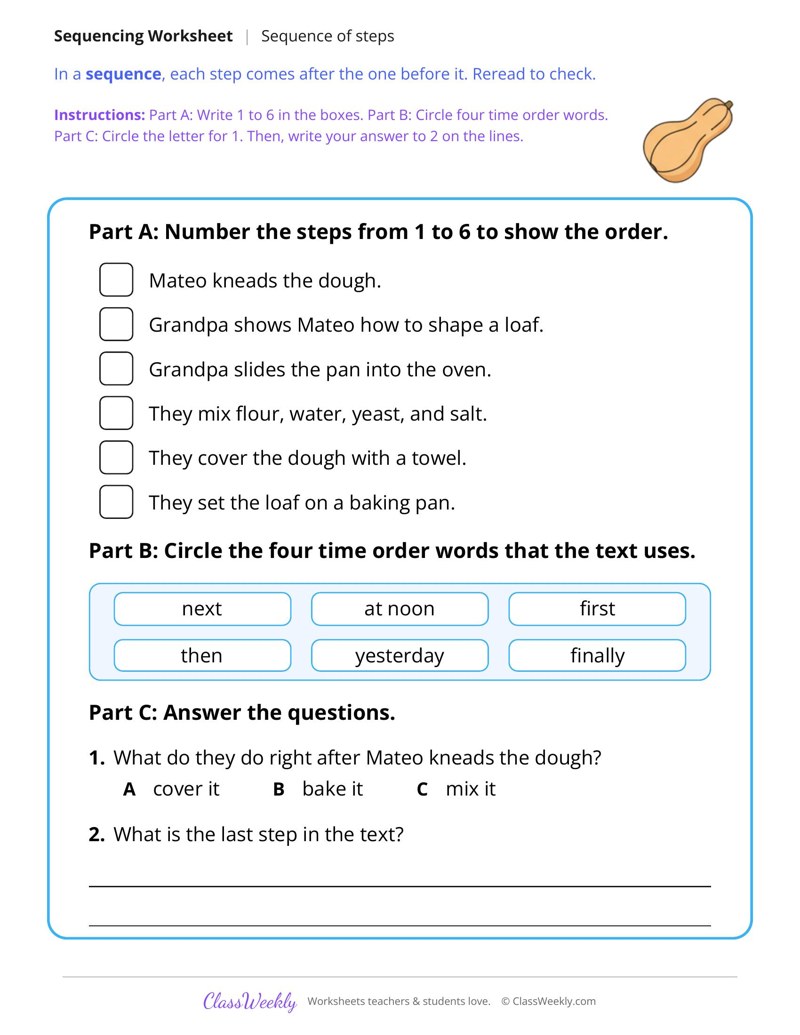
3rd grade reading worksheet: number 6 steps as Mateo and Grandpa bake a loaf of bread and circle 4 time order words. Answer key included. Part of our sequencing comprehension exercises collection. Aligned to Common Core standards.
How do I use this worksheet?
Begin with a shared reading or oral warm-up that highlights sequencing so students hear and see the skill in context before practicing it independently. Have students work through it independently, using a partner or small group only if they want to talk through their thinking, especially for phonics-based tasks where saying an answer aloud first helps. After completing the worksheet, use one or two examples from the page to start a discussion: "Where else have you seen this in your reading?" These sequencing worksheets are ideal for use during small group reading time, as independent center work, or as a homework activity.
What students will practice
- Students will read a story about Mateo and Grandpa baking a loaf of bread on Saturday morning.
- Students will number 6 steps from mixing flour, water, yeast and salt to sliding the pan into the oven.
- Students will circle 4 time order words and tell what they do right after Mateo kneads the dough.




Curriculum Links
Common Core State Standards
Reading: Literature · 3rd Grade
Standard: Describe characters in a story (e.g., their traits, motivations, or feelings) and explain how their actions contribute to the sequence of events.
View all RL.3.3 worksheets →Find this in the curriculum
Browse the grade, subject, and topic this belongs to.
FAQ
How do I use this sequencing worksheet?
⌄
Begin with a shared reading or oral warm-up that highlights sequencing so students hear and see the skill in context before practicing it independently. Have students work through it independently, using a partner or small group only if they want to talk through their thinking, especially for phonics-based tasks where saying an answer aloud first helps. After completing the worksheet, use one or two examples from the page to start a discussion: "Where else have you seen this in your reading?" These sequencing worksheets are ideal for use during small group reading time, as independent center work, or as a homework activity.
What does this worksheet teach?
⌄
Number 6 steps as Mateo and Grandpa bake a loaf of bread and circle 4 time order words. A sequence is the order in which things happen. Time order words are words that tell when each step happens. The directions on the page read: Read the text. Notice what happens at each step. Then, turn the page and answer the questions. On page 2: Part A: Write 1 to 6 in the boxes. Part B: Circle four time order words. Part C: Circle the letter for 1. Then, write your answer to 2 on the lines. The answer key covers the questions on page 2.
Can I use this sequencing worksheet for homeschool or classroom?
⌄
Yes, both. We made it for 3rd Grade comprehension exercises, and the page works the same whether it lands on a kitchen table or a center rotation. At home, most families go through it together and talk the answers out loud, and that talking is where most of the learning happens with sequencing. In class it runs well as independent work while you pull a small group. Print one copy or thirty, whichever the day needs.
What are time order words?
⌄
Words and phrases that tell when something happens, such as first, next, then, after that and finally. In Sequence the Events of the Hamster Escape, phrases like at bedtime, during the night and in the morning also mark the order.
Why sequence a science text?
⌄
Many science texts explain stages that always come in the same order, like a frog growing from an egg to a tadpole, a froglet and an adult. Numbering the stages shows how one leads to the next (RI.3.3).
Is there an answer key for each worksheet?
⌄
Yes. All 9 sequencing sheets have an answer key, with the correct order and sample written answers.
Ratings & Reviews
No reviews yet. Be the first to share what you think.
Reviews are for ClassWeekly members.
Make a Request
Spotted something to fix, or want a worksheet we don't have yet? Tell us and we'll make it.
Worksheet Details
| Grade | 3rd Grade |
| Subject | Reading |
| Topic | Comprehension Exercises |
| Standard | RL.3.3 |
| Pages | 2 pages |
| Difficulty | Medium |
What is ClassWeekly?
ClassWeekly offers free worksheets and printable learning resources for kids in preschool to grade 5. All worksheets are aligned to Common Core, NGSS, and C3 Framework standards and designed by educators. Become a member to access the full library and download unlimited PDFs.