3rd Grade Veterans Day Reading Passage
Written by Adi Ackerman, Head Teacher
"3rd Grade Veterans Day Reading Passage" is written for 3rd Grade (Ages 8-9), and it covers Common Core RI.3.1. If your little one is a year younger but already steady on paragraphs & passages, the page still works. You may just need to read the instructions out loud. And if they are older and nonfiction passages never quite stuck, this is a short review rather than busywork.
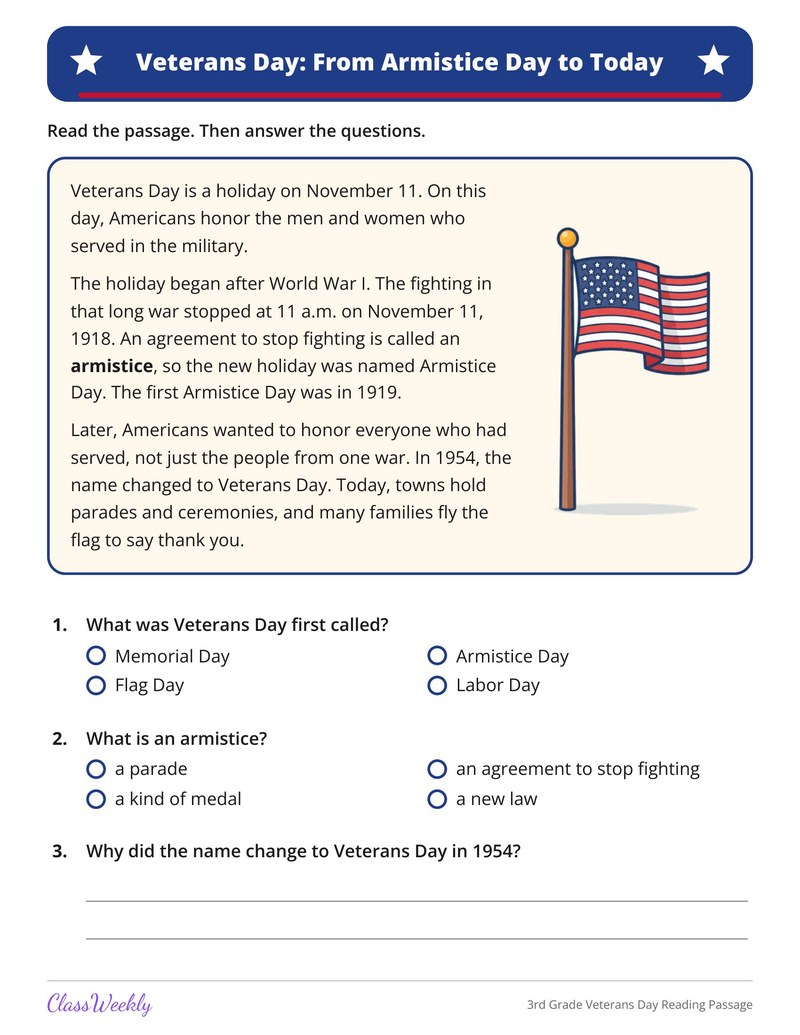
3rd grade reading worksheet: read how Armistice Day became Veterans Day in 1954, then answer 3 questions about the passage. Answer key included. Part of our nonfiction passages collection. Aligned to Common Core standards.
More Veterans Day activitiesVeterans Day 2026: dates and teaching guide
How do I use this worksheet?
Print the page and read the directions with your child: Read the passage. Then answer the questions. When they finish, check the work together with the answer key.
What students will practice
- Students will read a nonfiction passage about the history of Veterans Day.
- Students will use the text to tell what the word armistice means.
- Students will explain in writing why Armistice Day was renamed Veterans Day in 1954.


Curriculum Links
Common Core State Standards
Reading: Informational Text · 3rd Grade
Standard: Ask and answer questions to demonstrate understanding of a text, referring explicitly to the text as the basis for the answers.
View all RI.3.1 worksheets →Find this in the curriculum
Browse the grade, subject, and topic this belongs to.
FAQ
How do I use this nonfiction passages worksheet?
⌄
Print the page and read the directions with your child: Read the passage. Then answer the questions. When they finish, check the work together with the answer key.
What does this worksheet teach?
⌄
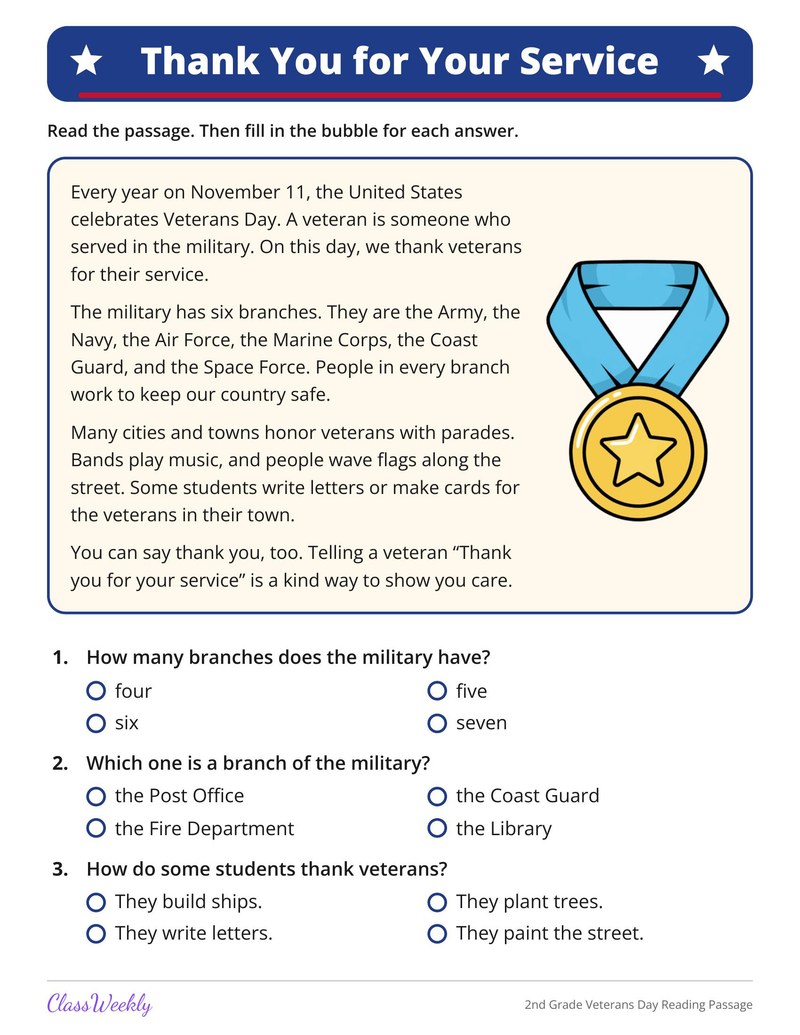
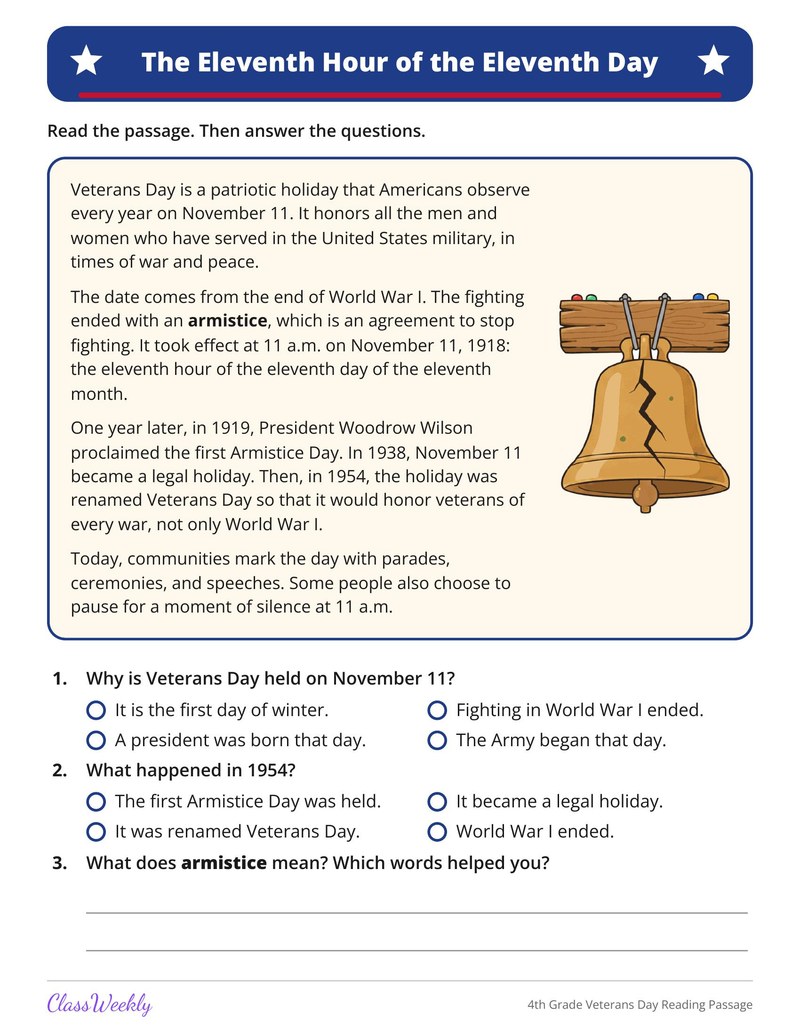
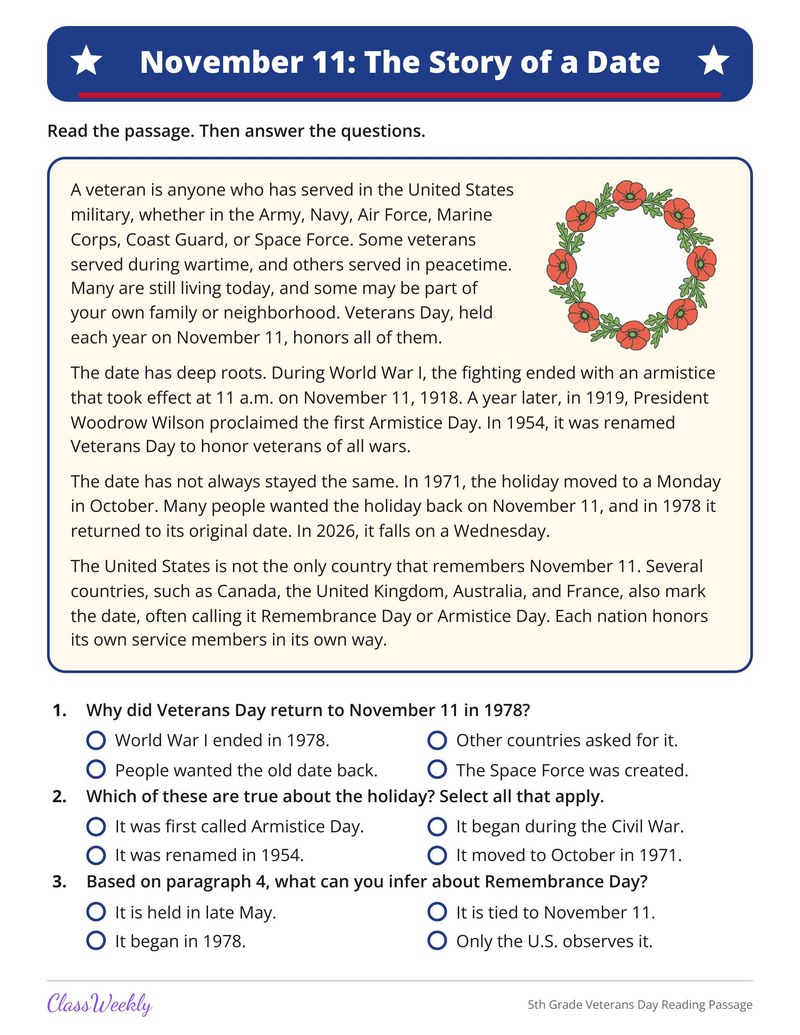
A three-paragraph nonfiction passage, Veterans Day: From Armistice Day to Today, explains that the fighting in World War I stopped at 11 a.m. on November 11, 1918, defines an armistice as an agreement to stop fighting, and tells how the first Armistice Day in 1919 was renamed Veterans Day in 1954 to honor everyone who served. Two multiple choice questions ask for the holiday's first name and the meaning of armistice, and a written question asks why the name changed. The directions on the page read: Read the passage. Then answer the questions. An answer key is included.
Can I use this nonfiction passages worksheet for homeschool or classroom?
⌄
Yes, both. We made it for 3rd Grade paragraphs & passages, and the page works the same whether it lands on a kitchen table or a center rotation. At home, most families go through it together and talk the answers out loud, and that talking is where most of the learning happens with nonfiction passages. In class it runs well as independent work while you pull a small group. Print one copy or thirty, whichever the day needs.
What is a nonfiction passage?
⌄
A nonfiction passage, also called informational text, gives true facts about a real topic, such as how puffins nest or how a submarine dives. On this page there are 65 of them for 3rd grade, each with an answer key.
What is the main idea of a nonfiction passage?
⌄
The main idea is what the whole passage is mostly about. The details are the facts that support it. A quick check: if a sentence could be covered up and the passage would still make sense, it is probably a detail rather than the main idea. Ten sheets have children fill in a main idea web with three key details.
Which reading skills do these passages practice?
⌄
Main idea and key details (RI.3.2), asking and answering questions (RI.3.1), the order of steps in a process (RI.3.3 and RI.3.8), word meanings from context clues (RI.3.4), an author's point of view (RI.3.6) and maps, tables, bar graphs and timelines (RI.3.7). Each new sheet names its skill in the header.
What is a reading passage worksheet?
⌄
It is a sheet with a whole text to read, followed by questions that send the reader back into the text for the answers. This 3rd grade page has 112 sheets, including 65 nonfiction passages, 20 fiction passages and 20 reading comprehension nonfiction sheets, and every sheet has an answer key.
What is on each 3rd grade passage sheet?
⌄
Most sheets have the passage on page one and the questions on page two. The newer nonfiction sheets each practice one skill: a main idea web, who, what and why questions with paragraph numbers, numbering steps in order, reading a map, table, bar graph or timeline, listing an author's reasons, or matching six bold words to their meanings with context clues. The older nonfiction and fiction passages mix multiple choice questions with short written answers.
Are the nonfiction and fiction sheets different?
⌄
Yes. The 65 nonfiction passages give true facts about a real topic, such as owls, the Liberty Bell or how cheese is made, and ask for the main idea, text evidence, sequence, visual information, point of view and word meanings. The 20 fiction passages tell a short story and ask for the theme and how a character feels. The opinion articles use made-up writers, and each one says so on the page, but the facts in them are real.
Do these passage worksheets have answer keys?
⌄
Yes. Each of the 85 nonfiction and fiction passage sheets comes with an answer key that shows the correct choices, sample answers for the written questions and other answers to accept.
Ratings & Reviews
No reviews yet. Be the first to share what you think.
Reviews are for ClassWeekly members.
Make a Request
Spotted something to fix, or want a worksheet we don't have yet? Tell us and we'll make it.
Worksheet Details
| Grade | 3rd Grade |
| Subject | Reading |
| Topic | Paragraphs & Passages |
| Standard | RI.3.1 |
| Pages | 1 page |
| Difficulty | Medium |
Learn More
What is ClassWeekly?
ClassWeekly offers free worksheets and printable learning resources for kids in preschool to grade 5. All worksheets are aligned to Common Core, NGSS, and C3 Framework standards and designed by educators. Become a member to access the full library and download unlimited PDFs.