Features of a Myth About How the Moon Got Its Glow
Written by Adi Ackerman, Head Teacher
"Features of a Myth About How the Moon Got Its Glow" is written for 4th Grade (Ages 9-10), and it covers Common Core RL.4.2. If your little one is a year younger but already steady on fables, the page still works. You may just need to read the instructions out loud. And if they are older and myths, fables and folktales never quite stuck, this is a short review rather than busywork.
2 pages in this set
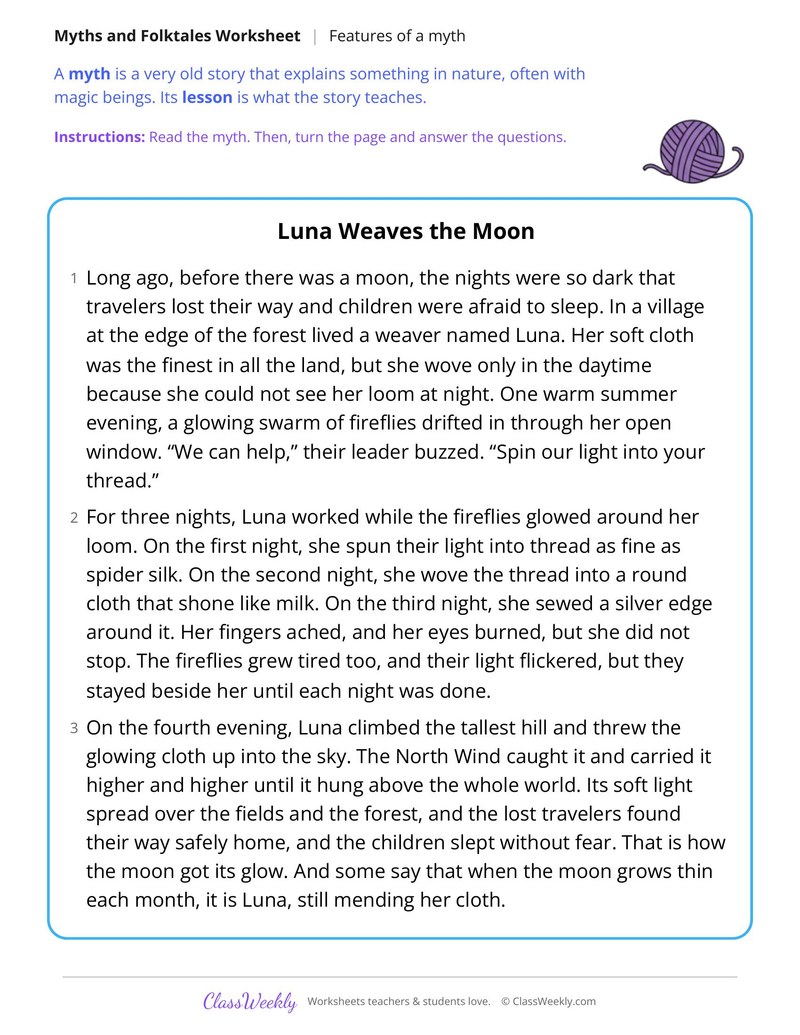
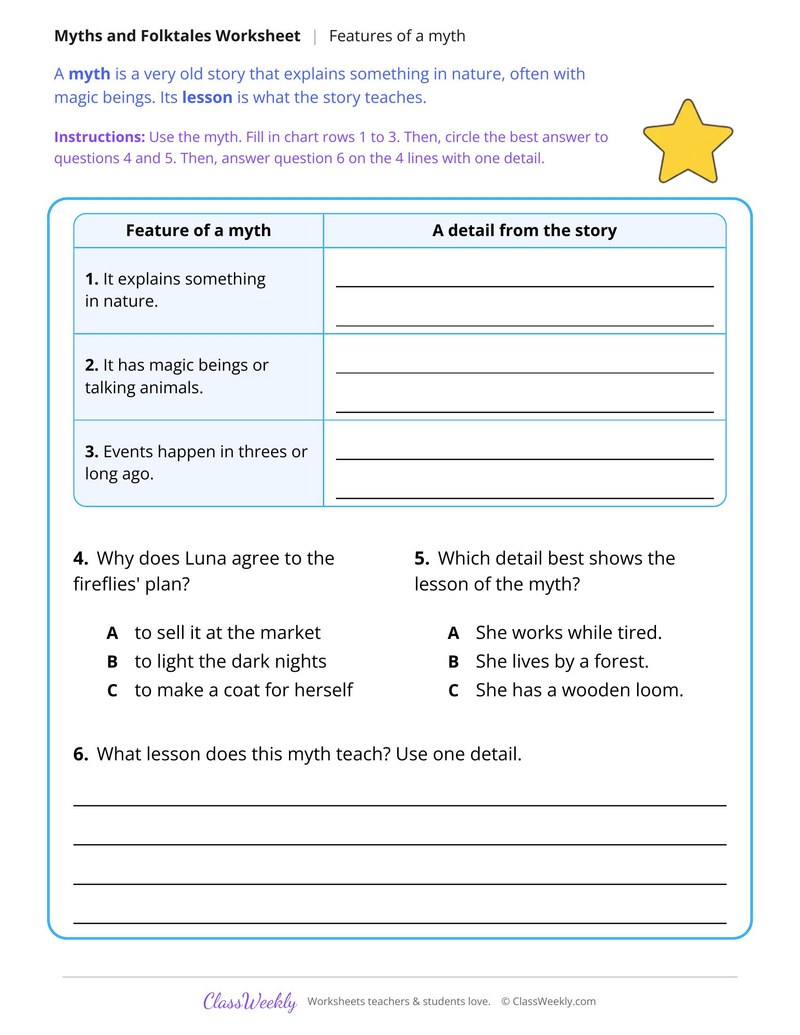
4th grade reading worksheet: find the features of a myth about how a weaver named Luna gave the moon its glow and tell its lesson. Answer key included. Part of our myths, fables and folktales collection. Aligned to Common Core standards.
How do I use this worksheet?
Before your child writes the lesson, ask what the main character wanted, what they did and what happened. The lesson usually sits in that last step. For the two tellings, read them one after the other and list what changed.
What students will practice
- Students will state the lesson of a myth, fable or folktale and support it with a detail.
- Students will find the features of a myth, such as explaining something in nature.
- Students will compare two tellings of the same folktale.
Curriculum Links
Common Core State Standards
Reading: Literature · 4th Grade
Standard: Determine a theme of a story, drama, or poem from details in the text; summarize the text.
View all RL.4.2 worksheets →Find this in the curriculum
Browse the grade, subject, and topic this belongs to.
FAQ
How do I use this myths, fables and folktales worksheet?
⌄
Before your child writes the lesson, ask what the main character wanted, what they did and what happened. The lesson usually sits in that last step. For the two tellings, read them one after the other and list what changed.
What does this worksheet teach?
⌄
Find the features of a myth about how a weaver named Luna gave the moon its glow and tell its lesson. A myth is a very old story that explains something in nature, often with magic beings. Its lesson is what the story teaches. The directions on the page read: Read the myth. Then, turn the page and answer the questions. On page 2: Use the myth. Fill in chart rows 1 to 3. Then, circle the best answer to questions 4 and 5. Then, answer question 6 on the 4 lines with one detail. The answer key covers the questions on page 2.
Can I use this myths, fables and folktales worksheet for homeschool or classroom?
⌄
Yes, both. We made it for 4th Grade fables, and the page works the same whether it lands on a kitchen table or a center rotation. At home, most families go through it together and talk the answers out loud, and that talking is where most of the learning happens with myths, fables and folktales. In class it runs well as independent work while you pull a small group. Print one copy or thirty, whichever the day needs.
What is the difference between a myth, a fable and a folktale?
⌄
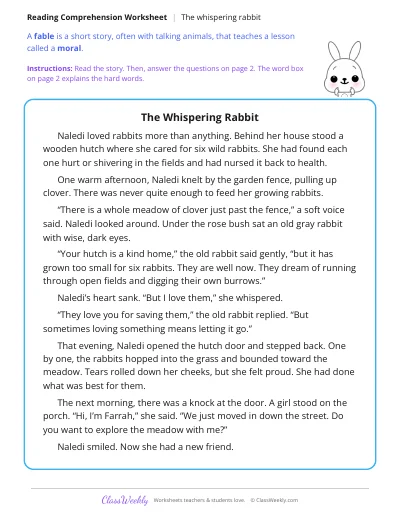
A folktale is an old story told aloud, so it can change a little in each telling. A myth often explains something in nature, like why the sea is salty. A fable is a short tale, often with talking animals, that teaches a lesson, like the peacock who learns that looks are not what matter most.
What is a trickster tale?
⌄
In a trickster tale, a clever character, often a small animal, wins by fooling a bigger or stronger one. On one sheet Hare fools a greedy lion, and on another a fox who tries to trick a rooster is tricked himself.
What is a pourquoi tale?
⌄
Pourquoi is the French word for why. A pourquoi tale is a folktale that tells why an animal is the way it is. Children chart how Turtle was long ago, what he did, what Old Owl did and how turtles are now.
Is there an answer key for each worksheet?
⌄
Yes. All seven myths, fables and folktales sheets have an answer key, with a sample lesson and a detail from the tale that supports it.
What is a fable and how is it different from a fairy tale or a regular story?
⌄
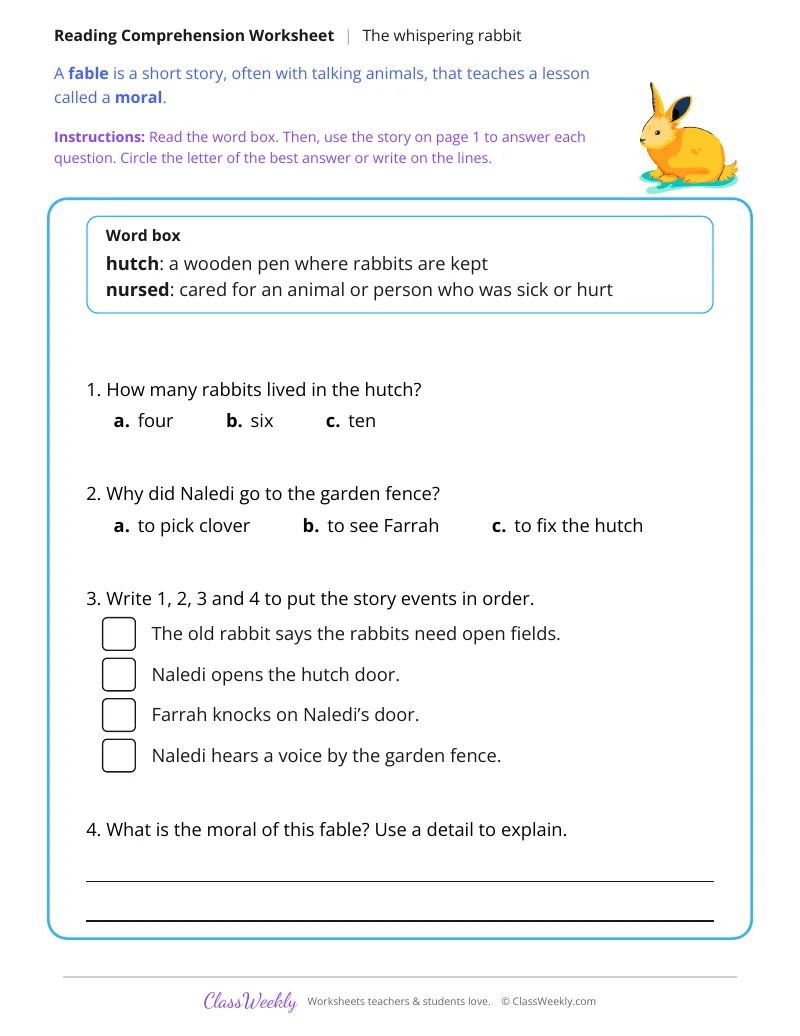
A fable is a short story, usually with animal or ordinary characters, written specifically to teach a lesson or moral. Unlike a fairy tale, a fable rarely includes magic for its own sake and almost always ends with a clear takeaway about how to behave. Unlike a general children's story, where the theme can be subtle or open to interpretation, a fable's moral is meant to be identifiable by the end, which makes fables a good entry point for teaching theme (CCSS RL.4.2).
Why do fourth graders study fables specifically?
⌄
Fables give students low-stakes practice at a high-value skill: identifying theme from character actions and consequences, rather than from an explicit statement in the text. Because the moral is usually inferable but not always spelled out, fables train the same inference muscle (RL.4.1) that harder literary texts require later, without the added difficulty of complex plot or vocabulary getting in the way.
How do I help my child find the moral or lesson in a fable?
⌄
Ask three questions in order: What did the character want? What did they do to get it? What happened as a result? The moral almost always lives in the gap between what the character wanted and what they got. Avoid asking "what's the moral" as the very first question, since it invites guessing. Working backward from the character's choice and its consequence gets a more reliable, text-supported answer.
Ratings & Reviews
No reviews yet. Be the first to share what you think.
Reviews are for ClassWeekly members.
Make a Request
Spotted something to fix, or want a worksheet we don't have yet? Tell us and we'll make it.
What is ClassWeekly?
ClassWeekly offers free worksheets and printable learning resources for kids in preschool to grade 5. All worksheets are aligned to Common Core, NGSS, and C3 Framework standards and designed by educators. Become a member to access the full library and download unlimited PDFs.