
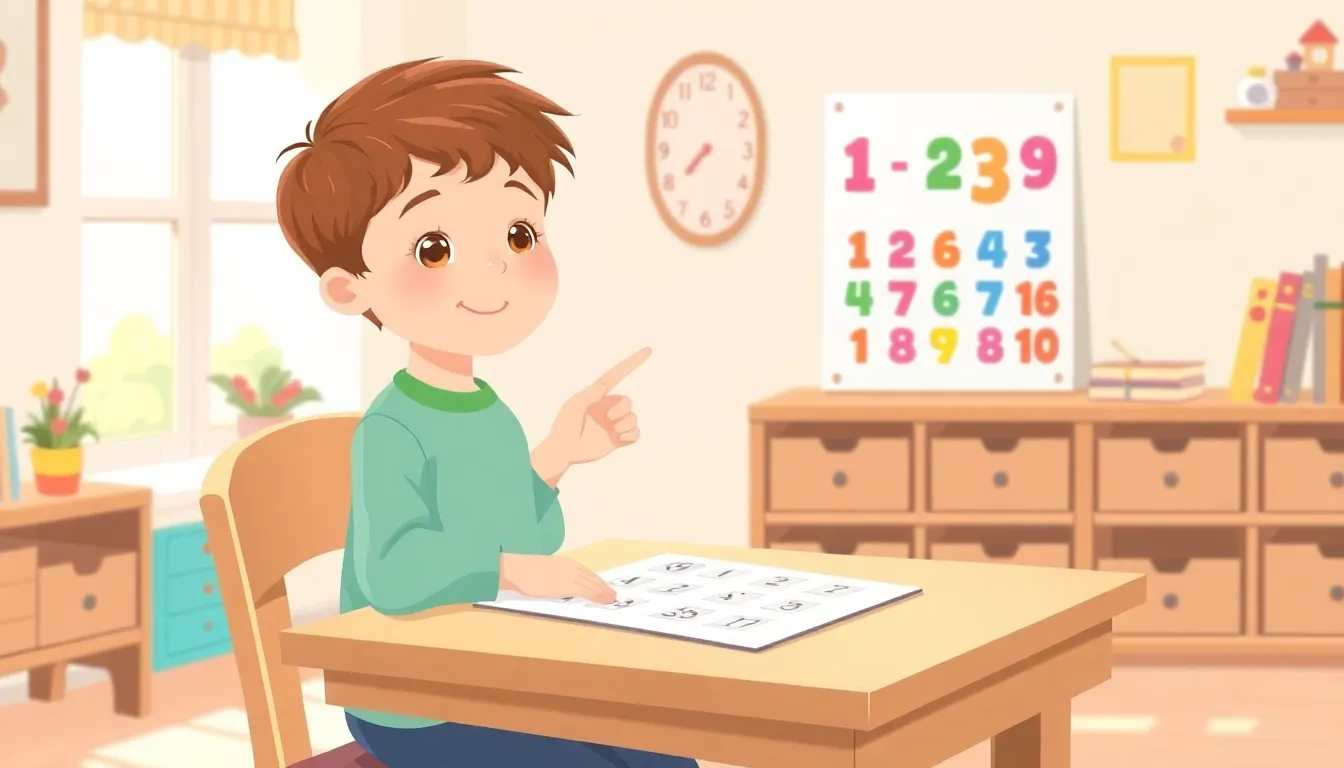
Homeschool 1st Grade Math: Teaching Number Charts
Get 30 days of free worksheet downloads
Key Takeaways
- Number charts build number sense by showing kids the visual pattern of counting, not just isolated facts.
- Printing numbers up to 100 in stages, 25 at a time, keeps handwriting practice manageable.
- Matching numbers with number words teaches a second, equally important way to represent quantity.
- Ordinal numbers (first, second, third) are a distinct skill from counting and deserve separate practice.
Number charts might look like one of the simpler parts of first grade math, but they're doing more work than they get credit for. A hundred chart isn't just a counting tool, it's a map of how our number system is built, and kids who spend real time with one develop number sense that shows up later in addition, subtraction, and place value.
This is also the stretch of first grade where numbers get big. Kids move from comfortably counting to 20 in kindergarten to confidently writing, reading, and ordering numbers all the way to 100.
Here's how to build strong number chart skills with your first grader, from basic number writing all the way through number words and ordinal numbers.
Free 1st Grade Number Chart Worksheets


What First Grade Number Chart Work Covers
Number chart practice in first grade typically breaks into stages by range: printing numbers 1-25, then 26-50, then 51-75, then 76-100. Splitting the work this way keeps handwriting practice manageable and lets your child build confidence with a smaller range before tackling trickier numbers like 70 or 90, which are easy to reverse or misprint.
Alongside writing numerals, kids learn to write number words, first for numbers 1-50 and then 51-100. This is a genuinely different skill from writing the numeral itself, since spelling "seventeen" or "eighty-four" involves letter patterns that don't map directly onto the digits. Matching numbers with their words rounds this out, asking kids to connect 42 with "forty-two" rather than produce either one from scratch.
Ordinal numbers, first, second, third, and onward, are their own category entirely. Unlike counting, which is about quantity, ordinals describe position or order, and first graders need direct teaching and practice to use them correctly, since the words themselves (first, second, third) don't follow an obvious pattern the way regular counting does.
Counting in sequence from 1 to 10, and activities like circling a specific number of objects, tend to sit underneath all of this as the foundational check: can your child reliably count a group of objects and connect that count to the correct written numeral.
How to Teach It Step by Step
Step 1: Master counting objects first. Before number charts, confirm your child can count a small group of objects accurately and circle the matching numeral.
Step 2: Practice writing 1-25. Use a simple numbered chart or trace-and-write worksheets. Focus on correct number formation, not just getting the right digit down.
Step 3: Move up in stages. Once 1-25 is solid, work through 26-50, then 51-75, then 76-100. Don't rush past teen numbers and the tricky-sounding decades like 30, 50, and 70.
Step 4: Introduce number words alongside numerals. Show your child "12" and "twelve" side by side, and have them practice matching numerals to their word forms with simple flash cards.
Step 5: Teach ordinal numbers with a real line-up. Line up toys or family members and ask your child to describe who is first, second, third, and so on. This makes the abstract word concrete immediately.
Step 6: Use a hundred chart for patterns. Point out how each row starts a new set of ten, and how counting down a column adds ten each time. Let your child notice patterns rather than just memorizing them.
Common Mistakes and Activity Ideas
Reversed digits, writing 21 as 12, or writing a 3 backward, are extremely common at this age and usually not something to worry over. Consistent, patient practice with number formation, ideally with a visual guide showing the correct stroke order, resolves this over time.
Mixing up "teen" and "ty" numbers (thirteen versus thirty) is another very frequent mistake, since the words sound so similar. Practicing them side by side, with the numeral visible, and emphasizing the ending sound out loud, helps kids hear and eventually internalize the difference.
For extra practice, try a hundred chart scavenger hunt: call out a number and have your child find and point to it as fast as they can. A "missing number" chart, where some numbers are blanked out for your child to fill in, is another great way to build fluency without it feeling like a drill.
FAQ
Why are number charts useful beyond just counting practice? A hundred chart shows kids visual patterns, like how every number in a column ends in the same digit, or how adding ten just moves you down one row. Those patterns build real number sense that pays off later in place value and mental math.
How high should a first grader be able to count and write numbers? By the end of first grade, most kids can count, read, and write numbers up to 100 or beyond. It's normal for accuracy and neatness to lag a bit behind counting ability, especially with numbers in the 70s through 90s.
What are ordinal numbers and why do they matter? Ordinal numbers describe position or order, like first, second, and third, rather than quantity. They matter for everyday situations like reading a recipe, following instructions, or understanding a race result, and they're a genuinely separate skill from regular counting.
My child mixes up number words like 'thirteen' and 'thirty.' How do I fix that? This mix-up is extremely common because the words sound similar. Practice them side by side with the numeral shown, and emphasize the ending sound, teen versus ty, out loud several times until your child can hear the difference clearly.
Keep Reading
Number charts feel repetitive in the moment, but they're quietly building the number sense that makes everything else in math click faster. Keep a hundred chart taped up somewhere visible, and watch how often your child glances at it on their own. 😊

Adi Ackerman
Head Teacher
Adi is the Head Teacher at ClassWeekly, with years of experience teaching elementary students. She designs our curriculum-aligned worksheets and writes practical guides for teachers and parents.
Keep Reading
Ready to download? Try ClassWeekly free for 30 days.
Unlimited worksheets for PreK through 5th grade. Cancel anytime.