
Homeschool 3rd Grade Math: Teaching Division
Get 30 days of free worksheet downloads
Key Takeaways
- Division in 3rd grade should start with physically splitting objects into equal groups before any numbers or symbols appear.
- Division and multiplication are two sides of the same fact family, and teaching them together speeds up fluency.
- Kids typically move fact by fact, mastering division by 2 or 3 before tackling the harder facts like 8 or 9.
- Missing dividend and missing divisor problems are where real number sense shows up, so don't rush past them.
Division is often the moment 3rd grade math starts to feel like "real math" to kids, and honestly to a lot of parents too. It's the last of the four basic operations to show up, and it builds directly on the multiplication facts your child has been working on.
The good news is that division isn't actually a brand new idea. It's the flip side of multiplication, and once kids see that connection, a lot of the mystery disappears. The trick is making sure that connection gets made explicitly, instead of leaving your child to guess at it.
Here's how we teach division so it clicks, along with free worksheets to build the specific skills 3rd graders need.
Free 3rd Grade Division Worksheets


What 3rd Grade Division Actually Covers
The unit typically opens with division sentences, learning to read and write expressions like 12 ÷ 3 = 4 and understand what each number represents. This pairs closely with dividing into equal groups, where kids physically or visually split a set of objects into a given number of equal piles, which is really the concrete meaning behind the division symbol.
From there, practice moves fact by fact: division by 2 or 3, then 4 or 5, then the harder 6 or 7, and finally 8 or 9. This gradual buildup matters because some division facts (like dividing by 9) are genuinely trickier to hold in memory than others, and rushing through all of them at once overwhelms most kids.
Once the individual facts feel solid, kids practice division facts across the full range, first tables 1 through 10, then tables 1 through 12, building speed and automatic recall the same way they built multiplication fact fluency.
Finally, the unit introduces missing dividend or divisor problems, both within the 1 through 10 range and the 1 through 12 range. These ask kids to find a missing number in a division sentence, like ___ ÷ 4 = 6, or 24 ÷ ___ = 6, which requires genuinely flexible thinking about the relationship between the numbers.
How to Teach It Step by Step
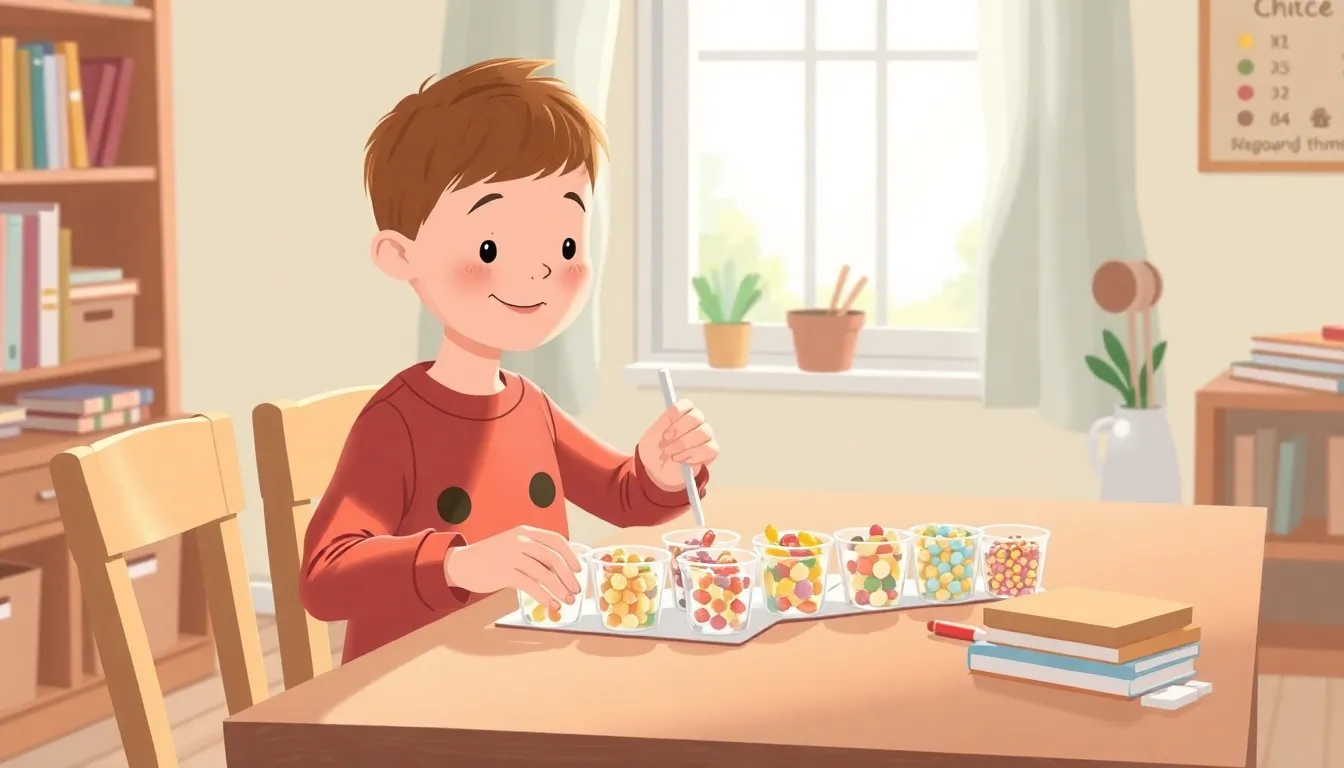
Step 1: Start with physical equal groups. Give your child 12 counters and ask them to split them into 3 equal piles. Count how many end up in each pile. This is division, no symbols needed yet, just hands-on splitting.
Step 2: Introduce the division sentence after the concept is solid. Once your child has split objects into groups several times, show them how to write it: 12 ÷ 3 = 4. Point out that the first number is the total, the second is how many groups, and the answer is how many in each group.
Step 3: Connect division directly to multiplication. Show your child a multiplication fact they already know, like 4 x 3 = 12, right next to the related division facts, 12 ÷ 3 = 4 and 12 ÷ 4 = 3. Fact families make the relationship obvious instead of leaving kids to memorize division as a totally separate skill.
Step 4: Drill facts in small, manageable chunks. Focus on one or two divisors at a time (division by 2, then 3) rather than mixing everything together. Short, focused practice with flashcards or quick oral drills works better than long mixed worksheets early on.
Step 5: Save missing number problems for last. Once your child is fluent with straightforward division facts, introduce missing dividend and missing divisor problems. Frame them as puzzles: "What number, divided by 4, gives us 6?" This reframing helps kids see it as a known fact in disguise, not a new type of math.
Common Mistakes and Signs of Mastery
A frequent mistake is mixing up which number is the total and which is the group count, especially in word problems. If a problem says "18 cookies split among 6 friends," some kids will divide 6 by 18 instead of 18 by 6. Reading the problem aloud and asking "what's the total we're starting with?" helps sort this out.
Another common stumble is treating each division fact as brand new information instead of connecting it back to multiplication. If your child seems to be memorizing division facts from scratch, stop and explicitly point back to the matching multiplication fact they already know.
You'll know your child has really mastered 3rd grade division when they can solve a missing dividend or divisor problem without hesitating, and when they can explain a division fact using the related multiplication fact on their own, without you prompting them to make that connection.
FAQ
Should my child know multiplication facts before starting division? It helps a lot, but they don't need to be fully mastered first. Teaching multiplication and division together, as a fact family, actually reinforces both skills faster than learning them one after the other.
My child can divide but doesn't understand what division means. Should I worry? Yes, go back to hands-on grouping activities. If your child is just recalling a memorized fact without understanding that division means splitting into equal groups, they'll struggle the moment a word problem changes the context.
What order should we tackle the division facts in? Start with division by 2 and 3, since these connect most naturally to skip counting your child likely already knows. Then move to 4 and 5, followed by the trickier 6, 7, 8, and 9 facts, which need the most repeated practice.
How do I know my child is ready for missing dividend or divisor problems? Wait until basic division facts (through the tables they've covered) feel automatic. Missing number problems ask kids to work backward through a fact they already know, so that fact needs to be solid first.
Keep Reading
Division ties together everything your child has learned about multiplication, grouping, and fact families. Give it time and plenty of hands-on grouping practice, and it will click faster than you expect. 😊

Adi Ackerman
Head Teacher
Adi is the Head Teacher at ClassWeekly, with years of experience teaching elementary students. She designs our curriculum-aligned worksheets and writes practical guides for teachers and parents.
Keep Reading
Ready to download? Try ClassWeekly free for 30 days.
Unlimited worksheets for PreK through 5th grade. Cancel anytime.