
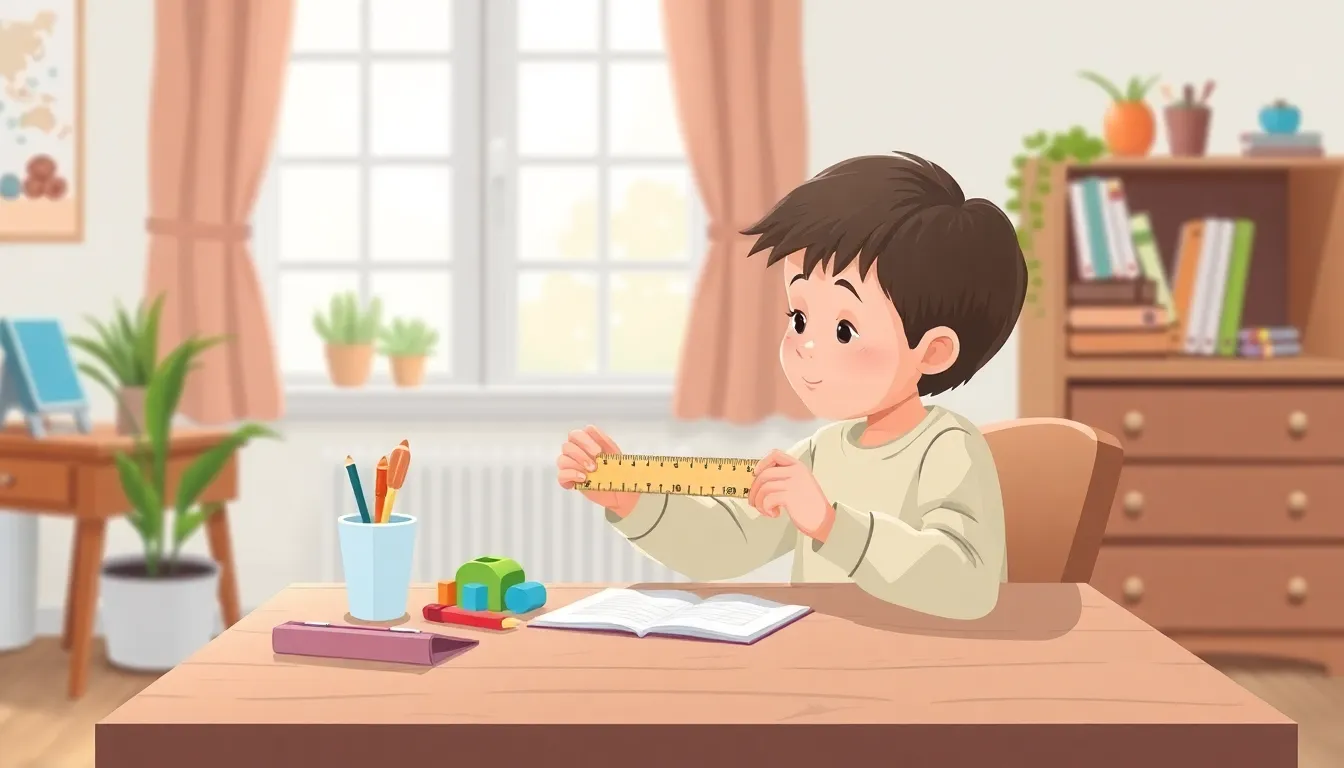
Homeschool 3rd Grade Math: Teaching Measurement
Get 30 days of free worksheet downloads
Key Takeaways
- 3rd grade measurement covers both customary units (inches, feet, yards, miles) and metric units side by side.
- Measuring to the nearest quarter inch or millimeter is a precision skill that needs a real ruler, not just worksheet practice.
- Unit conversion only makes sense once a child has physically measured with each unit and has a feel for its size.
- Reading a scale ties the whole unit together and is one of the most practical, real-world skills in 3rd grade math.
Measurement is one of those 3rd grade math units that feels immediately useful, and our kiddos usually sense that too. Suddenly they're not just doing abstract number problems, they're figuring out how long the hallway is or how much taller they've gotten since last year.
This year's measurement work covers both customary units (inches, feet, yards, miles) and metric units (centimeters, meters, kilometers), along with converting between related units and reading scales accurately. It's a lot of ground, but it builds naturally if you take it step by step with real tools in hand.
Here's how we approach it at home, plus free worksheets to build each specific skill.
Free 3rd Grade Measurement Worksheets


What 3rd Grade Measurement Covers
The unit opens with units of length in the customary system: inches, feet, yards, and miles, learning what each unit is roughly used for and how they relate in size to one another. Right alongside that, kids learn the metric equivalents: centimeters, meters, and kilometers, building a parallel sense of scale in that system too.
From there, the unit moves into precision measuring: reading a ruler to the nearest quarter inch, and separately, to the nearest millimeter. These are genuinely different skills from just knowing what an inch or centimeter is, since they require careful attention to the smaller marks between the whole numbers on a ruler.
Conversion work follows, starting with converting between inches, feet, and yards, then a harder version of the same skill with larger or less obvious numbers. On the metric side, kids convert between centimeters and millimeters, first without decimals, then with decimals, and eventually work across all three metric length units (meters, centimeters, millimeters) together.
The unit closes with reading and using a scale, a practical skill that ties together everything kids have learned about reading marked measurement tools accurately, whether it's a bathroom scale, a kitchen scale, or a diagram in a worksheet.
How to Teach It Step by Step
Step 1: Build a feel for each unit before teaching conversions. Have your child hold up their hands to show roughly an inch, then a foot. Walk out a yard. This physical sense of scale makes every conversion afterward much more intuitive than a memorized chart.
Step 2: Practice measuring real objects with a ruler. Measure books, crayons, and shoes to the nearest quarter inch. Go slow, and make sure your child is reading the small marks correctly, not just guessing at the nearest whole number.
Step 3: Introduce metric units the same hands-on way. Switch the ruler around to the centimeter side and remeasure the same objects. Comparing the same object in two unit systems side by side helps the metric system feel less foreign.
Step 4: Teach conversions using the objects you've already measured. If your child measured a table at 3 feet, ask how many inches that is, and let them physically count using a 12-inch ruler moved along the table three times. Concrete conversion beats formula memorization every time at this age.
Step 5: Finish with scale reading using something in your kitchen. A food scale is perfect for this. Have your child read the weight of a few household items and record it, paying close attention to the increments marked between numbers.
Common Mistakes and Signs of Mastery
The most common mistake in this unit is misreading the smaller marks on a ruler, especially with millimeters, where the marks are close together and easy to miscount. Slow down here and have your child count aloud as they move along the ruler, rather than trying to eyeball the answer.
Conversion mistakes usually come from applying the wrong operation, multiplying when they should divide or vice versa. If your child is getting conversions backward, go back to the physical measuring from Step 4 and rebuild the number sense before returning to worksheet practice.
Mastery in this unit looks like a child who can pick up an unfamiliar object, estimate its length reasonably well before measuring, then confirm with a ruler and convert that measurement into a different unit without needing a formula written down in front of them.
FAQ
Should we focus more on customary units or metric units? Both matter and show up side by side in most 3rd grade curricula. In the US, customary units (inches, feet, yards) get more everyday use, but metric fluency (centimeters, meters) matters for science later on, so it's worth solid time on both.
My child gets conversions right on paper but seems confused by what the numbers mean. What should I do? Go back to physical measuring. If a child can convert 3 feet to 36 inches correctly but can't picture how long that actually is, the conversion is just a memorized formula, not real understanding. More hands-on measuring with a tape measure usually fixes this.
What's the best tool for practicing quarter-inch and millimeter measurement? A clear plastic ruler with both inch and metric markings works best, since your child can see both systems on the same tool. Avoid tape measures for this specific skill at first, the small print and curled shape make precise reading harder for beginners.
How do I teach reading a scale if we don't have one at home? A kitchen food scale works well for hands-on practice, or you can use printable worksheets with drawn scale illustrations. The key skill is reading the marks between labeled numbers accurately, which you can also practice on a ruler or a thermometer.
Keep Reading
Measurement is one of those units where the real world does most of the teaching for you. Grab a ruler, measure everything in sight for a week, and watch the concept take hold. 😊

Adi Ackerman
Head Teacher
Adi is the Head Teacher at ClassWeekly, with years of experience teaching elementary students. She designs our curriculum-aligned worksheets and writes practical guides for teachers and parents.
Keep Reading
Ready to download? Try ClassWeekly free for 30 days.
Unlimited worksheets for PreK through 5th grade. Cancel anytime.