
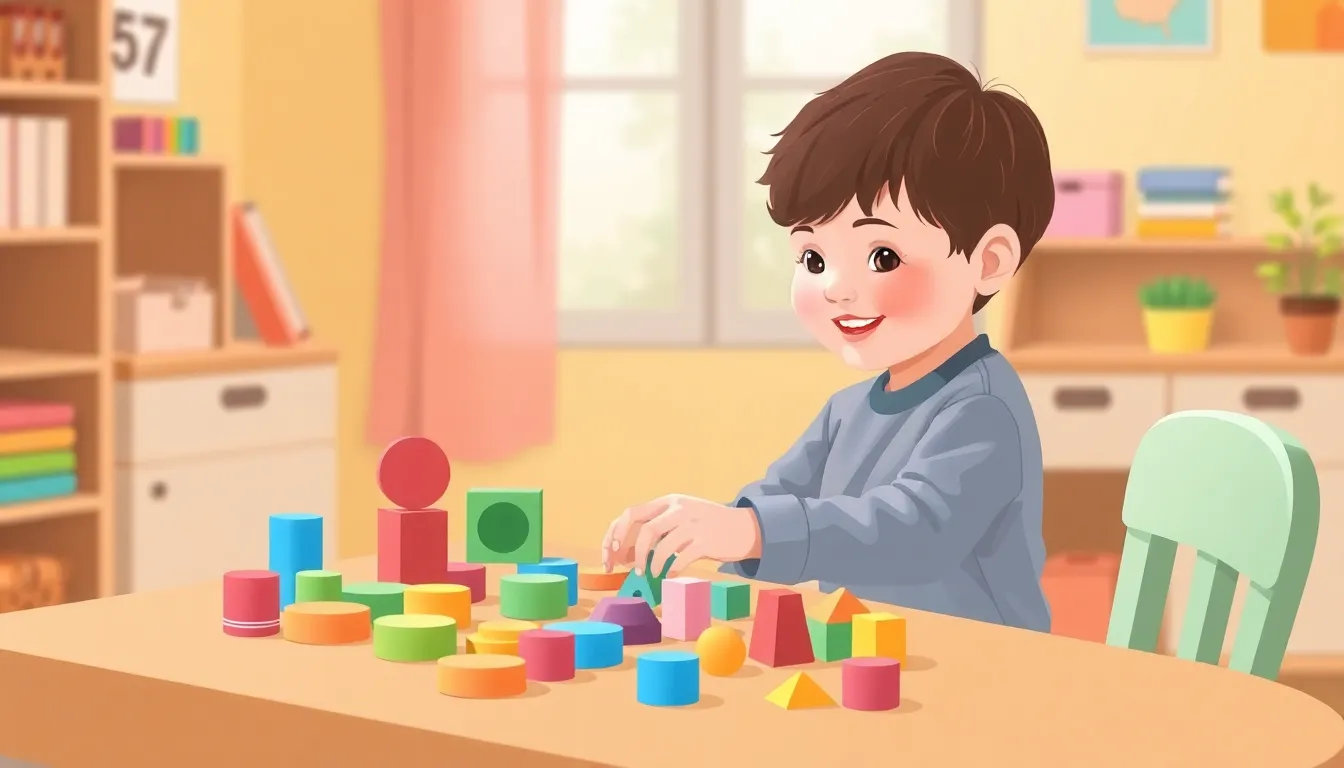
Homeschool Kindergarten Math: Teaching Shapes
Get 30 days of free worksheet downloads
Key Takeaways
- Kindergarten shape work starts with naming and identifying 2D shapes before it ever touches 3D shapes or comparisons between the two.
- Finding shapes in real objects around the house connects the abstract shape name to something concrete a child already understands.
- Tangram puzzles build spatial reasoning by asking kids to combine smaller shapes into a larger picture, a skill that pays off in later geometry.
- Pattern recognition using shapes is one of the earliest forms of the logical thinking kids will use in math for years to come.
Shapes are one of the more visual, hands-on corners of kindergarten math, and honestly, one of the more fun ones to teach. Kids are naturally drawn to sorting, matching, and building, and shape work leans right into that instinct.
We think shapes deserve more attention than they sometimes get in a homeschool schedule. Beyond just naming a triangle, shape work builds spatial reasoning, an early form of logical thinking, and it sets up geometry concepts your child won't formally revisit for a couple more years.
Here's how we approach teaching shapes at home, from simple identification through to patterns and puzzles.
Free Kindergarten Shapes Worksheets


What Kindergarten Shape Work Covers
The starting point is always names of shapes, the basic vocabulary of circle, square, triangle, and rectangle, expanding into oval, diamond, and hexagon as a child gets comfortable. This is straightforward identification, often through pointing, matching, or coloring.
2D shapes get the bulk of early attention since they're simpler to draw and compare on paper. Once a child is solid there, 2D vs 3D work introduces the idea that some shapes can be picked up and turned around, like a ball, a box, or a cone, versus a flat shape drawn on a page.
Shapes in real objects is where the abstract vocabulary becomes useful. A clock is a circle, a door is a rectangle, a slice of pizza looks like a triangle. This connects the shape names to your child's actual world instead of leaving them stuck on a worksheet.
Similar shapes and identify color exercises sharpen a child's eye for detail, comparing shapes that are almost, but not quite, the same, or sorting shapes by their color as an added layer.
Patterns build on shape knowledge by asking a child to predict what comes next in a repeating sequence, like circle-square-circle-square. Tangram puzzles take it further, asking kids to combine several small shapes into a larger picture, which builds real spatial reasoning.
Draw identify and trace draw round out the practice, having kids draw a shape from memory or trace one and then identify it, tying the visual and motor skills together.
How to Teach It Step by Step
Step 1: Introduce one new shape at a time. Start with circle, then square, then triangle, then rectangle. Trace each one with a finger while naming it out loud before asking your child to identify it independently.
Step 2: Go on a shape hunt around your house. Ask your child to find three circles, two squares, and a triangle somewhere in the room. This is where shapes in real objects really comes alive, and kids love the scavenger hunt feel of it.
Step 3: Introduce 3D shapes by comparing them to their 2D counterparts. Hold up a paper circle next to a ball. Ask what's different. This concrete comparison does more than any explanation.
Step 4: Practice simple patterns using shape manipulatives or cutouts. Lay out a repeating pattern and ask your child what comes next, then let them build their own pattern for you to guess.
Step 5: Try a simple tangram puzzle. Start with a picture that only needs two or three pieces, like a small house or a boat, before working up to more complex images.
Building Real Spatial Understanding
Watch for kids who can name shapes on a flashcard but freeze when asked to find that same shape in a messier, real-world context, like a window frame or a road sign. This is common and just means more real-world practice is needed, not more flashcard drilling.
Similar shapes exercises are a great way to catch shallow recognition. If a child can only identify a "textbook perfect" triangle but not a slightly tilted or oddly proportioned one, spend extra time with varied examples, not just the classic version of each shape.
You'll know shape knowledge is solid when your child starts spontaneously naming shapes they notice out in the world, no prompting needed, and when they can successfully complete a tangram puzzle with four or more pieces, showing they understand how smaller shapes combine into a bigger picture.
FAQ
What shapes should I start with in kindergarten? Start with the basics: circle, square, triangle, and rectangle. Once those four feel automatic, move on to less common ones like oval, diamond, and hexagon.
Are tangram puzzles too advanced for kindergartners? Not at all, as long as you start with simple pictures made from just a few pieces. Tangrams build spatial reasoning and shape recognition at the same time, and most five and six-year-olds enjoy the puzzle format.
How do I explain the difference between 2D and 3D shapes to a kindergartner? Keep it concrete and hands-on. A 2D shape is flat, like a shape drawn on paper, and a 3D shape can be picked up and turned around, like a ball or a box. Comparing a paper circle to an actual ball works well as a first example.
My child can name shapes but struggles to find them in real objects. Why? This is a normal gap between recognizing a textbook shape and identifying that same shape in a messier, real-world object like a clock or a window. Practice by taking a shape walk around your house and naming everything you spot together.
Keep Reading
Shape hunts around the living room are some of the easiest, most low-key learning you'll do all year. Keep it playful, let your kiddo lead the hunt sometimes, and the geometry will build itself 😊

Adi Ackerman
Head Teacher
Adi is the Head Teacher at ClassWeekly, with years of experience teaching elementary students. She designs our curriculum-aligned worksheets and writes practical guides for teachers and parents.
Keep Reading
Ready to download? Try ClassWeekly free for 30 days.
Unlimited worksheets for PreK through 5th grade. Cancel anytime.