Prepositions of Place and Time
Written by Adi Ackerman, Head Teacher
"Prepositions of Place and Time - Back to School" is written for 4th Grade (Ages 9-10), and it covers Common Core L.4.1.E. If your little one is a year younger but already steady on parts of speech, the page still works. You may just need to read the instructions out loud. And if they are older and using prepositions never quite stuck, this is a short review rather than busywork.

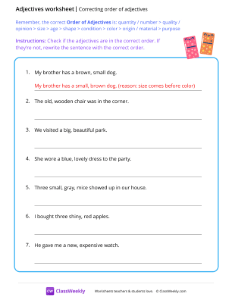
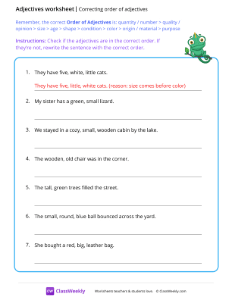
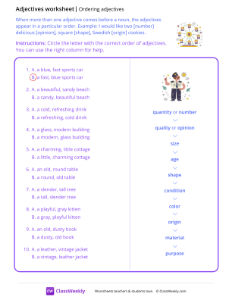
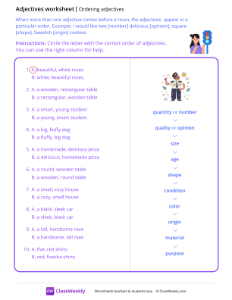
Fill in seven school-themed sentences with prepositions of place and time from the word bank: under, across, during, above, behind, into, beside. Part of our using prepositions parts of speech collection. Aligned to Common Core standards.
How do I use this worksheet?
Introduce the skill with a brief whole-class activity, such as calling out examples and asking students to give a thumbs up when they hear using prepositions in a sentence. Then let students work through it independently, since students at this age benefit more from productive struggle than from being walked through each step, referring to a class anchor chart if one is available. When reviewing answers, ask students to explain why an answer is correct rather than just confirming it. These using prepositions worksheets work well as a focused practice activity, a homework assignment, or a warm-up at the start of a language arts lesson.
What students will practice
- Students will identify and correctly use using prepositions in sentences and short passages.
- Students will distinguish using prepositions from related language concepts and apply rules consistently.
- Students will demonstrate understanding of using prepositions through independent reading and discussion, in both reading and their own writing.


Curriculum Links
Common Core State Standards
Language · 4th Grade
Standard: Form and use prepositional phrases.
View all L.4.1.E worksheets →Find this in the curriculum
Browse the grade, subject, and topic this belongs to.
FAQ
How do I use this using prepositions worksheet?
⌄
Introduce the skill with a brief whole-class activity, such as calling out examples and asking students to give a thumbs up when they hear using prepositions in a sentence. Then let students work through it independently, since students at this age benefit more from productive struggle than from being walked through each step, referring to a class anchor chart if one is available. When reviewing answers, ask students to explain why an answer is correct rather than just confirming it. These using prepositions worksheets work well as a focused practice activity, a homework assignment, or a warm-up at the start of a language arts lesson.
What does this worksheet teach?
⌄
These using prepositions worksheets for 4th grade give students the targeted language arts practice they need to master this important grammar skill. Students identify, sort, complete, and write using using prepositions through a variety of exercises designed to reinforce both recognition and application. Our parts speech worksheets connect grammar practice to reading and writing so students see how using prepositions works in real language. Building a solid understanding of using prepositions in 4th grade sets students up for stronger writing and clearer communication in every subject.
Can I use this using prepositions worksheet for homeschool or classroom?
⌄
Yes, both. We made it for 4th Grade parts of speech, and the page works the same whether it lands on a kitchen table or a center rotation. At home, most families go through it together and talk the answers out loud, and that talking is where most of the learning happens with using prepositions. In class it runs well as independent work while you pull a small group. Print one copy or thirty, whichever the day needs.
Why is correct preposition use challenging for 4th grade students?
⌄
Preposition usage in English is often idiomatic and doesn't follow predictable rules - native speakers say 'interested in' but 'good at,' patterns that must be learned through exposure rather than formulas.
What types of preposition practice do these worksheets include?
⌄
Activities include fill-in-the-blank sentences, choosing the correct preposition from two options, rewriting sentences with incorrect prepositions, and writing original sentences using target prepositions.
How does preposition practice support writing precision for 4th graders?
⌄
Choosing the right preposition affects meaning significantly - 'She hid behind the door' and 'She hid beside the door' describe very different positions, so accurate preposition use is key to precise descriptive writing.
What should a 4th grader know about prepositions and prepositional phrases?
⌄
Fourth graders should recognize prepositions and the phrases they begin, and use them correctly in their own sentences (CCSS L.4.1e). A preposition is a word that shows direction, location, or time, such as in, on, under, before, after, or between. A prepositional phrase starts with that preposition and ends with a noun or pronoun called its object, as in "under the wooden bridge" or "after lunch." By fourth grade, students learn to find the whole phrase, not just the preposition, and to see that a prepositional phrase can act like an adverb, telling where, when, or how something happens ("She ran across the field"). This matters because prepositional phrases add the detail that turns a bare sentence into a clear one. Common confusion comes from mistaking a preposition for another part of speech, since words like "up" and "over" can also be adverbs. Worksheets that ask students to underline the whole phrase, circle the object, and then add a prepositional phrase to a plain sentence give the hands-on practice L.4.1e calls for, and reading the finished sentence aloud confirms the phrase adds real, useful detail.
How do you teach prepositional phrases to a 4th grader?
⌄
Teach the phrase as a unit, not just the preposition. Begin with the idea that a preposition answers where, when, or in what direction, then show that it always drags an object along with it: "on the shelf," "before recess," "into the pond." A quick trick your fourth grader will remember: a preposition is almost anywhere a squirrel can go relative to a tree, up the tree, around the tree, or behind the tree. Once students can spot the phrase, have them find its two ends, the preposition at the start and the noun or pronoun object at the end, and underline everything in between. Next, move to building: give a plain sentence like "The dog slept" and ask students to add a prepositional phrase that tells where ("The dog slept under the porch"). Finally, show how the same phrase can act as an adverb describing the verb. Worksheets that progress from underlining phrases, to identifying the object, to writing new phrases into sentences match the sequence CCSS L.4.1e expects. Reading each finished sentence aloud confirms the phrase actually adds clear, useful detail.
Why do fourth graders confuse prepositions, and how do worksheets help?
⌄
Fourth graders confuse prepositions for two main reasons. First, many preposition words double as other parts of speech: "up," "down," "over," and "in" can be adverbs when they stand alone ("Come in") but prepositions when they lead a phrase ("Come in the house"). Second, students often grab only the preposition and miss the rest of the phrase, so they underline "under" but skip "the old wooden table." The fix is to always look for the object, the noun or pronoun that finishes the phrase. If there is an object, it is a prepositional phrase, and if the word stands alone, it is probably an adverb. Another common slip is choosing the wrong preposition for the meaning, such as "different than" instead of "different from." Worksheets help by isolating the skill: some ask students to underline the full phrase and box the object, some ask them to sort words as prepositions or not, and some ask them to drop the right preposition into a sentence. This targeted practice, aligned with CCSS L.4.1e, builds the habit of seeing the whole phrase, which is exactly where most preposition errors disappear.
Ratings & Reviews
No reviews yet. Be the first to share what you think.
Reviews are for ClassWeekly members.
Make a Request
Spotted something to fix, or want a worksheet we don't have yet? Tell us and we'll make it.
Worksheet Details
| Grade | 4th Grade |
| Subject | Grammar & Writing |
| Topic | Parts of Speech |
| Standard | L.4.1.E |
| Pages | 1 page |
| Difficulty | Medium |
What is ClassWeekly?
ClassWeekly offers free worksheets and printable learning resources for kids in preschool to grade 5. All worksheets are aligned to Common Core, NGSS, and C3 Framework standards and designed by educators. Become a member to access the full library and download unlimited PDFs.