Logic Grid, Clues From a Scatter Plot
Written by Adi Ackerman, Head Teacher
"Logic Grid, Clues From a Scatter Plot" is written for 8th Grade (Ages 13-14), and it covers Common Core 8.SP.A.1. A 7th grader who is already steady on math puzzles can use it too, and an older student can use it as a short review.
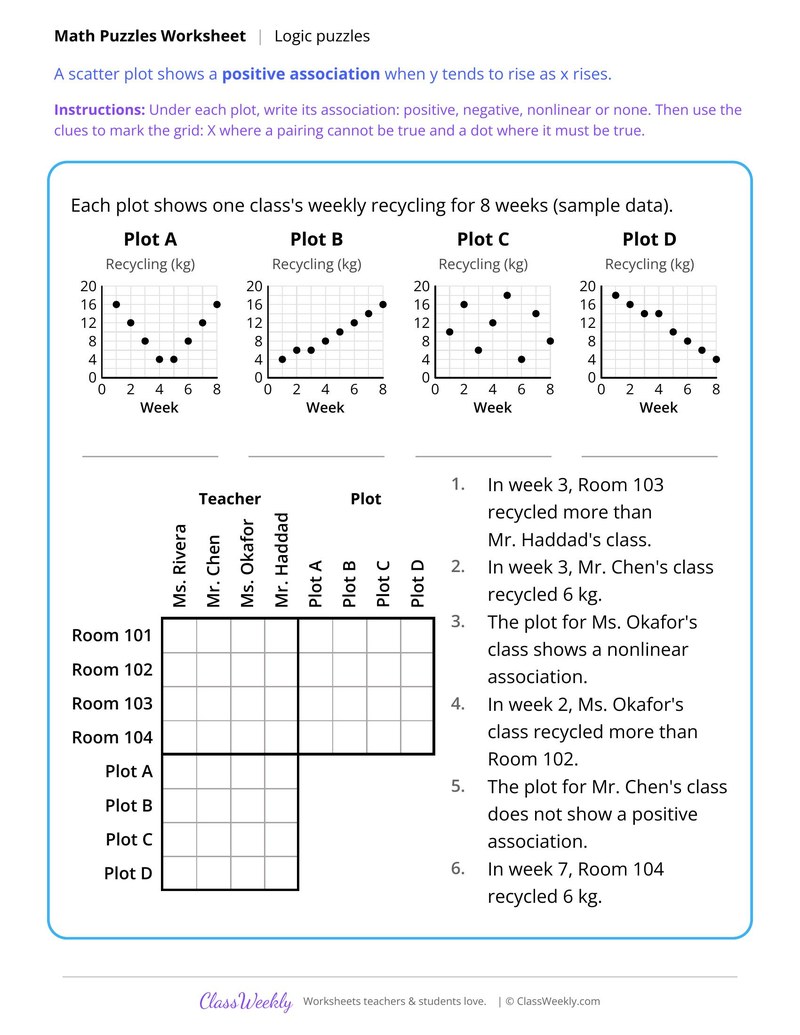
8th grade math worksheet: name the association in four recycling scatter plots, then match teachers to rooms with the clues. Answer key included. Part of our logic puzzles collection. Aligned to Common Core standards.
How do I use this worksheet?
Use a math logic grid to review a unit or a reasoning puzzle as a break between units. Model how to mark one clue before students start.
What students will practice
- Students will label scatter plots as positive, negative, nonlinear or none.
- Students will read weekly recycling values from sample data plots.
- Students will match teachers, rooms and plots in a logic grid.
Curriculum Links
Common Core State Standards
Statistics and Probability · 8th Grade
Standard: Construct and interpret scatter plots for bivariate measurement data to investigate patterns of association between two quantities. Describe patterns such as clustering, outliers, positive or negative association, linear association, and nonlinear association.
View all 8.SP.A.1 worksheets →Find this in the curriculum
Browse the grade, subject, and topic this belongs to.
FAQ
How do I use this logic puzzles worksheet?
⌄
Use a math logic grid to review a unit or a reasoning puzzle as a break between units. Model how to mark one clue before students start.
What does this worksheet teach?
⌄
Name the association in four recycling scatter plots, then match teachers to rooms with the clues. A scatter plot shows a positive association when y tends to rise as x rises. The directions on the page read: Under each plot, write its association: positive, negative, nonlinear or none. Then use the clues to mark the grid: X where a pairing cannot be true and a dot where it must be true. An answer key is included.
Can I use this logic puzzles worksheet for homeschool or classroom?
⌄
Yes, both. We made it for 8th grade math puzzles, and it works the same at home or at school. At home, a student can work through it alone and then go over it with you, which shows quickly what is solid and what needs another look. In class it works as independent practice, homework or a warm-up, and you can print one copy or a full set.
How do you solve a logic grid puzzle?
⌄
Read each clue and mark X where a pairing cannot be true and a dot or circle where it must be. When a row has only one open square, it must be the match. Keep going until every square is marked.
What is a nonogram?
⌄
A nonogram is a grid puzzle where the numbers beside each row and column give the lengths of shaded runs. Shading only the squares the clues prove reveals a hidden picture, such as the hot air balloon in the 12 by 12 puzzle.
How do math clues fit into a logic grid?
⌄
Students first solve a problem, such as finding four slopes or four planter volumes, and then use those answers to apply the clues. Logic Grid, Kite Strings and Right Triangles uses the Pythagorean theorem this way.
Ratings & Reviews
No reviews yet. Be the first to share what you think.
Reviews are for ClassWeekly members.
Make a Request
Spotted something to fix, or want a worksheet we don't have yet? Tell us and we'll make it.
Worksheet Details
| Grade | 8th Grade |
| Subject | Math |
| Topic | Math Puzzles |
| Standard | 8.SP.A.1 |
| Pages | 1 page |
| Difficulty | Medium |
What is ClassWeekly?
ClassWeekly offers free worksheets and printable learning resources for kids, from preschool up. All worksheets are aligned to Common Core, NGSS, and C3 Framework standards and designed by educators. Become a member to access the full library and download unlimited PDFs.