Match Sums and Differences in Scientific Notation
Written by Adi Ackerman, Head Teacher
"Match Sums and Differences in Scientific Notation" is written for 8th Grade (Ages 13-14), and it covers Common Core 8.EE.A.4. A 7th grader who is already steady on scientific notation can use it too, and an older student can use it as a short review.
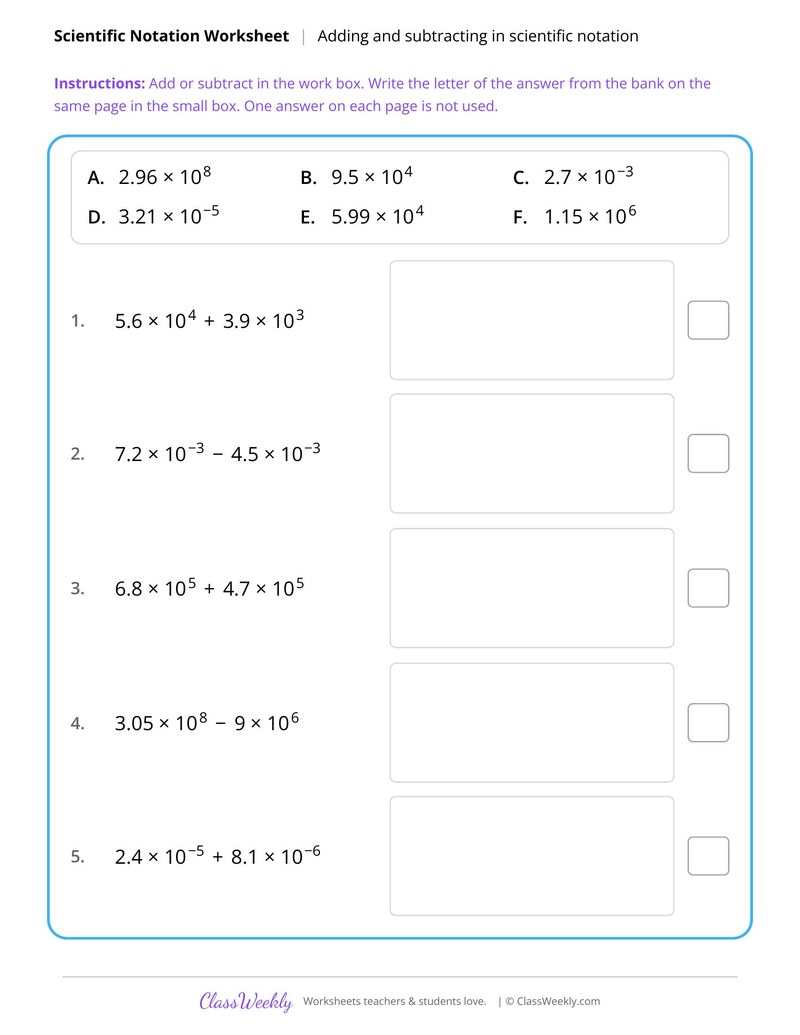
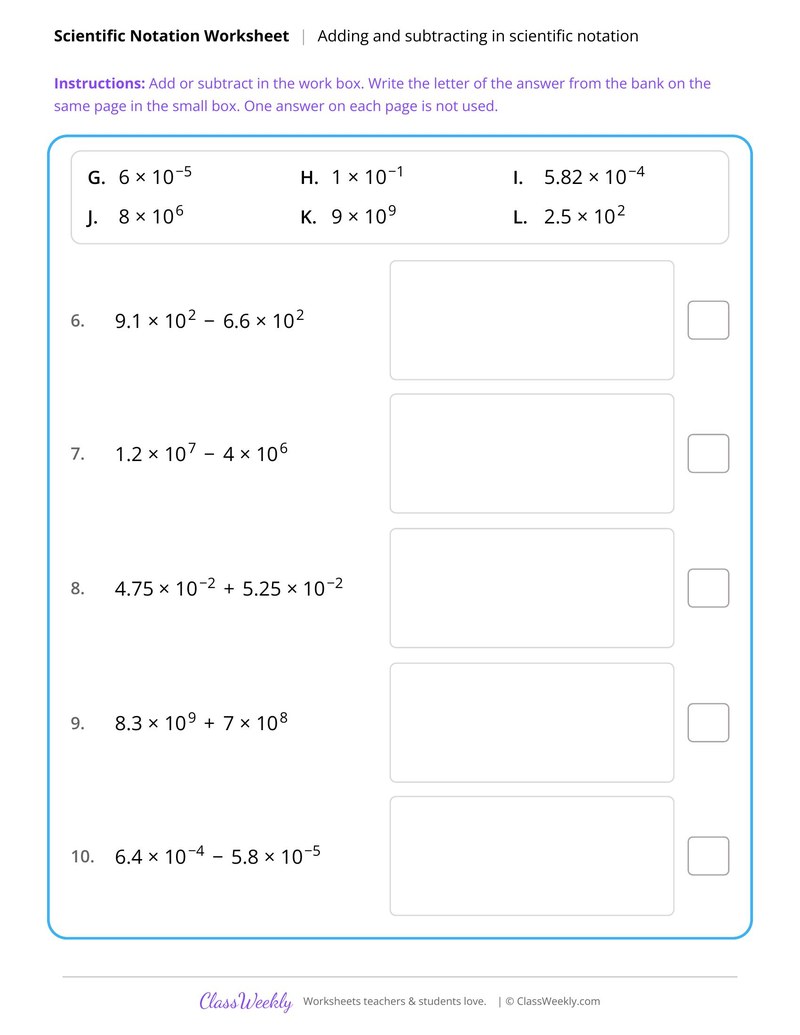
2 pages in this set
8th grade math worksheet: add and subtract pairs like 5.6 × 10⁴ + 3.9 × 10³ and match each answer to a bank on its page. Answer key included. Part of our operations in scientific notation collection. Aligned to Common Core standards.
How do I use this worksheet?
Teach addition and subtraction before multiplication and division, since the exponent steps differ. Use the matching sheets for self checking and save the find the error sheet for review.
What students will practice
- Students will add and subtract numbers in scientific notation.
- Students will match the powers of 10 before combining.
- Students will match each answer to a bank where one choice per page goes unused.
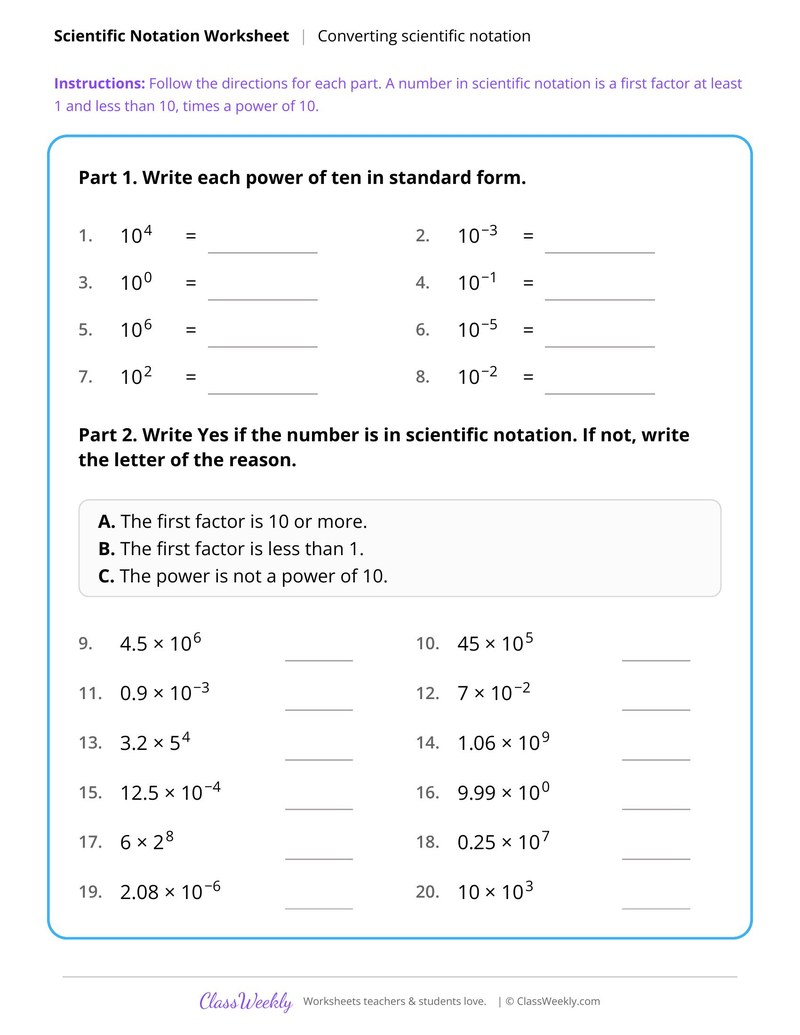
Powers of Ten and Scientific Notation Basics
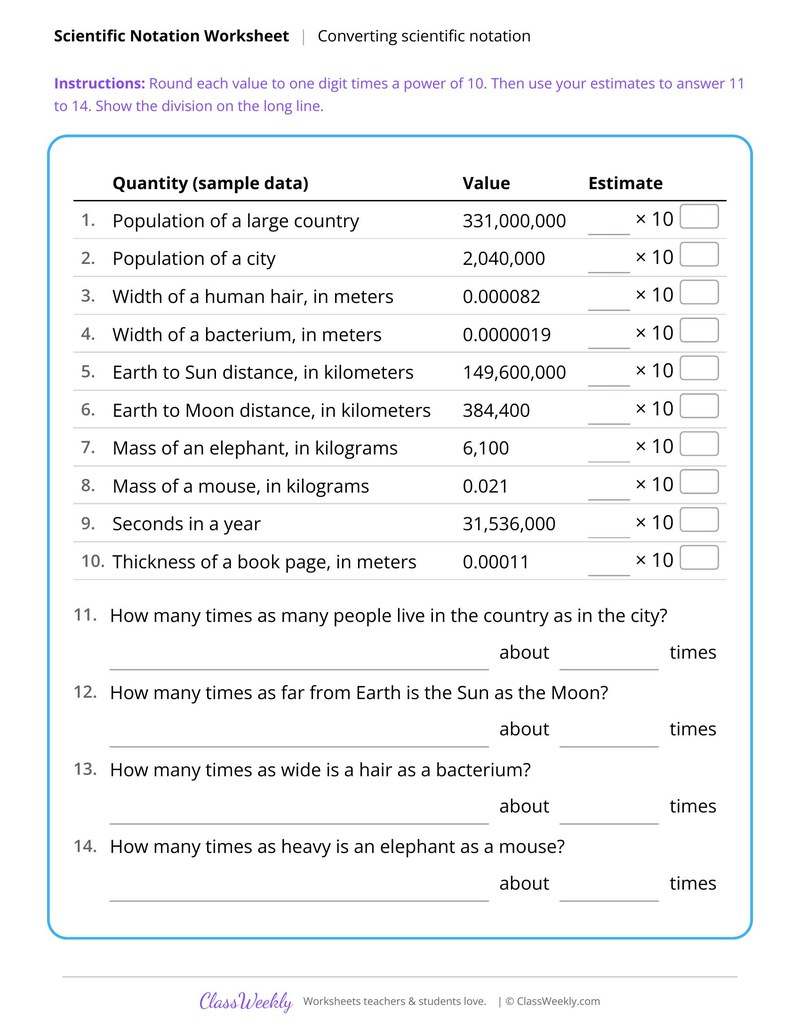
Estimate Quantities as a Digit Times a Power of 10
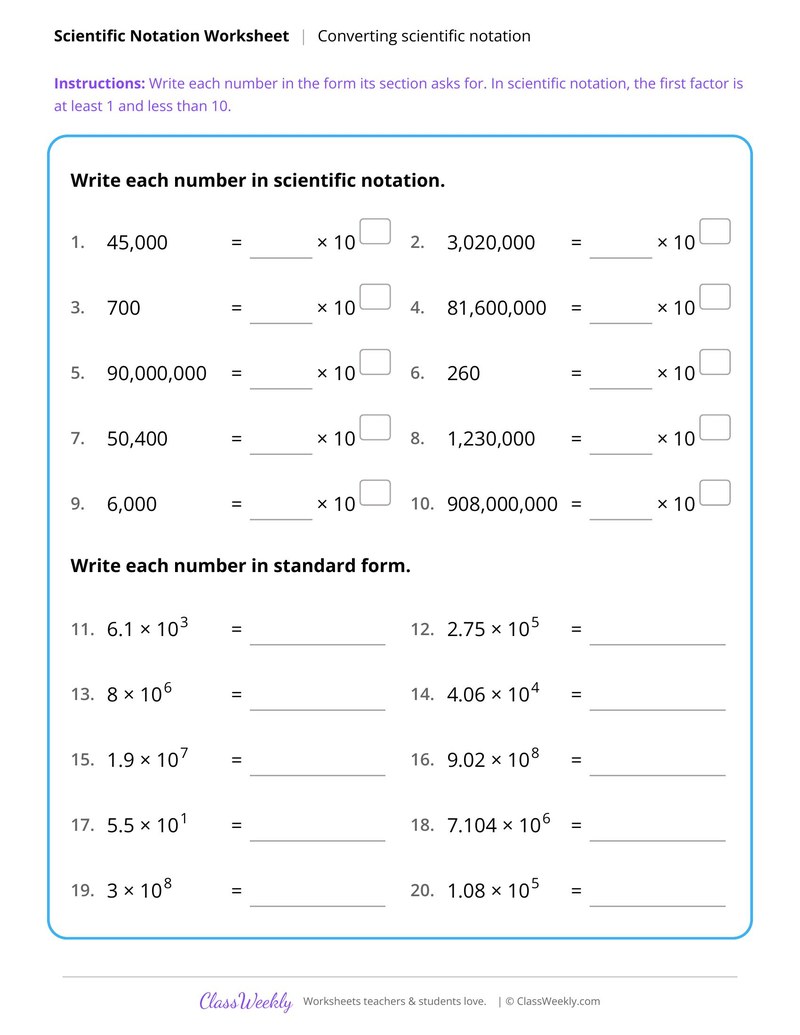
Convert Both Ways, Whole Numbers
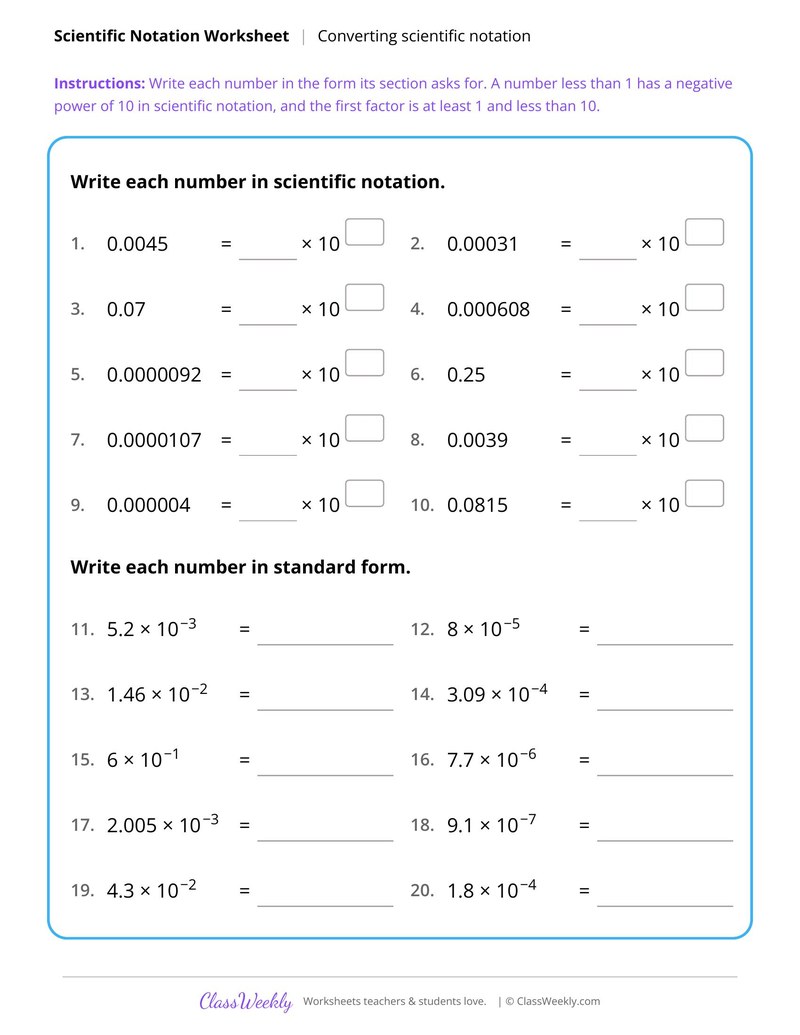
Convert Both Ways, Decimals Less Than One
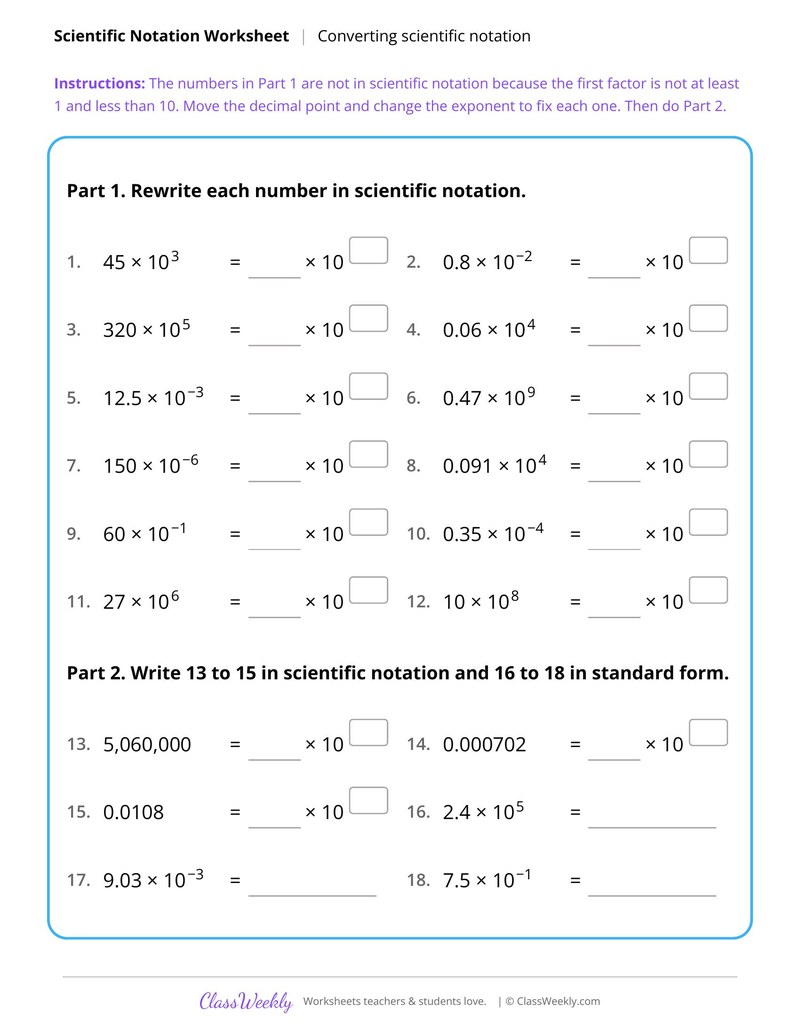
Fix Numbers Not in Scientific Notation
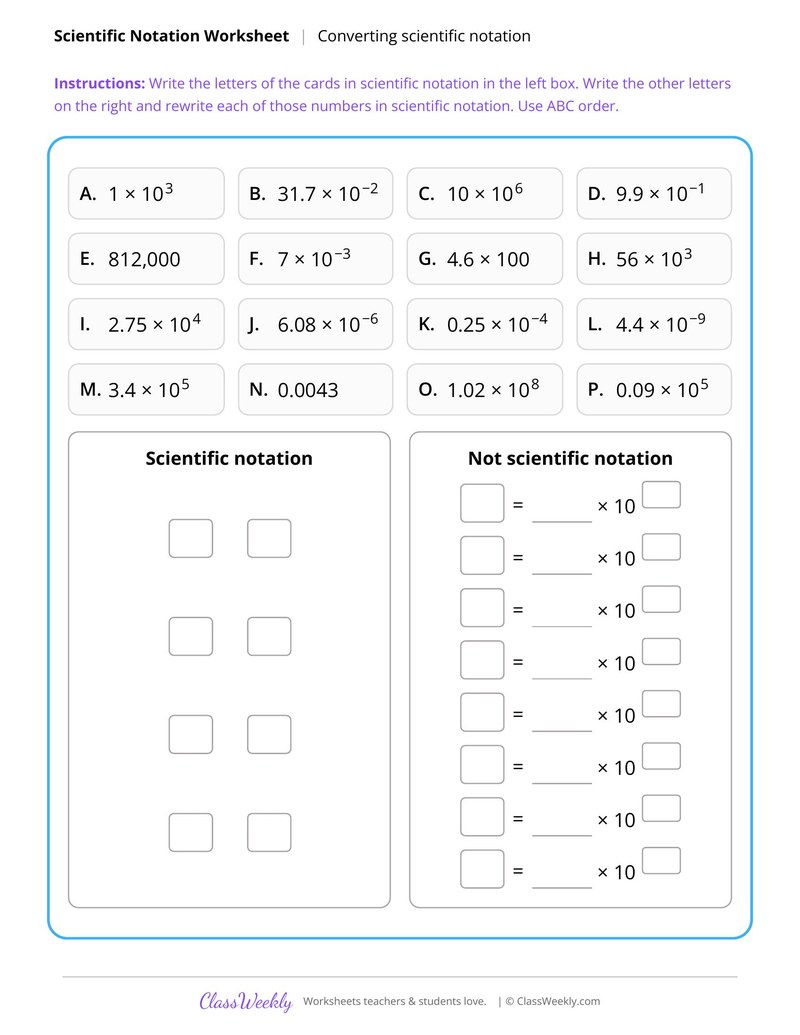
Is It Scientific Notation? Sort and Fix
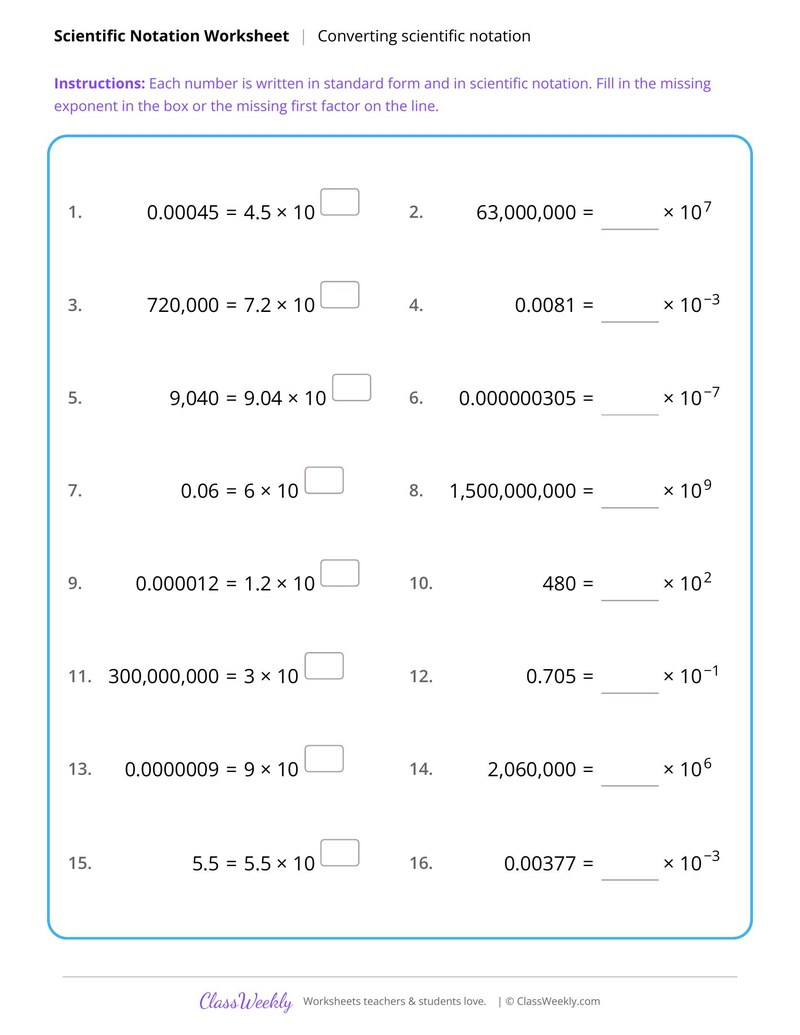
Fill In the Missing Exponent or Coefficient
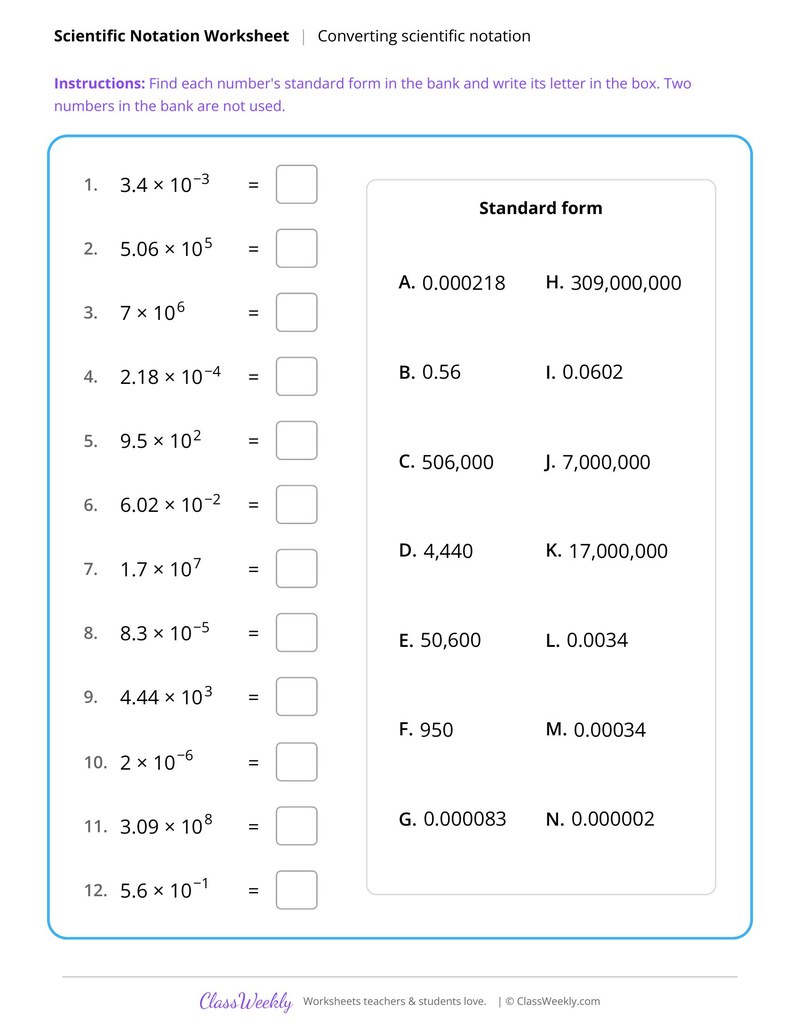
Match Scientific Notation to Standard Form
Curriculum Links
Common Core State Standards
Expressions and Equations · 8th Grade
Standard: Perform operations with numbers expressed in scientific notation, including problems where both decimal and scientific notation are used. Use scientific notation and choose units of appropriate size for measurements of very large or very small quantities (e.g., use millimeters per year for seafloor spreading). Interpret scientific notation that has been generated by technology.
View all 8.EE.A.4 worksheets →Find this in the curriculum
Browse the grade, subject, and topic this belongs to.
FAQ
How do I use this operations in scientific notation worksheet?
⌄
Teach addition and subtraction before multiplication and division, since the exponent steps differ. Use the matching sheets for self checking and save the find the error sheet for review.
What does this worksheet teach?
⌄
Add and subtract pairs like 5.6 × 10⁴ + 3.9 × 10³ and match each answer to a bank on its page. The directions on the page read: Add or subtract in the work box. Write the letter of the answer from the bank on the same page in the small box. One answer on each page is not used. An answer key is included.
Can I use this operations in scientific notation worksheet for homeschool or classroom?
⌄
Yes, both. We made it for 8th grade scientific notation, and it works the same at home or at school. At home, a student can work through it alone and then go over it with you, which shows quickly what is solid and what needs another look. In class it works as independent practice, homework or a warm-up, and you can print one copy or a full set.
How do you subtract numbers in scientific notation with different powers?
⌄
Rewrite the number with the smaller power of 10 so both powers match, then subtract the first factors. If the first factor drops below 1, move the decimal point right and subtract 1 from the exponent, as on Subtract When the Coefficient Drops Below One.
Do you add the exponents when you add in scientific notation?
⌄
No. You add exponents only when you multiply. When you add, the powers of 10 must already match and stay the same. Find the Error in Scientific Notation Operations shows this mistake for students to correct.
How do you read E on a calculator?
⌄
A calculator shows a very large or very small number with an E, and the number after the E is the exponent on the power of 10. Read Scientific Notation on a Calculator Display matches each display to its scientific notation and standard form.
Are the word problem numbers real measurements?
⌄
No. The word problem sheets say that all numbers are sample data. They give realistic contexts, such as cell sizes and distances, so students practice dividing to tell how many times larger one value is.
Ratings & Reviews
No reviews yet. Be the first to share what you think.
Reviews are for ClassWeekly members.
Make a Request
Spotted something to fix, or want a worksheet we don't have yet? Tell us and we'll make it.
Worksheet Details
| Grade | 8th Grade |
| Subject | Math |
| Topic | Scientific Notation |
| Standard | 8.EE.A.4 |
| Pages | 2 pages |
| Difficulty | Medium |
What is ClassWeekly?
ClassWeekly offers free worksheets and printable learning resources for kids, from preschool up. All worksheets are aligned to Common Core, NGSS, and C3 Framework standards and designed by educators. Become a member to access the full library and download unlimited PDFs.
Powers of Ten and Scientific Notation Basics
Estimate Quantities as a Digit Times a Power of 10
Convert Both Ways, Whole Numbers
Convert Both Ways, Decimals Less Than One
Fix Numbers Not in Scientific Notation
Is It Scientific Notation? Sort and Fix
Fill In the Missing Exponent or Coefficient
Match Scientific Notation to Standard Form