Find the Sequence That Maps Similar Figures
Written by Adi Ackerman, Head Teacher
"Find the Sequence That Maps Similar Figures" is written for 8th Grade (Ages 13-14), and it covers Common Core 8.G.A.4. A 7th grader who is already steady on transformations can use it too, and an older student can use it as a short review.
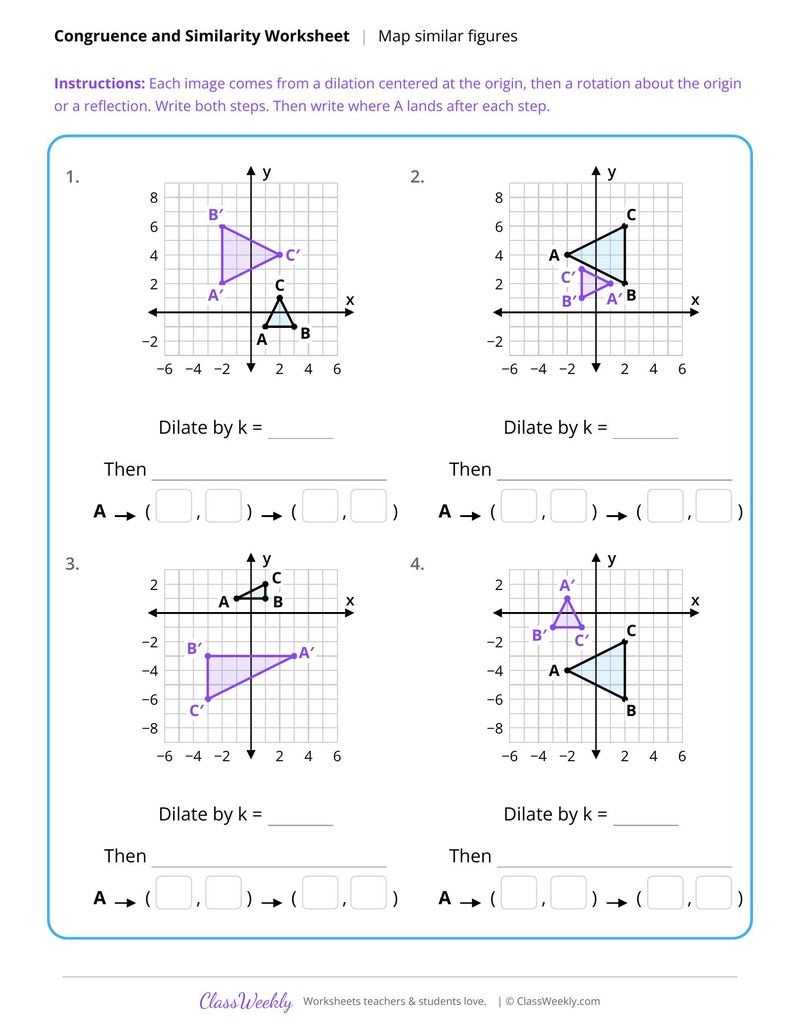
8th grade math worksheet: write the dilation and the rotation or reflection that map each figure, tracking A after each step. Answer key included. Part of our congruence and similarity transformations collection. Aligned to Common Core standards.
How do I use this worksheet?
Start with What Rigid Motions Preserve so students see why rigid motions make congruent figures. Move to the sequence and similarity grids, then close with the angle-angle sheets.
What students will practice
- Students will find the scale factor of a dilation centered at the origin.
- Students will name the rotation or reflection that comes after the dilation.
- Students will write the coordinates of A after each of the two steps.
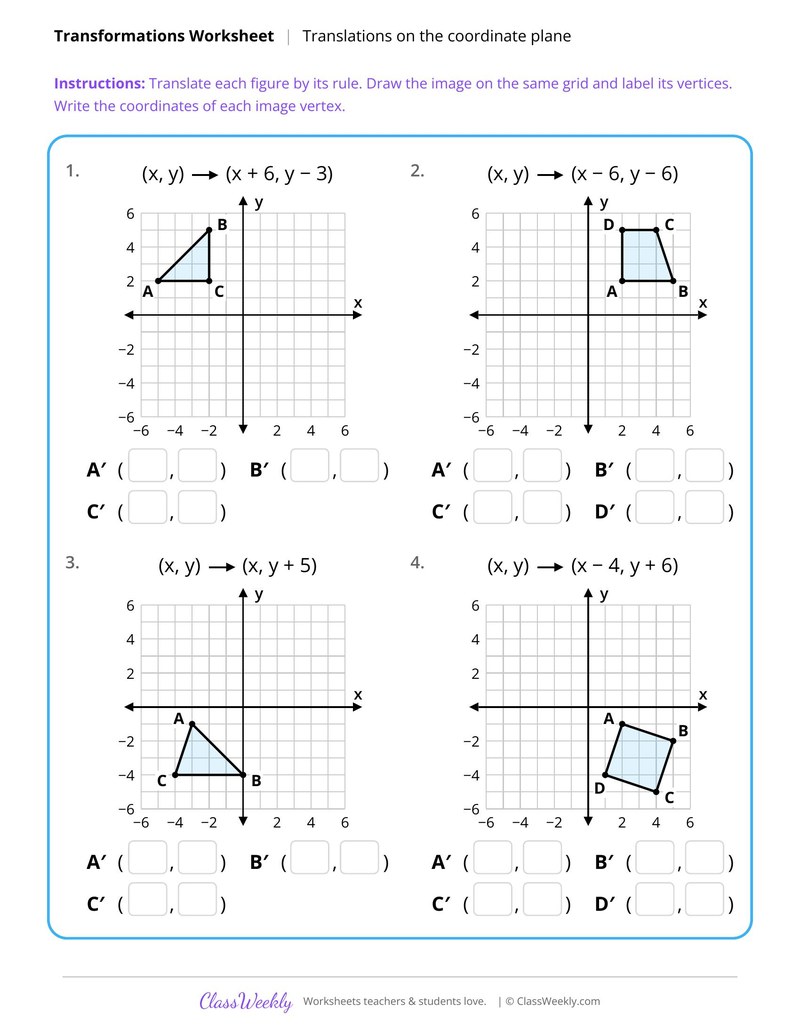
Translate Figures on the Coordinate Plane
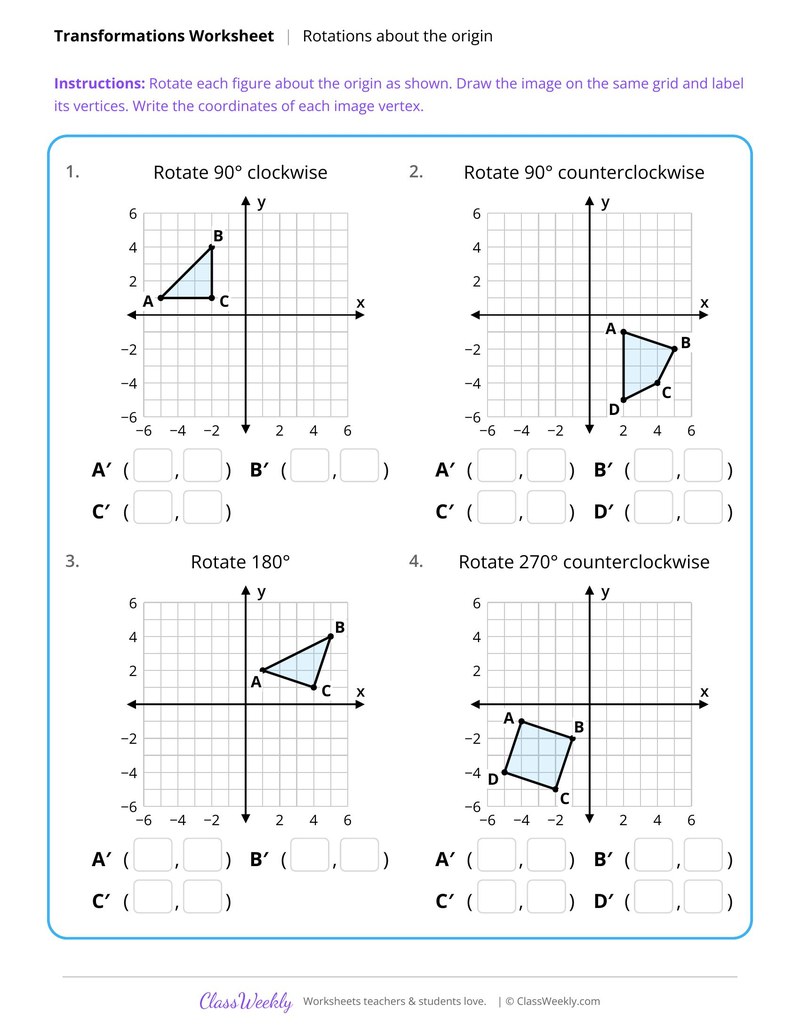
Rotate Figures About the Origin
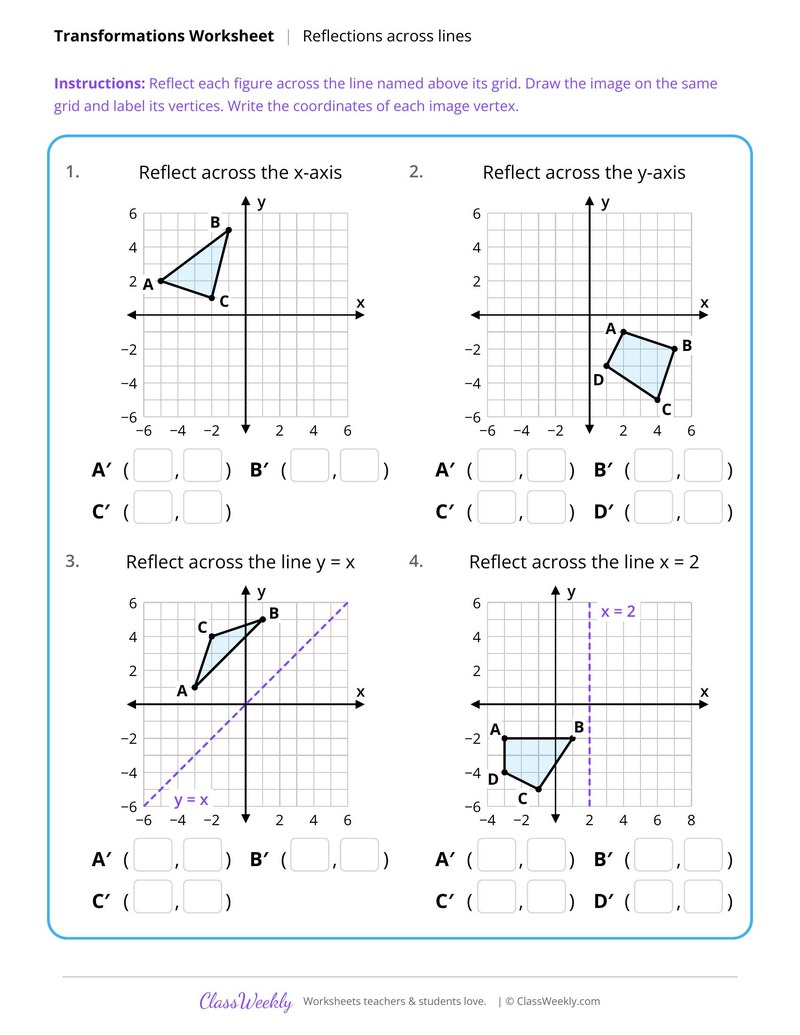
Reflect Figures Across the Axes and Lines
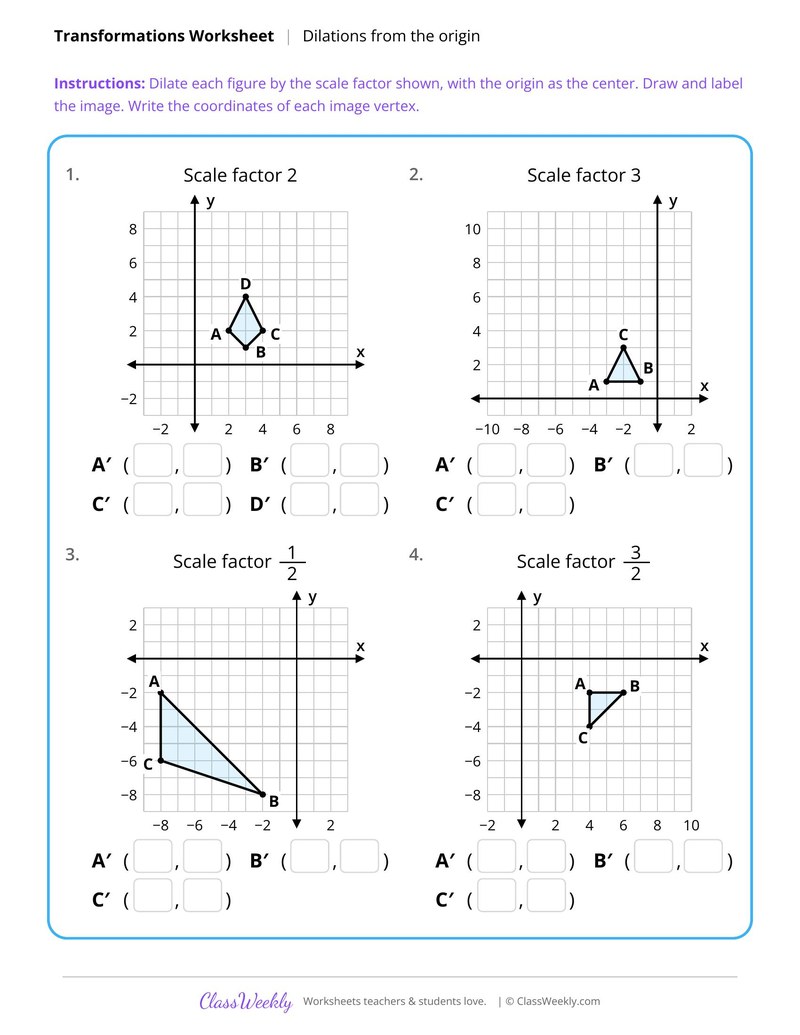
Dilate Figures From the Origin
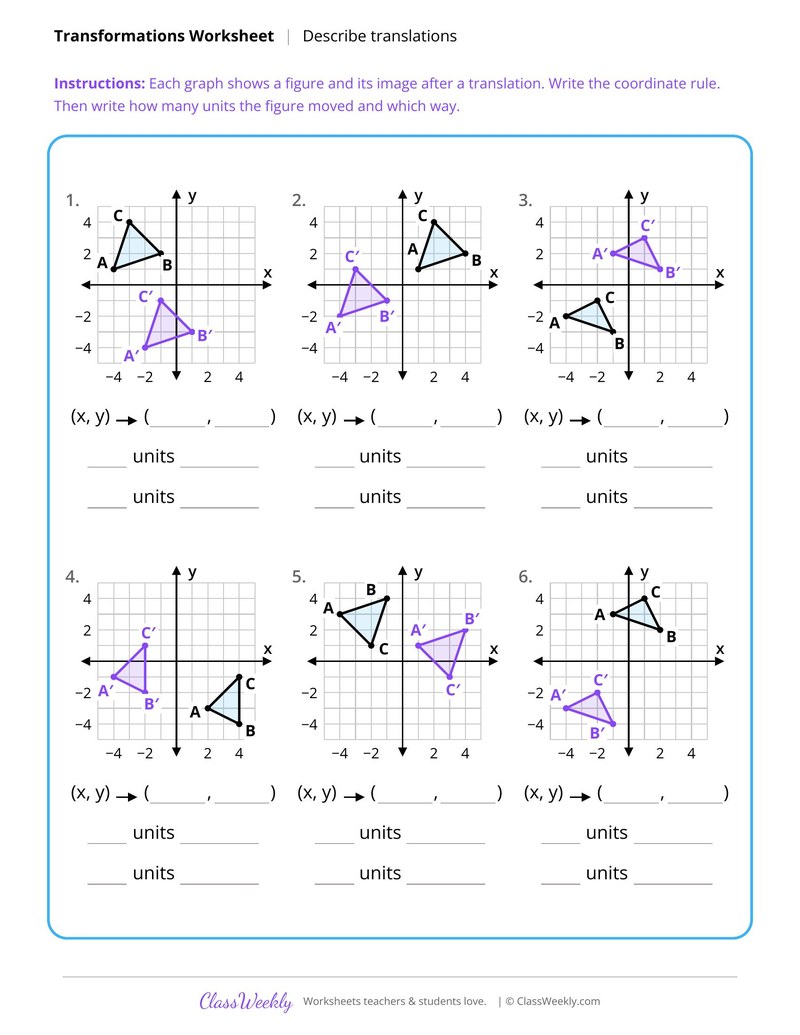
Describe Translations With Coordinate Rules
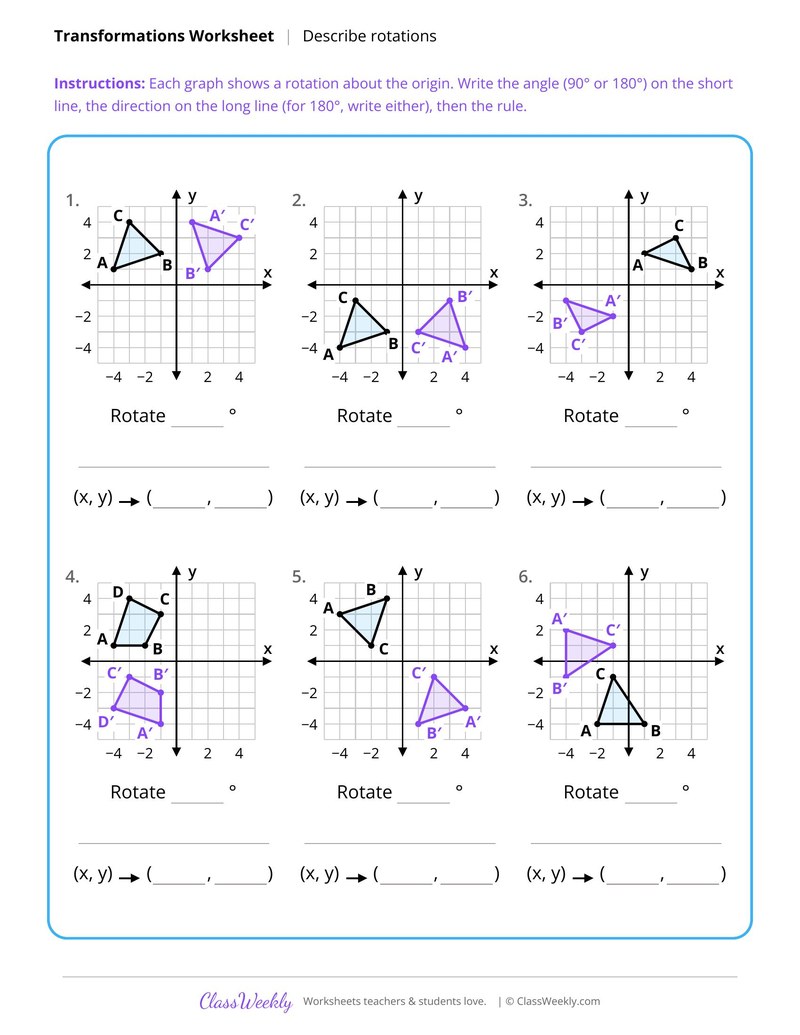
Describe Rotations From Before and After Graphs
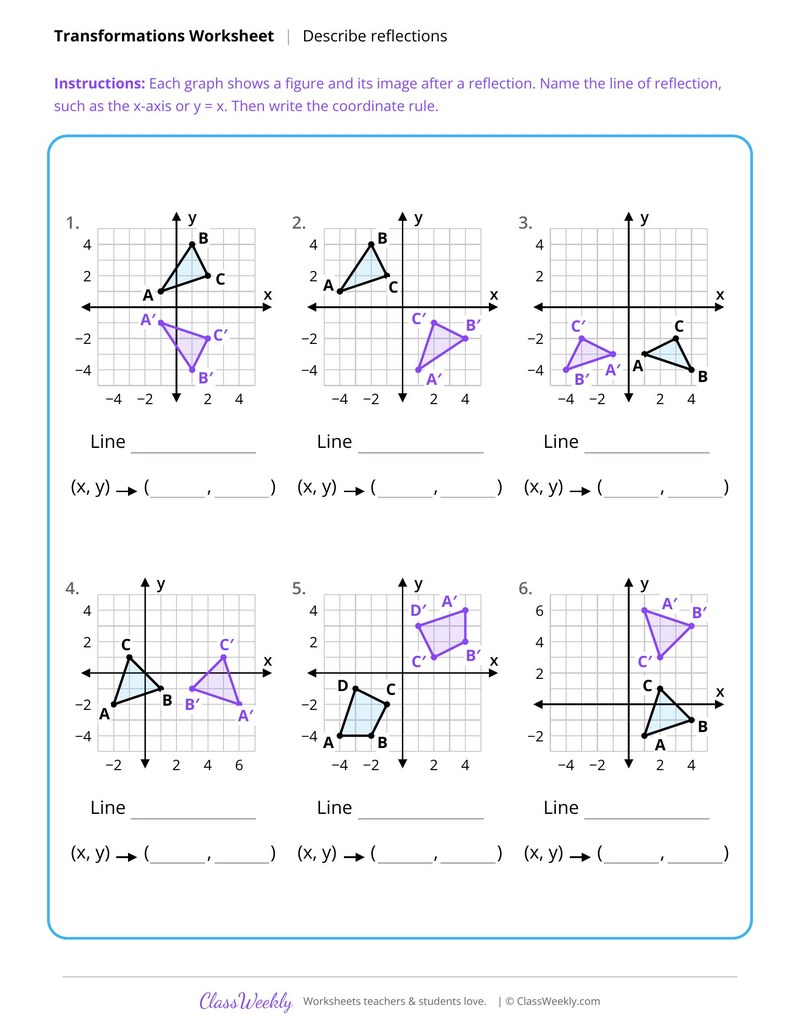
Describe Reflections and Name the Line
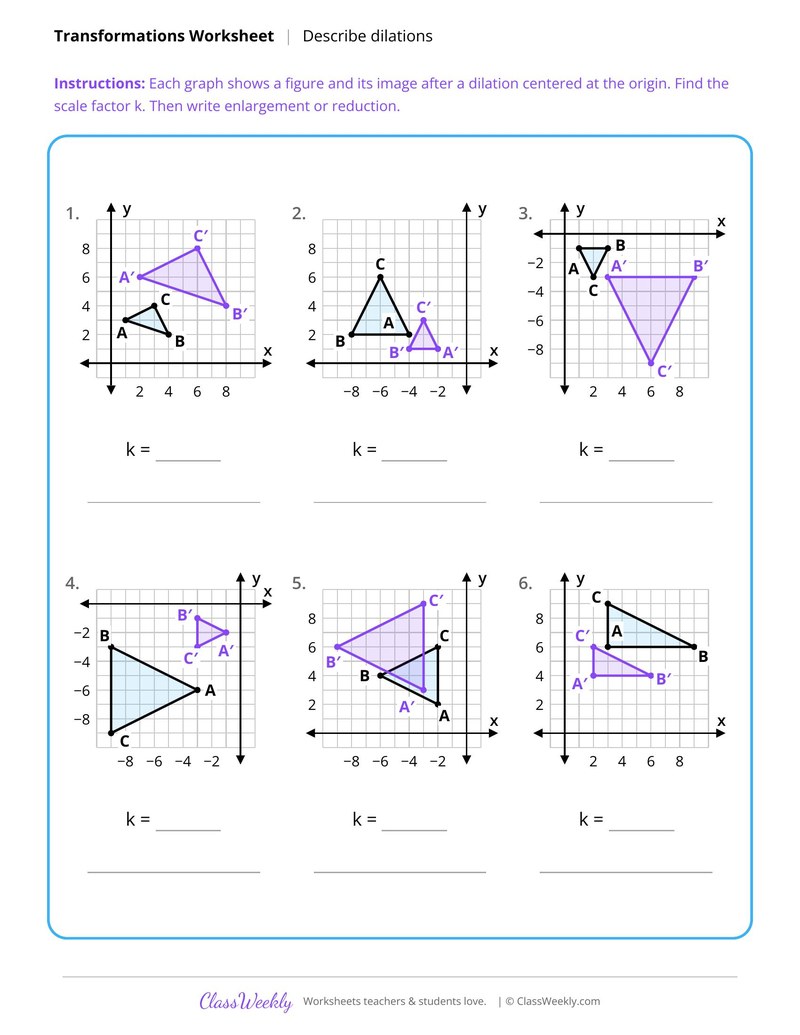
Describe Dilations and Find the Scale Factor
Curriculum Links
Common Core State Standards
Geometry · 8th Grade
Standard: Understand that a two-dimensional figure is similar to another if the second can be obtained from the first by a sequence of rotations, reflections, translations, and dilations; given two similar two-dimensional figures, describe a sequence that exhibits the similarity between them.
View all 8.G.A.4 worksheets →Find this in the curriculum
Browse the grade, subject, and topic this belongs to.
FAQ
How do I use this congruence and similarity worksheet?
⌄
Start with What Rigid Motions Preserve so students see why rigid motions make congruent figures. Move to the sequence and similarity grids, then close with the angle-angle sheets.
What does this worksheet teach?
⌄
Write the dilation and the rotation or reflection that map each figure, tracking A after each step. The directions on the page read: Each image comes from a dilation centered at the origin, then a rotation about the origin or a reflection. Write both steps. Then write where A lands after each step. An answer key is included.
Can I use this congruence and similarity worksheet for homeschool or classroom?
⌄
Yes, both. We made it for 8th grade transformations, and it works the same at home or at school. At home, a student can work through it alone and then go over it with you, which shows quickly what is solid and what needs another look. In class it works as independent practice, homework or a warm-up, and you can print one copy or a full set.
What do rigid motions preserve?
⌄
Translations, reflections and rotations keep side lengths and angle measures the same, so the image is congruent to the original. What Rigid Motions Preserve has students measure a trapezoid and its image to check.
What is angle-angle similarity?
⌄
If two angles of one triangle are equal to two angles of another triangle, the triangles are similar. The third angles must then match too, because each triangle's angles add up to 180°.
How do you find a missing side in similar triangles?
⌄
Match the corresponding sides, write a proportion and solve for x. Use Angle-Angle Similarity to Find Missing Sides first asks which two pairs of angles make the triangles similar.
Ratings & Reviews
No reviews yet. Be the first to share what you think.
Reviews are for ClassWeekly members.
Make a Request
Spotted something to fix, or want a worksheet we don't have yet? Tell us and we'll make it.
Worksheet Details
| Grade | 8th Grade |
| Subject | Math |
| Topic | Transformations |
| Standard | 8.G.A.4 |
| Pages | 1 page |
| Difficulty | Medium |
What is ClassWeekly?
ClassWeekly offers free worksheets and printable learning resources for kids, from preschool up. All worksheets are aligned to Common Core, NGSS, and C3 Framework standards and designed by educators. Become a member to access the full library and download unlimited PDFs.
Translate Figures on the Coordinate Plane
Rotate Figures About the Origin
Reflect Figures Across the Axes and Lines
Dilate Figures From the Origin
Describe Translations With Coordinate Rules
Describe Rotations From Before and After Graphs
Describe Reflections and Name the Line
Describe Dilations and Find the Scale Factor