Hydrogen's Line Spectrum and Light Waves
Written by Adi Ackerman, Head Teacher
"Hydrogen's Line Spectrum and Light Waves" is written for 8th Grade (Ages 13-14). A 7th grader who is already steady on waves and light can use it too, and an older student can use it as a short review.
2 pages in this set
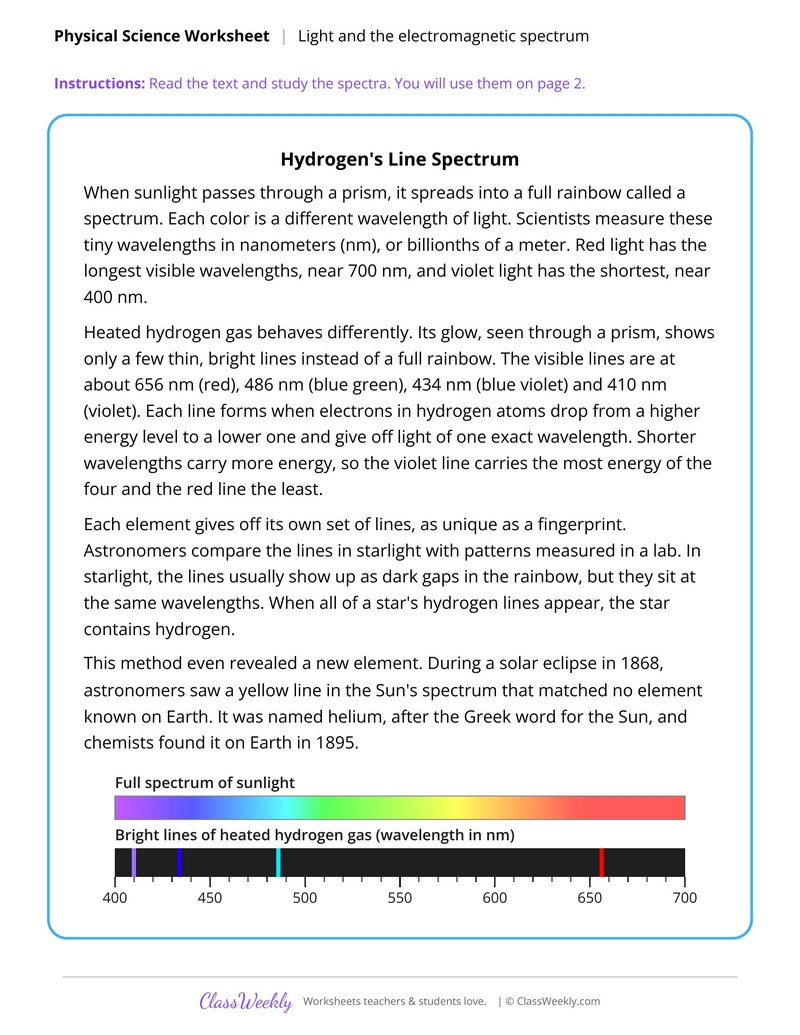
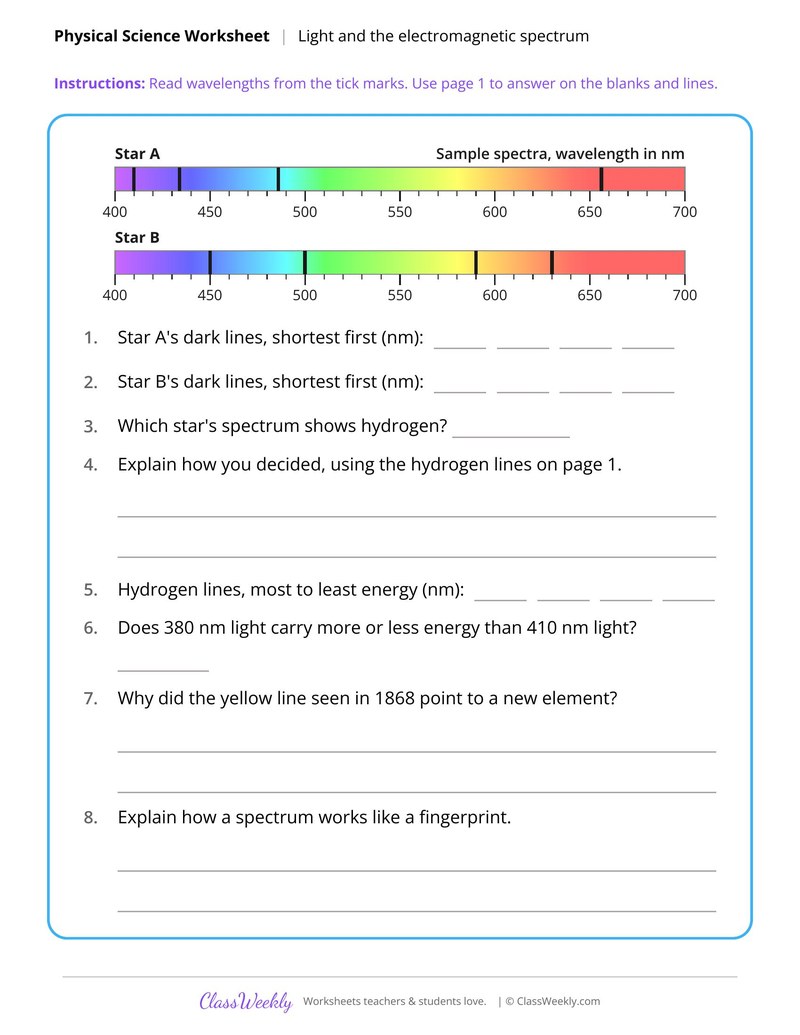
8th grade science worksheet: read hydrogen's four visible lines at 410 to 656 nm, then decide which star spectrum shows hydrogen. Answer key included. Part of our waves, sound and light collection.
How do I use this worksheet?
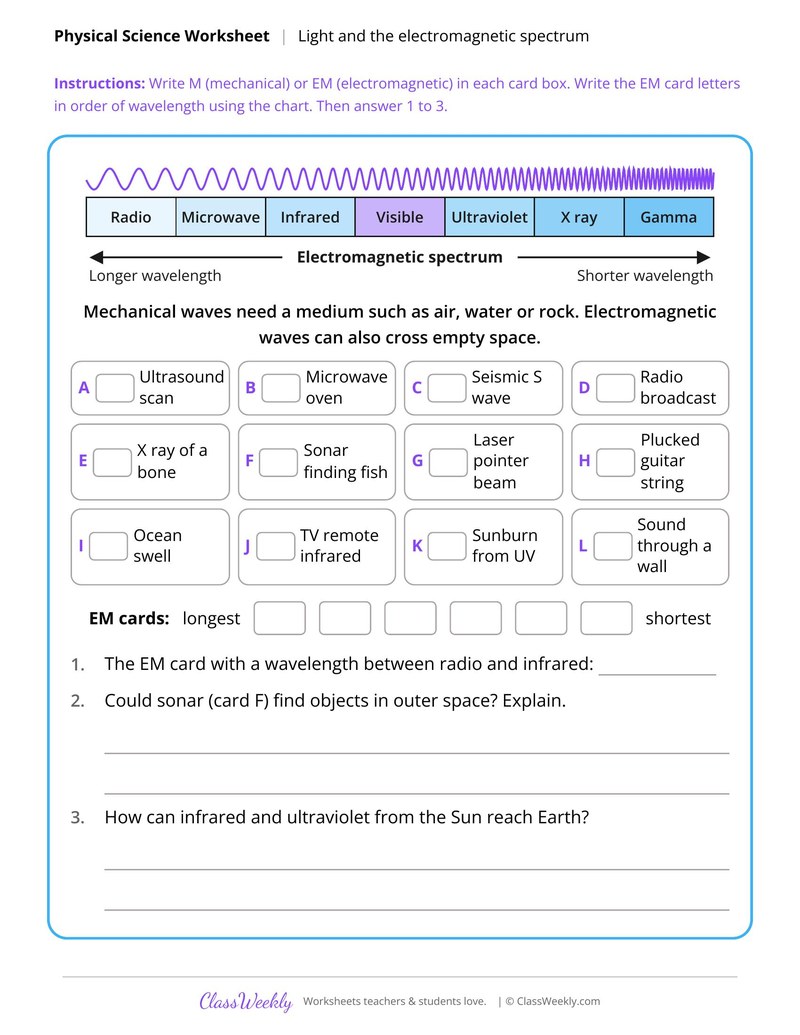
Begin with Sort Waves as Mechanical or Electromagnetic to review wave types, then use the amplitude and earthquake sheets together. The lens and spectrum sheets fit a light unit, and the binary sheet pairs well with a talk about phones and storage.
What students will practice
- Students will read wavelengths in nanometers from spectrum tick marks.
- Students will match dark lines in a star spectrum to hydrogen's lines.
- Students will rank light by energy from its wavelength.
Curriculum Links
Find this in the curriculum
Browse the grade, subject, and topic this belongs to.
FAQ
How do I use this waves, sound and light worksheet?
⌄
Begin with Sort Waves as Mechanical or Electromagnetic to review wave types, then use the amplitude and earthquake sheets together. The lens and spectrum sheets fit a light unit, and the binary sheet pairs well with a talk about phones and storage.
What does this worksheet teach?
⌄
Read hydrogen's four visible lines at 410 to 656 nm, then decide which star spectrum shows hydrogen. The directions on the page read: Read the text and study the spectra. You will use them on page 2. An answer key is included.
Can I use this waves, sound and light worksheet for homeschool or classroom?
⌄
Yes, both. We made it for 8th grade waves and light, and it works the same at home or at school. At home, a student can work through it alone and then go over it with you, which shows quickly what is solid and what needs another look. In class it works as independent practice, homework or a warm-up, and you can print one copy or a full set.
How do scientists use a line spectrum?
⌄
Each element gives off light at its own set of wavelengths, so its spectrum works like a fingerprint. Hydrogen's visible lines sit near 410, 434, 486 and 656 nm. On Hydrogen's Line Spectrum and Light Waves, students match a star's dark lines to these values.
How does earthquake magnitude relate to wave amplitude?
⌄
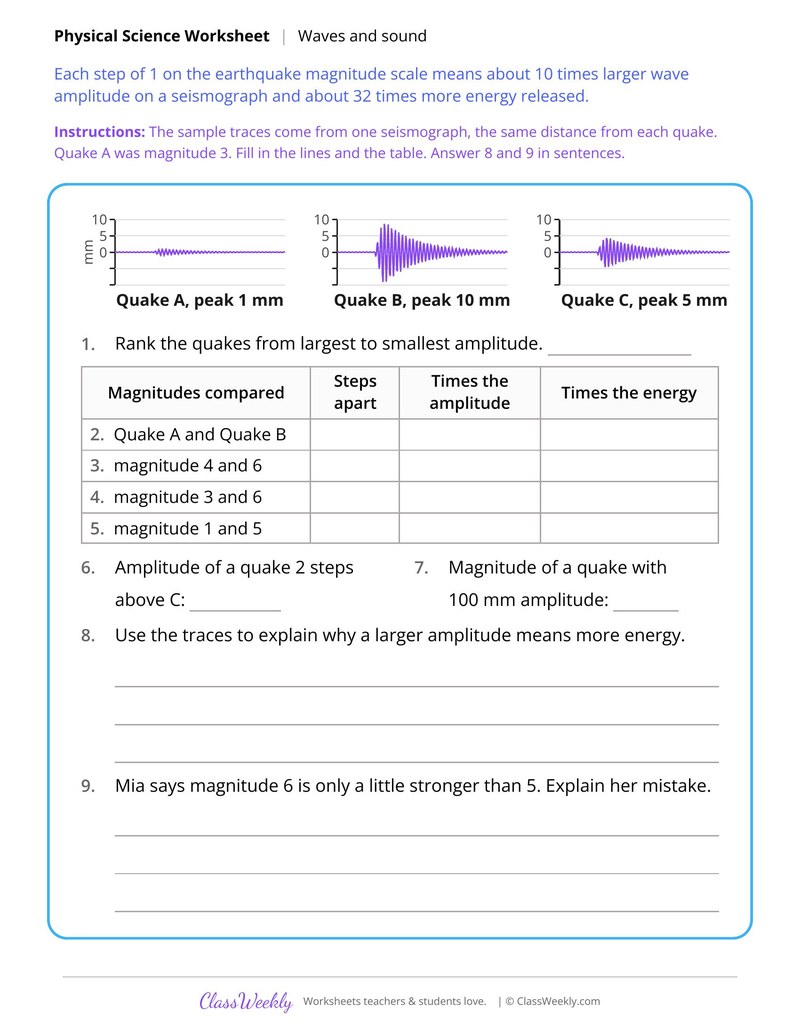
Each step of 1 on the magnitude scale means about 10 times larger amplitude on a seismograph and about 32 times more energy. Earthquake Magnitude, Amplitude and Energy has students compare three sample traces and fill in a table of steps.
Why does light get dimmer farther from a lamp?
⌄
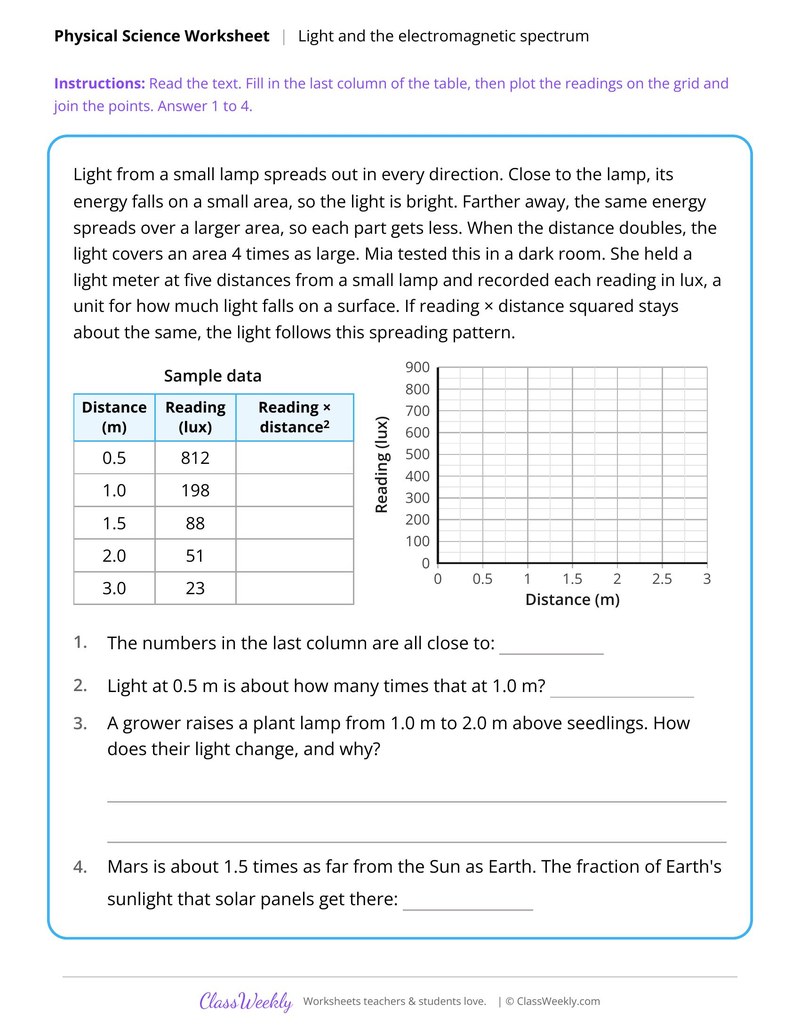
Light spreads out in every direction, so the same energy covers a larger area farther away. When the distance doubles, the area is 4 times as large. Light Meter Readings at Increasing Distance checks this by multiplying each reading by the distance squared.
Ratings & Reviews
No reviews yet. Be the first to share what you think.
Reviews are for ClassWeekly members.
Make a Request
Spotted something to fix, or want a worksheet we don't have yet? Tell us and we'll make it.
Worksheet Details
| Grade | 8th Grade |
| Subject | Science |
| Topic | Waves and Light |
| Pages | 2 pages |
| Difficulty | Medium |
What is ClassWeekly?
ClassWeekly offers free worksheets and printable learning resources for kids, from preschool up. All worksheets are aligned to Common Core, NGSS, and C3 Framework standards and designed by educators. Become a member to access the full library and download unlimited PDFs.