Protons, Neutrons and Electrons Compared
Written by Adi Ackerman, Head Teacher
"Protons, Neutrons and Electrons Compared" is written for 7th Grade (Ages 12-13), and it covers NGSS MS-PS1-1. A 6th grader who is already steady on matter can use it too, and an older student can use it as a short review.
2 pages in this set
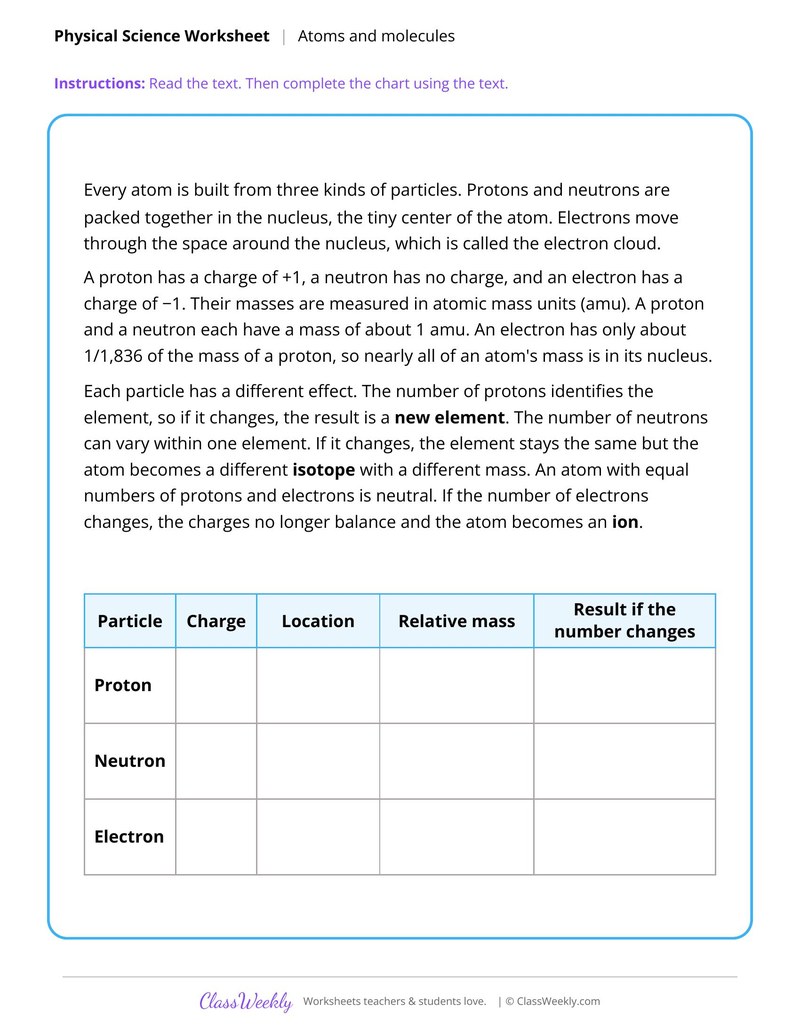
7th grade science worksheet: read about particle charges, fill a comparison chart, then tell new elements, isotopes and ions apart. Answer key included. Part of our atoms and molecules matter collection. Aligned to NGSS standards.
How do I use this worksheet?
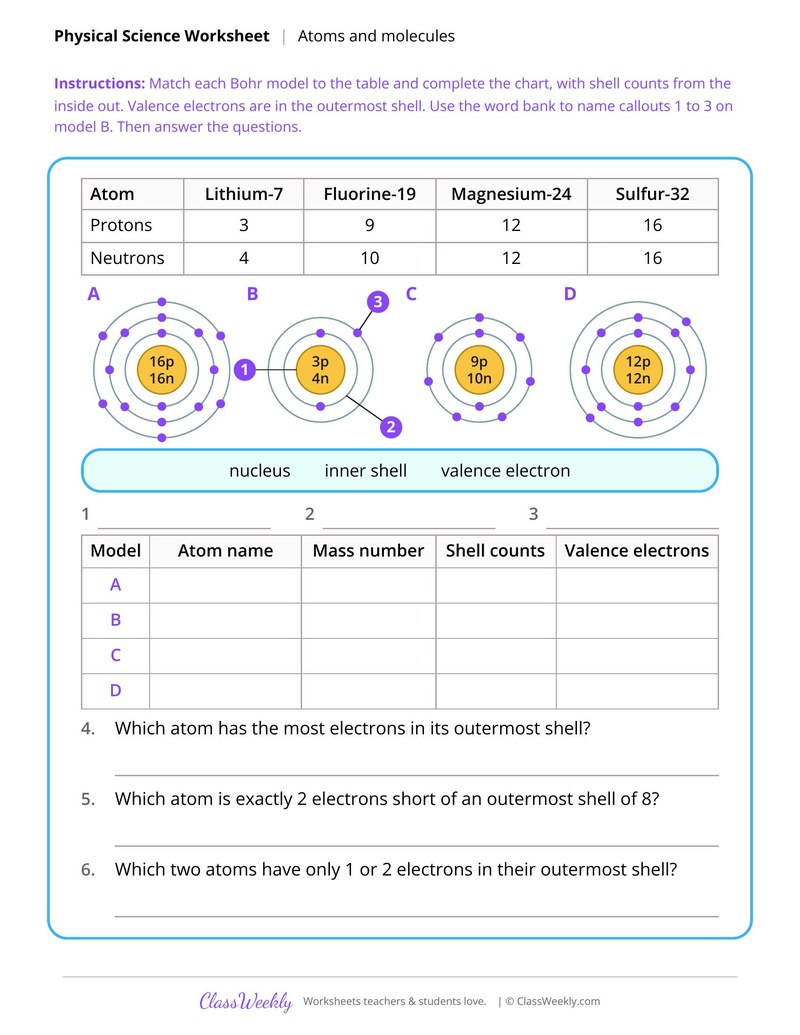
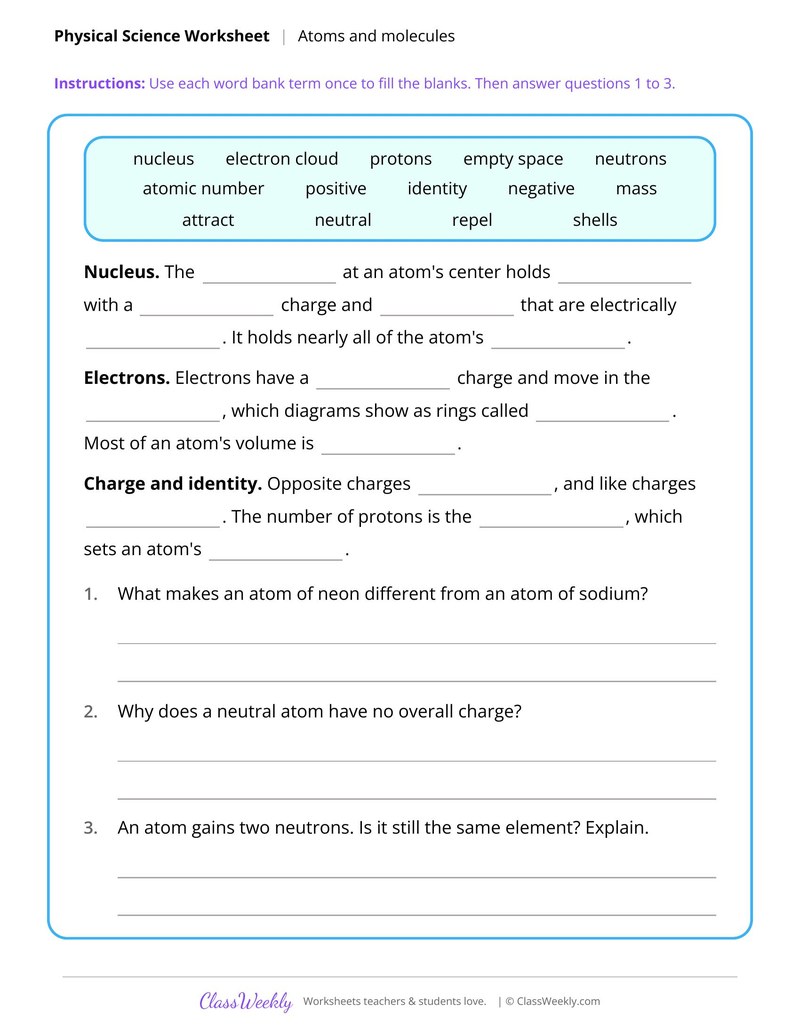
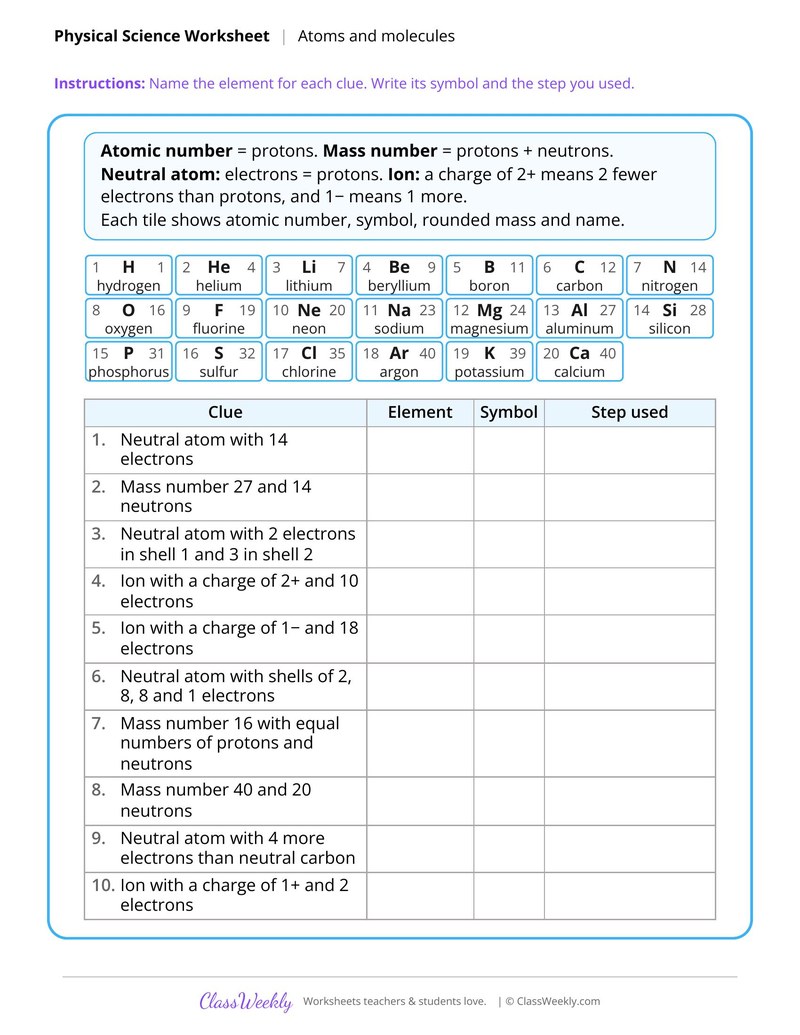
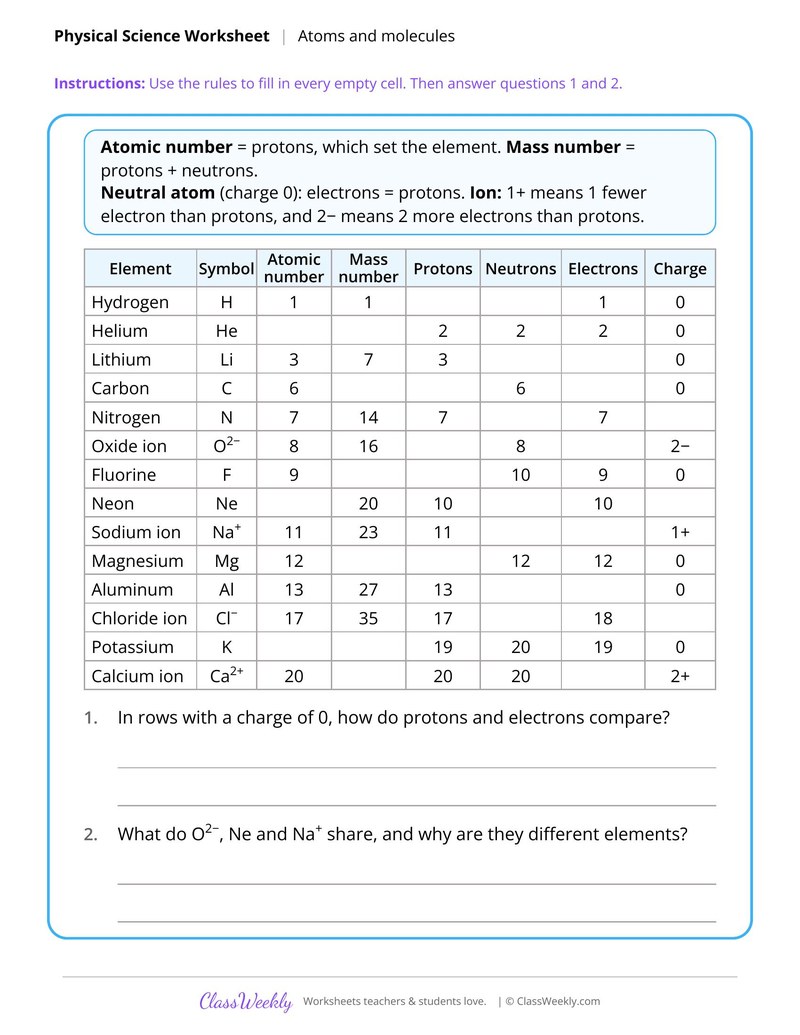
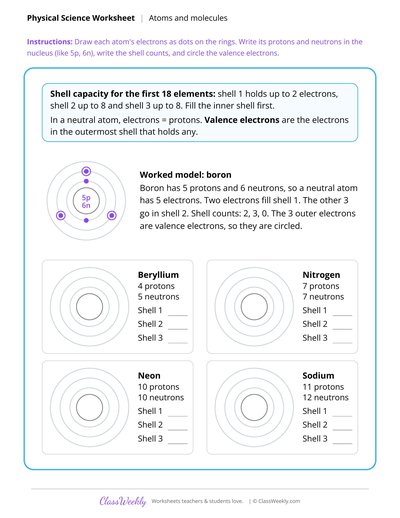
Start with the guided notes or the Bohr model sheet to set vocabulary. Then assign the data table, isotope and formula sheets as practice, and use the history and scale sheets for reading and discussion.
What students will practice
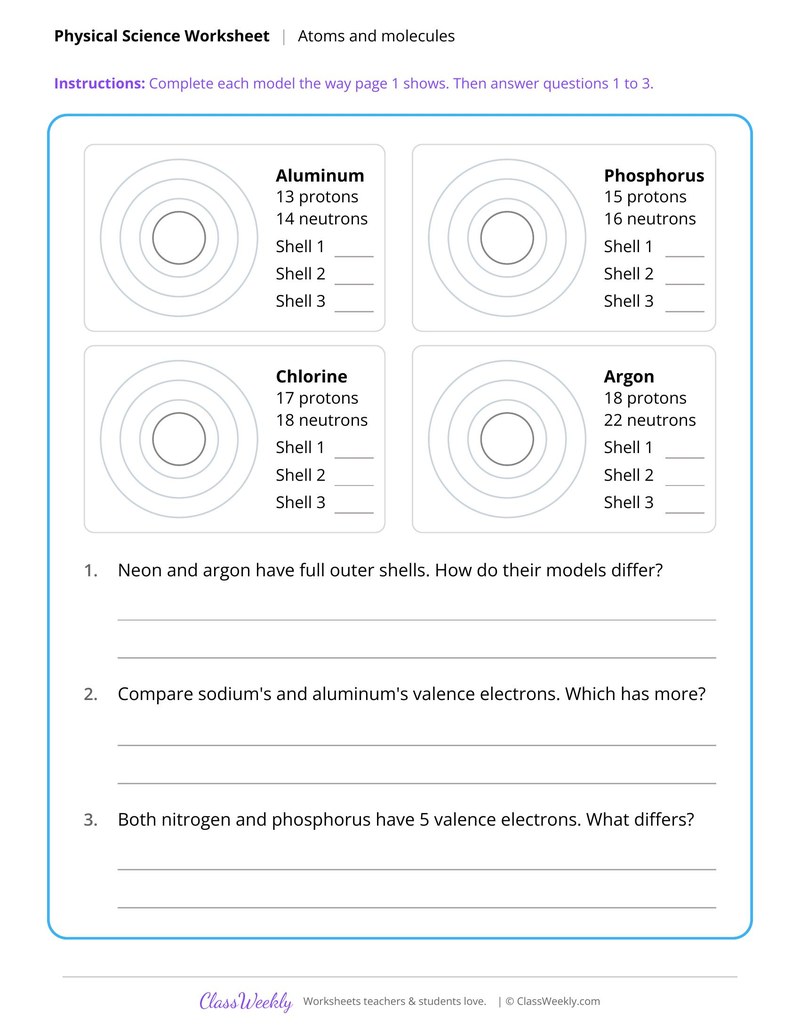
- Students will compare protons, neutrons and electrons by charge and location.
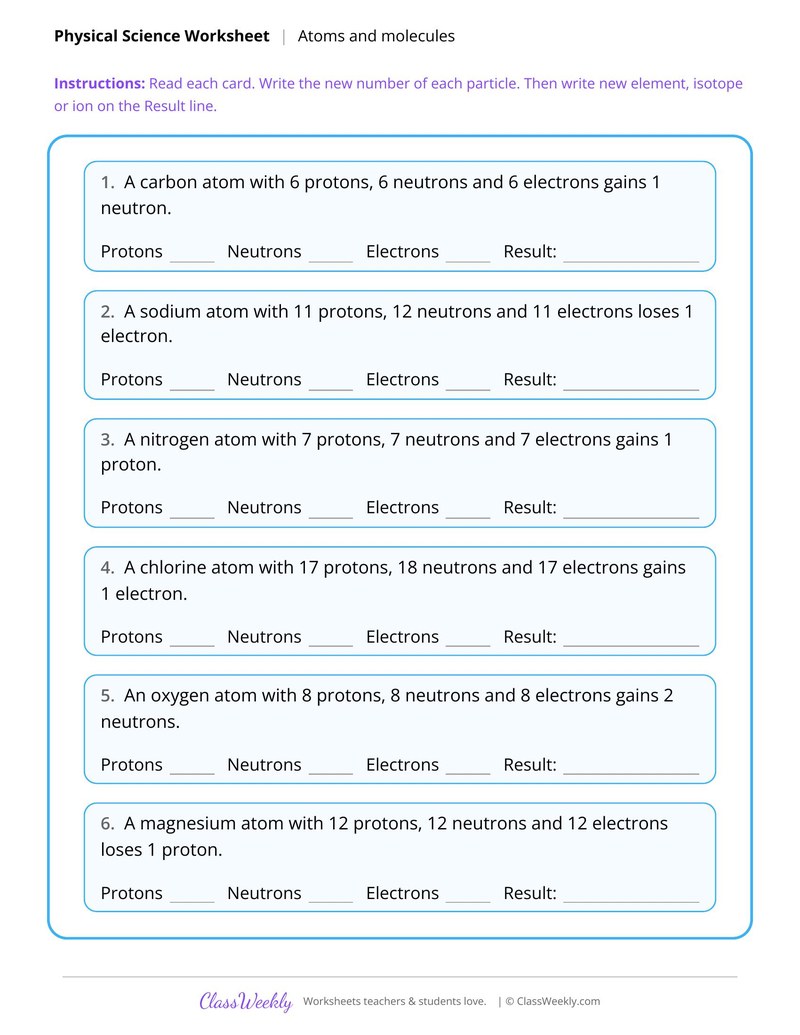
- Students will write the new number of each particle after a change.
- Students will label each result as a new element, an isotope or an ion.
Curriculum Links
Next Generation Science Standards
Science · 7th Grade
Find this in the curriculum
Browse the grade, subject, and topic this belongs to.
FAQ
How do I use this atoms and molecules worksheet?
⌄
Start with the guided notes or the Bohr model sheet to set vocabulary. Then assign the data table, isotope and formula sheets as practice, and use the history and scale sheets for reading and discussion.
What does this worksheet teach?
⌄
Read about particle charges, fill a comparison chart, then tell new elements, isotopes and ions apart. The directions on the page read: Read the text. Then complete the chart using the text. An answer key is included.
Can I use this atoms and molecules worksheet for homeschool or classroom?
⌄
Yes, both. We made it for 7th grade matter, and it works the same at home or at school. At home, a student can work through it alone and then go over it with you, which shows quickly what is solid and what needs another look. In class it works as independent practice, homework or a warm-up, and you can print one copy or a full set.
What is the difference between an element and a compound?
⌄
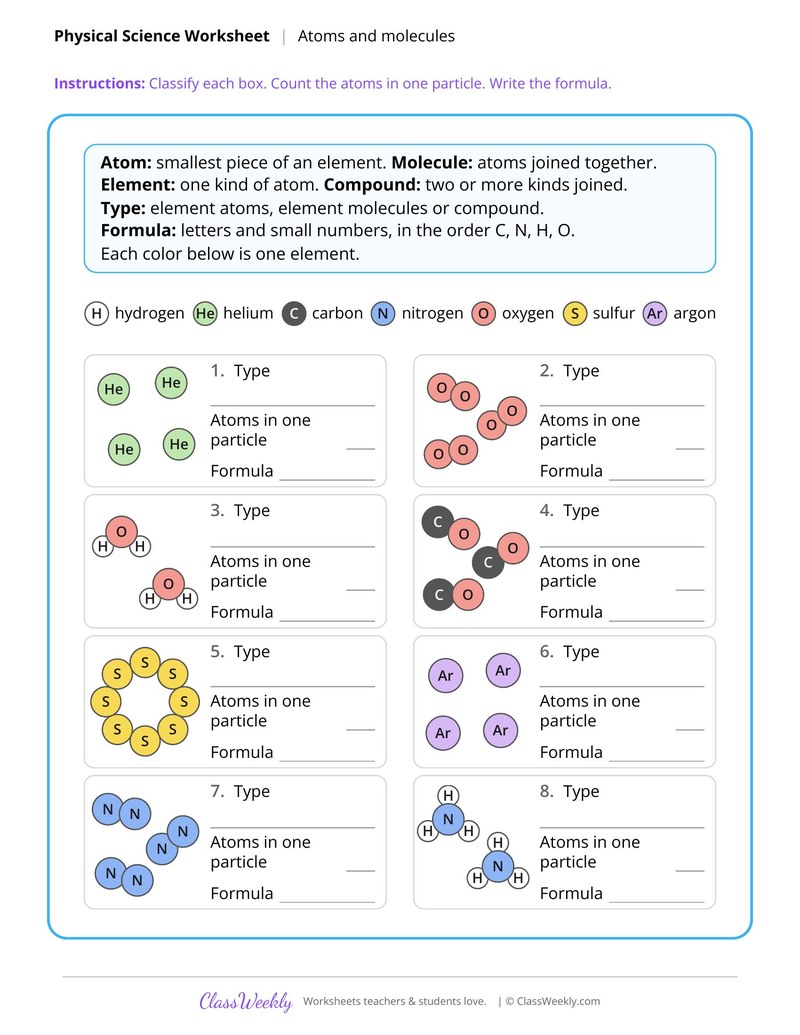
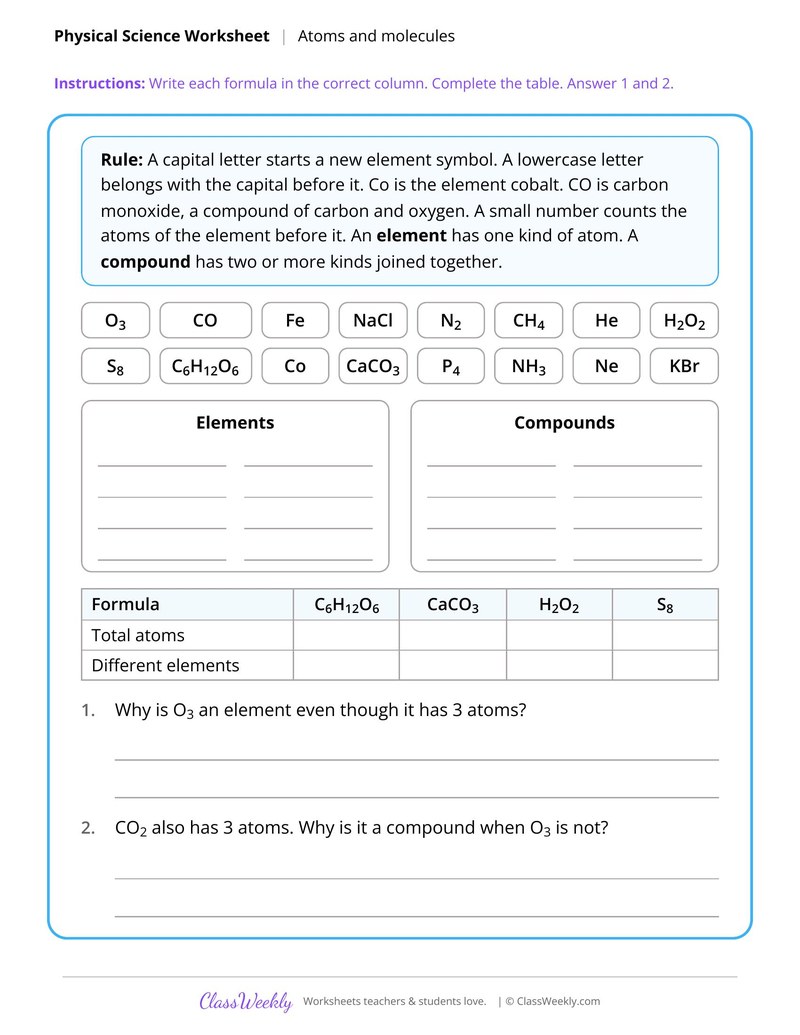
An element has one kind of atom and a compound has two or more kinds joined together. On the formula sheet, students sort formulas such as O3 and CO and count the total atoms in each.
How do students find protons, neutrons and electrons?
⌄
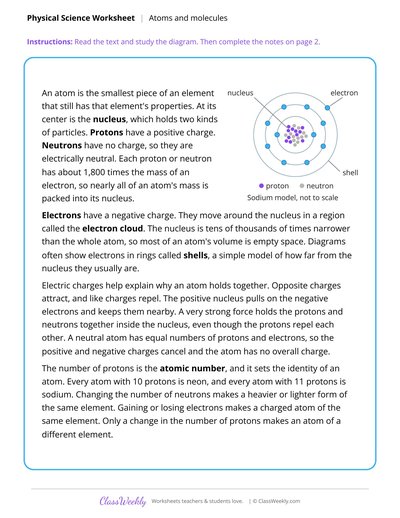
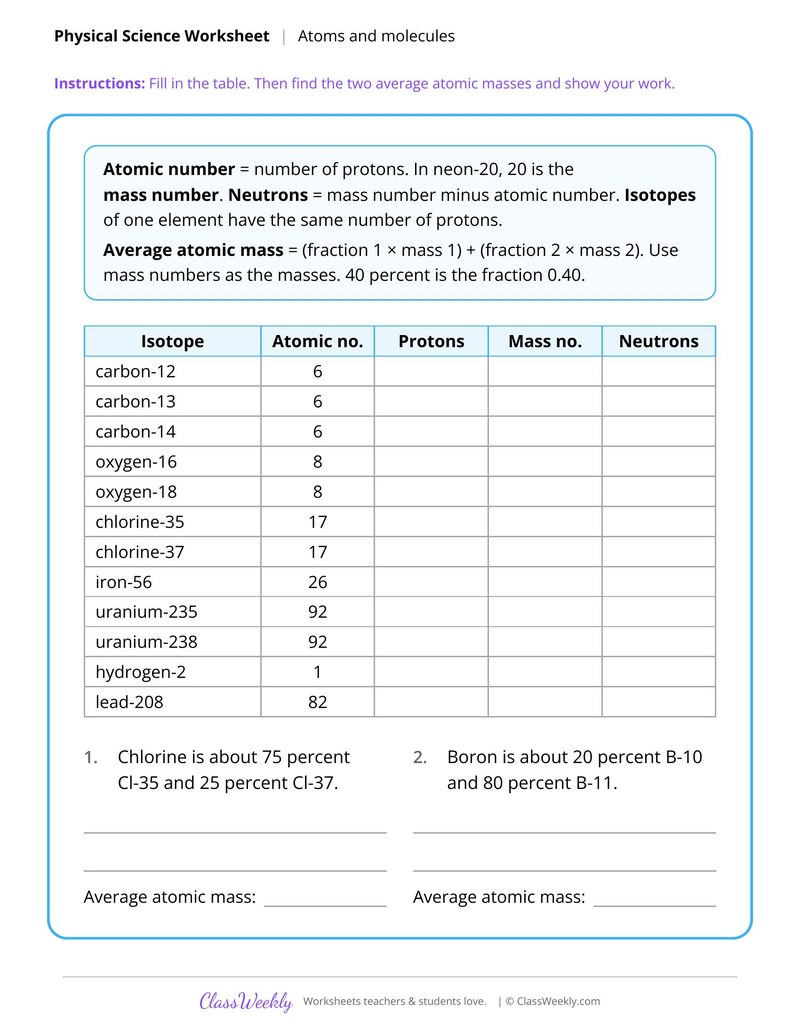
They use atomic number for protons and mass number minus atomic number for neutrons. In a neutral atom, electrons equal protons, and an ion's charge shows how many electrons were lost or gained.
Do the sheets cover how the model of the atom changed?
⌄
Yes. One sheet places Dalton, Thomson, Rutherford and later models on a timeline and links each change to the evidence that caused it.
How small is an atom on these worksheets?
⌄
A small atom is about 0.1 nanometer across, and a hair is about 0.1 millimeter wide. Students convert units and calculate how many atoms would span a hair.
Ratings & Reviews
No reviews yet. Be the first to share what you think.
Reviews are for ClassWeekly members.
Make a Request
Spotted something to fix, or want a worksheet we don't have yet? Tell us and we'll make it.
What is ClassWeekly?
ClassWeekly offers free worksheets and printable learning resources for kids, from preschool up. All worksheets are aligned to Common Core, NGSS, and C3 Framework standards and designed by educators. Become a member to access the full library and download unlimited PDFs.