Natural and Synthetic Materials
Written by Adi Ackerman, Head Teacher
"Natural and Synthetic Materials" is written for 6th Grade (Ages 11-12), and it covers NGSS MS-PS1-3. If your student is a year younger but already steady on matter, the page still works. You may just need to read the instructions out loud. And if they are older and physical and chemical changes never quite stuck, this is a short review rather than busywork.
2 pages in this set
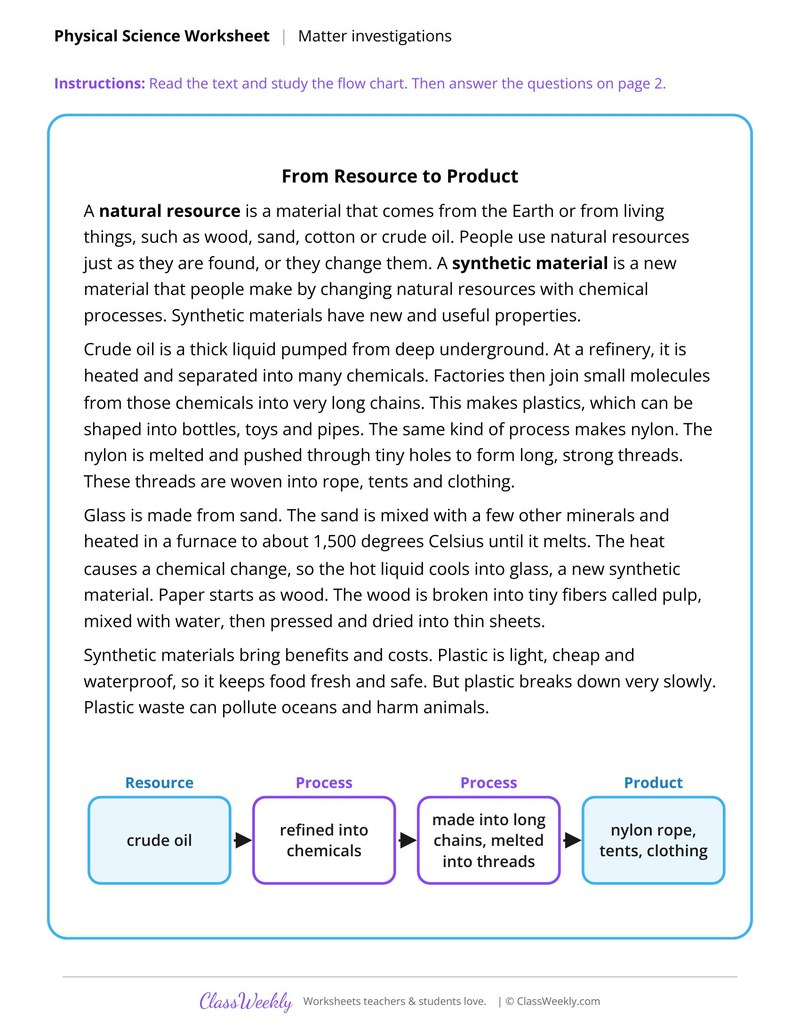
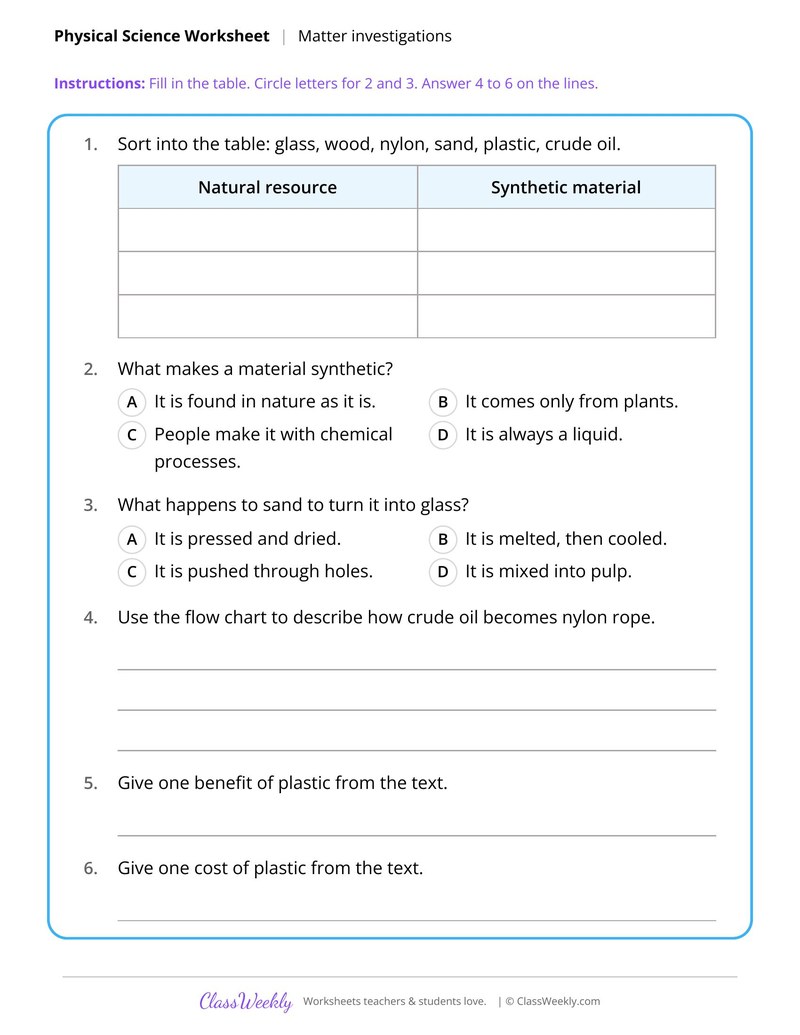
6th grade science worksheet: sort natural resources and synthetic materials, then trace how crude oil becomes nylon rope. Answer key included. Part of our physical and chemical changes matter collection. Aligned to NGSS standards.
How do I use this worksheet?
Begin with the sorting sheet, then ask students which of the five signs they would look for in a test. On the conservation sheet, have students explain the missing 2 g in the open cup before they fill in the atom table.
What students will practice
- Students will sort glass, wood, nylon, sand, plastic and crude oil as natural or synthetic.
- Students will use a flow chart to describe how crude oil becomes nylon rope.
- Students will give one benefit and one cost of plastic from the text.
Curriculum Links
Next Generation Science Standards
Science · 6th Grade
Find this in the curriculum
Browse the grade, subject, and topic this belongs to.
FAQ
How do I use this physical and chemical changes worksheet?
⌄
Begin with the sorting sheet, then ask students which of the five signs they would look for in a test. On the conservation sheet, have students explain the missing 2 g in the open cup before they fill in the atom table.
What does this worksheet teach?
⌄
Sort natural resources and synthetic materials, then trace how crude oil becomes nylon rope. The directions on the page read: Read the text and study the flow chart. Then answer the questions on page 2. An answer key is included.
Can I use this physical and chemical changes worksheet for homeschool or classroom?
⌄
Yes, both. We made it for 6th Grade matter, and the page works the same whether it lands on a kitchen table or a center rotation. At home, most families go through it together and talk the answers out loud, and that talking is where most of the learning happens with physical and chemical changes. In class it runs well as independent work while you pull a small group. Print one copy or thirty, whichever the day needs.
What are the signs of a chemical change?
⌄
The five common signs on these pages are a gas forming, a color change, light or heat given off, a precipitate forming and a new odor appearing. One sign alone does not prove a chemical change, and the best proof is a new substance.
What is the law of conservation of mass?
⌄
In a chemical reaction no atoms are made or destroyed, so the total mass stays the same. In a sealed container, the mass before equals the mass after. In an open container a gas can escape, so the scale shows less.
What makes a material synthetic?
⌄
A synthetic material is one that people make by changing natural resources with chemical processes. Plastic and nylon are made from crude oil, and glass is made from sand.
Ratings & Reviews
No reviews yet. Be the first to share what you think.
Reviews are for ClassWeekly members.
Make a Request
Spotted something to fix, or want a worksheet we don't have yet? Tell us and we'll make it.
What is ClassWeekly?
ClassWeekly offers free worksheets and printable learning resources for kids, from preschool up. All worksheets are aligned to Common Core, NGSS, and C3 Framework standards and designed by educators. Become a member to access the full library and download unlimited PDFs.