Melting and Boiling Points Table
Written by Adi Ackerman, Head Teacher
"Melting and Boiling Points Table" is written for 6th Grade (Ages 11-12). If your student is a year younger but already steady on matter, the page still works. You may just need to read the instructions out loud. And if they are older and states and properties of matter never quite stuck, this is a short review rather than busywork.
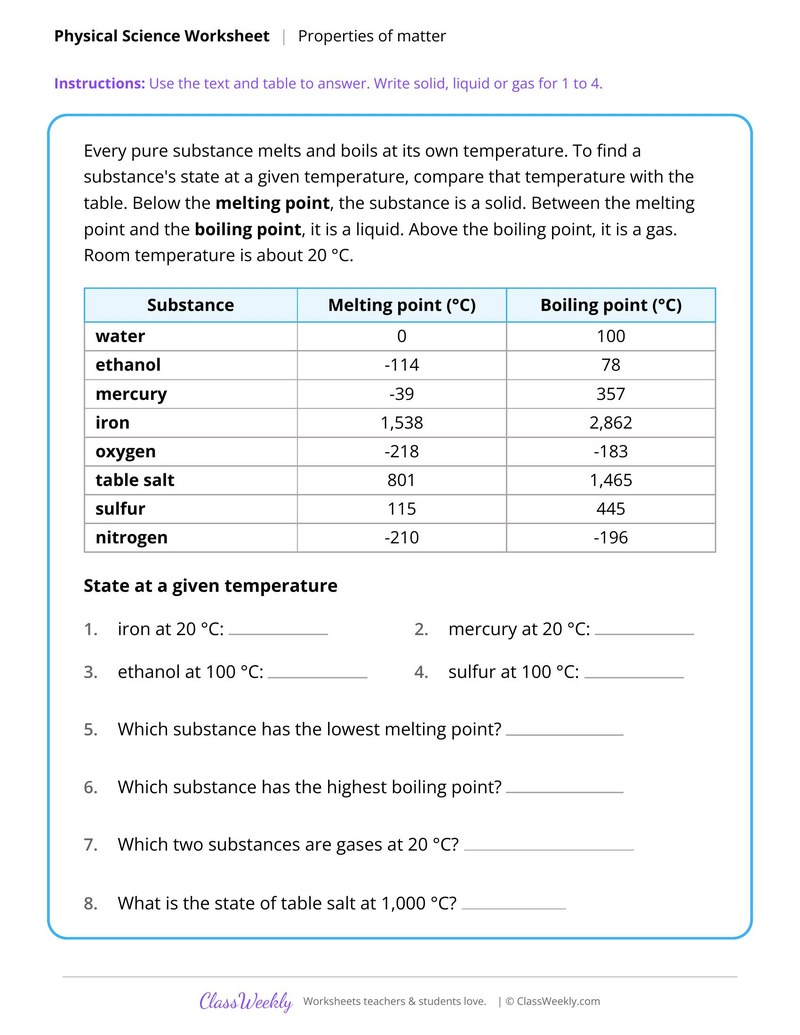
6th grade science worksheet: use a table of eight substances such as ethanol and iron to find a state at a given temperature. Answer key included. Part of our states and properties of matter collection.
How do I use this worksheet?
Have students say what the particles are doing at each part of the heating curve before labeling it. Save Physical Science Vocabulary for the end of a unit, since its terms reach past matter into forces, energy and waves.
What students will practice
- Students will compare a temperature with melting and boiling points to find a substance's state.
- Students will find the lowest melting point and highest boiling point in a table of eight substances.
- Students will identify which two substances in the table are gases at 20 °C.
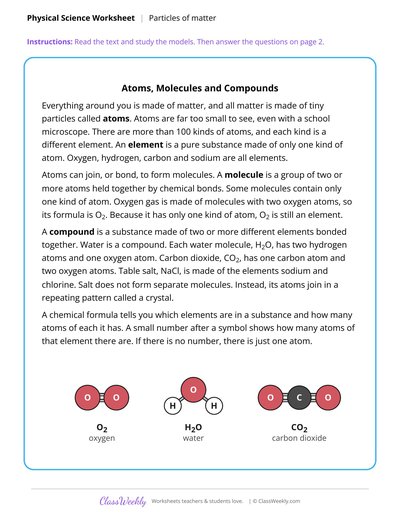
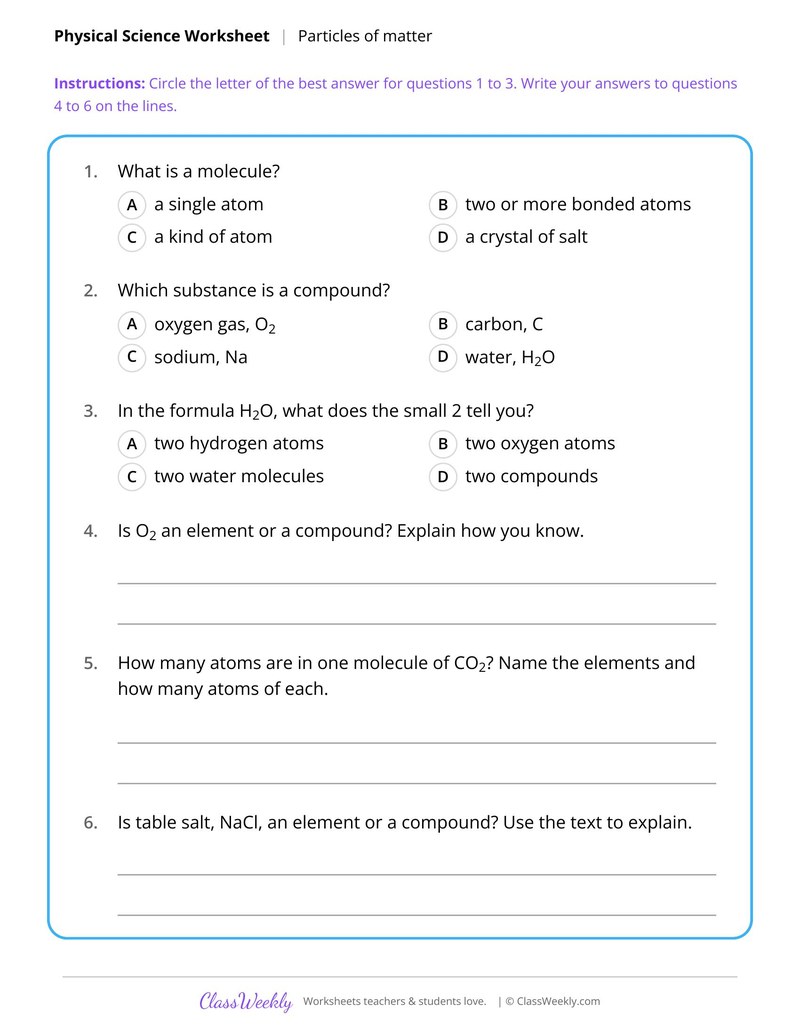
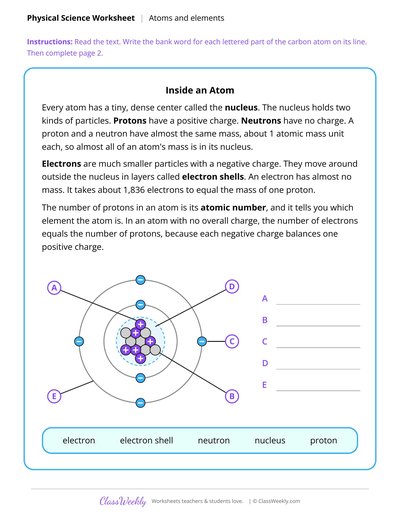
Curriculum Links
Find this in the curriculum
Browse the grade, subject, and topic this belongs to.
FAQ
How do I use this states and properties of matter worksheet?
⌄
Have students say what the particles are doing at each part of the heating curve before labeling it. Save Physical Science Vocabulary for the end of a unit, since its terms reach past matter into forces, energy and waves.
What does this worksheet teach?
⌄
Use a table of eight substances such as ethanol and iron to find a state at a given temperature. The directions on the page read: Use the text and table to answer. Write solid, liquid or gas for 1 to 4. An answer key is included.
Can I use this states and properties of matter worksheet for homeschool or classroom?
⌄
Yes, both. We made it for 6th Grade matter, and the page works the same whether it lands on a kitchen table or a center rotation. At home, most families go through it together and talk the answers out loud, and that talking is where most of the learning happens with states and properties of matter. In class it runs well as independent work while you pull a small group. Print one copy or thirty, whichever the day needs.
What happens to particles when a solid is heated?
⌄
Adding thermal energy makes the particles move faster. When a solid is heated enough, its particles break out of their fixed positions and it melts into a liquid.
Why is a heating curve flat in places?
⌄
On the flat parts, the water is changing state. The added energy pulls the particles apart instead of speeding them up, so the temperature stays the same until the change is finished.
How do you find a substance's state at a given temperature?
⌄
Compare the temperature with the melting and boiling points. Below the melting point the substance is a solid, between the two it is a liquid, and above the boiling point it is a gas.
What is the difference between sublimation and deposition?
⌄
Sublimation is a solid changing straight into a gas, as dry ice does. Deposition is the reverse, a gas turning straight into a solid, which is how frost forms on a cold window.
Ratings & Reviews
No reviews yet. Be the first to share what you think.
Reviews are for ClassWeekly members.
Make a Request
Spotted something to fix, or want a worksheet we don't have yet? Tell us and we'll make it.
What is ClassWeekly?
ClassWeekly offers free worksheets and printable learning resources for kids, from preschool up. All worksheets are aligned to Common Core, NGSS, and C3 Framework standards and designed by educators. Become a member to access the full library and download unlimited PDFs.