Latin Roots Duc, Fac, Pend and Vert
Written by Adi Ackerman, Head Teacher
"Latin Roots Duc, Fac, Pend and Vert" is written for 7th Grade (Ages 12-13), and it covers Common Core L.7.4.B. A 6th grader who is already steady here can use it too, and an older student can use it as a short review.
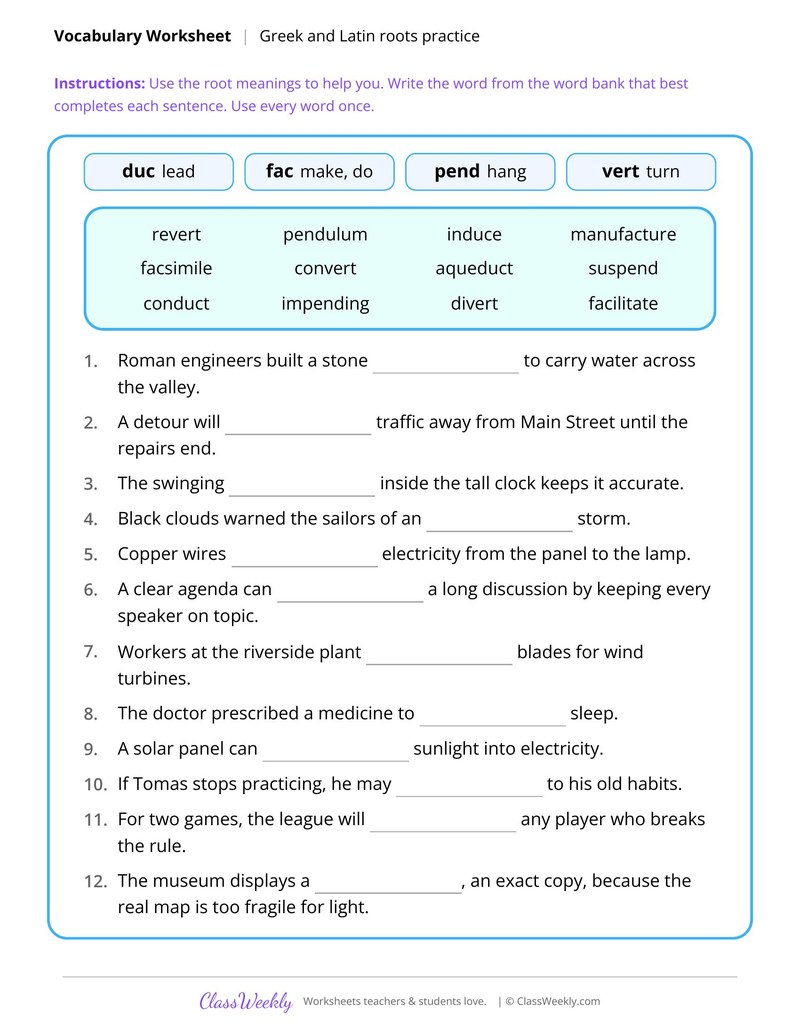
7th grade vocabulary worksheet: fill sentences with words from duc, fac, pend and vert, such as aqueduct and pendulum. Answer key included. Part of our Greek and Latin roots collection. Aligned to Common Core standards.
How do I use this worksheet?
Start with the root sort, then let students use the root boxes as a reference on the other sheets. Use the organizer after the practice sheets with words from current reading.
What students will practice
- Students will use the meanings of duc, fac, pend and vert to choose the right word.
- Students will complete sentences with words such as aqueduct, manufacture, impending and divert.
- Students will check each word choice against the context of its sentence.
Curriculum Links
Common Core State Standards
Language · 7th Grade
Standard: Use common, grade-appropriate Greek or Latin affixes and roots as clues to the meaning of a word (e.g., belligerent, bellicose, rebel).
View all L.7.4.B worksheets →Find this in the curriculum
Browse the grade, subject, and topic this belongs to.
FAQ
How do I use this Greek and Latin roots worksheet?
⌄
Start with the root sort, then let students use the root boxes as a reference on the other sheets. Use the organizer after the practice sheets with words from current reading.
What does this worksheet teach?
⌄
Fill sentences with words from duc, fac, pend and vert, such as aqueduct and pendulum. The directions on the page read: Use the root meanings to help you. Write the word from the word bank that best completes each sentence. Use every word once. An answer key is included.
Can I use this Greek and Latin roots worksheet for homeschool or classroom?
⌄
Yes, both. We made it for 7th grade Greek and Latin roots, and it works the same at home or at school. At home, a student can work through it alone and then go over it with you, which shows quickly what is solid and what needs another look. In class it works as independent practice, homework or a warm-up, and you can print one copy or a full set.
What does the root dict mean?
⌄
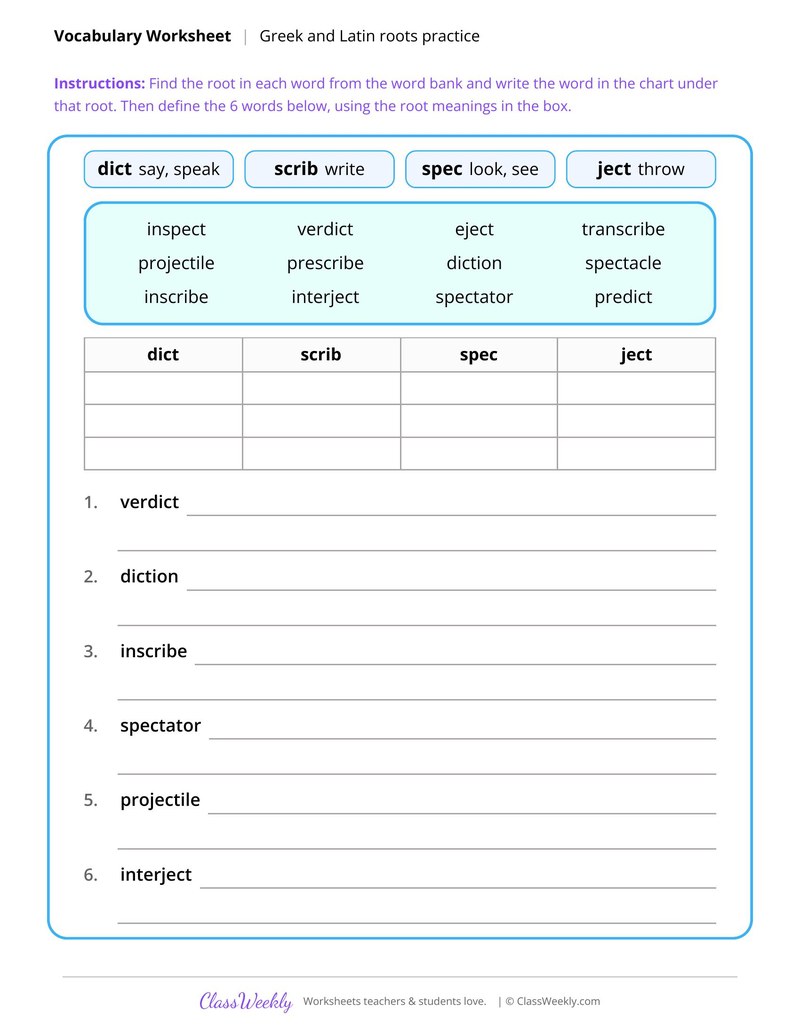
Dict means say or speak. Verdict, diction and predict all contain it. Latin Roots Dict, Scrib, Spec and Ject has students sort these words under dict with the other three roots.
How can roots help define a word?
⌄
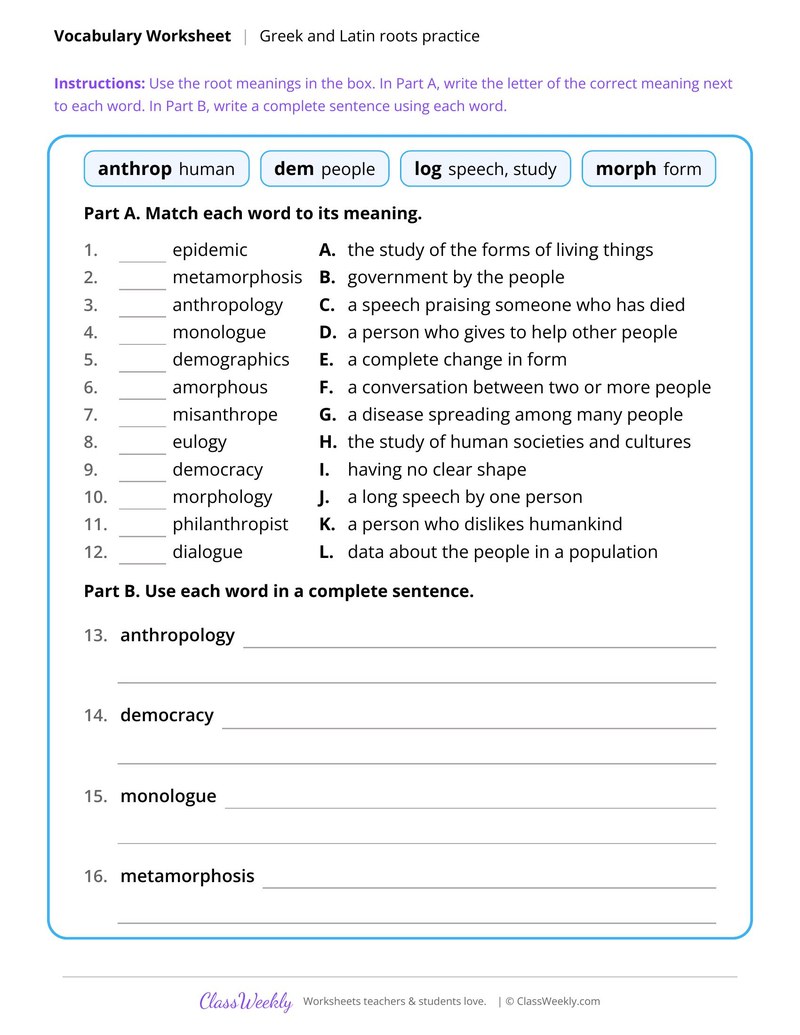
Students split a word into its parts and use the meaning of the root. Anthropology joins anthrop, meaning human, with log, meaning study, so it is the study of humans. Greek Roots Anthrop, Dem, Log and Morph gives the root meanings in a box on the page.
What is the Word Part Analysis Organizer?
⌄
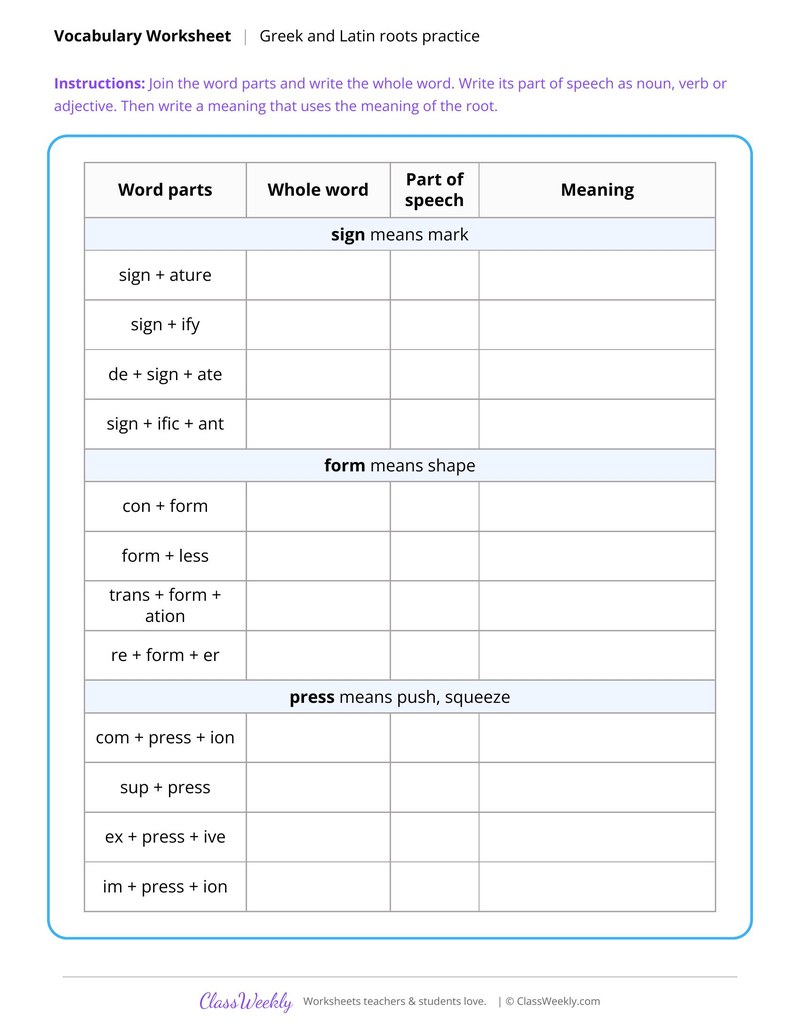
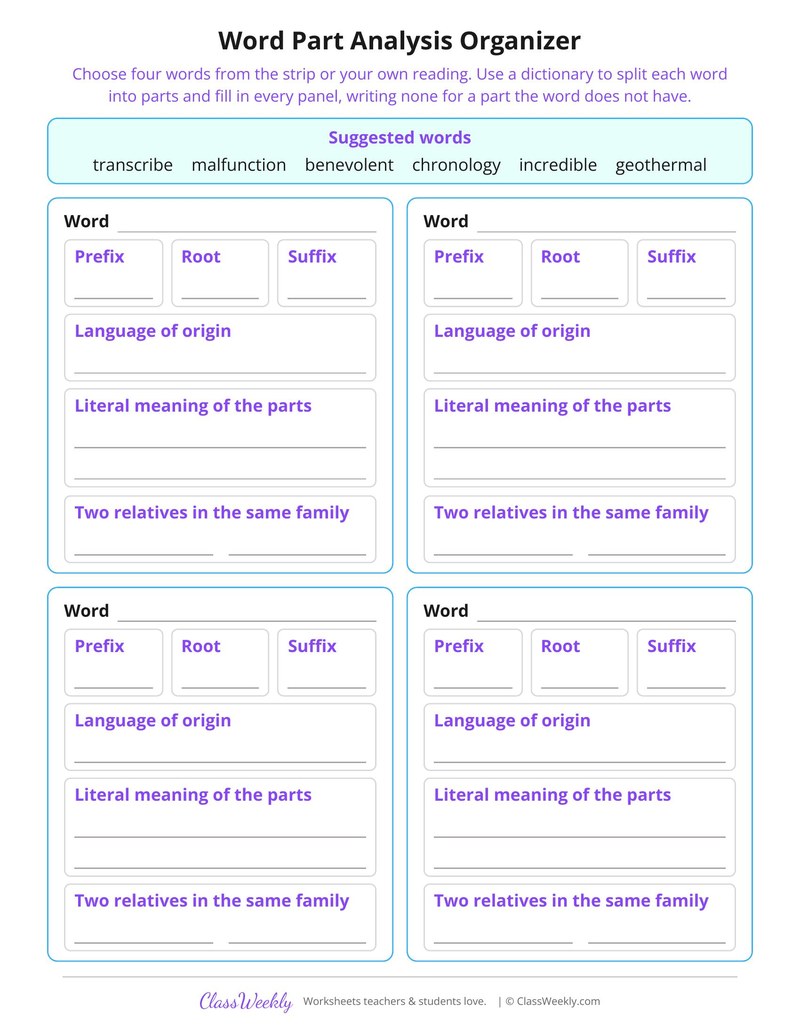
It is a recording sheet for four words chosen by the student. For each word students write the prefix, root and suffix, the language of origin, the literal meaning of the parts and two relatives in the same family. It has no answer key because the words vary.
Ratings & Reviews
No reviews yet. Be the first to share what you think.
Reviews are for ClassWeekly members.
Make a Request
Spotted something to fix, or want a worksheet we don't have yet? Tell us and we'll make it.
Worksheet Details
| Grade | 7th Grade |
| Subject | Vocabulary |
| Topic | Greek and Latin Roots |
| Standard | L.7.4.B |
| Pages | 1 page |
| Difficulty | Medium |
What is ClassWeekly?
ClassWeekly offers free worksheets and printable learning resources for kids, from preschool up. All worksheets are aligned to Common Core, NGSS, and C3 Framework standards and designed by educators. Become a member to access the full library and download unlimited PDFs.