
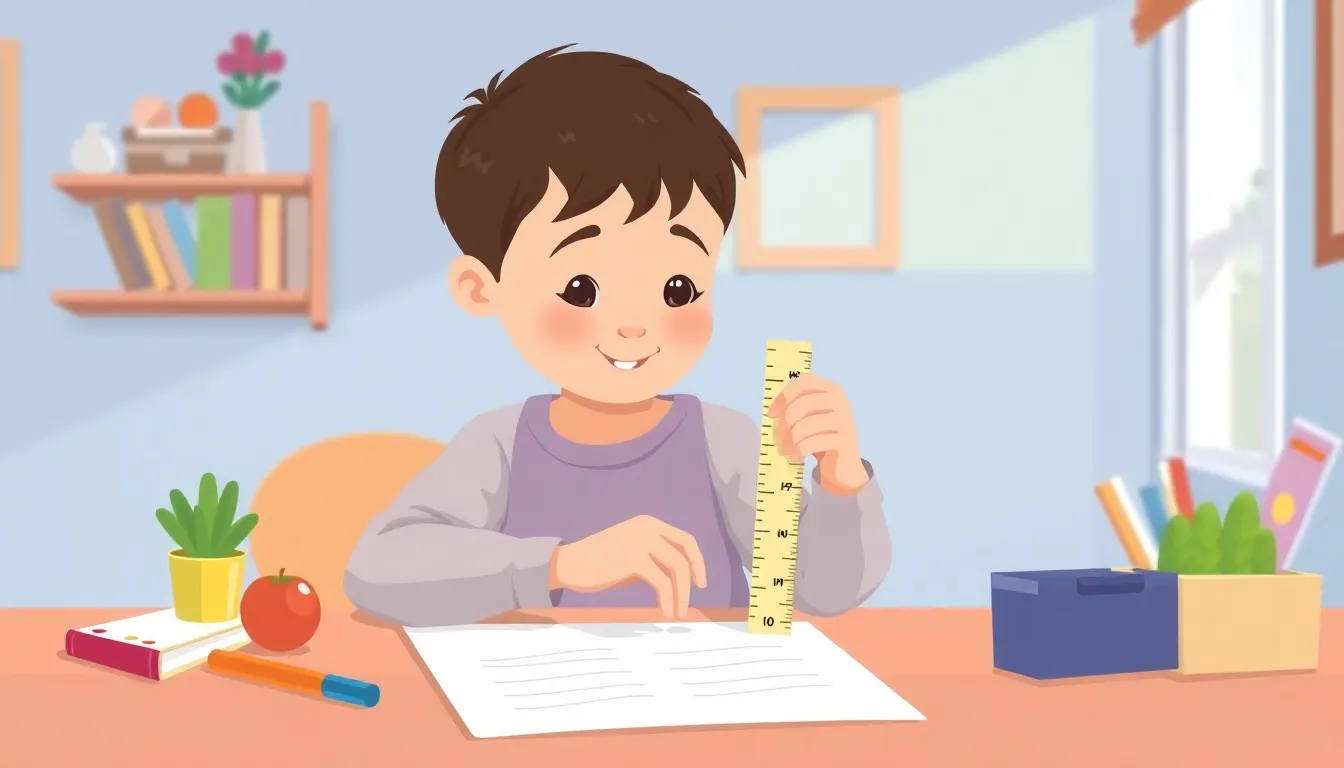
Homeschool 1st Grade Math: Teaching Measurement
Get 30 days of free worksheet downloads
Key Takeaways
- Comparing two objects directly, longer or shorter, taller or shorter, comes before any tool-based measuring.
- Non-standard units, like paper clips or blocks, build the core idea of measurement before rulers get involved.
- Reading a ruler correctly, starting at zero, is a specific skill that needs direct teaching, not just handing over a ruler.
- Comparing lengths by measuring, rather than just eyeballing, teaches kids why precise measurement actually matters.
Measurement is one of those first grade math topics that connects almost immediately to real life. Your child measuring the couch, comparing their height to a sibling's, or figuring out whose pencil is longer, all of that is measurement, happening naturally before a worksheet ever enters the picture.
That real-world connection is exactly why measurement is worth teaching hands-on rather than jumping straight into rulers and numbers. Kids need to build an intuitive sense of "longer," "shorter," and "how much" before precise units make any sense to them.
Here's how to build measurement skills step by step, from simple comparisons all the way to reading a ruler accurately.
Free 1st Grade Measurement Worksheets


What First Grade Measurement Covers
Measurement instruction typically opens with direct visual comparison: longer or shorter, taller or shorter. These questions don't require any tools at all, just two objects side by side and a child's ability to judge which one wins. This is foundational, because it establishes the whole idea that length is something that can be compared and ordered.
From there, kids move into ordering three objects by length, which adds a layer of complexity since it's no longer a simple either-or comparison. Your child has to hold three items in mind and place them correctly from shortest to longest or the reverse.
Measuring with non-standard units comes next, using something like paper clips, blocks, or crayons lined up along an object and counted. This step matters more than it might seem, since it isolates the core act of measuring, repeating a unit and counting, without the added complexity of reading a ruler's markings.
Once that concept is solid, kids move into measuring with standard units: inches and centimeters, using an actual ruler. Reading a ruler correctly is its own specific skill, since it requires starting at the zero mark rather than the edge of the ruler, a mistake nearly every first grader makes at first. Comparing lengths by measuring, in both inches and centimeters, wraps this up, asking kids to move beyond eyeballing and use their new tool to settle comparisons precisely.
How to Teach It Step by Step
Step 1: Compare two objects directly. Line up two household items, like two spoons or two books, and ask your child which is longer and which is shorter.
Step 2: Order three objects. Gather three items of different lengths and have your child arrange them from shortest to longest.
Step 3: Measure with non-standard units. Choose a small object, like paper clips, and have your child line them up end to end along a book or table edge, then count the total.
Step 4: Introduce the ruler and the zero mark. Show your child exactly where zero is on a ruler, and practice placing that mark at the very start of an object before reading the measurement.
Step 5: Measure in inches, then centimeters. Practice measuring the same objects with both units so your child sees that the same object gets a different number depending on the unit used.
Step 6: Compare by measuring, not guessing. Give your child two objects that look close in length and ask them to measure both to determine which is actually longer.
Common Mistakes and Activity Ideas
The single most common measurement mistake is starting the ruler at its physical edge instead of the zero mark, which throws off every measurement by however far the edge is from zero. Explicitly pointing out and practicing with the zero mark solves this quickly with repetition.
Another common issue is inconsistent technique with non-standard units, leaving gaps between paper clips or overlapping them, which throws off the count. Modeling careful, edge-to-edge placement a few times usually fixes this.
For a fun, low-pressure way to practice, try a household measuring hunt: give your child a ruler and a list of five things to measure around the house, like a shoe, a book, or a toy. Comparing family members' heights over time, marking a doorway and re-measuring every few months, is another activity kids tend to genuinely enjoy and remember.
FAQ
Do first graders need to learn both inches and centimeters? Many first grade programs introduce both, starting with whichever unit your family uses more often at home. The core skill, understanding what measurement means and how to use a ruler correctly, transfers between units once your child gets the concept.
Why start with non-standard units like paper clips instead of a ruler right away? Non-standard units strip away the complexity of reading ruler markings and let your child focus purely on the concept of measuring: lining up a unit repeatedly along an object and counting. Once that idea is solid, introducing standard units and a ruler goes much more smoothly.
My child starts measuring from the edge of the ruler instead of the zero mark. How do I fix that? This is one of the most common ruler mistakes at this age. Physically point to and label the zero mark before every measurement for a while, and have your child place their finger there before starting, until it becomes an automatic habit.
How do I make measurement practice feel less like a worksheet? Turn it into a real task: measure furniture, siblings, pets, or toys around the house and keep a running list. Comparing and re-measuring real objects tends to be far more engaging for a first grader than a printed page alone.
Keep Reading
Measurement is one of the easiest math topics to sneak into everyday life, so take advantage of that. Grab a ruler next time you're comparing toys or furniture, and the practice will barely feel like practice at all. 😊

Adi Ackerman
Head Teacher
Adi is the Head Teacher at ClassWeekly, with years of experience teaching elementary students. She designs our curriculum-aligned worksheets and writes practical guides for teachers and parents.
Keep Reading
Ready to download? Try ClassWeekly free for 30 days.
Unlimited worksheets for PreK through 5th grade. Cancel anytime.