
Homeschool 2nd Grade Math: Teaching Fractions
Get 30 days of free worksheet downloads
Key Takeaways
- Second grade fractions are about equal parts and basic notation, not calculations like adding or comparing fractions yet.
- Numerator and denominator need to be taught as 'how many parts I have' versus 'how many equal parts total,' not just as vocabulary words.
- Fractions of a group (like coloring 2 out of 5 apples) are just as important as fractions of a shape, and often get skipped.
- Matching a fraction to its word form (1/2 to 'one half') builds reading fluency that pure symbol practice misses.
Fractions can feel like an odd fit in second grade math, sandwiched between addition facts and multiplication tables. But this is exactly the right time to introduce them, while kids are still comfortable thinking in very concrete, visual terms.
We tell homeschool parents not to worry if fractions feel slower going than other math units. That's normal, and it's actually a good sign. Fractions ask kids to think about parts and wholes in a new way, and rushing this stage tends to create shaky number sense that shows up again in later grades.
Here's how the second grade fraction skills build on each other, and how to teach them without overwhelming your child.
Free 2nd Grade Fractions Worksheets


What 2nd Grade Fractions Actually Cover
The unit begins with equal parts worksheets, which ask kids to identify whether a shape has been divided into pieces of the same size. This sounds basic, but it's the entire foundation fractions rest on. A shape split into four unequal chunks can't be described with fourths in any meaningful way.
From there, kids learn the numerator and denominator of a fraction, the two numbers that make up a fraction and what each one tells you. Writing fractions from a numerator and denominator has kids build the fraction notation themselves once they understand what each number means. Reading fractions and matching to words connects the symbol 1/2 to the word "one half," and writing fractions in words asks kids to go the other direction, from symbol to written words.
Picture matching makes up a big chunk of this unit too: choosing the fraction that matches a picture, and the reverse, choosing the picture that matches a given fraction. Coloring exercises reinforce the same skill hands-on, coloring a shape to match a fraction like 3/4, and coloring parts of a group (say, 2 out of 6 stars) to match a fraction. Writing fractions to represent parts of a set closes the unit, asking kids to look at a group of objects and write the fraction that describes how many are colored, marked, or set apart.
How to Teach It Step by Step
Step 1: Start with sorting equal versus unequal parts. Show your child several shapes divided different ways, some into equal pieces, some not, and have them sort which ones show "fair" divisions. This builds the prerequisite understanding before any fraction language shows up.
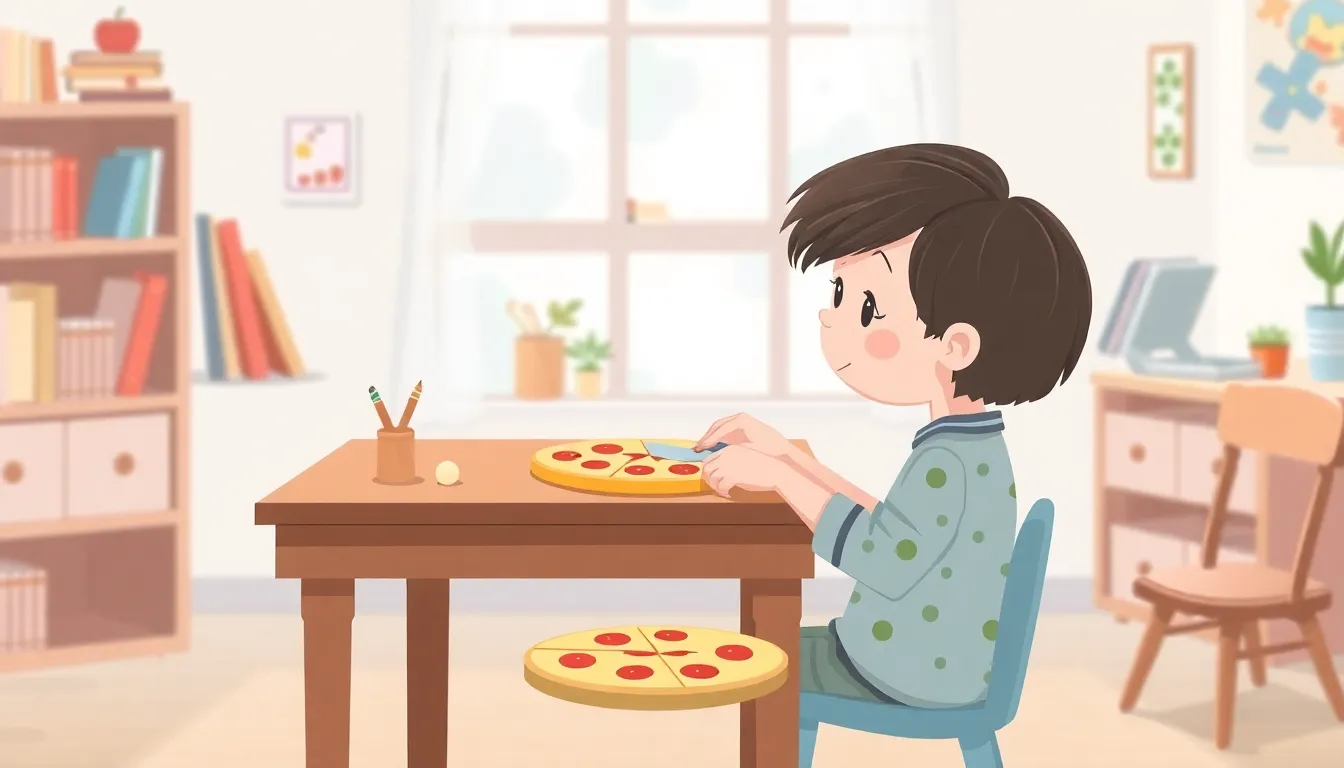
Step 2: Introduce numerator and denominator using food. Cut a sandwich or a pizza into equal pieces. Ask "into how many pieces did we cut it" (denominator) and "how many pieces are on your plate" (numerator). Real food makes the two numbers memorable.
Step 3: Practice reading fractions as words. Say fractions out loud together, 1/2 as "one half," 1/4 as "one fourth," 3/4 as "three fourths." Kids who can say a fraction correctly usually understand it better than kids who only see the symbol.
Step 4: Move to matching pictures and fractions. Use worksheets or hands on shapes where your child matches a colored-in picture to its fraction, and vice versa. This step confirms the concept is sinking in, not just the vocabulary.
Step 5: Shift from shapes to groups of objects. Once shape fractions feel solid, introduce fractions of a group, like 3 out of 8 crayons being red. This is a genuinely harder jump, so expect it to take longer than the shape work did.
Common Mistakes and How to Know They've Got It
The most common mistake is a child confusing the numerator and denominator, writing 4/3 when they mean 3/4. Reinforcing the "how many pieces total" versus "how many pieces we have" framing, every single time, usually clears this up faster than repeating the terms alone.
Fractions of a group are the other sticking point. Kids used to shape fractions sometimes try to count individual objects as if they were slices of one shape, losing track of the group as a whole. Slow down and physically separate the group into two piles, the "counted" pile and the "not counted" pile, before writing the fraction.
You'll know your child has mastered second grade fractions when they can look at any equally divided shape or group and correctly state the fraction without prompting, and when they can also go the other way, drawing or coloring a picture to match a fraction you give them out loud.
FAQ
Why does "equal parts" matter so much before teaching actual fractions? If a shape is divided into four pieces but they're not the same size, the fraction 1/4 doesn't accurately describe any one piece. Kids need to internalize that fractions only work when the parts are equal before the numbers on top and bottom mean anything real.
What's an easy way to explain numerator and denominator? Try this: the denominator (bottom number) answers "into how many equal pieces was this cut," and the numerator (top number) answers "how many of those pieces are we talking about." Practice saying both parts out loud with real objects, like a pizza cut into 4 slices with 3 slices shown.
My child understands fractions of a shape but gets confused with fractions of a group, like 2 out of 5 apples. Why? Fractions of a group ask kids to treat separate objects as one unit, which is a bigger cognitive leap than dividing a single shape like a pizza or a rectangle. Slow down here and use real countable objects, like buttons or crayons, sorted into a "colored" pile and a "not colored" pile.
Do 2nd graders need to compare or add fractions yet? No, not typically at this stage. Second grade fraction work focuses on understanding what a fraction represents: equal parts, reading and writing fraction notation, and matching fractions to pictures and words. Comparing and operating on fractions comes later, once this foundation is solid.
Keep Reading
Fractions ask your child to think about the world in pieces and wholes, which is a genuinely new kind of math thinking. Give it the slow, hands on approach it deserves, and the numerator and denominator will start to feel like old friends instead of strange new vocabulary. 😊

Adi Ackerman
Head Teacher
Adi is the Head Teacher at ClassWeekly, with years of experience teaching elementary students. She designs our curriculum-aligned worksheets and writes practical guides for teachers and parents.
Keep Reading
Ready to download? Try ClassWeekly free for 30 days.
Unlimited worksheets for PreK through 5th grade. Cancel anytime.