Map the Plot of a Short Story
Written by Adi Ackerman, Head Teacher
"Map the Plot of a Short Story" is written for 6th Grade (Ages 11-12), and it covers Common Core RL.6.3. If your student is a year younger but already steady on story elements, the page still works. You may just need to read the instructions out loud. And if they are older and character, setting & plot never quite stuck, this is a short review rather than busywork.
2 pages in this set
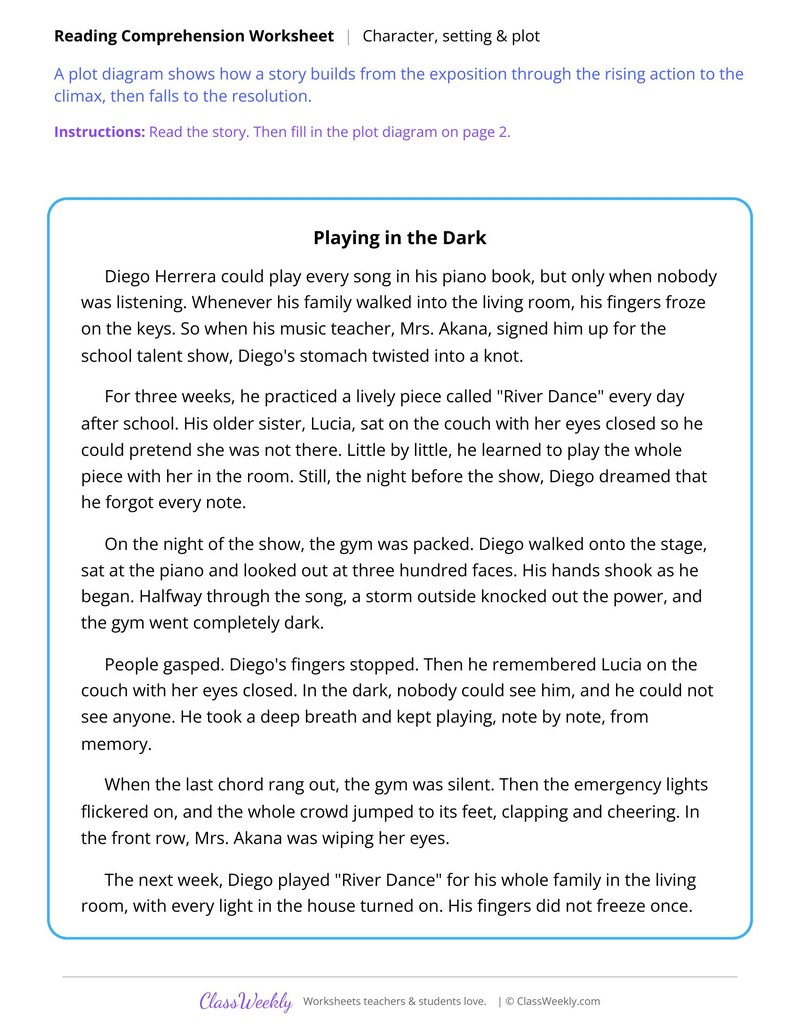
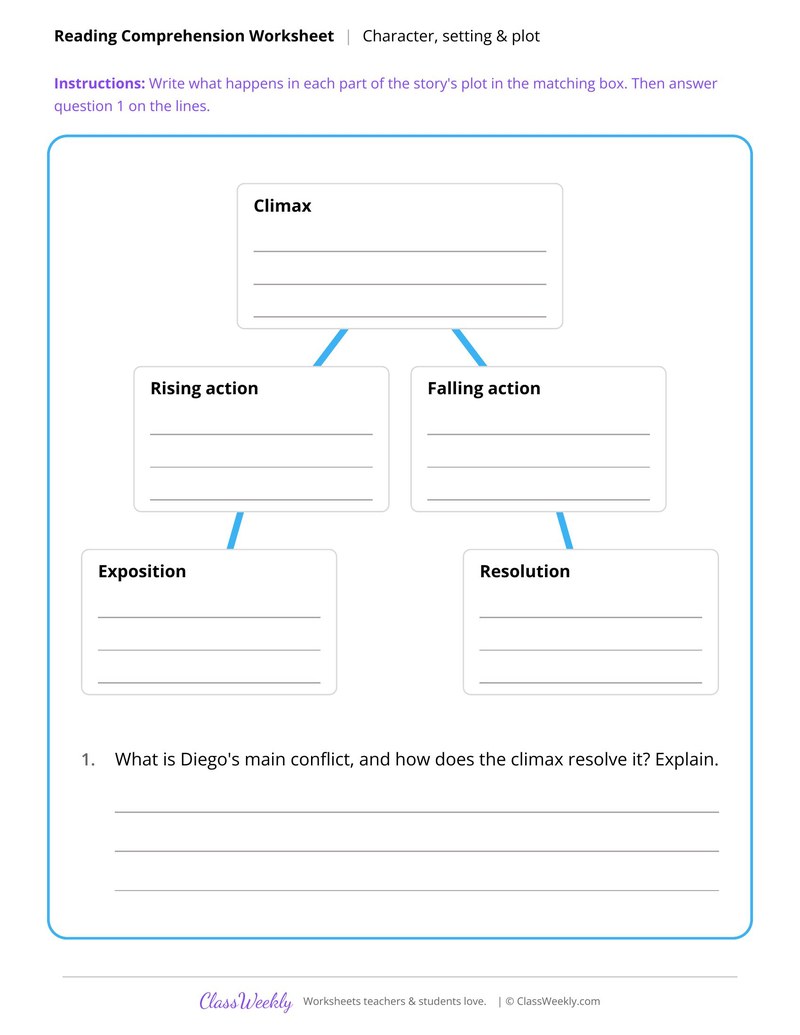
6th grade reading worksheet: fill a 5-part plot diagram for Playing in the Dark, a story about Diego at a talent show. Answer key included. Part of our character, setting & plot story elements collection. Aligned to Common Core standards.
How do I use this worksheet?
Start with Exposition, Climax and Resolution so students learn the five parts, then map Playing in the Dark. Use the conflict scenes for quick partner talk.
What students will practice
- Students will read Playing in the Dark, a story about a boy who freezes at the piano.
- Students will fill in the exposition, rising action, climax, falling action and resolution.
- Students will explain Diego's main conflict and how the climax resolves it.
Curriculum Links
Common Core State Standards
Reading: Literature · 6th Grade
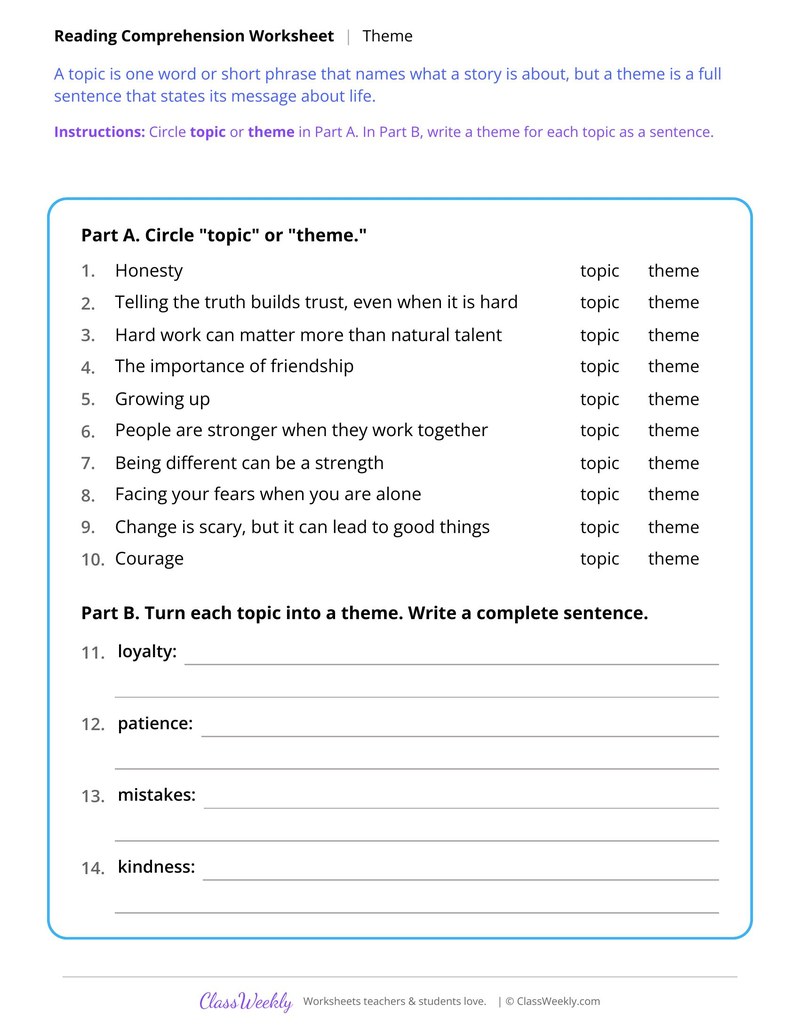
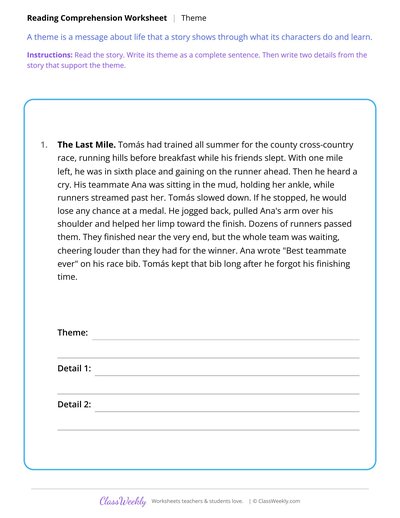
Standard: Describe how a particular story's or drama's plot unfolds in a series of episodes as well as how the characters respond or change as the plot moves toward a resolution.
View all RL.6.3 worksheets →Find this in the curriculum
Browse the grade, subject, and topic this belongs to.
FAQ
How do I use this character, setting & plot worksheet?
⌄
Start with Exposition, Climax and Resolution so students learn the five parts, then map Playing in the Dark. Use the conflict scenes for quick partner talk.
What does this worksheet teach?
⌄
Fill a 5-part plot diagram for Playing in the Dark, a story about Diego at a talent show. A plot diagram shows how a story builds from the exposition through the rising action to the climax, then falls to the resolution. The directions on the page read: Read the story. Then fill in the plot diagram on page 2. An answer key is included.
Can I use this character, setting & plot worksheet for homeschool or classroom?
⌄
Yes, both. We made it for 6th Grade story elements, and the page works the same whether it lands on a kitchen table or a center rotation. At home, most families go through it together and talk the answers out loud, and that talking is where most of the learning happens with character, setting & plot. In class it runs well as independent work while you pull a small group. Print one copy or thirty, whichever the day needs.
What is the climax of a story?
⌄
It is the turning point, where the main conflict comes to a head. In Playing in the Dark, the climax is when Diego keeps playing the piano from memory after the power goes out.
What is the difference between falling action and resolution?
⌄
Falling action is what happens right after the climax, and the resolution is how the story ends. In The Final Word, Marcus gets the trophy, then decides to enter the county spelling bee.
What is character versus self conflict?
⌄
It is a struggle inside a character's own mind. In Types of Conflict in Short Scenes, Owen finds a twenty-dollar bill and is unable to decide whether to keep it.
Ratings & Reviews
No reviews yet. Be the first to share what you think.
Reviews are for ClassWeekly members.
Make a Request
Spotted something to fix, or want a worksheet we don't have yet? Tell us and we'll make it.
Worksheet Details
| Grade | 6th Grade |
| Subject | Reading |
| Topic | Story Elements |
| Standard | RL.6.3 |
| Pages | 2 pages |
| Difficulty | Medium |
What is ClassWeekly?
ClassWeekly offers free worksheets and printable learning resources for kids, from preschool up. All worksheets are aligned to Common Core, NGSS, and C3 Framework standards and designed by educators. Become a member to access the full library and download unlimited PDFs.