Eclipse Seasons on a Yearly Timeline
Written by Adi Ackerman, Head Teacher
"Eclipse Seasons on a Yearly Timeline" is written for 8th Grade (Ages 13-14), and it covers NGSS MS-ESS1-1. A 7th grader who is already steady on Earth and space can use it too, and an older student can use it as a short review.
2 pages in this set
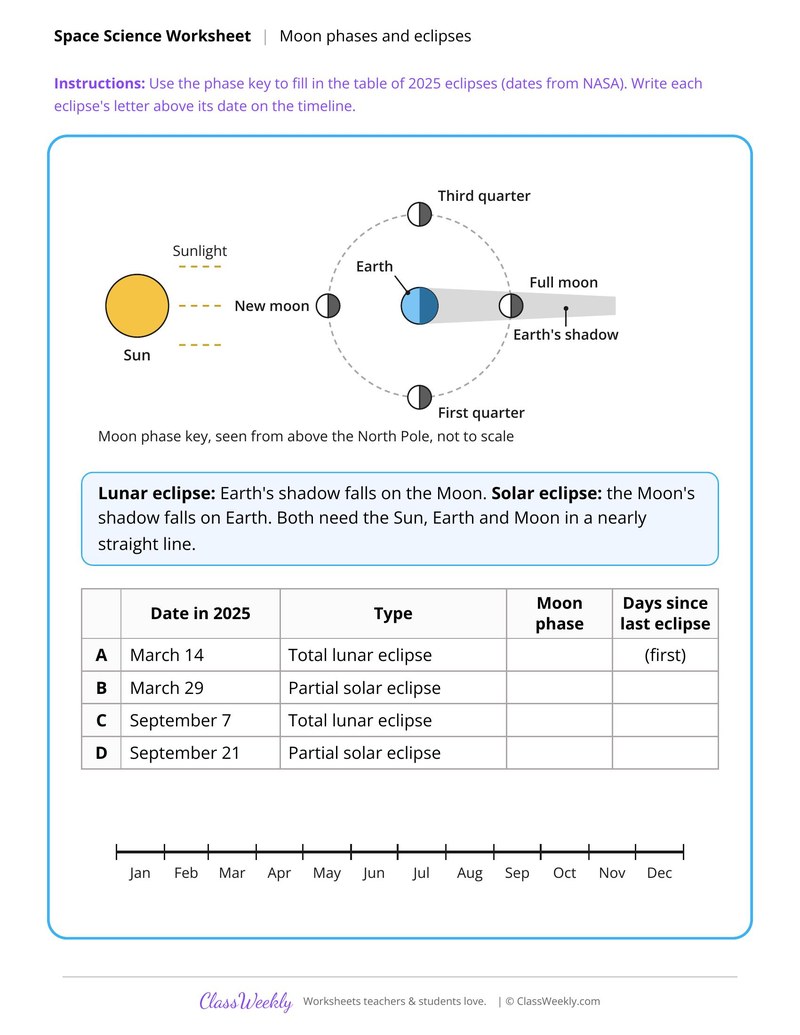
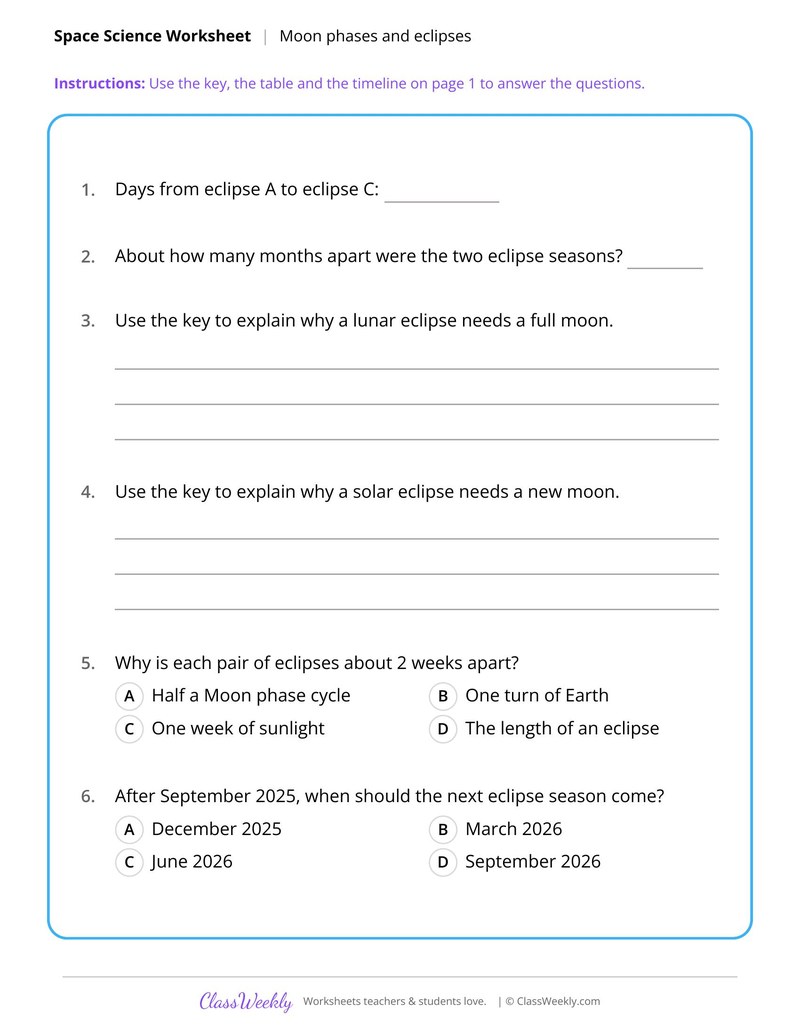
8th grade science worksheet: place four 2025 eclipses on a timeline and match each to a full or new moon phase. Answer key included. Part of our moon phases, eclipses and seasons earth and space collection. Aligned to NGSS standards.
How do I use this worksheet?
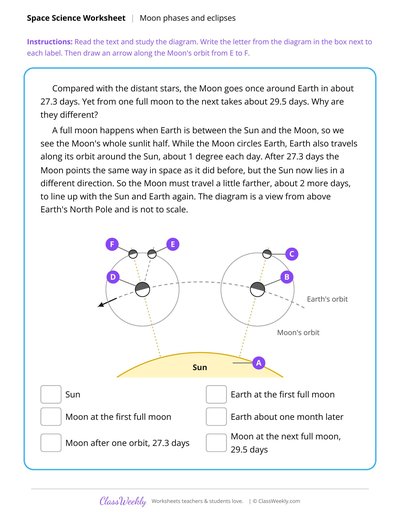
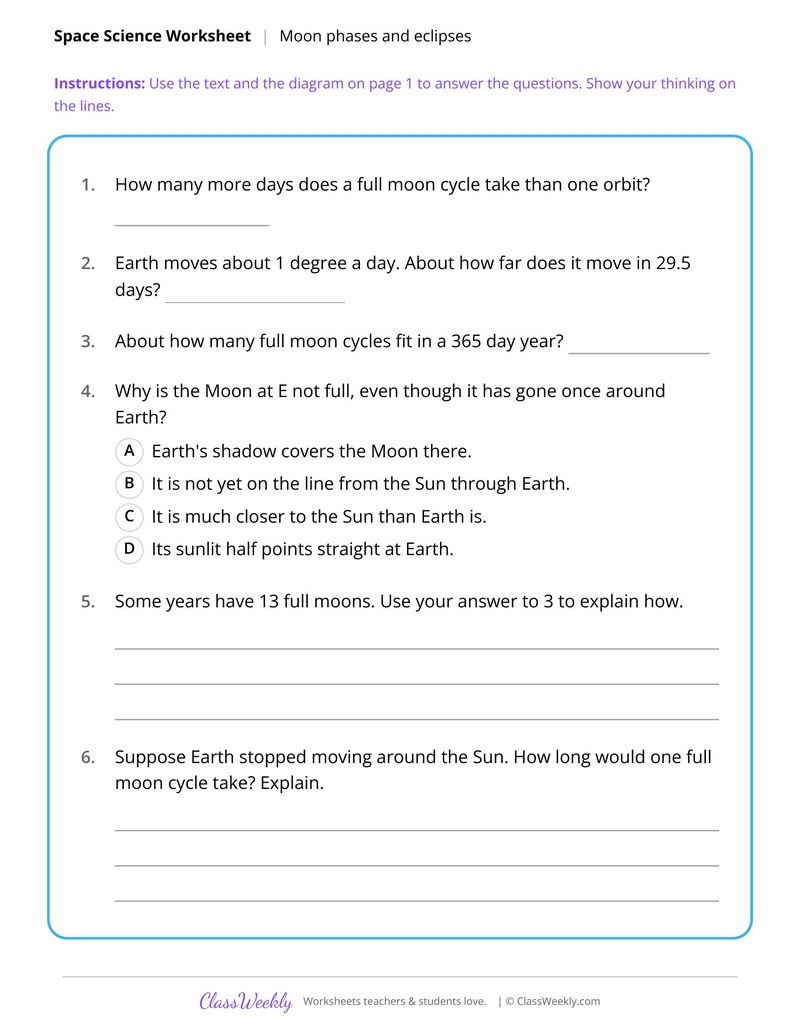
Start with the lunar month diagram, then the tilted orbit sheet. Use the 2025 timeline to test the model, and add the pendulum sheet as evidence of rotation.
What students will practice
- Students will match each 2025 eclipse to its Moon phase using a key.
- Students will place the eclipses on a timeline and count the days between them.
- Students will explain why a lunar eclipse needs a full moon.
Curriculum Links
Next Generation Science Standards
Science · 8th Grade
Find this in the curriculum
Browse the grade, subject, and topic this belongs to.
FAQ
How do I use this moon phases, eclipses and seasons worksheet?
⌄
Start with the lunar month diagram, then the tilted orbit sheet. Use the 2025 timeline to test the model, and add the pendulum sheet as evidence of rotation.
What does this worksheet teach?
⌄
Place four 2025 eclipses on a timeline and match each to a full or new moon phase. The directions on the page read: Use the phase key to fill in the table of 2025 eclipses (dates from NASA). Write each eclipse's letter above its date on the timeline. An answer key is included.
Can I use this moon phases, eclipses and seasons worksheet for homeschool or classroom?
⌄
Yes, both. We made it for 8th grade Earth and space, and it works the same at home or at school. At home, a student can work through it alone and then go over it with you, which shows quickly what is solid and what needs another look. In class it works as independent practice, homework or a warm-up, and you can print one copy or a full set.
What is an eclipse season?
⌄
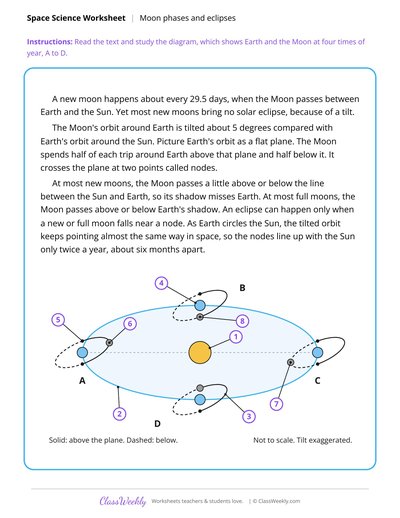
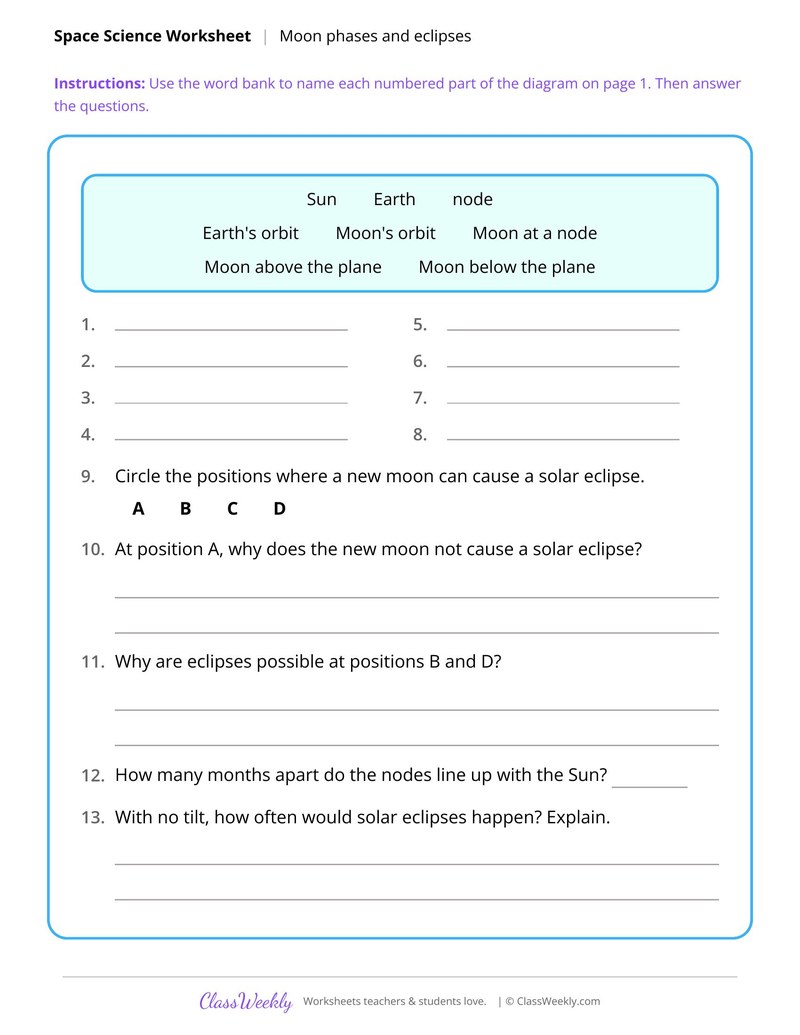
An eclipse season is a stretch of a few weeks when the Moon's nodes line up with the Sun, so both solar and lunar eclipses can happen. In 2025, a lunar eclipse on March 14 was followed by a solar eclipse on March 29. The timeline sheet places all four 2025 eclipses.
Why does a lunar eclipse need a full moon?
⌄
A lunar eclipse happens when Earth's shadow falls on the Moon. That requires Earth to be between the Sun and the Moon, which is the full moon position. A solar eclipse needs a new moon instead.
How does a Foucault pendulum show that Earth spins?
⌄
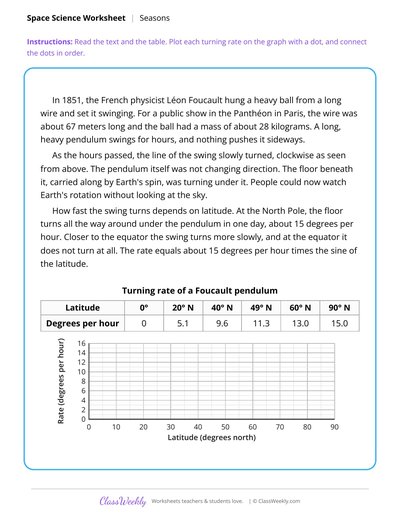
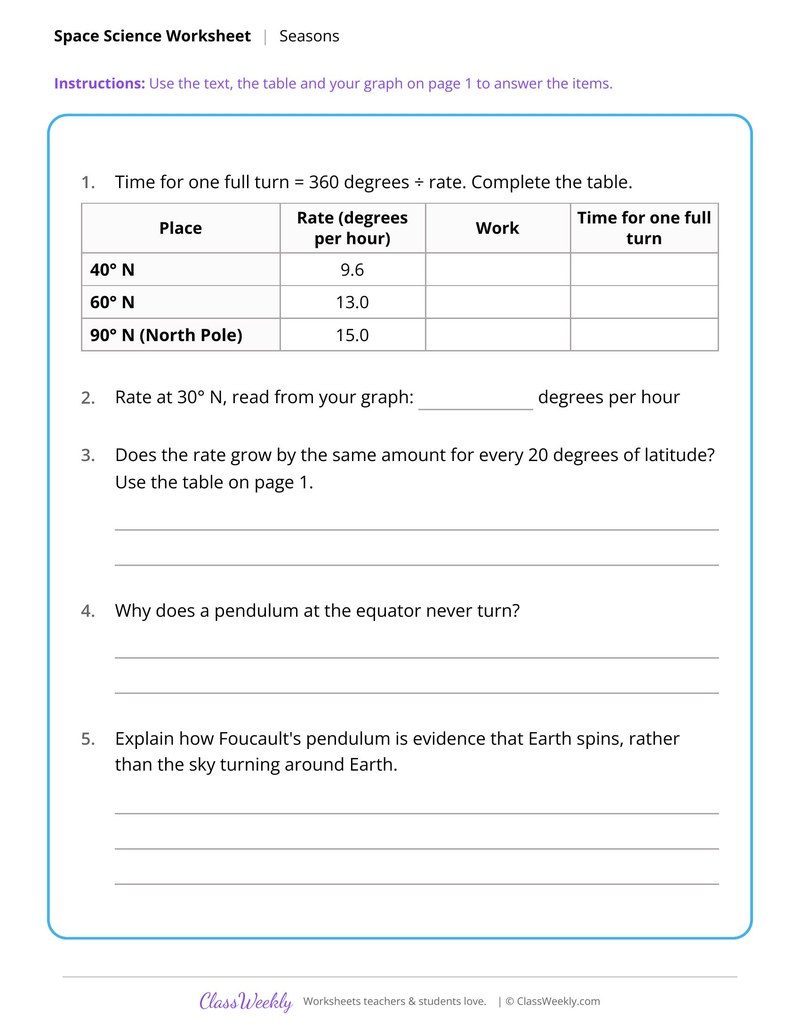
The pendulum keeps swinging in the same direction, but the floor under it turns with Earth. At the North Pole the swing turns about 15 degrees per hour, and at the equator it does not turn. The pendulum sheet graphs the rate by latitude.
Ratings & Reviews
No reviews yet. Be the first to share what you think.
Reviews are for ClassWeekly members.
Make a Request
Spotted something to fix, or want a worksheet we don't have yet? Tell us and we'll make it.
Worksheet Details
| Grade | 8th Grade |
| Subject | Science |
| Topic | Earth and Space |
| Standard | MS-ESS1-1 |
| Pages | 2 pages |
| Difficulty | Medium |
What is ClassWeekly?
ClassWeekly offers free worksheets and printable learning resources for kids, from preschool up. All worksheets are aligned to Common Core, NGSS, and C3 Framework standards and designed by educators. Become a member to access the full library and download unlimited PDFs.