Jupiter's Moons and the Pull of Gravity
Written by Adi Ackerman, Head Teacher
"Jupiter's Moons and the Pull of Gravity" is written for 8th Grade (Ages 13-14), and it covers NGSS MS-ESS1-2. A 7th grader who is already steady on Earth and space can use it too, and an older student can use it as a short review.
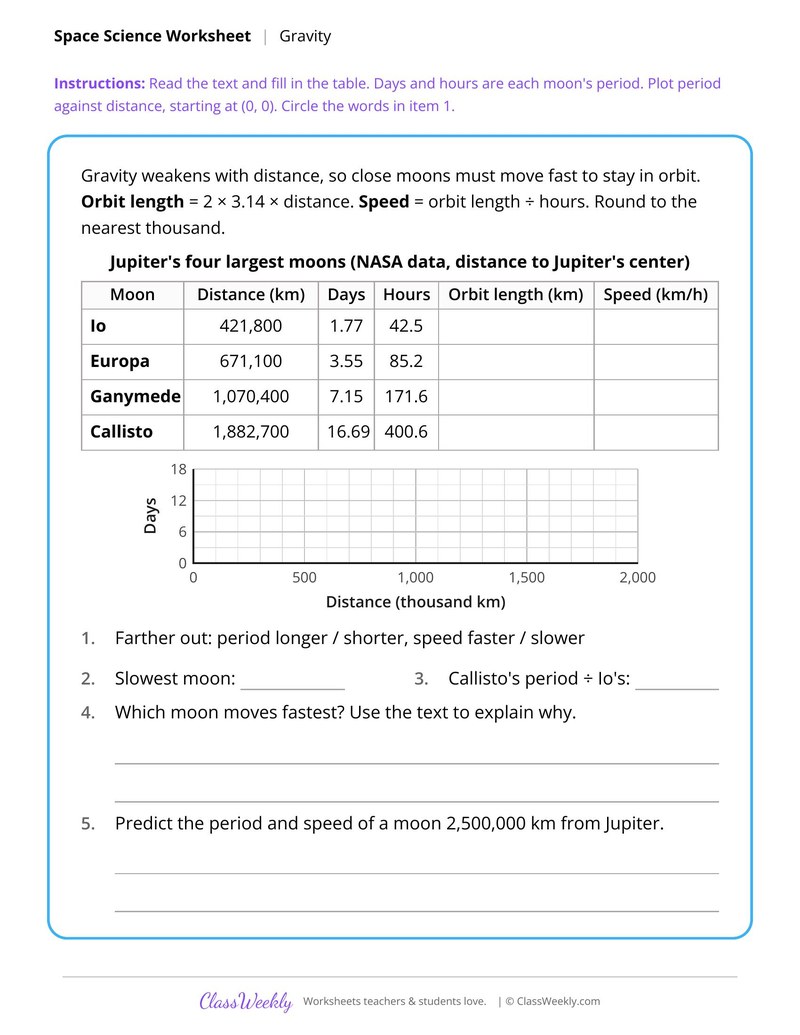
8th grade science worksheet: find orbit lengths and speeds for Io, Europa, Ganymede and Callisto and graph period against distance. Answer key included. Part of our solar system and beyond earth and space collection. Aligned to NGSS standards.
How do I use this worksheet?
Use the light travel time sheet to set the scale, then the Jupiter sheet as a graphing lab. Finish with the gravity rule sheet and its real planet data.
What students will practice
- Students will calculate orbit length and speed for Jupiter's four largest moons.
- Students will plot orbital period against distance from Jupiter's center.
- Students will explain why closer moons must move faster to stay in orbit.
Curriculum Links
Next Generation Science Standards
Science · 8th Grade
Find this in the curriculum
Browse the grade, subject, and topic this belongs to.
FAQ
How do I use this solar system and beyond worksheet?
⌄
Use the light travel time sheet to set the scale, then the Jupiter sheet as a graphing lab. Finish with the gravity rule sheet and its real planet data.
What does this worksheet teach?
⌄
Find orbit lengths and speeds for Io, Europa, Ganymede and Callisto and graph period against distance. The directions on the page read: Read the text and fill in the table. Days and hours are each moon's period. Plot period against distance, starting at (0, 0). Circle the words in item 1. An answer key is included.
Can I use this solar system and beyond worksheet for homeschool or classroom?
⌄
Yes, both. We made it for 8th grade Earth and space, and it works the same at home or at school. At home, a student can work through it alone and then go over it with you, which shows quickly what is solid and what needs another look. In class it works as independent practice, homework or a warm-up, and you can print one copy or a full set.
What is a light year?
⌄
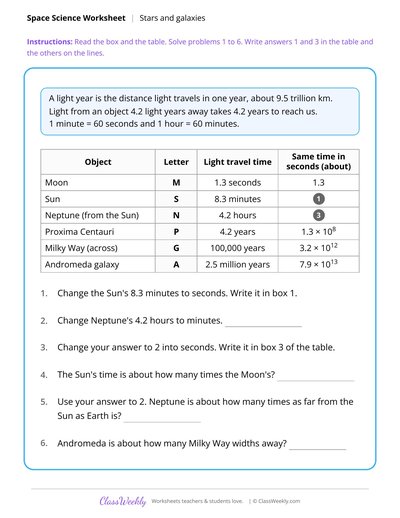
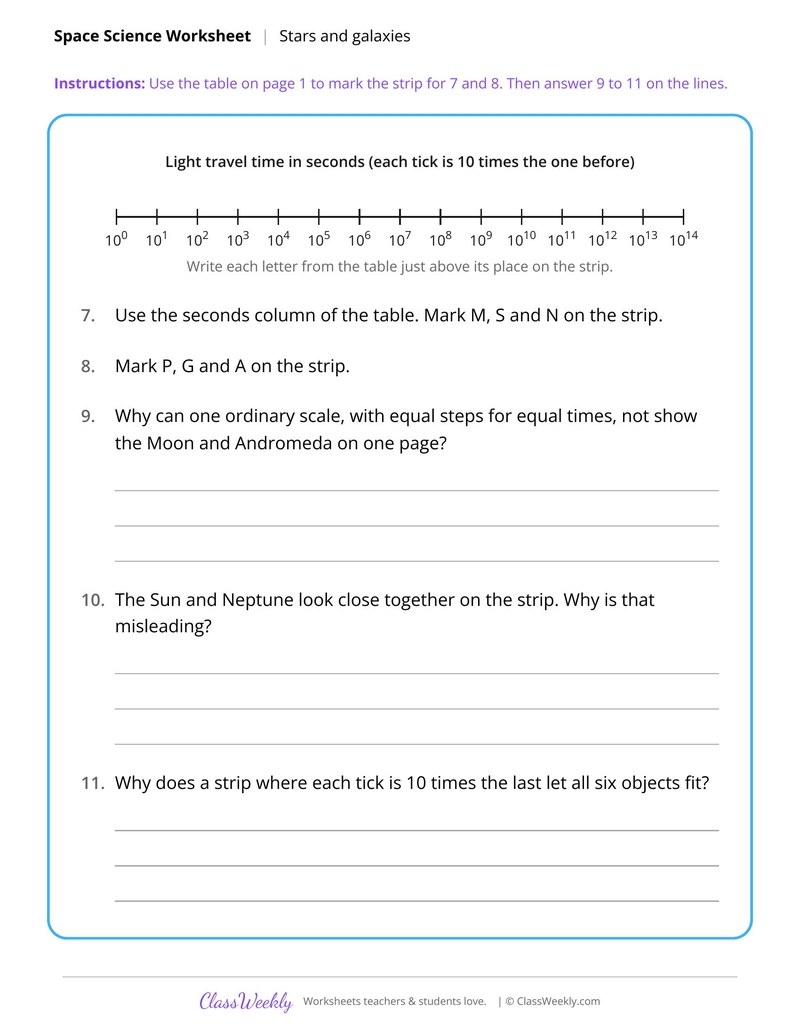
A light year is the distance light travels in one year, about 9.5 trillion km. Light from an object 4.2 light years away takes 4.2 years to reach us. Scale the Universe in Light Travel Time compares objects from the Moon to the Andromeda galaxy.
Why do closer moons orbit faster?
⌄
Gravity is stronger close to the planet, so a close moon must move fast to stay in orbit. On the Jupiter sheet, Io orbits in 1.77 days while Callisto takes 16.69 days. Students calculate each moon's speed.
Why can't you feel the gravity of a building?
⌄
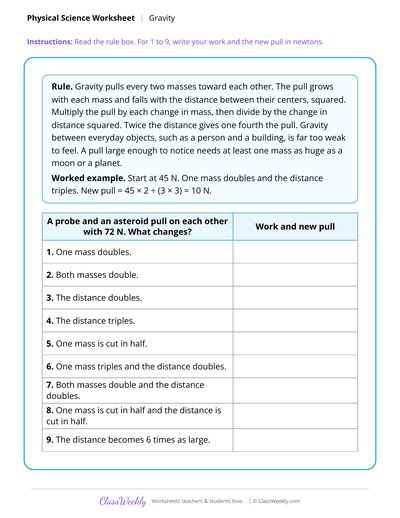
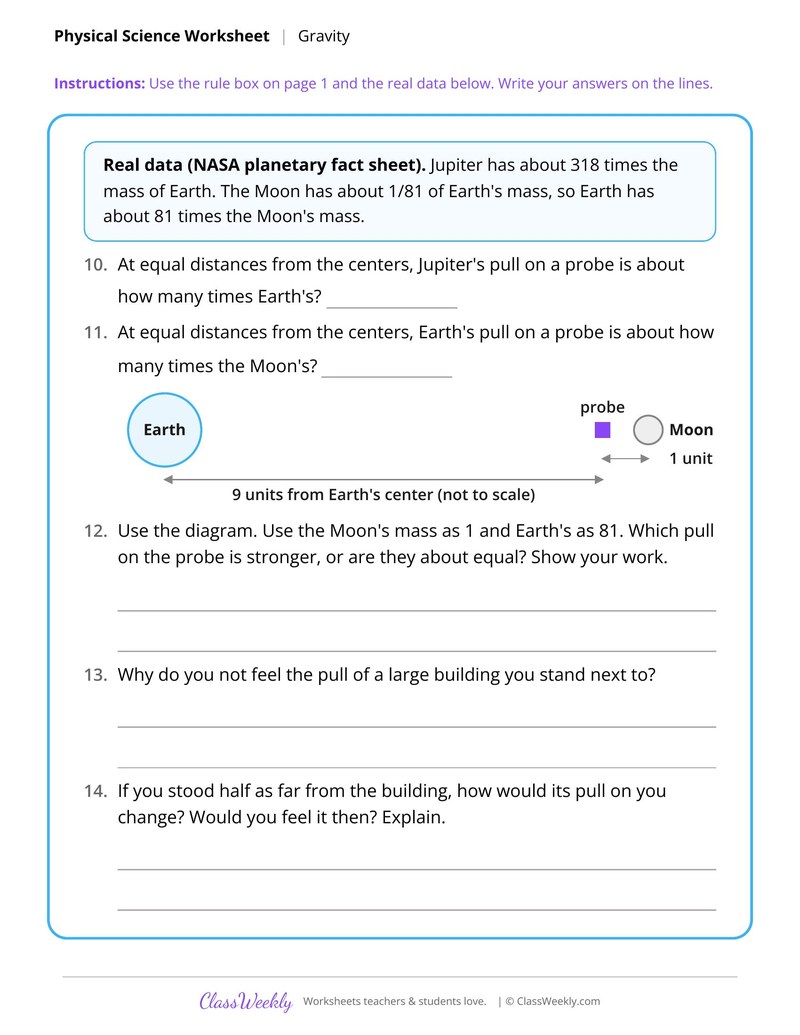
Gravity between everyday objects is far too weak to feel. A pull large enough to notice needs at least one mass as huge as a moon or a planet. The gravitational pulls sheet asks students to explain this.
Ratings & Reviews
No reviews yet. Be the first to share what you think.
Reviews are for ClassWeekly members.
Make a Request
Spotted something to fix, or want a worksheet we don't have yet? Tell us and we'll make it.
Worksheet Details
| Grade | 8th Grade |
| Subject | Science |
| Topic | Earth and Space |
| Standard | MS-ESS1-2 |
| Pages | 1 page |
| Difficulty | Medium |
What is ClassWeekly?
ClassWeekly offers free worksheets and printable learning resources for kids, from preschool up. All worksheets are aligned to Common Core, NGSS, and C3 Framework standards and designed by educators. Become a member to access the full library and download unlimited PDFs.