Rank Metals by Reactivity From Displacement Tests
Written by Adi Ackerman, Head Teacher
"Rank Metals by Reactivity From Displacement Tests" is written for 8th Grade (Ages 13-14), and it covers NGSS MS-PS1-2. A 7th grader who is already steady on matter can use it too, and an older student can use it as a short review.
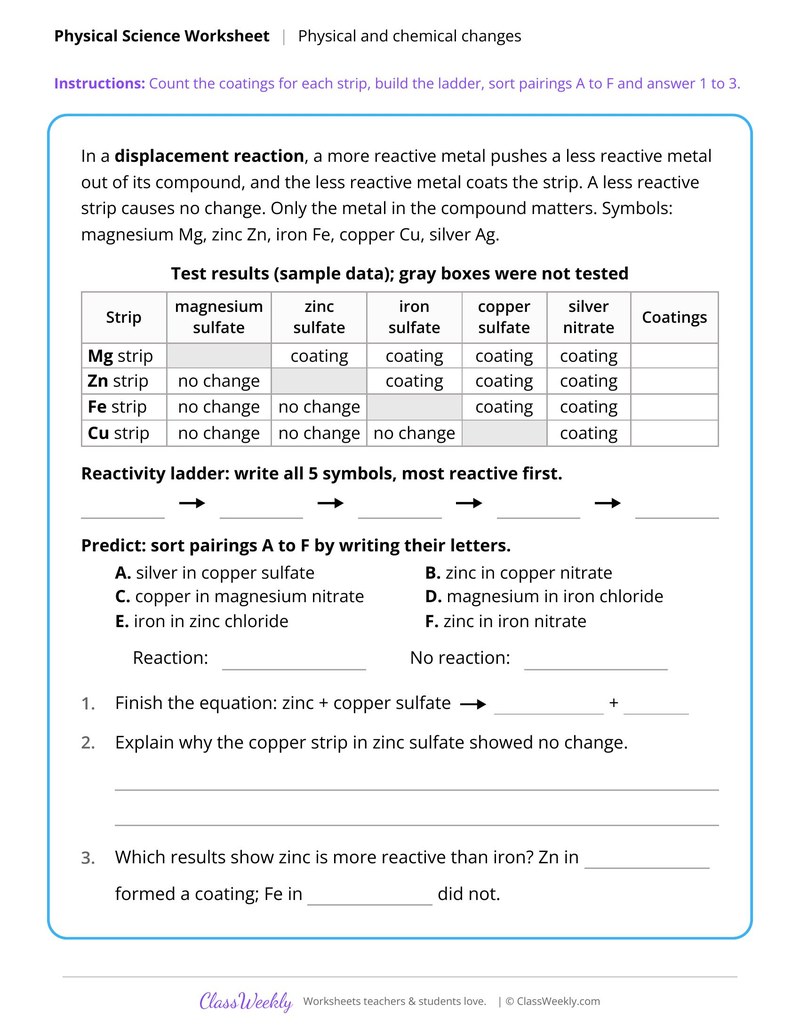
8th grade science worksheet: count metal coatings from strip tests, then rank magnesium, zinc, iron, copper and silver by reactivity. Answer key included. Part of our physical and chemical changes matter collection. Aligned to NGSS standards.
How do I use this worksheet?
Start with Interpret Coefficients, Subscripts and State Symbols so students can read equations, then move to the particle diagram and balancing sheets. Use the data sheets on reaction rate, cold packs and unknown powders as lab style practice.
What students will practice
- Students will read displacement test results for five metal strips in sulfate and nitrate solutions.
- Students will count coatings to build a reactivity ladder from most to least reactive.
- Students will predict whether pairings of a metal and a compound will react.
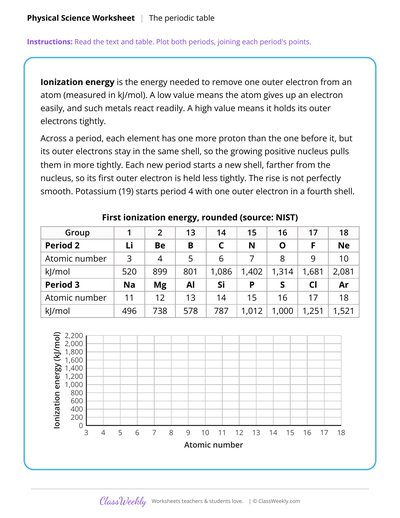
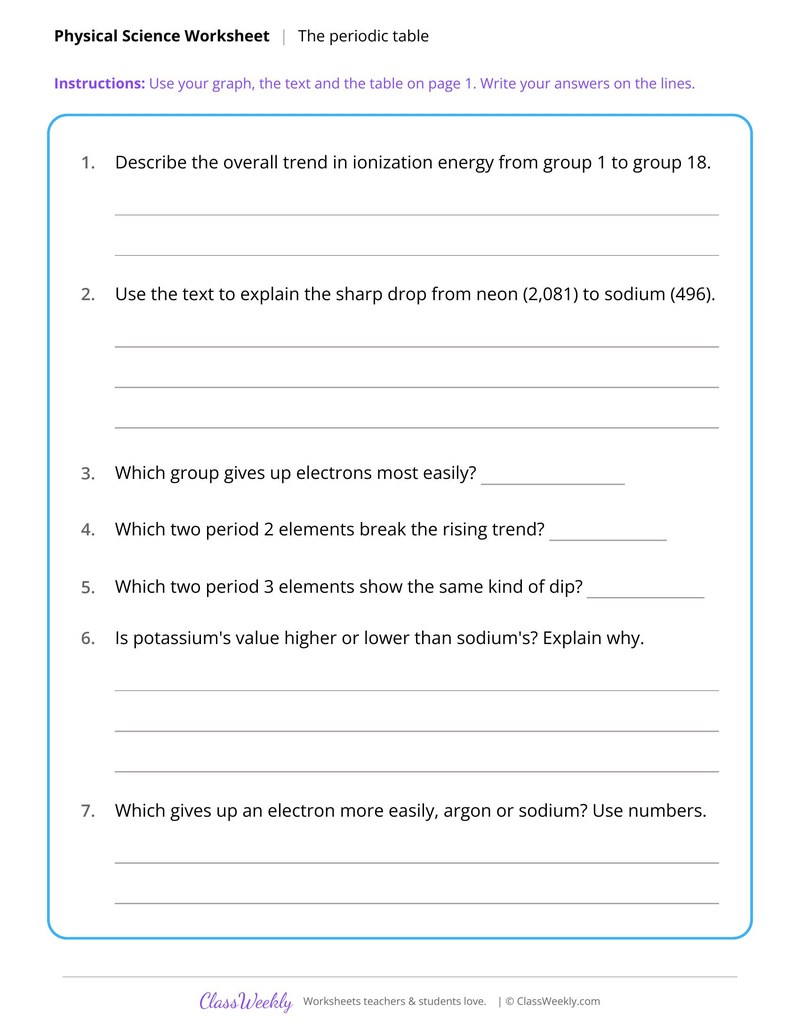
Graph First Ionization Energy Across Periods 2 and 3
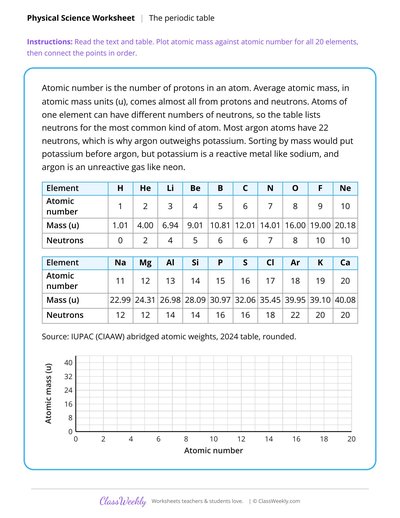
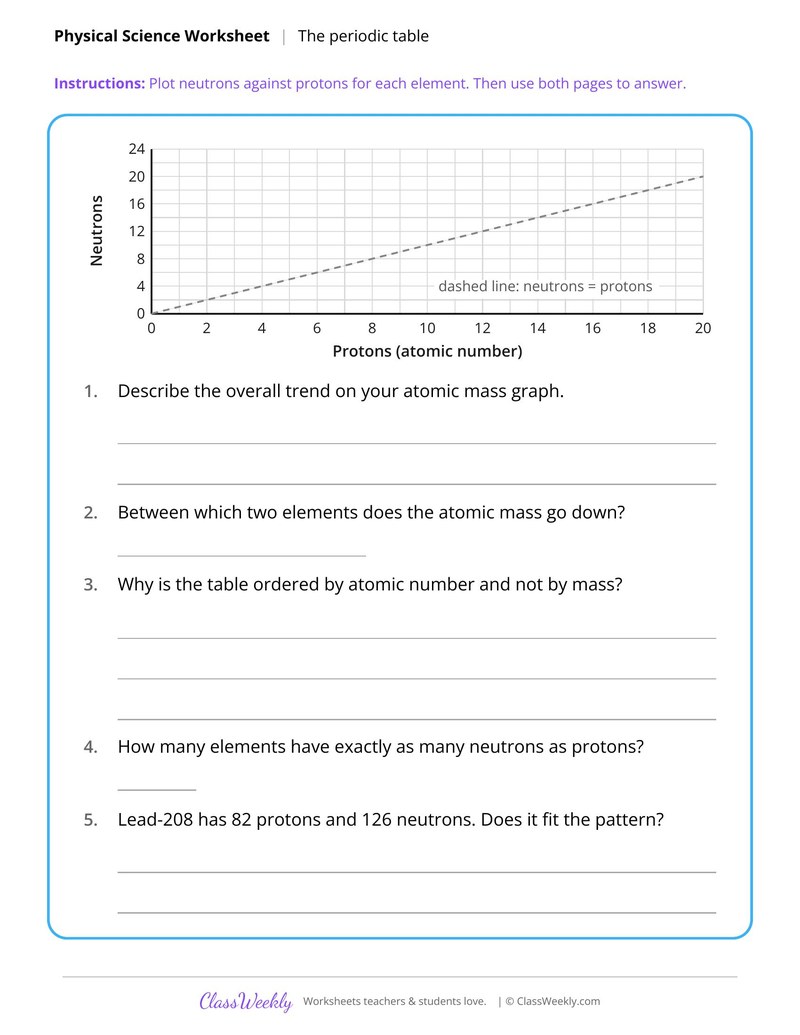
Graph Atomic Mass Against Atomic Number
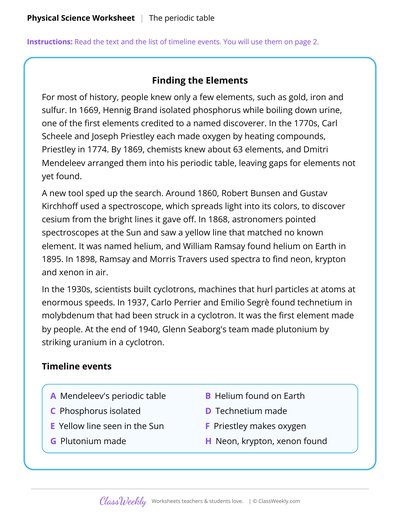
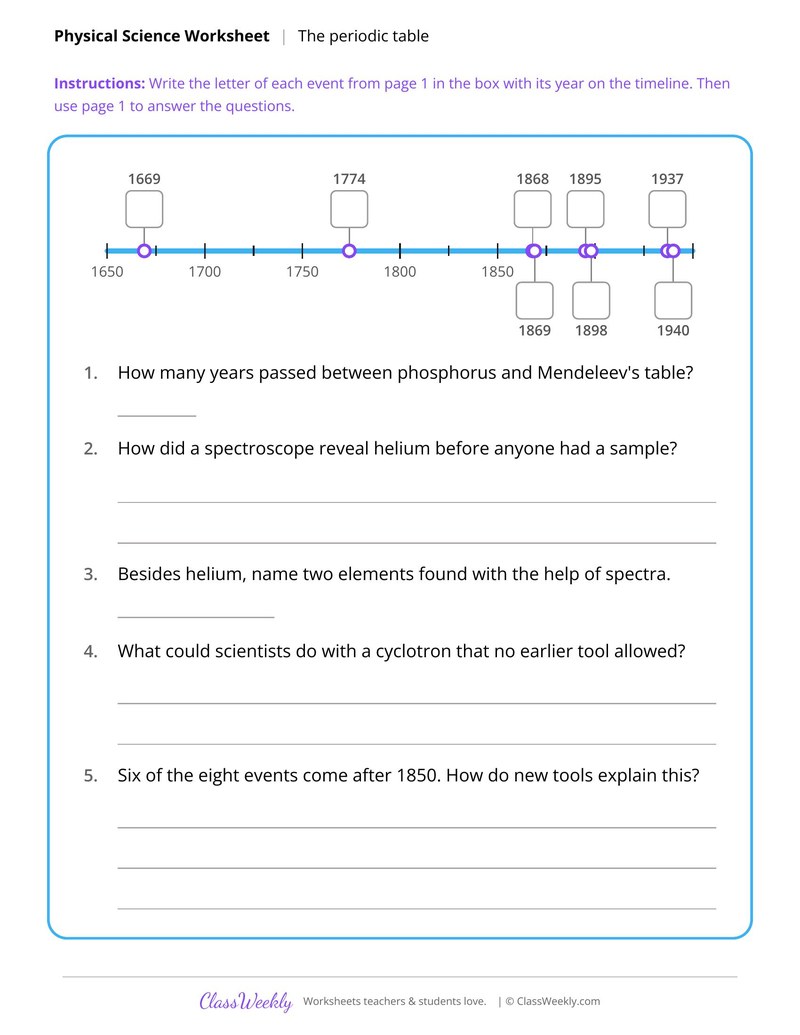
Element Discoveries Through Time
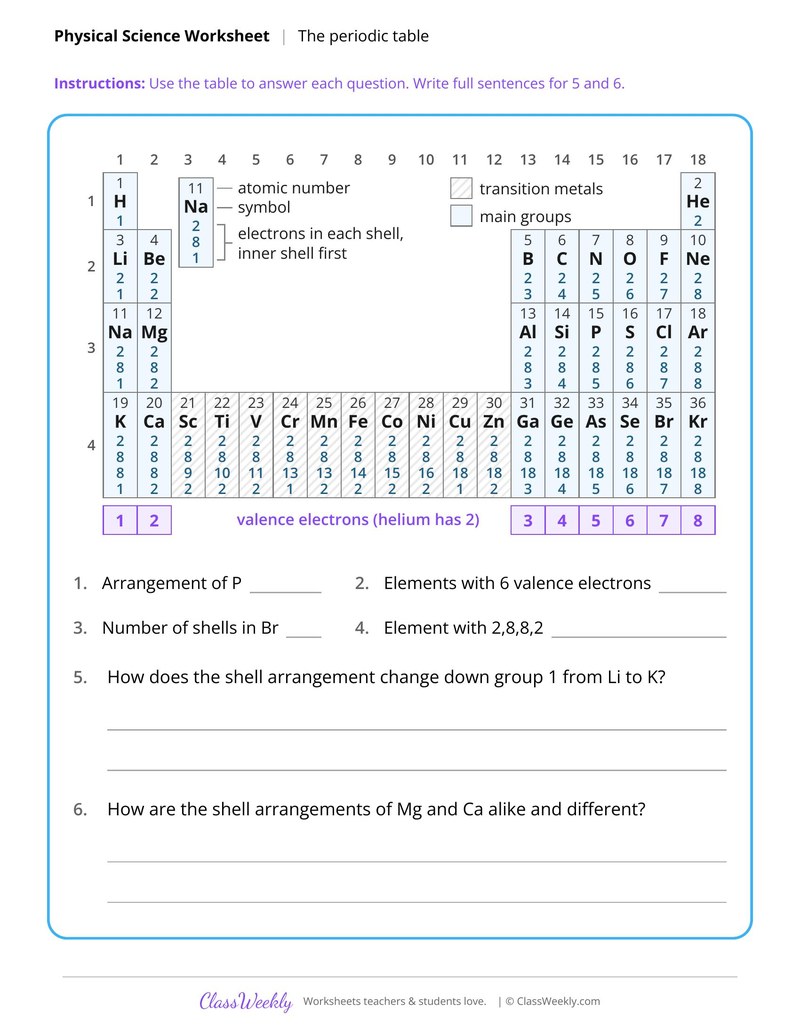
Periodic Table With Valence Electron Counts
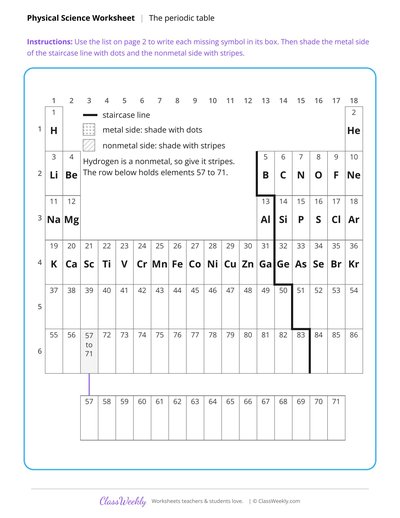
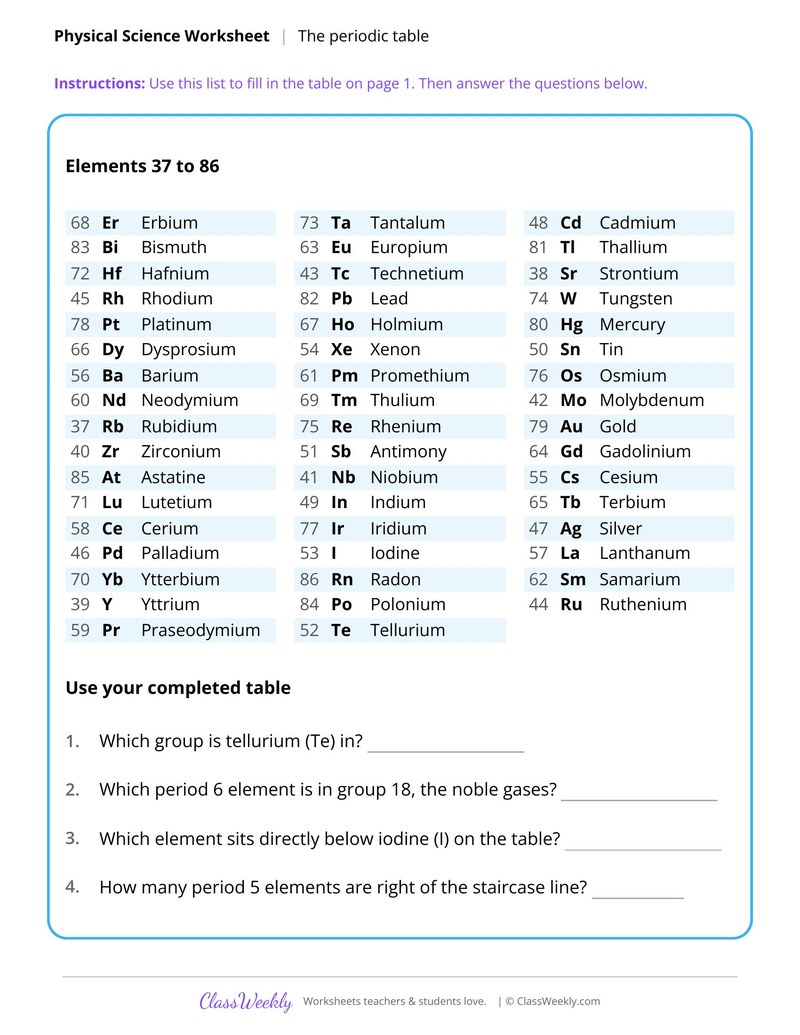
Complete Periods 5 and 6 on a Blank Table
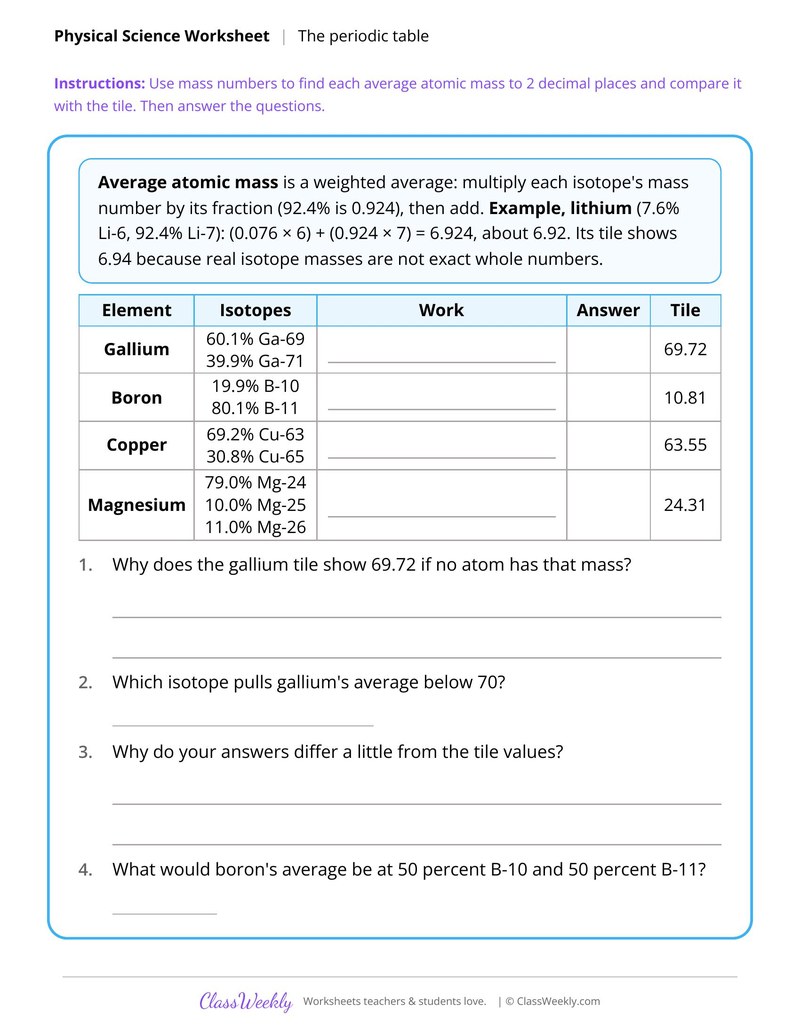
Calculate Average Atomic Mass From Isotopes
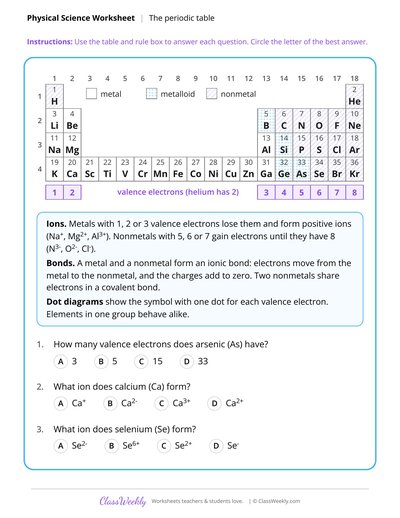
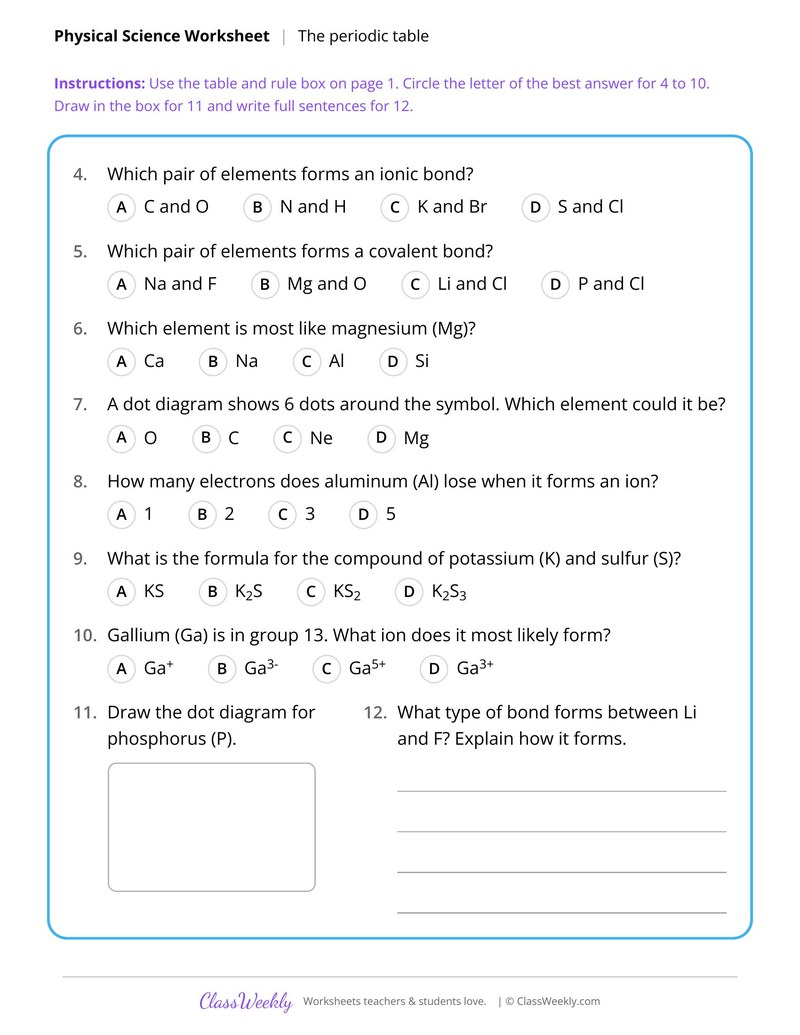
Periodic Table and Bonding Review Quiz
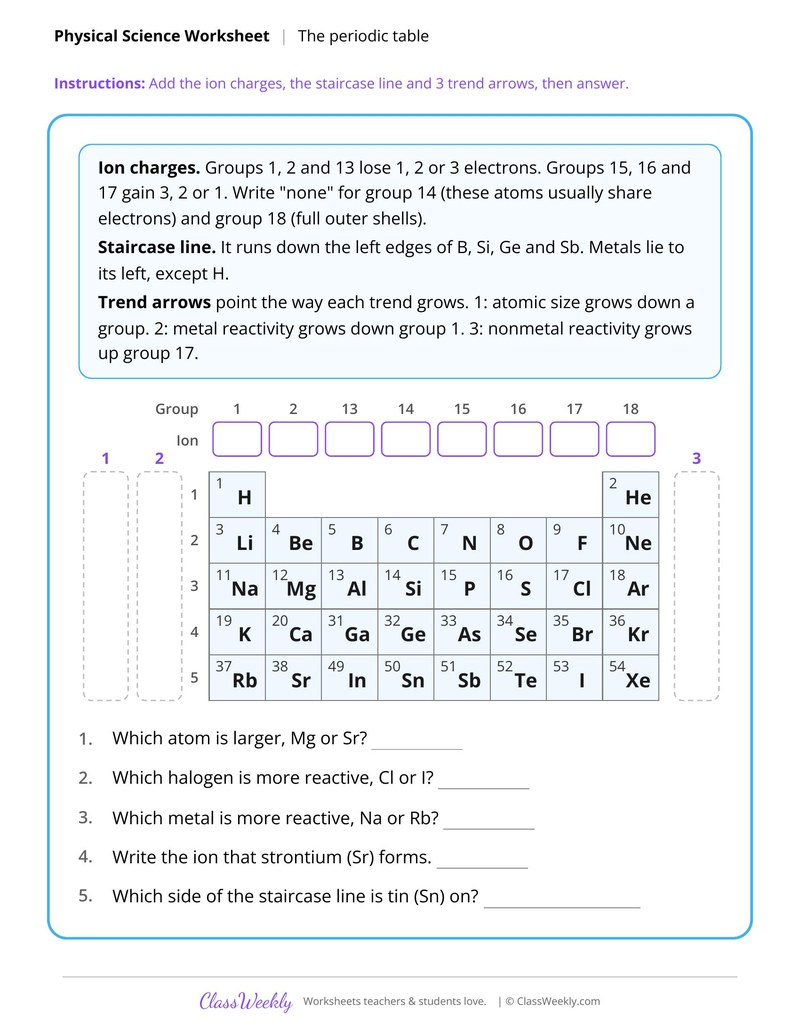
Label Ion Charges and Trends on the Table
Curriculum Links
Next Generation Science Standards
Science · 8th Grade
Find this in the curriculum
Browse the grade, subject, and topic this belongs to.
FAQ
How do I use this physical and chemical changes worksheet?
⌄
Start with Interpret Coefficients, Subscripts and State Symbols so students can read equations, then move to the particle diagram and balancing sheets. Use the data sheets on reaction rate, cold packs and unknown powders as lab style practice.
What does this worksheet teach?
⌄
Count metal coatings from strip tests, then rank magnesium, zinc, iron, copper and silver by reactivity. The directions on the page read: Count the coatings for each strip, build the ladder, sort pairings A to F and answer 1 to 3. An answer key is included.
Can I use this physical and chemical changes worksheet for homeschool or classroom?
⌄
Yes, both. We made it for 8th grade matter, and it works the same at home or at school. At home, a student can work through it alone and then go over it with you, which shows quickly what is solid and what needs another look. In class it works as independent practice, homework or a warm-up, and you can print one copy or a full set.
How do you balance a chemical equation?
⌄
Change only the coefficients, the big numbers in front, until each kind of atom matches on both sides. Changing a subscript would make a different substance. Balance Equations With Polyatomic Groups shows how to count a group such as SO4 as one unit when it stays whole.
Why is mass conserved in a chemical reaction?
⌄
Atoms are never created or destroyed in a reaction, they only rearrange into new substances. In a closed system the total mass stays the same. In an open system a gas can escape or join from the air, so the measured mass can change, as on Conservation of Mass in Open and Closed Systems.
How can you tell if a chemical reaction happened?
⌄
Compare the properties of the substances before and after, such as density, melting point and whether they dissolve. If the properties change, a new substance formed. Use Properties to Decide If a Reaction Happened compares four tests, from dried sugar to burned magnesium.
What changes the speed of a chemical reaction?
⌄
Temperature, surface area, concentration and catalysts all change how often particles collide with enough energy. What Changes the Speed of a Reaction explains each factor, and Graph How Temperature Changes Reaction Time has students graph antacid fizzing times.
Ratings & Reviews
No reviews yet. Be the first to share what you think.
Reviews are for ClassWeekly members.
Make a Request
Spotted something to fix, or want a worksheet we don't have yet? Tell us and we'll make it.
What is ClassWeekly?
ClassWeekly offers free worksheets and printable learning resources for kids, from preschool up. All worksheets are aligned to Common Core, NGSS, and C3 Framework standards and designed by educators. Become a member to access the full library and download unlimited PDFs.
Graph First Ionization Energy Across Periods 2 and 3
Graph Atomic Mass Against Atomic Number
Element Discoveries Through Time
Periodic Table With Valence Electron Counts
Complete Periods 5 and 6 on a Blank Table
Calculate Average Atomic Mass From Isotopes
Periodic Table and Bonding Review Quiz
Label Ion Charges and Trends on the Table