How Density Differences Lift a Balloon
Written by Adi Ackerman, Head Teacher
"How Density Differences Lift a Balloon" is written for 7th Grade (Ages 12-13), and it covers NGSS MS-PS1-4. A 6th grader who is already steady on energy can use it too, and an older student can use it as a short review.
2 pages in this set
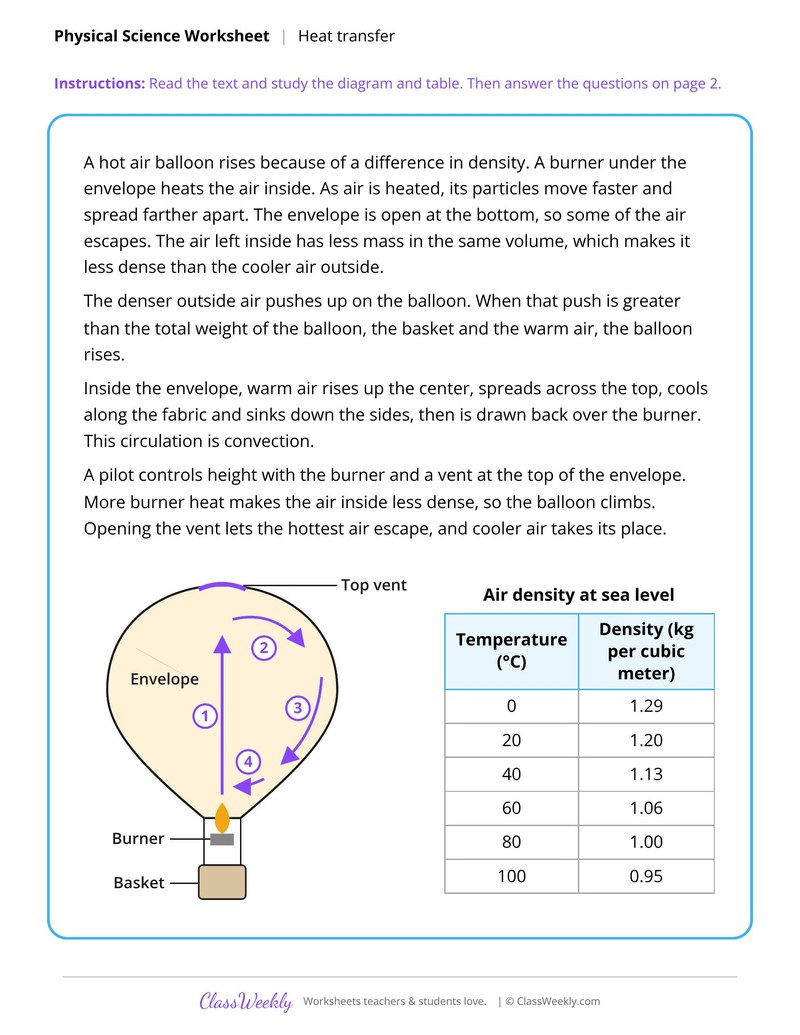
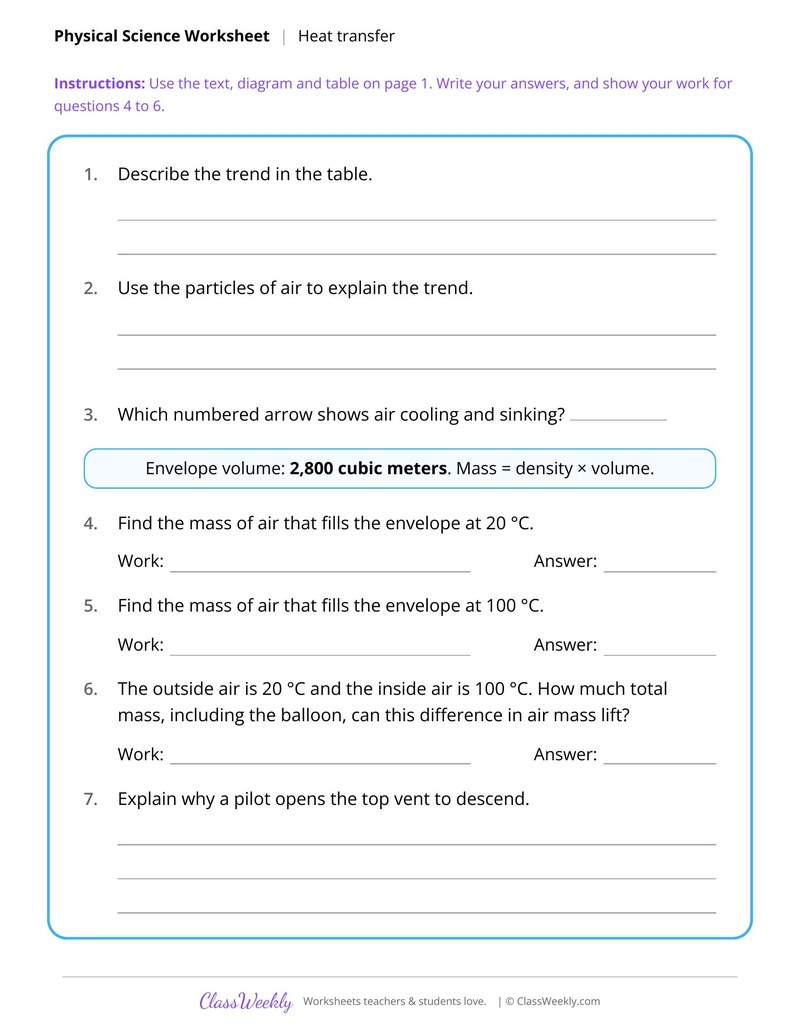
7th grade science worksheet: explain why a hot air balloon rises with air density, then find the mass of air in its envelope. Answer key included. Part of our heat transfer energy collection. Aligned to NGSS standards.
How do I use this worksheet?
Begin with the conductivity sheet and the particle model of conduction. Then use the house and balloon sheets for types of transfer, and the lunch carrier, heat sink and fabric sheets for design and data.
What students will practice
- Students will explain why warmed air inside a balloon is less dense than the cooler air outside.
- Students will use particles of air to explain the trend in a density table.
- Students will use mass = density × volume to compare the air mass in the envelope at two temperatures.
Curriculum Links
Next Generation Science Standards
Science · 7th Grade
Find this in the curriculum
Browse the grade, subject, and topic this belongs to.
FAQ
How do I use this heat transfer worksheet?
⌄
Begin with the conductivity sheet and the particle model of conduction. Then use the house and balloon sheets for types of transfer, and the lunch carrier, heat sink and fabric sheets for design and data.
What does this worksheet teach?
⌄
Explain why a hot air balloon rises with air density, then find the mass of air in its envelope. The directions on the page read: Read the text and study the diagram and table. Then answer the questions on page 2. An answer key is included.
Can I use this heat transfer worksheet for homeschool or classroom?
⌄
Yes, both. We made it for 7th grade energy, and it works the same at home or at school. At home, a student can work through it alone and then go over it with you, which shows quickly what is solid and what needs another look. In class it works as independent practice, homework or a warm-up, and you can print one copy or a full set.
What is the difference between conduction and convection?
⌄
Conduction passes energy between particles that touch, and the particles stay in place. In convection a heated fluid expands, rises, and carries energy with it while cooler fluid sinks.
Why do some materials insulate well?
⌄
Materials such as wool and foam board trap still air, which conducts energy poorly. Sort Materials by Thermal Conductivity lists values for 12 materials from silver to still air.
What affects how much a liquid's temperature rises?
⌄
With the same energy supplied, 200 g of water rises less than 100 g of water, and 100 g of cooking oil rises differently from water. Energy Transfer, Mass and Temperature Change has students graph all three.
Why does a hot air balloon rise?
⌄
Heated air spreads out and becomes less dense than the cooler air outside, so the outside air pushes up on the balloon. How Density Differences Lift a Balloon also finds the mass of air in the envelope.
Ratings & Reviews
No reviews yet. Be the first to share what you think.
Reviews are for ClassWeekly members.
Make a Request
Spotted something to fix, or want a worksheet we don't have yet? Tell us and we'll make it.
Learn More
What is ClassWeekly?
ClassWeekly offers free worksheets and printable learning resources for kids, from preschool up. All worksheets are aligned to Common Core, NGSS, and C3 Framework standards and designed by educators. Become a member to access the full library and download unlimited PDFs.