Adding Bricks Word Problems
Written by Adi Ackerman, Head Teacher
"Adding Bricks Word Problems" is written for 1st Grade (Ages 6-7), and it covers Common Core 1.OA.A.1. If your little one is a year younger but already steady on word problems, the page still works. You may just need to read the instructions out loud. And if they are older and add / subtract word problems with mostly single digit numbers never quite stuck, this is a short review rather than busywork.
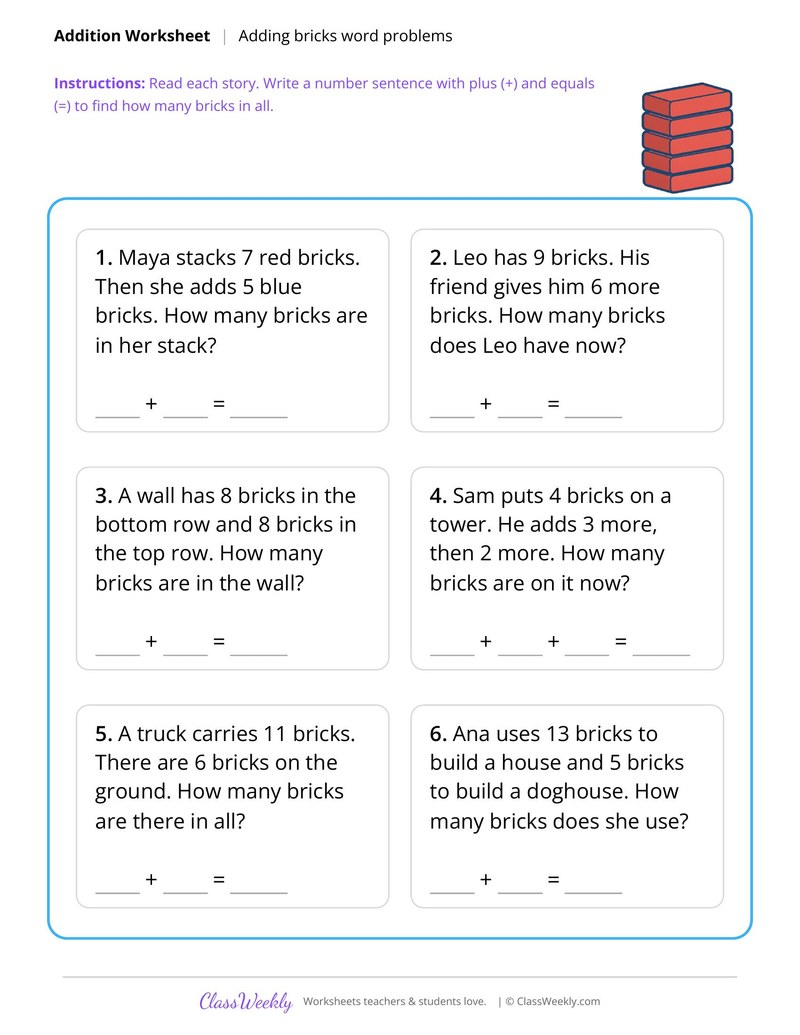
1st grade math worksheet: solve 6 addition stories about stacking bricks, with sums to 20, and write a number sentence for each. Answer key included. Part of our add / subtract word problems with mostly single digit numbers collection. Aligned to Common Core standards.
How do I use this worksheet?
Print the page and read the directions with your child: Read each story. Write a number sentence with plus (+) and equals (=) to find how many bricks in all. When they finish, check the work together with the answer key.
What students will practice
- Students will solve addition word problems within 20.
- Students will write a number sentence for a story.
- Students will add three numbers in one problem.
Curriculum Links
Common Core State Standards
Operations and Algebraic Thinking · 1st Grade
Standard: Use addition and subtraction within 20 to solve word problems involving situations of adding to, taking from, putting together, taking apart, and comparing, with unknowns in all positions.
View all 1.OA.A.1 worksheets →Find this in the curriculum
Browse the grade, subject, and topic this belongs to.
FAQ
How do I use this add / subtract word problems with mostly single digit numbers worksheet?
⌄
Print the page and read the directions with your child: Read each story. Write a number sentence with plus (+) and equals (=) to find how many bricks in all. When they finish, check the work together with the answer key.
What does this worksheet teach?
⌄
Six short addition stories about bricks, such as Maya stacks 7 red bricks and adds 5 blue bricks, and Sam puts 4 bricks on a tower, adds 3 more, then 2 more. Each story has a number sentence frame with plus and equals signs to fill in. The directions on the page read: Read each story. Write a number sentence with plus (+) and equals (=) to find how many bricks in all. An answer key is included.
Can I use this add / subtract word problems with mostly single digit numbers worksheet for homeschool or classroom?
⌄
Yes, both. We made it for 1st Grade word problems, and the page works the same whether it lands on a kitchen table or a center rotation. At home, most families go through it together and talk the answers out loud, and that talking is where most of the learning happens with add / subtract word problems with mostly single digit numbers. In class it runs well as independent work while you pull a small group. Print one copy or thirty, whichever the day needs.
How do students decide whether to add or subtract in a mixed word problem?
⌄
They look for key language clues - words like 'altogether' or 'in all' suggest addition, while 'left,' 'fewer,' or 'took away' signal subtraction.
Why is mixed operation practice more challenging than single-operation practice?
⌄
Students can no longer rely on the operation type being the same throughout - they must re-read each problem carefully and think about what the story is asking.
At what point in the year are mixed add/subtract word problems typically introduced?
⌄
Most 1st grade teachers introduce mixed problems after students are secure with both operations separately, typically in the second half of the school year.
What types of word problems should first graders solve?
⌄
First graders should solve addition and subtraction word problems within 20 involving three main types: result unknown (8 plus 4 equals what?), change unknown (8 plus what equals 12?), and start unknown (what plus 4 equals 12?) per CCSS 1.OA.A.1. They should also solve compare problems using phrases like "how many more" and "how many fewer." These problem types develop different aspects of mathematical reasoning. Worksheets that present one problem type at a time, with picture support, help children develop strategies for each type before mixing them together. First graders may use drawings, number lines, or equations to solve these problems, and all representations should be encouraged.
How do you teach first graders to solve word problems?
⌄
Use a structured approach: read the problem aloud, identify what you know and what you need to find, choose a strategy, solve, and check. Teach children to draw pictures or diagrams to represent the problem before writing an equation. The bar model (tape diagram) is particularly effective: draw a bar representing the total and divide it to show the parts. Practice with worksheets that include space for drawing a picture and writing an equation helps children internalize this process. Start with simple result-unknown problems and familiar contexts (toys, animals, food) before introducing more complex problem types. Consistent daily word problem practice, even just one problem per day, builds confidence and strategy fluency.
Why do first graders struggle with word problems more than computation?
⌄
Word problems require reading comprehension, identifying the mathematical operation hidden in the language, and translating words into numbers and symbols. A child who can solve 7 plus 5 easily may struggle when the same problem is presented as "Maria has 7 stickers. She gets 5 more. How many does she have now?" The language processing adds cognitive load. Key phrases like "how many more" (subtraction) and "altogether" (addition) must be learned explicitly. Worksheets that highlight key words, provide picture support, and include space for drawing help bridge the gap between reading and computing. Regular exposure to varied word problem formats teaches children that math is not just about numbers on a page but about solving real situations.
Ratings & Reviews
No reviews yet. Be the first to share what you think.
Reviews are for ClassWeekly members.
Make a Request
Spotted something to fix, or want a worksheet we don't have yet? Tell us and we'll make it.
Worksheet Details
| Grade | 1st Grade |
| Subject | Math |
| Topic | Word Problems |
| Standard | 1.OA.A.1 |
| Pages | 1 page |
| Difficulty | Medium |
Learn More
What is ClassWeekly?
ClassWeekly offers free worksheets and printable learning resources for kids, from preschool up. All worksheets are aligned to Common Core, NGSS, and C3 Framework standards and designed by educators. Become a member to access the full library and download unlimited PDFs.