The Science of Sleep
Written by Adi Ackerman, Head Teacher
"The Science of Sleep" is written for 5th Grade (Ages 10-11), and it covers Common Core RI.5.2. If your little one is a year younger but already steady on paragraphs & passages, the page still works. You may just need to read the instructions out loud. And if they are older and nonfiction passages never quite stuck, this is a short review rather than busywork.
2 pages in this set
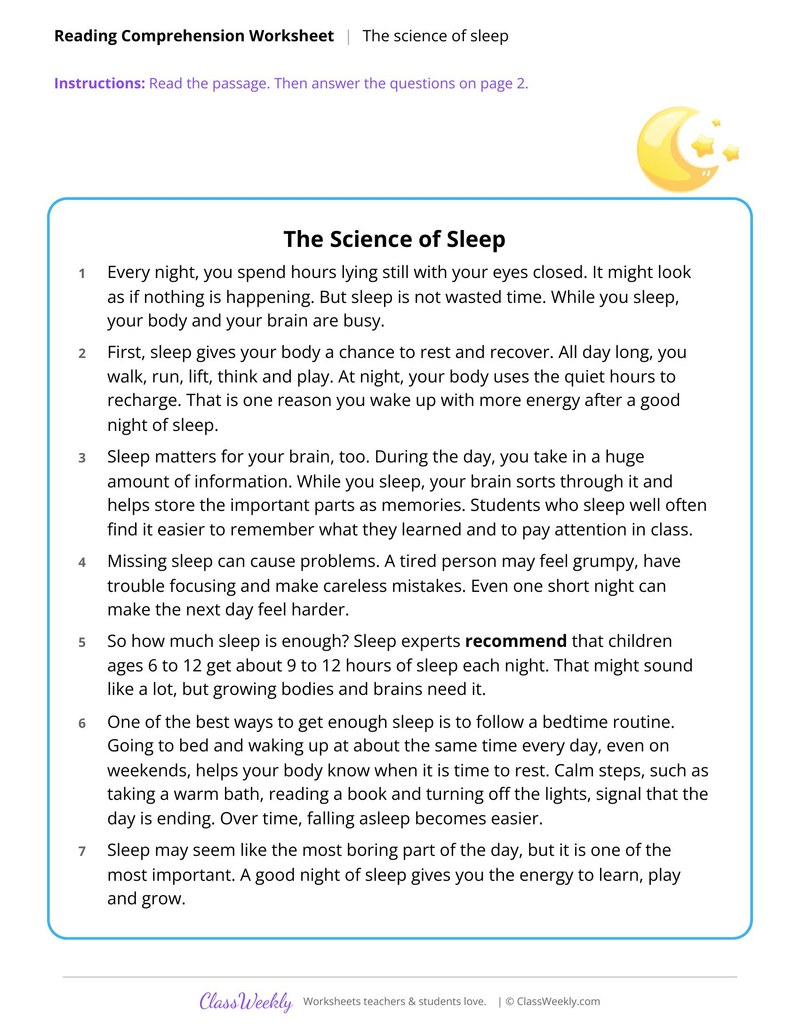
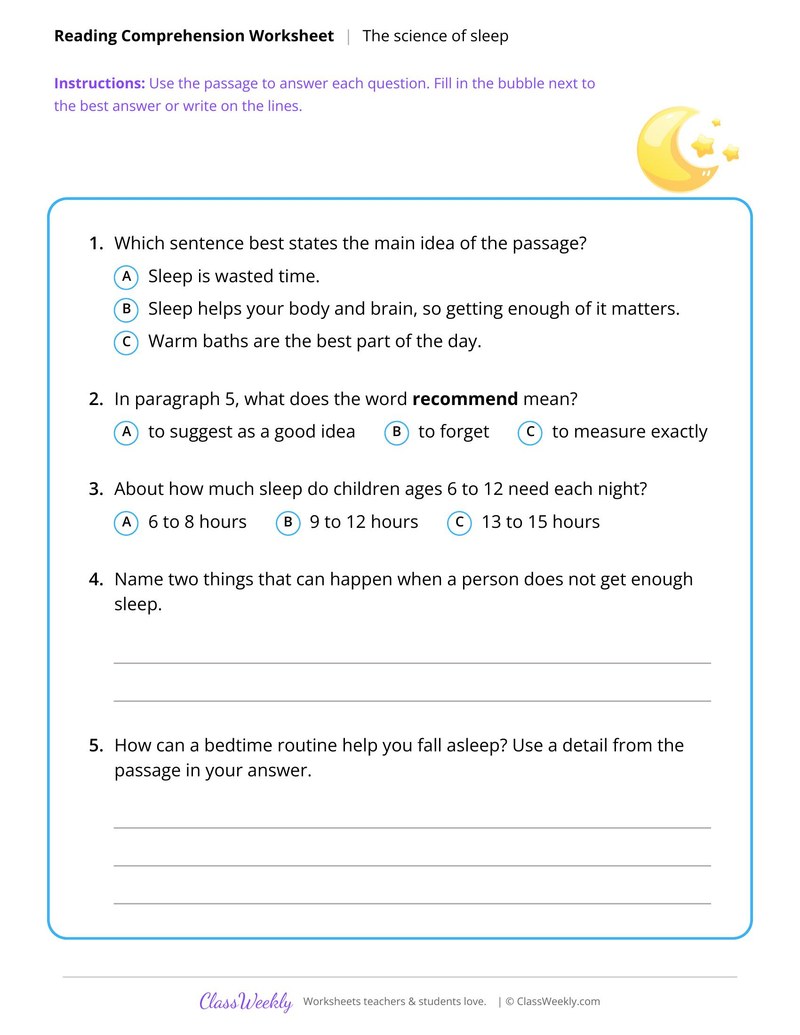
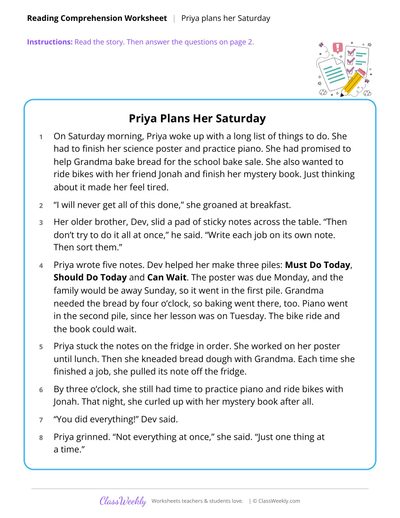
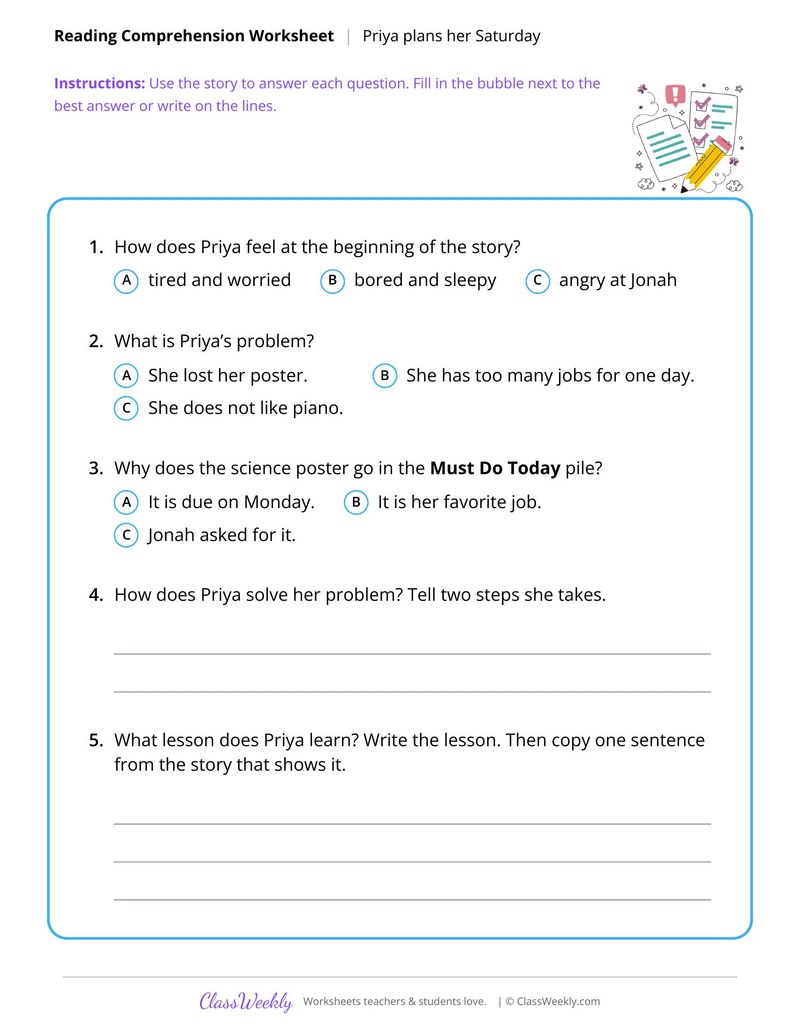
5th grade reading worksheet: read why the body and brain need sleep and how much children need, then answer 5 questions. Answer key included. Part of our nonfiction passages collection. Aligned to Common Core standards.
How do I use this worksheet?
Print the page and read the directions with your child: Read the passage. Then answer the questions on page 2. When they finish, check the work together with the answer key.
What students will practice
- Students will determine the main idea of a nonfiction passage.
- Students will use context to find the meaning of a word.
- Students will support an answer with a detail from the text.
Curriculum Links
Common Core State Standards
Reading: Informational Text · 5th Grade
Standard: Determine two or more main ideas of a text and explain how they are supported by key details; summarize the text.
View all RI.5.2 worksheets →Find this in the curriculum
Browse the grade, subject, and topic this belongs to.
FAQ
How do I use this nonfiction passages worksheet?
⌄
Print the page and read the directions with your child: Read the passage. Then answer the questions on page 2. When they finish, check the work together with the answer key.
What does this worksheet teach?
⌄
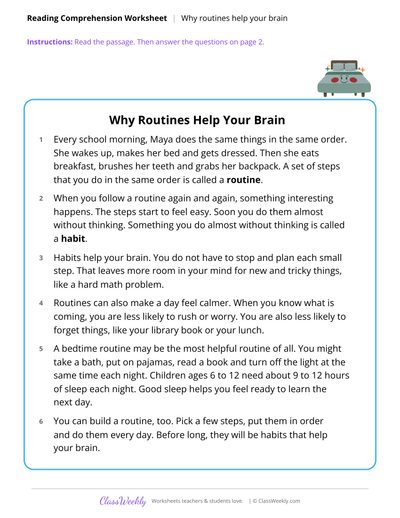
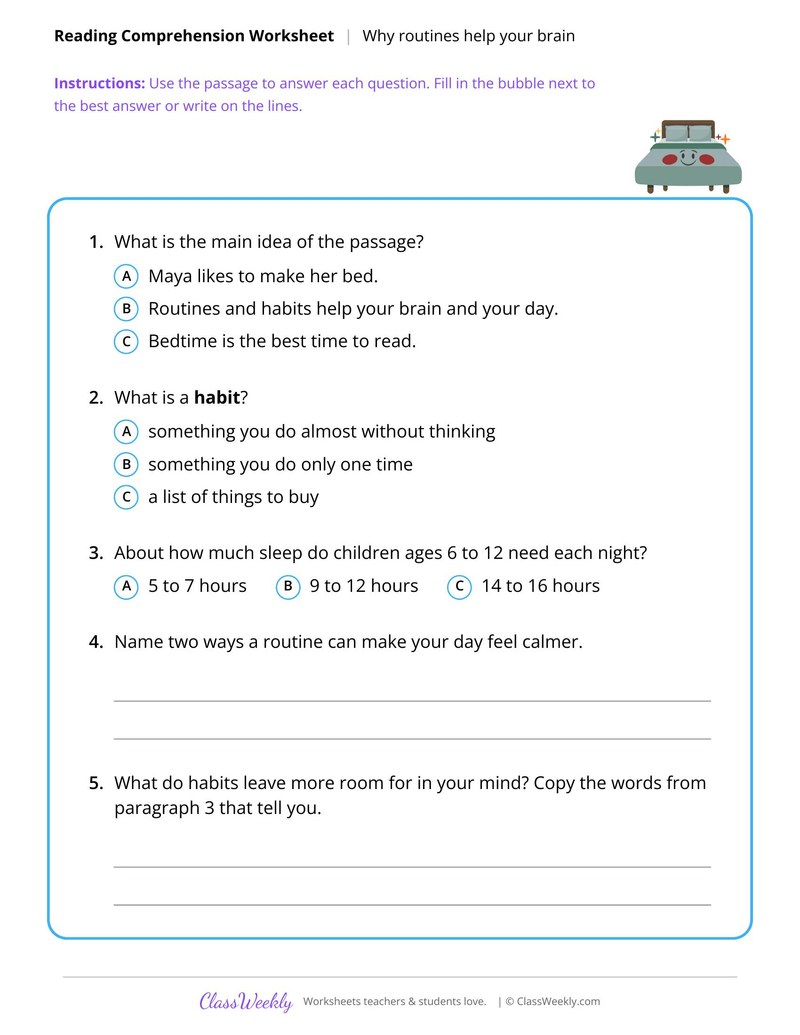
A nonfiction passage, The Science of Sleep, explains that sleep lets the body rest and recover, that the brain sorts the day's information and stores memories during sleep, what can happen after missing sleep, and that sleep experts recommend about 9 to 12 hours a night for children ages 6 to 12. It ends with how a bedtime routine helps. Page 2 asks for the main idea, the meaning of recommend, how much sleep children need, two effects of too little sleep and how a bedtime routine helps. The directions on the page read: Read the passage. Then answer the questions on page 2. An answer key is included.
Can I use this nonfiction passages worksheet for homeschool or classroom?
⌄
Yes, both. We made it for 5th Grade paragraphs & passages, and the page works the same whether it lands on a kitchen table or a center rotation. At home, most families go through it together and talk the answers out loud, and that talking is where most of the learning happens with nonfiction passages. In class it runs well as independent work while you pull a small group. Print one copy or thirty, whichever the day needs.
What is a nonfiction passage?
⌄
A nonfiction passage, also called informational text, gives true facts about real people, places and events. Most 5th grade sheets have a passage or two short texts on one topic, then a page of questions (the Veterans Day passage fits both on one page), and every sheet has an answer key.
How do you find two main ideas in one text?
⌄
Look at what each part of the text is mostly about. A subheading often marks where a new big idea starts, so ask what the details in each part have in common. On the Silk Road sheet, one part tells how goods such as silk traveled and the other tells how ideas such as papermaking and Buddhism spread. Students write each main idea in a web with two key details under it, then summarize using both.
What does quote accurately mean?
⌄
To quote accurately is to copy the exact words of a text inside quotation marks, without changing or leaving out a word (RI.5.1). On the quoting sheets, students read an inference, such as Sequoyah was very patient, then copy the sentence that supports it with its paragraph number.
What is on each 5th grade passage sheet?
⌄
Most sheets have a passage page and a question page, the paired text sheets add a third page, and the Veterans Day passage fits its text and 3 questions on one page. The 96 newest nonfiction sheets have six or nine items: a web, chart or chain to fill in, multiple choice questions with three options and a written answer. The older 20 nonfiction and 20 fiction sheets mix multiple choice and short written answers.
How are the 5th grade passages different from 4th grade?
⌄
They are longer and the questions go deeper. Students find two main ideas in one text, quote a passage accurately to back an inference, compare the structure of two texts on the same topic, and combine facts from a text, a table and a map. The stories ask about theme, point of view and figurative language.
What topics do the nonfiction and fiction passages cover?
⌄
The 117 nonfiction passages cover history, science and people, such as Machu Picchu, Mae Jemison, the Berlin Wall, Mars rovers, the Nile, Angkor Wat and the Miracle on Ice, plus older sheets on vaccines and black holes. The 20 stories include The Last Train Home, The Tide Pool Mystery and The Dragon Who Could Not Fly.
Is there an answer key for each passage?
⌄
Yes. All 137 sheets have an answer key. Written questions show a sample answer, and on the newest sheets every chart and web box lists other answers the passage supports.
Ratings & Reviews
No reviews yet. Be the first to share what you think.
Reviews are for ClassWeekly members.
Make a Request
Spotted something to fix, or want a worksheet we don't have yet? Tell us and we'll make it.
Worksheet Details
| Grade | 5th Grade |
| Subject | Reading |
| Topic | Paragraphs & Passages |
| Standard | RI.5.2 |
| Pages | 2 pages |
| Difficulty | Medium |
Learn More
What is ClassWeekly?
ClassWeekly offers free worksheets and printable learning resources for kids, from preschool up. All worksheets are aligned to Common Core, NGSS, and C3 Framework standards and designed by educators. Become a member to access the full library and download unlimited PDFs.