Beginning Sounds Builder Tools
Written by Adi Ackerman, Head Teacher
"Beginning Sounds Builder Tools" is written for Kindergarten (Ages 5-6). If your little one is a year younger but already steady on beginning sounds, the page still works. You may just need to read the instructions out loud. And if they are older and circle letter never quite stuck, this is a short review rather than busywork.
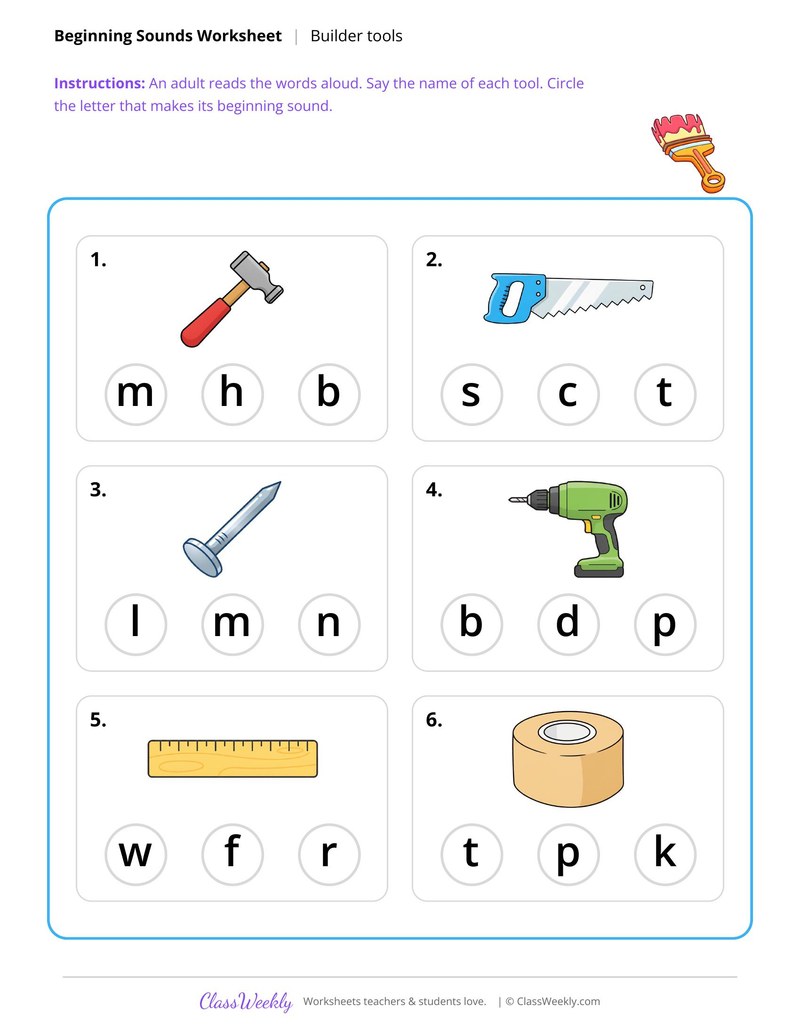
Kindergarten phonics worksheet: say the names of 6 tools, like hammer, saw and drill, and circle each beginning letter. Answer key included. Part of our circle letter beginning sounds collection.
How do I use this worksheet?
Print the page and read the directions with your child: An adult reads the words aloud. Say the name of each tool. Circle the letter that makes its beginning sound. When they finish, check the work together with the answer key.
What students will practice
- Students will say the names of six tools.
- Students will hear the first sound in each word.
- Students will circle the letter that makes the beginning sound.
Curriculum Links
Find this in the curriculum
Browse the grade, subject, and topic this belongs to.
FAQ
How do I use this circle letter worksheet?
⌄
Print the page and read the directions with your child: An adult reads the words aloud. Say the name of each tool. Circle the letter that makes its beginning sound. When they finish, check the work together with the answer key.
What does this worksheet teach?
⌄
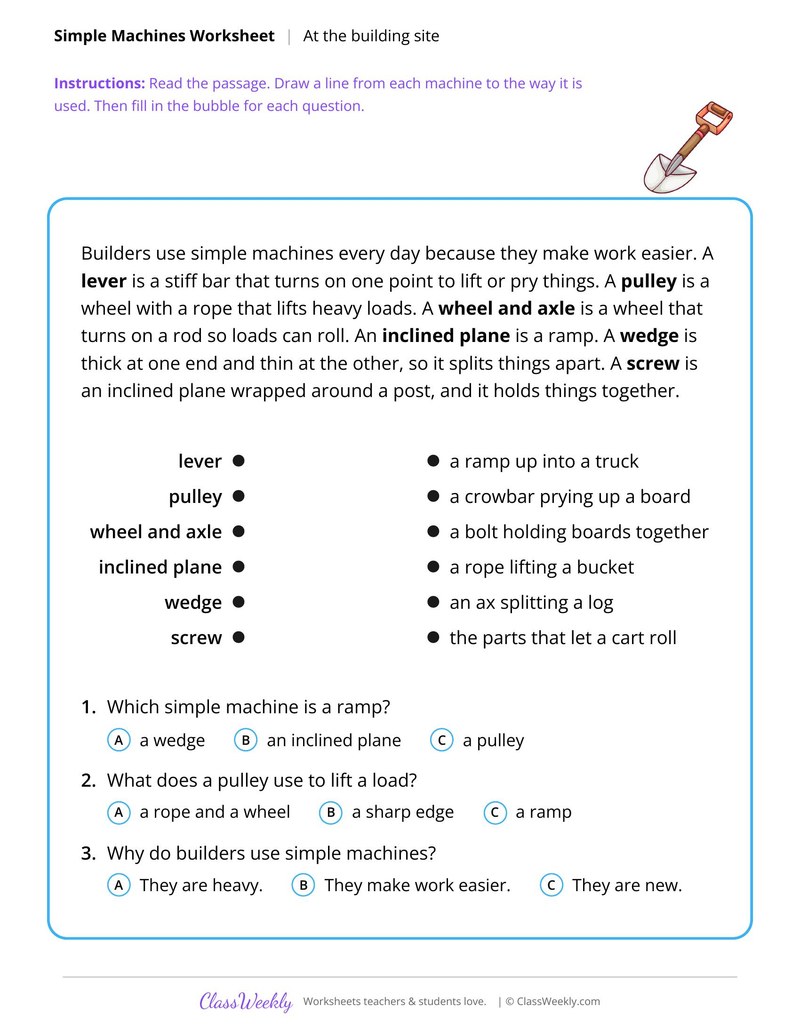
Six builder tools (a hammer, a saw, a nail, a drill, a ruler and a roll of tape), each with three letters to choose from. Children say the name of each tool and circle the letter for its beginning sound. The directions on the page read: An adult reads the words aloud. Say the name of each tool. Circle the letter that makes its beginning sound. An answer key is included.
Can I use this circle letter worksheet for homeschool or classroom?
⌄
Yes, both. We made it for Kindergarten beginning sounds, and the page works the same whether it lands on a kitchen table or a center rotation. At home, most families go through it together and talk the answers out loud, and that talking is where most of the learning happens with circle letter. In class it runs well as independent work while you pull a small group. Print one copy or thirty, whichever the day needs.
Why start with beginning sounds?
⌄
Because they are the easiest sounds to hear. Ending sounds come next, and vowels in the middle are the last to be heard reliably. Starting where success is likely builds the confidence needed for the harder parts of a word.
What does this worksheet ask my child to do?
⌄
Beginning Sounds Builder Tools. Writing the answer is the hardest version, because nothing is provided to choose from. Your child has to retrieve the word from memory and spell it, so expect this one to take longer.
My child names letters but cannot hear the sound. What helps?
⌄
They are two different skills, and letter names can actively get in the way. Drop the names for a while and play sound games with no paper: "what does moon start with?" Say the sound, not the letter. Once your child can hear the sound, connecting it to the letter is quick.
What does a 'circle the letter' beginning sounds worksheet ask children to do?
⌄
In a typical activity, the child sees a picture - like a dog - alongside two or three letter choices. The child must identify the beginning sound of the word ('dog' starts with /d/) and circle the letter 'd.' This format requires both phonemic awareness and letter discrimination, making it a useful activity that assesses multiple skills at once.
Why is the 'circle the letter' format particularly helpful for kindergartners?
⌄
The multiple-choice format reduces the demand on fine motor skills and letter formation, allowing children to focus entirely on the phonics task. For children who are still developing pencil control, circling is less frustrating than writing letters. The format also gives teachers a fast way to check whether a child knows beginning letter sounds without requiring a written response.
How can these worksheets be used in the classroom or at home?
⌄
In the classroom, these are excellent as a morning warm-up, an exit ticket after a phonics lesson, or a literacy center activity. At home, parents can complete a few examples together first to model how to say the picture name, isolate the first sound, and then find the matching letter. Keep sessions short - 5 to 10 minutes is enough for most kindergartners.
What is a beginning sound?
⌄
The first sound you hear in a spoken word, like the s in sun or the d in dog. Kindergartners learn to hear that sound and match it to its letter (CCSS RF.K.2.D and RF.K.3.A).
Does my kindergartner need to read the picture names?
⌄
No. An adult says each picture name aloud, and the child listens for the first sound. On Circle the First Letter, M, S and T the child then circles m, s or t and traces the letters.
How do I help a child who mixes up b, d and p?
⌄
Practice one look-alike letter at a time and say the sound with a picture, like b for bear and d for dinosaur. Circle the First Letter, B, D and P and the B or D cut and glue sort give these letters pages of their own.
What kinds of beginning sounds pages are there?
⌄
75 sheets: circle the first letter, draw a line to the letter, circle the picture that starts with a letter, color the pictures for one sound, cut and glue sorts, trace words and circle the first letter, mazes and two checkups.
Ratings & Reviews
No reviews yet. Be the first to share what you think.
Reviews are for ClassWeekly members.
Make a Request
Spotted something to fix, or want a worksheet we don't have yet? Tell us and we'll make it.
Worksheet Details
| Grade | Kindergarten |
| Subject | Reading |
| Topic | Beginning Sounds |
| Pages | 1 page |
| Difficulty | Medium |
What is ClassWeekly?
ClassWeekly offers free worksheets and printable learning resources for kids, from preschool up. All worksheets are aligned to Common Core, NGSS, and C3 Framework standards and designed by educators. Become a member to access the full library and download unlimited PDFs.