Cause and Effect Testing a Model
Written by Adi Ackerman, Head Teacher
"Cause and Effect Testing a Model" is written for 4th Grade (Ages 9-10). If your little one is a year younger but already steady on comprehension exercises, the page still works. You may just need to read the instructions out loud. And if they are older and cause and effect in the real world never quite stuck, this is a short review rather than busywork.
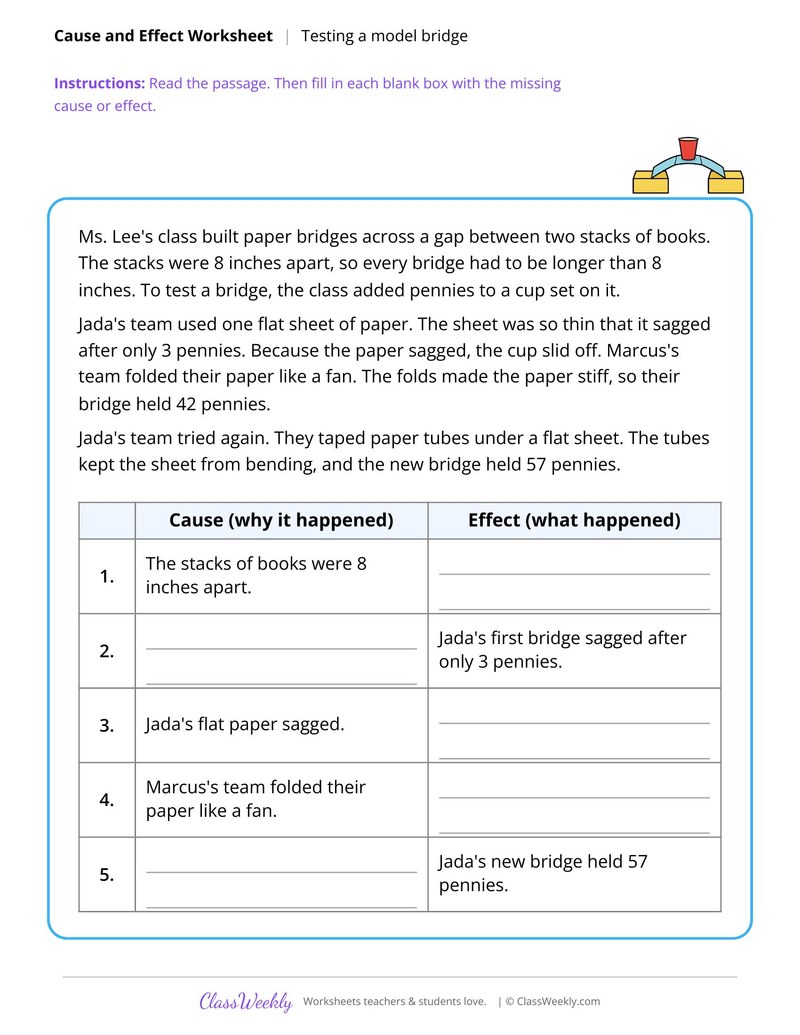
4th grade reading worksheet: read how a class tested paper bridges with pennies, then fill in 5 missing causes and effects. Answer key included. Part of our cause and effect in the real world comprehension exercises collection.
How do I use this worksheet?
Print the page and read the directions with your child: Read the passage. Then fill in each blank box with the missing cause or effect. When they finish, check the work together with the answer key.
What students will practice
- Students will identify causes and effects in a text.
- Students will explain why each bridge held more or fewer pennies.
- Students will complete a cause and effect chart.
Curriculum Links
Find this in the curriculum
Browse the grade, subject, and topic this belongs to.
FAQ
How do I use this cause and effect in the real world worksheet?
⌄
Print the page and read the directions with your child: Read the passage. Then fill in each blank box with the missing cause or effect. When they finish, check the work together with the answer key.
What does this worksheet teach?
⌄
A short account tells how Ms. Lee's class built paper bridges across an 8-inch gap and tested them with pennies in a cup: a flat sheet sagged after 3 pennies, a sheet folded like a fan held 42 and a sheet with paper tubes underneath held 57. A two-column chart of causes and effects has five blanks to fill. The directions on the page read: Read the passage. Then fill in each blank box with the missing cause or effect. An answer key is included.
Can I use this cause and effect in the real world worksheet for homeschool or classroom?
⌄
Yes, both. We made it for 4th Grade comprehension exercises, and the page works the same whether it lands on a kitchen table or a center rotation. At home, most families go through it together and talk the answers out loud, and that talking is where most of the learning happens with cause and effect in the real world. In class it runs well as independent work while you pull a small group. Print one copy or thirty, whichever the day needs.
How is cause and effect in the real world different from cause and effect in fiction?
⌄
Real-world cause and effect focuses on factual relationships (e.g., scientific events, historical causes) rather than fictional plot events, requiring students to apply the same logic to nonfiction contexts.
What signal words help students find cause-and-effect relationships?
⌄
Words like 'because,' 'therefore,' 'as a result,' 'due to,' 'since,' and 'consequently' signal a cause-and-effect relationship and help students locate these connections in text.
Why is teaching cause and effect with real-world examples important?
⌄
Real-world examples show students that cause-and-effect reasoning has practical value - from understanding weather patterns to historical events - making the skill feel relevant and meaningful.
What specific comprehension skills does fourth grade focus on?
⌄
Fourth grade comprehension standards cover: main idea and supporting details (RI.4.2), cause and effect (RI.4.3), compare and contrast between two texts on the same topic (RI.4.9), point of view, meaning first person versus third person (RL.4.6), fact versus opinion (RI.4.8), using context clues for unfamiliar words (L.4.4), and prediction based on evidence in the text. Each of these is typically taught and tested as its own distinct skill rather than bundled together.
How is a comprehension exercise worksheet different from a story worksheet?
⌄
A story worksheet centers on one passage and asks a range of question types about it. A comprehension exercise worksheet isolates a single skill, like cause and effect or compare and contrast, and gives focused practice on just that skill, often using two shorter passages instead of one longer one. This is useful when a student has already mastered general reading but is struggling with one particular skill, since it lets you target the exact gap instead of re-practicing everything at once.
How can I help my child improve reading comprehension skills at home?
⌄
Pick one skill at a time rather than practicing comprehension in general. If cause and effect is the target, read a short passage together and explicitly ask "what happened, and why did it happen?" after every paragraph, not just at the end. Repetition on a single named skill builds a mental habit faster than mixed general-comprehension practice, and it's easier to tell when the skill has actually clicked.
What is author's purpose in 4th grade?
⌄
It is the reason an author writes: to persuade, to inform or to entertain. Two of the author's purpose sheets give three texts on one theme, such as a text about tides, a letter asking for beach trash cans and a hermit crab story, and ask children to name each purpose and copy a detail that proves it (RI.4.6).
Ratings & Reviews
No reviews yet. Be the first to share what you think.
Reviews are for ClassWeekly members.
Make a Request
Spotted something to fix, or want a worksheet we don't have yet? Tell us and we'll make it.
Worksheet Details
| Grade | 4th Grade |
| Subject | Reading |
| Topic | Comprehension Exercises |
| Pages | 1 page |
| Difficulty | Medium |
What is ClassWeekly?
ClassWeekly offers free worksheets and printable learning resources for kids, from preschool up. All worksheets are aligned to Common Core, NGSS, and C3 Framework standards and designed by educators. Become a member to access the full library and download unlimited PDFs.