Emily Roebling and the Brooklyn Bridge
Written by Adi Ackerman, Head Teacher
"Emily Roebling and the Brooklyn Bridge" is written for 4th Grade (Ages 9-10), and it covers Common Core RI.4.1. If your little one is a year younger but already steady on paragraphs & passages, the page still works. You may just need to read the instructions out loud. And if they are older and nonfiction passages never quite stuck, this is a short review rather than busywork.
2 pages in this set
4th grade reading worksheet: read how Emily Warren Roebling helped build the Brooklyn Bridge, opened in 1883, then answer 5 questions. Answer key included. Part of our nonfiction passages collection. Aligned to Common Core standards.
How do I use this worksheet?
Print the page and read the directions with your child: Read the passage on page 1. Then use it to answer the questions on page 2. Fill in the bubble or write your answer on the lines. When they finish, check the work together with the answer key.
What students will practice
- Students will read a nonfiction passage about a historical figure.
- Students will refer to details in the text to answer questions.
- Students will use context to find the meaning of oversaw.
Curriculum Links
Common Core State Standards
Reading: Informational Text · 4th Grade
Standard: Refer to details and examples in a text when explaining what the text says explicitly and when drawing inferences from the text.
View all RI.4.1 worksheets →Find this in the curriculum
Browse the grade, subject, and topic this belongs to.
FAQ
How do I use this nonfiction passages worksheet?
⌄
Print the page and read the directions with your child: Read the passage on page 1. Then use it to answer the questions on page 2. Fill in the bubble or write your answer on the lines. When they finish, check the work together with the answer key.
What does this worksheet teach?
⌄
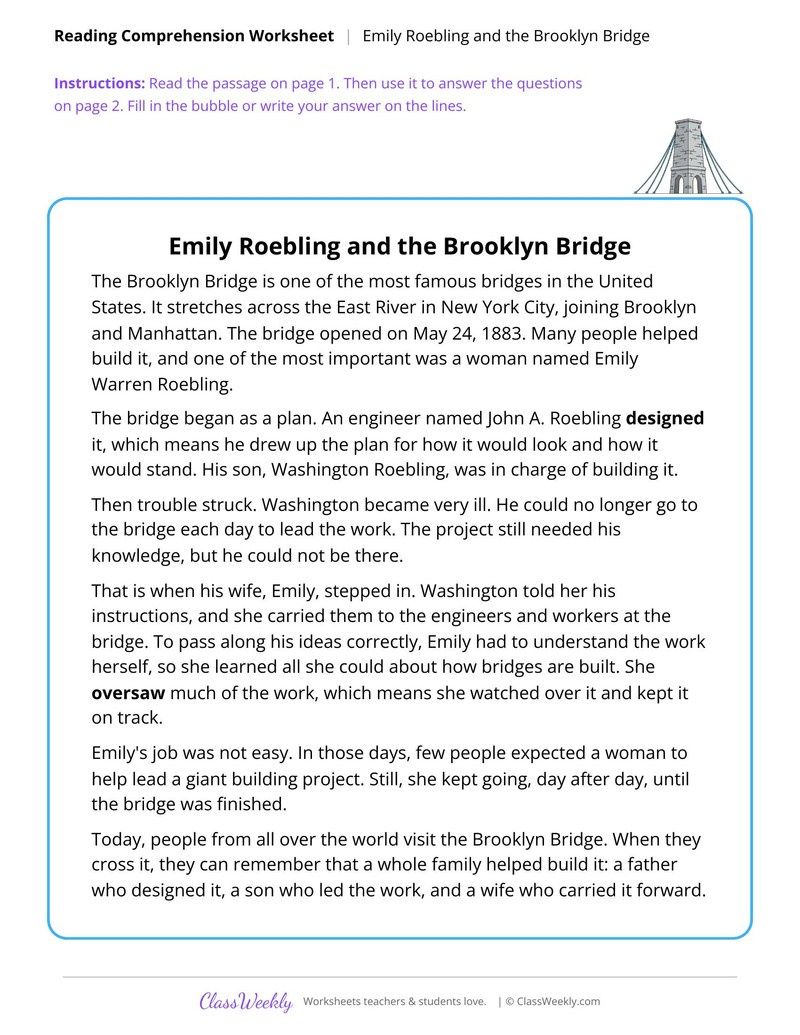
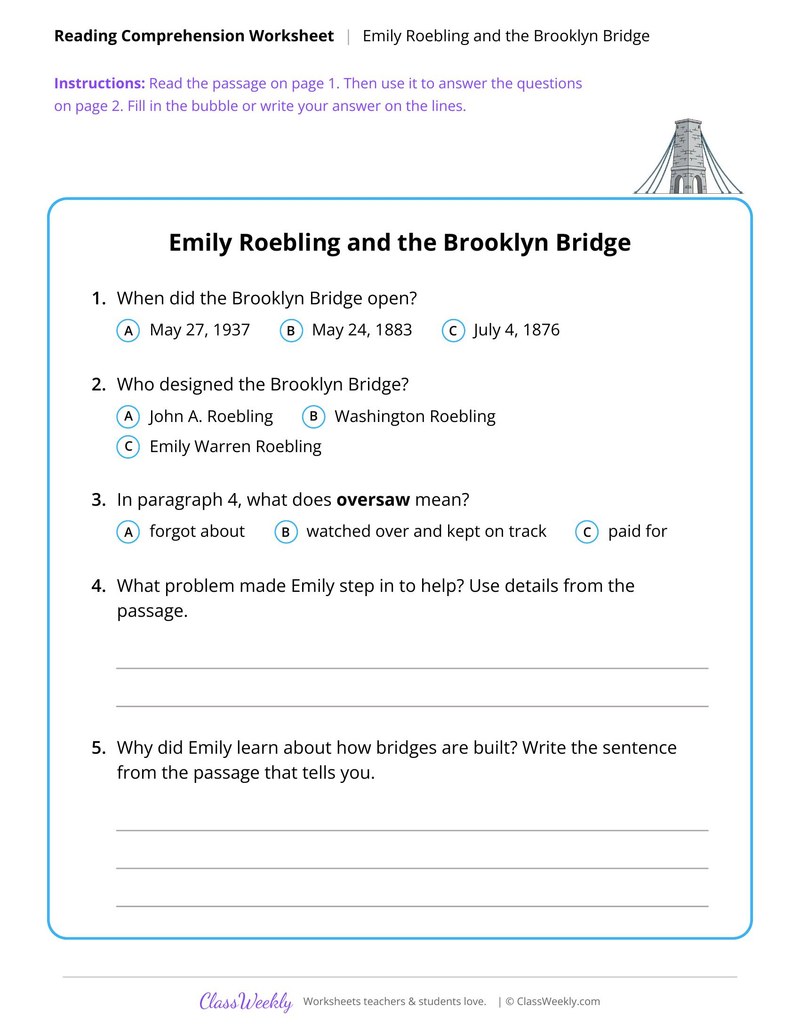
A nonfiction passage tells how the Brooklyn Bridge, which opened on May 24, 1883, was designed by John A. Roebling and built under his son Washington, and how Washington's wife, Emily Warren Roebling, carried his instructions to the engineers and workers after he became very ill. Page 2 asks when the bridge opened, who designed it, what oversaw means, what problem made Emily step in and why she learned how bridges are built. The directions on the page read: Read the passage on page 1. Then use it to answer the questions on page 2. Fill in the bubble or write your answer on the lines. An answer key is included.
Can I use this nonfiction passages worksheet for homeschool or classroom?
⌄
Yes, both. We made it for 4th Grade paragraphs & passages, and the page works the same whether it lands on a kitchen table or a center rotation. At home, most families go through it together and talk the answers out loud, and that talking is where most of the learning happens with nonfiction passages. In class it runs well as independent work while you pull a small group. Print one copy or thirty, whichever the day needs.
What is a nonfiction passage?
⌄
A nonfiction passage, also called informational text, gives true facts about a real topic, such as a person, a place, an animal or an event. Some sheets use an opinion article, letter or diary by a made-up writer, and each one is labeled made up on the page while the facts in it are real.
What are the five text structures?
⌄
The five text structures are description, sequence (time order), compare and contrast, cause and effect, and problem and solution. The text structure sheets use four of them, with time order texts on the Golden Gate Bridge and the Space Needle, compare and contrast texts on frogs and toads and on comets and asteroids, cause and effect texts on the Model T and penicillin, and problem and solution texts on lost pets and wildlife crossings. Clue words like first, both, because and to fix help students tell them apart.
What is the difference between a firsthand and a secondhand account?
⌄
A firsthand account is told by someone who was there, using words like I and we, and it shares what they saw and felt. A secondhand account is told by someone who was not there, such as an encyclopedia writer, and it usually gives more facts and numbers. On 12 sheets students compare a made-up firsthand letter or diary, such as a visitor's letter from the first Ferris wheel in 1893 or a child's diary from the first World Series in 1903, with an encyclopedia article about the same event.
Do the passages have answer keys?
⌄
Yes. All 124 nonfiction sheets have an answer key. On the newer sheets, the key gives a model answer for every chart box and written item and lists other answers the passage supports.
What are the best nonfiction reading worksheets for 4th grade?
⌄
Short nonfiction passages on science, history and real people, each followed by questions. The 4th grade passages here include The Great Barrier Reef, How Earthquakes Happen, The Life of Harriet Tubman, Wolves of Yellowstone, The Wright Brothers and The Human Heart, with a few fiction passages for comparison.
What is on each 4th grade passage sheet?
⌄
The 102 newer nonfiction sheets have a passage of about 230 to 310 words on page one and 6 to 9 questions on the next page, with a chart, chain, timeline, table, map or bar graph to fill in or read. The firsthand account and paired text sheets add a second text on its own page, so they run three pages. The 40 earlier sheets, 20 nonfiction and 20 fiction, pair a passage of about 200 to 260 words with a page of multiple choice and short written questions. The Veterans Day passage fits its text and 3 questions on one page. The Veterans Day passage fits its text and 3 questions on one page. The Veterans Day passage fits its text and 3 questions on one page. The Veterans Day passage fits its text and 3 questions on one page. The Veterans Day passage fits its text and 3 questions on one page. The Veterans Day passage fits its text and 3 questions on one page. The Veterans Day passage fits its text and 3 questions on one page.
What reading skills do these 4th grade passages practice?
⌄
The nonfiction sheets practice main idea and summarizing (RI.4.2), explaining events and steps (RI.4.3), text structure (RI.4.5), firsthand and secondhand accounts (RI.4.6), reading timelines, tables, maps and graphs (RI.4.7), reasons and evidence (RI.4.8) and combining two texts on one topic (RI.4.9). The fiction sheets practice theme, character feelings, inference and similes (RL.4.1, RL.4.2).
How do I use passage worksheets in a reading routine?
⌄
Have students read the passage once for the gist, then again with a pencil to underline clues. Then answer the questions and check against the key. Use a nonfiction passage one day and a story the next, so students practice both text types.
Ratings & Reviews
No reviews yet. Be the first to share what you think.
Reviews are for ClassWeekly members.
Make a Request
Spotted something to fix, or want a worksheet we don't have yet? Tell us and we'll make it.
Worksheet Details
| Grade | 4th Grade |
| Subject | Reading |
| Topic | Paragraphs & Passages |
| Standard | RI.4.1 |
| Pages | 2 pages |
| Difficulty | Medium |
Learn More
What is ClassWeekly?
ClassWeekly offers free worksheets and printable learning resources for kids, from preschool up. All worksheets are aligned to Common Core, NGSS, and C3 Framework standards and designed by educators. Become a member to access the full library and download unlimited PDFs.