Deduce Charges From Attraction and Repulsion Tests
Written by Adi Ackerman, Head Teacher
"Deduce Charges From Attraction and Repulsion Tests" is written for 8th Grade (Ages 13-14). A 7th grader who is already steady on energy can use it too, and an older student can use it as a short review.
2 pages in this set
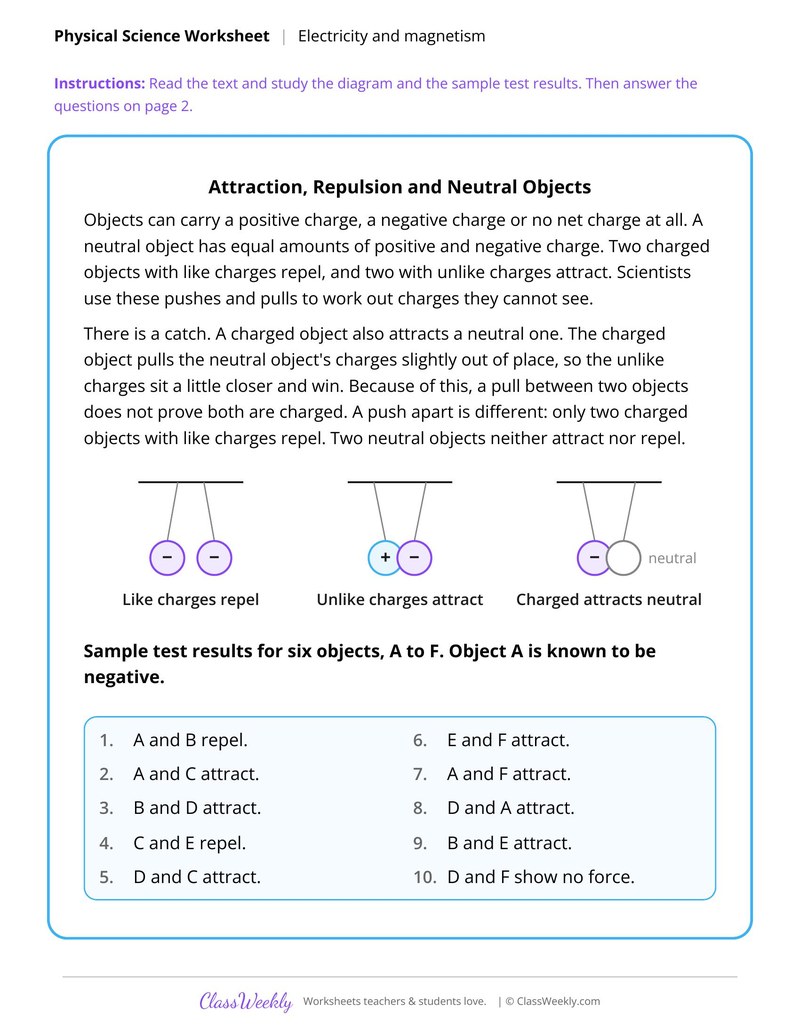
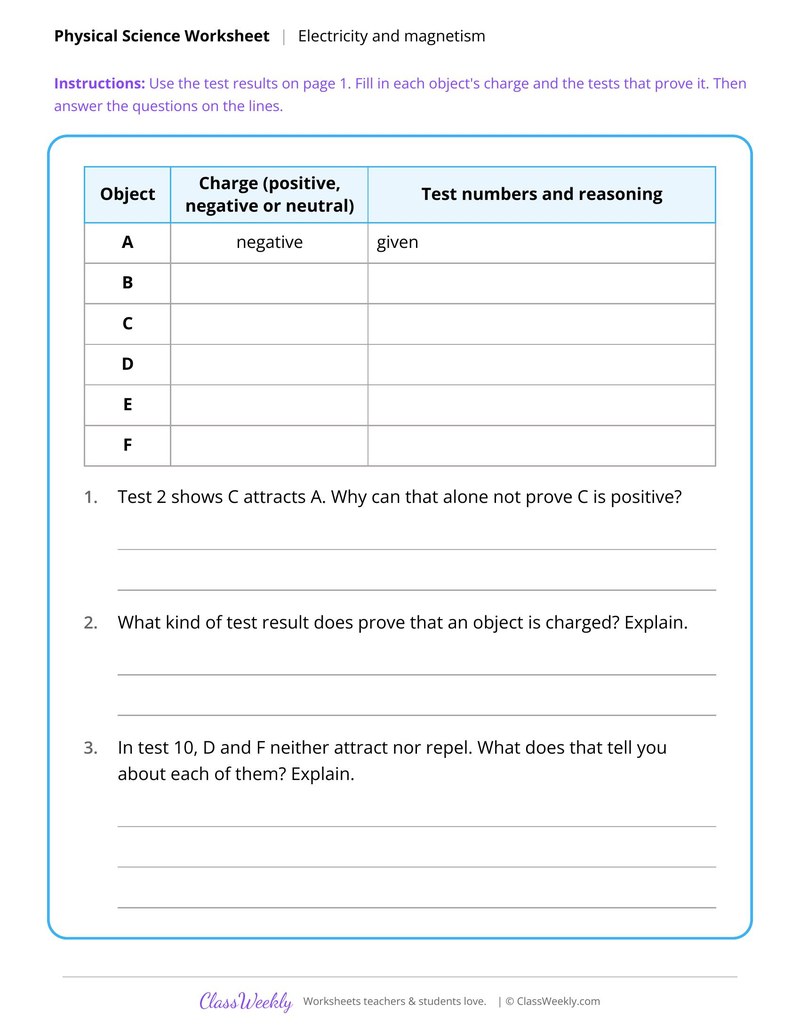
8th grade science worksheet: use attraction and repulsion tests to decide if objects A to F are positive, negative or neutral. Answer key included. Part of our electricity and magnetism energy collection.
How do I use this worksheet?
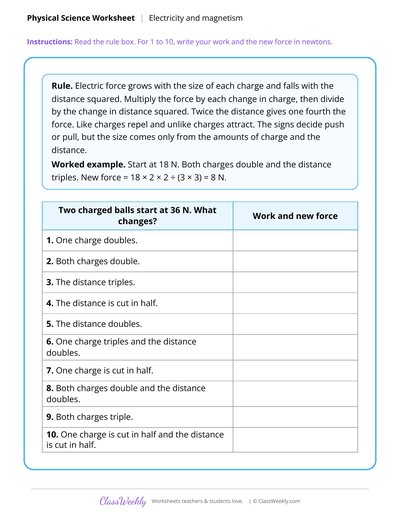
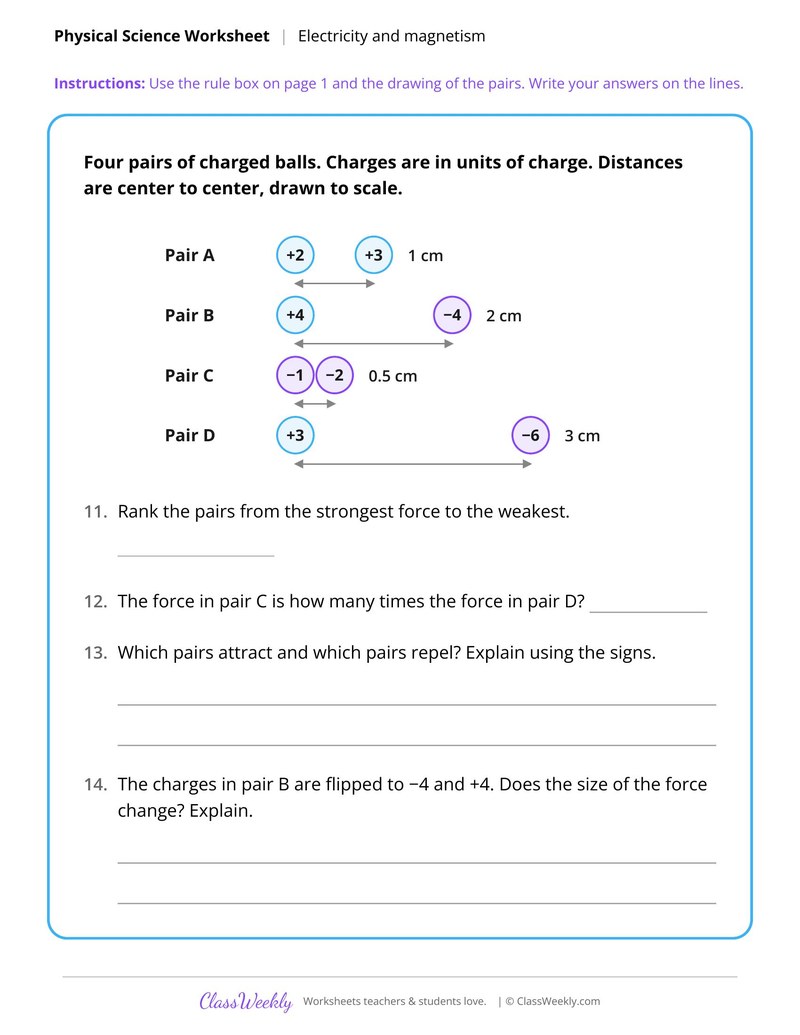
Begin with Sort Forces by Field Type, then the field line sheet. Use the three data sheets as lab style practice, and the force calculation sheet once students are comfortable with multiplying and dividing.
What students will practice
- Students will deduce each object's charge from a set of test results.
- Students will explain why attraction alone does not prove an object is charged.
- Students will explain why only repulsion proves two objects carry charge.
Curriculum Links
Find this in the curriculum
Browse the grade, subject, and topic this belongs to.
FAQ
How do I use this electricity and magnetism worksheet?
⌄
Begin with Sort Forces by Field Type, then the field line sheet. Use the three data sheets as lab style practice, and the force calculation sheet once students are comfortable with multiplying and dividing.
What does this worksheet teach?
⌄
Use attraction and repulsion tests to decide if objects A to F are positive, negative or neutral. The directions on the page read: Read the text and study the diagram and the sample test results. Then answer the questions on page 2. An answer key is included.
Can I use this electricity and magnetism worksheet for homeschool or classroom?
⌄
Yes, both. We made it for 8th grade energy, and it works the same at home or at school. At home, a student can work through it alone and then go over it with you, which shows quickly what is solid and what needs another look. In class it works as independent practice, homework or a warm-up, and you can print one copy or a full set.
How did Oersted link electricity and magnetism?
⌄
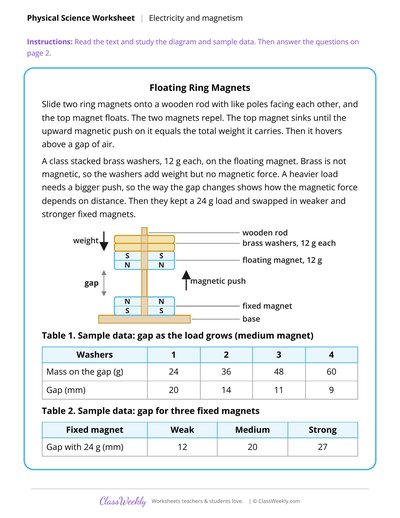
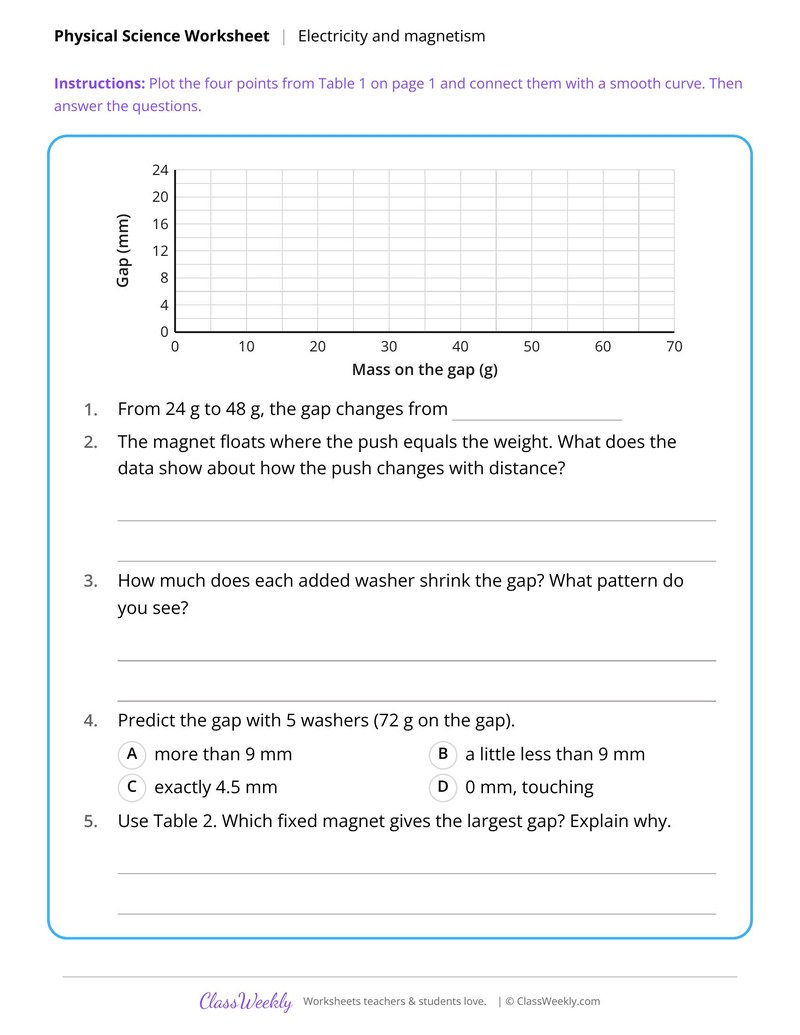
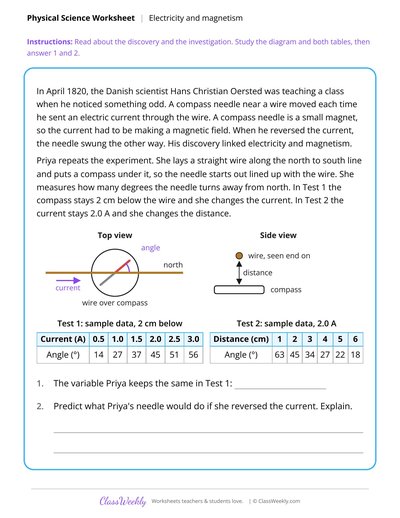
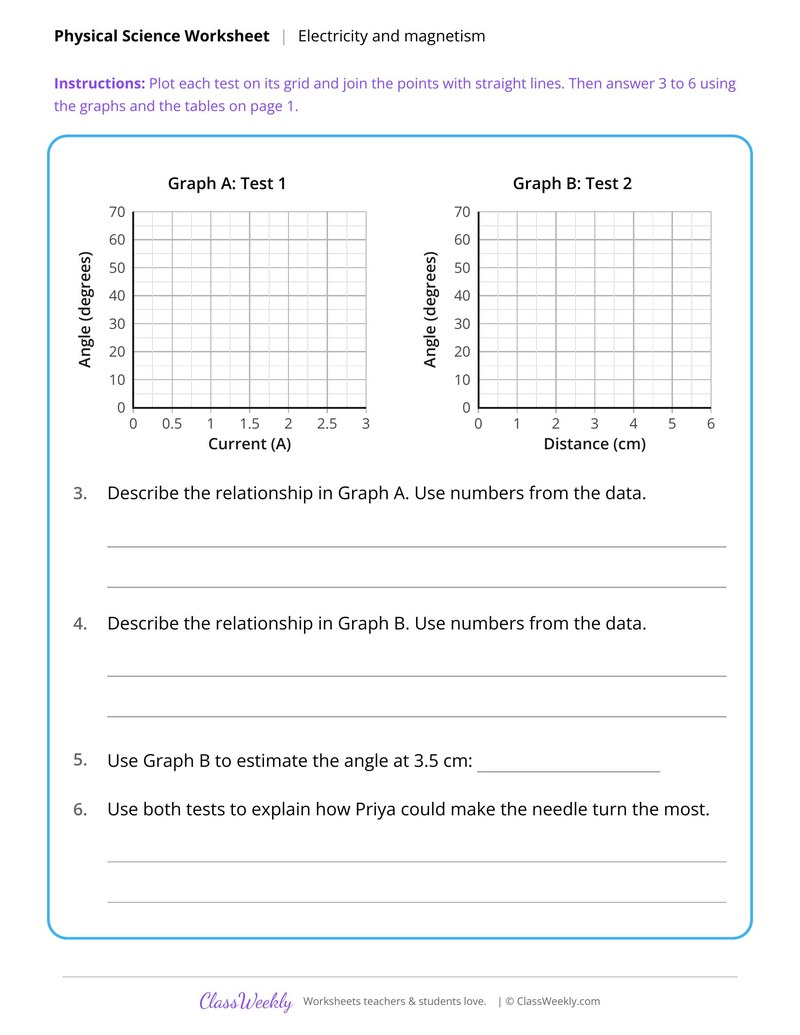
In 1820 Hans Christian Oersted saw a compass needle move each time he sent a current through a nearby wire. A compass needle is a small magnet, so the current had to make a magnetic field. Compass Deflection Near a Wire Carrying Current has students graph needle angles against current and distance.
Does attraction prove an object is charged?
⌄
No. A charged object can also attract a neutral one, so a pull alone does not prove both are charged. Only a push apart proves two objects carry like charges. Deduce Charges From Attraction and Repulsion Tests uses this rule to identify six objects.
What kinds of forces act at a distance?
⌄
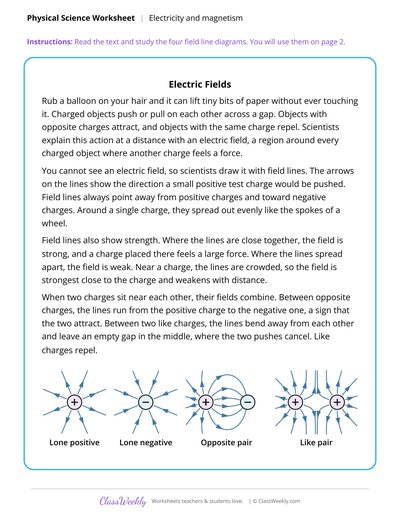
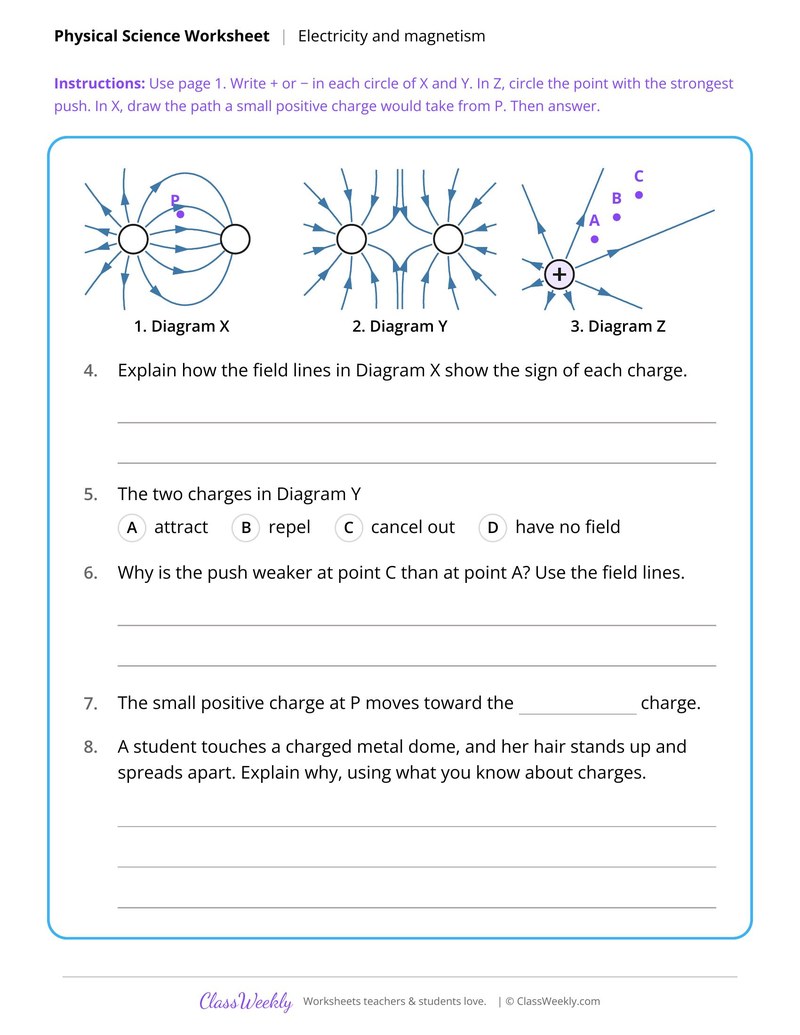
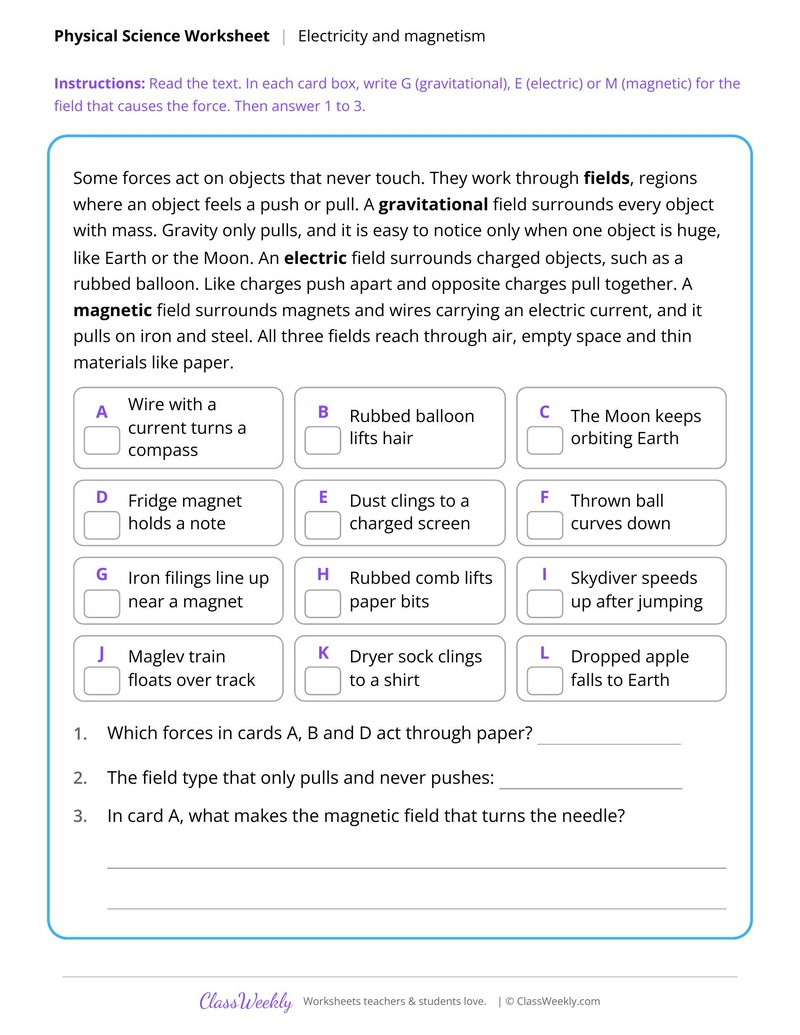
Gravitational, electric and magnetic forces all act through fields. Gravity pulls on anything with mass, electric fields surround charged objects and magnetic fields surround magnets and wires with a current. Sort Forces by Field Type has students sort everyday examples.
Ratings & Reviews
No reviews yet. Be the first to share what you think.
Reviews are for ClassWeekly members.
Make a Request
Spotted something to fix, or want a worksheet we don't have yet? Tell us and we'll make it.
Learn More
What is ClassWeekly?
ClassWeekly offers free worksheets and printable learning resources for kids, from preschool up. All worksheets are aligned to Common Core, NGSS, and C3 Framework standards and designed by educators. Become a member to access the full library and download unlimited PDFs.