Compound Words Skyscraper and More
Written by Adi Ackerman, Head Teacher
"Compound Words Skyscraper and More" is written for 2nd Grade (Ages 7-8), and it covers Common Core L.2.4.D. If your little one is a year younger but already steady on affixes and compound words, the page still works. You may just need to read the instructions out loud. And if they are older and write compound words never quite stuck, this is a short review rather than busywork.
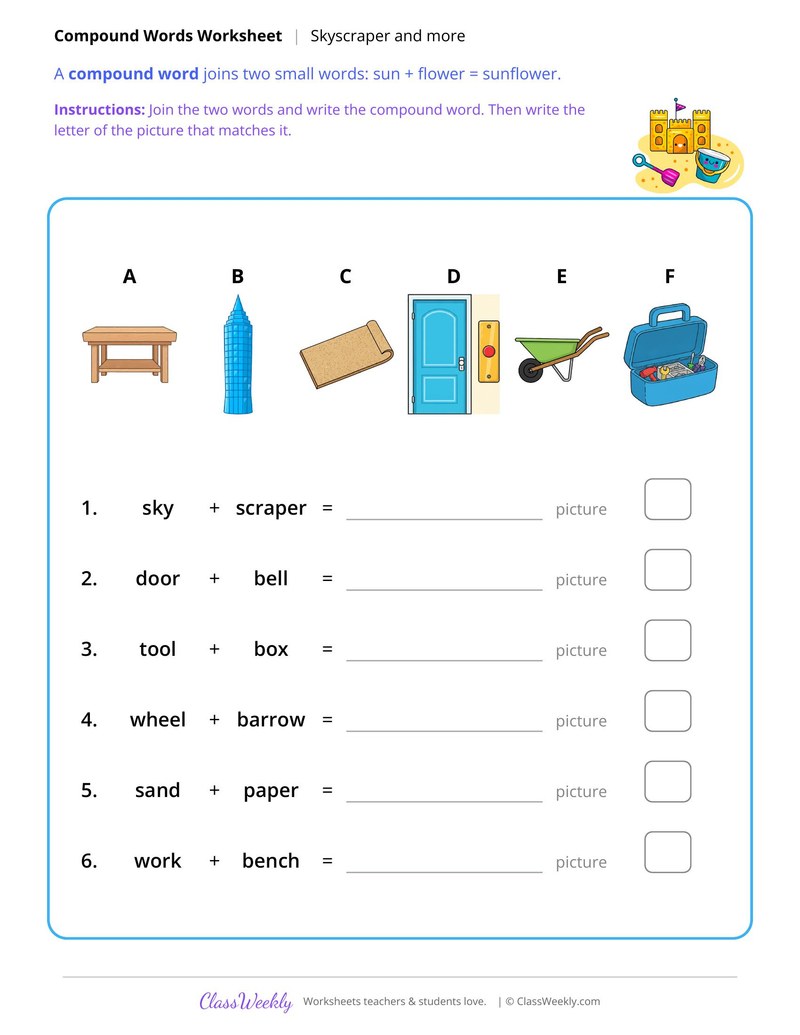
2nd grade vocabulary worksheet: join 6 word pairs like sky and scraper into compound words and match each to a picture. Answer key included. Part of our write compound words collection. Aligned to Common Core standards.
How do I use this worksheet?
Print the page and read the directions with your child: Join the two words and write the compound word. Then write the letter of the picture that matches it. When they finish, check the work together with the answer key.
What students will practice
- Students will join two words to make a compound word.
- Students will write 6 compound words.
- Students will match each compound word to a picture.
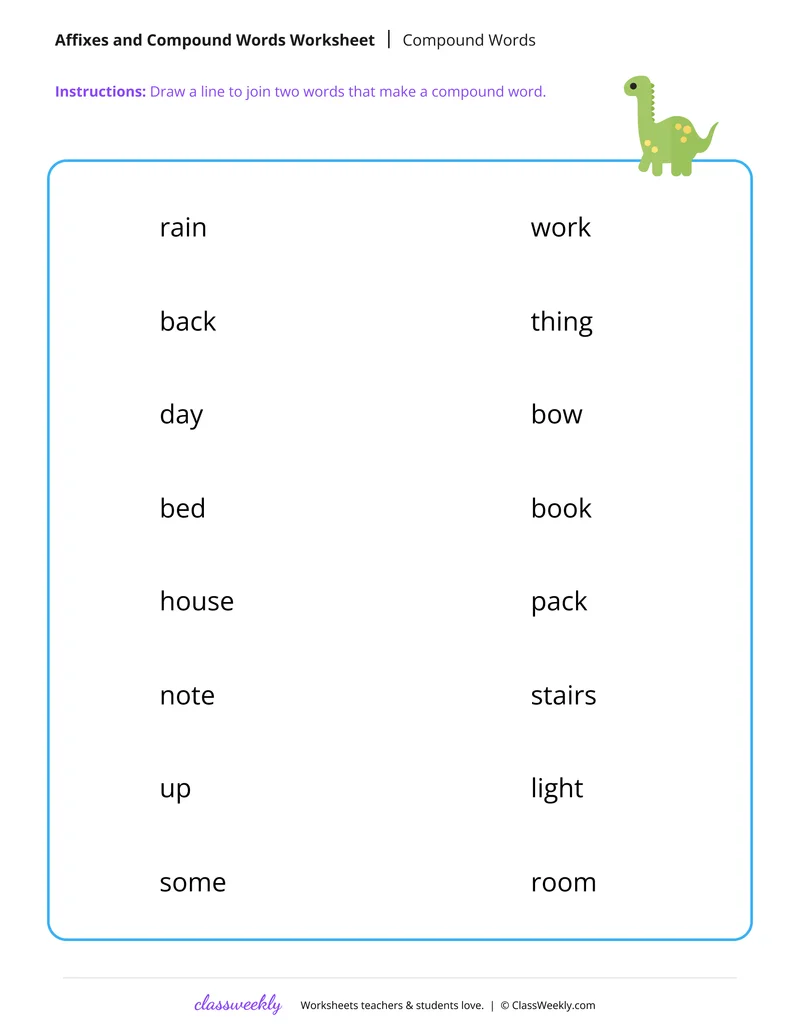
Curriculum Links
Common Core State Standards
Language · 2nd Grade
Standard: Use knowledge of the meaning of individual words to predict the meaning of compound words (e.g., birdhouse, lighthouse, housefly; bookshelf, notebook, bookmark).
View all L.2.4.D worksheets →Find this in the curriculum
Browse the grade, subject, and topic this belongs to.
FAQ
How do I use this write compound words worksheet?
⌄
Print the page and read the directions with your child: Join the two words and write the compound word. Then write the letter of the picture that matches it. When they finish, check the work together with the answer key.
What does this worksheet teach?
⌄
A note shows how a compound word joins two small words, as in sun and flower. Six word pairs follow: sky and scraper, door and bell, tool and box, wheel and barrow, sand and paper, and work and bench, with six lettered pictures to match. The directions on the page read: Join the two words and write the compound word. Then write the letter of the picture that matches it. An answer key is included.
Can I use this write compound words worksheet for homeschool or classroom?
⌄
Yes, both. We made it for 2nd Grade affixes and compound words, and the page works the same whether it lands on a kitchen table or a center rotation. At home, most families go through it together and talk the answers out loud, and that talking is where most of the learning happens with write compound words. In class it runs well as independent work while you pull a small group. Print one copy or thirty, whichever the day needs.
How can a compound word help with its meaning?
⌄
The two smaller words often explain the big one. A toolbox is a box for tools, and a doorbell is a bell by the door.
Is there an answer key?
⌄
Yes. Both sheets have an answer key.
What is the difference between Suffixes and Identify Suffixes?
⌄
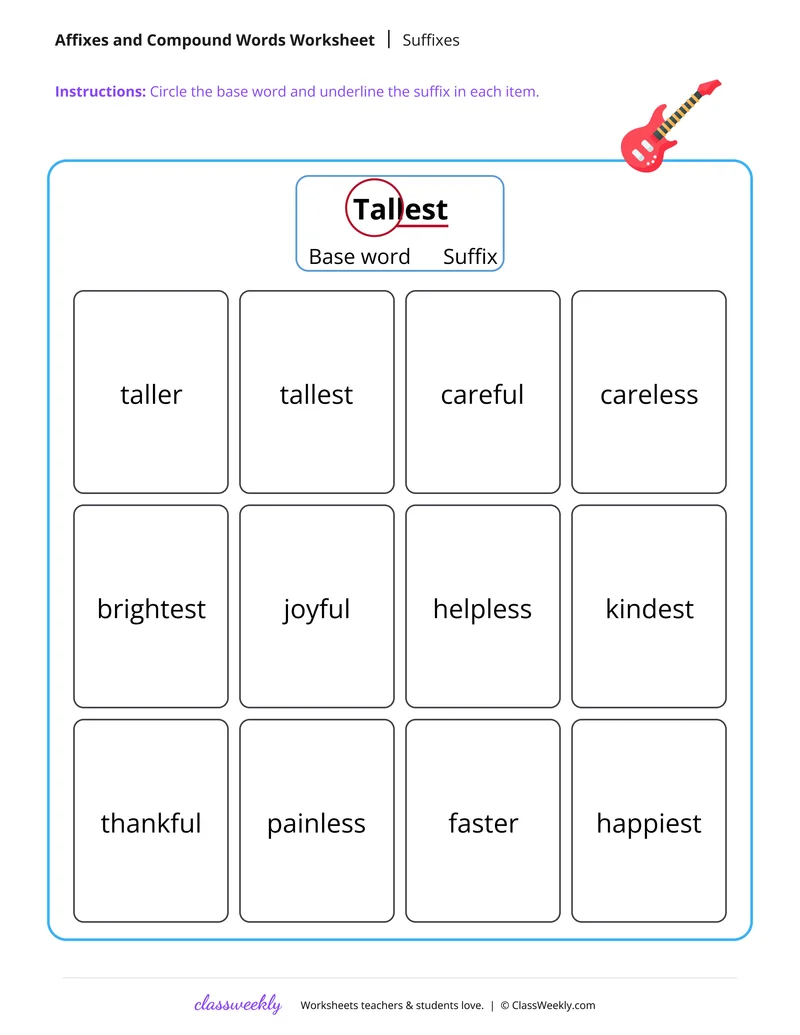
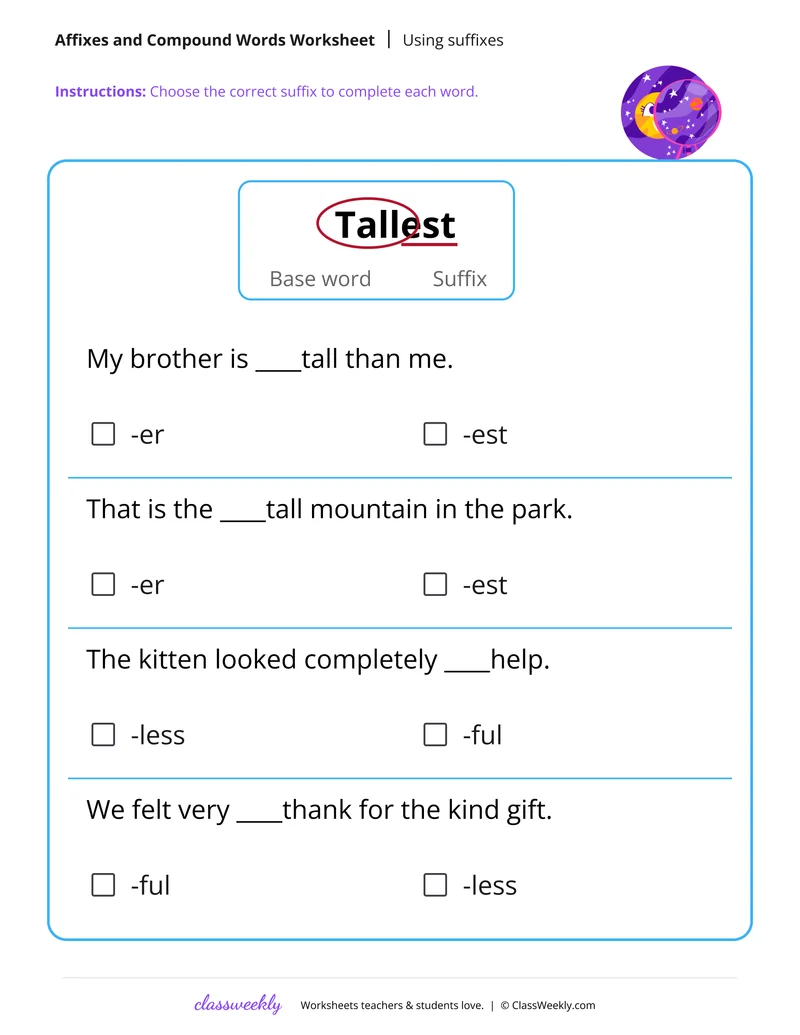
Suffixes pages take words apart and build them, splitting words like jumped into jump and ed and matching ful, less, er and est to their meanings. Identify Suffixes pages ask your child to choose the suffix that fits, like ed or ing, er or est, or ful or less, in sentences and a short zoo story.
What's the difference between Prefixes and Identify Prefixes?
⌄
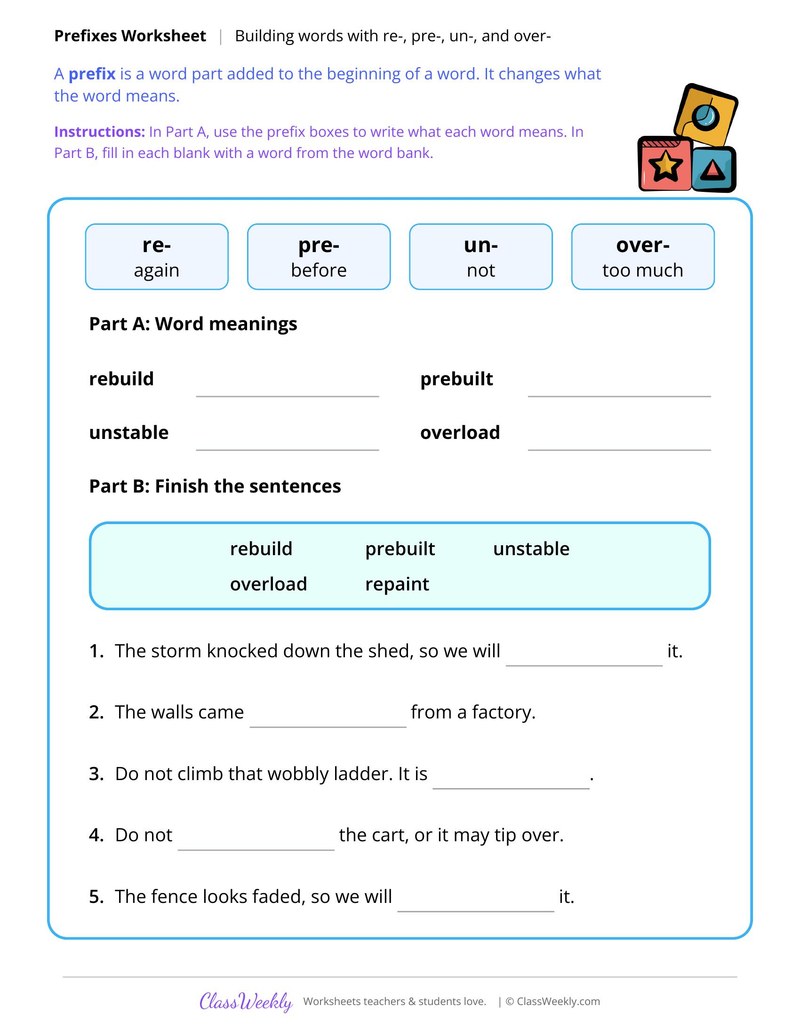
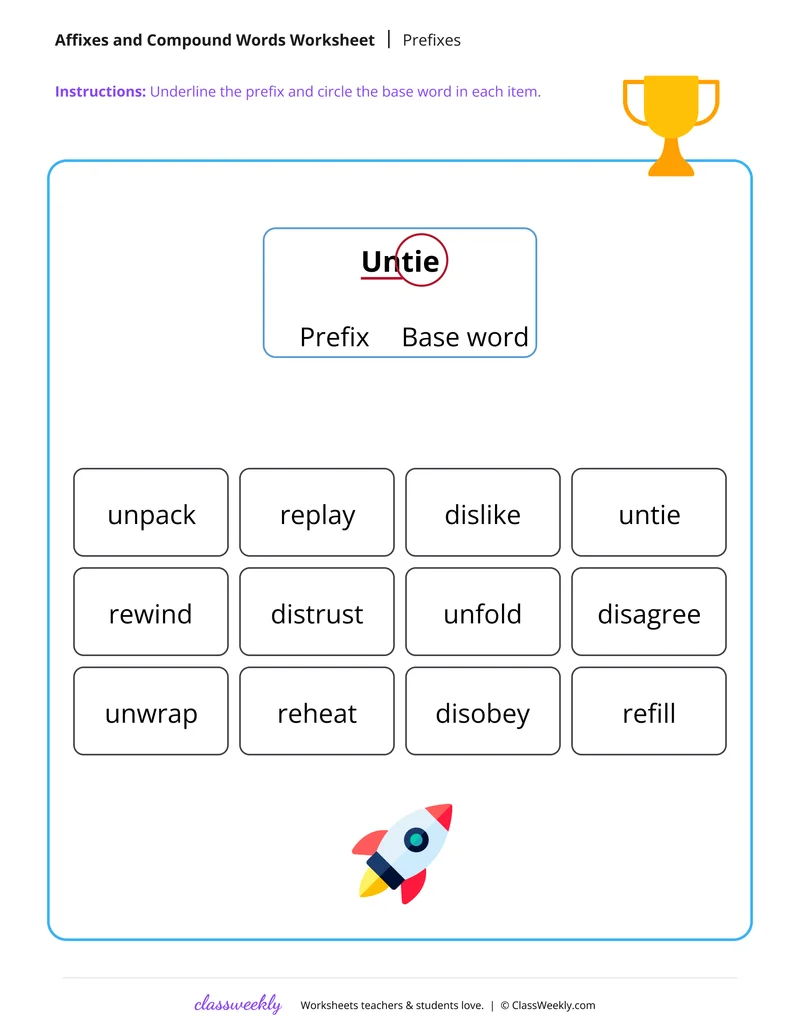
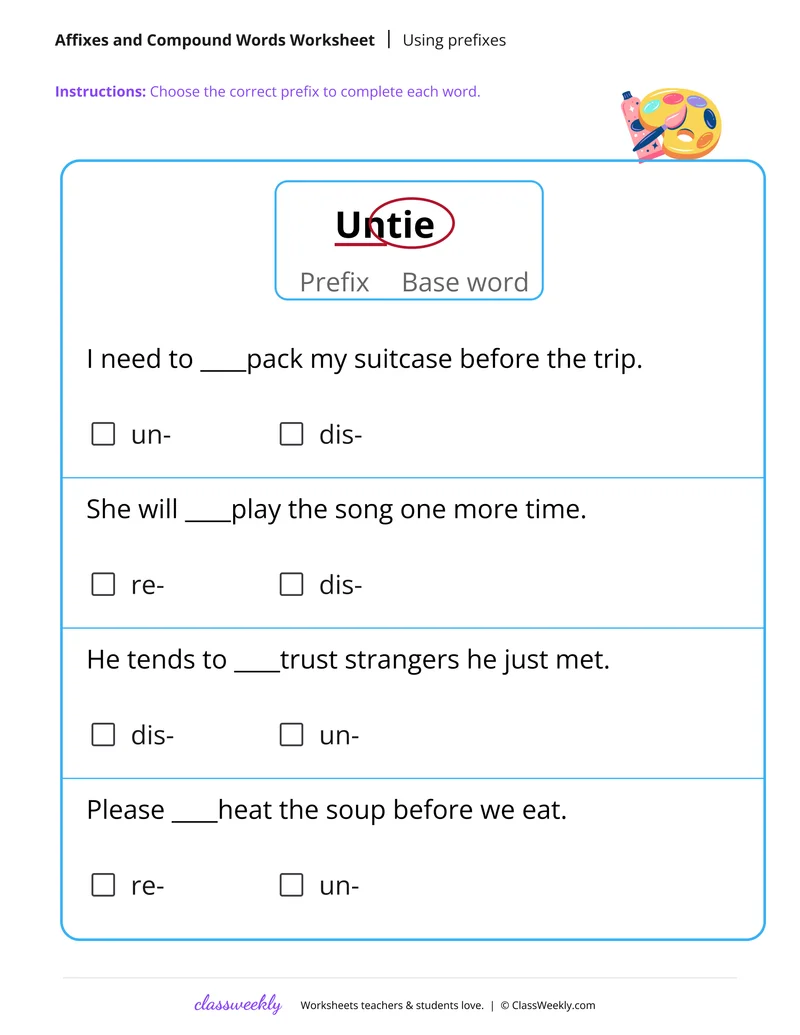
Prefixes has your child underline the prefix and circle the base word inside an already-complete word, a labeling task. Identify Prefixes goes a step further: the word is missing its prefix inside a full sentence, and your child has to choose the correct one from two options based on what the sentence means. Labeling comes first, then choosing correctly in context.
Why teach compound words in the same topic as prefixes and suffixes?
⌄
Both skills are about noticing that a longer, unfamiliar-looking word is often built from smaller, familiar pieces. Compound words combine two whole words (sunlight from sun and light), while prefixes and suffixes attach a smaller piece to a base word (unhappy from un and happy). Once a child sees English this way, long words stop feeling scary and start feeling solvable.
My child adds a prefix or suffix that doesn't exist, like 'unkindful.' Is that a bad sign?
⌄
It's actually a good sign. A word like unkindful means your child has correctly learned that un means not and ful means full of, and is combining two real rules they've picked up separately. The rules just haven't learned their limits yet. Point out that kindful isn't a real word to begin with, and the mix-up usually clears up fast.
Ratings & Reviews
No reviews yet. Be the first to share what you think.
Reviews are for ClassWeekly members.
Make a Request
Spotted something to fix, or want a worksheet we don't have yet? Tell us and we'll make it.
Worksheet Details
| Grade | 2nd Grade |
| Subject | Vocabulary |
| Topic | Affixes and Compound Words |
| Standard | L.2.4.D |
| Pages | 1 page |
| Difficulty | Medium |
What is ClassWeekly?
ClassWeekly offers free worksheets and printable learning resources for kids, from preschool up. All worksheets are aligned to Common Core, NGSS, and C3 Framework standards and designed by educators. Become a member to access the full library and download unlimited PDFs.