Coordinate Plane Blueprint
Written by Adi Ackerman, Head Teacher
"Coordinate Plane Blueprint" is written for 5th Grade (Ages 10-11), and it covers Common Core 5.G.A.2. If your little one is a year younger but already steady on geometry, the page still works. You may just need to read the instructions out loud. And if they are older and plot points on a coordinate grid never quite stuck, this is a short review rather than busywork.
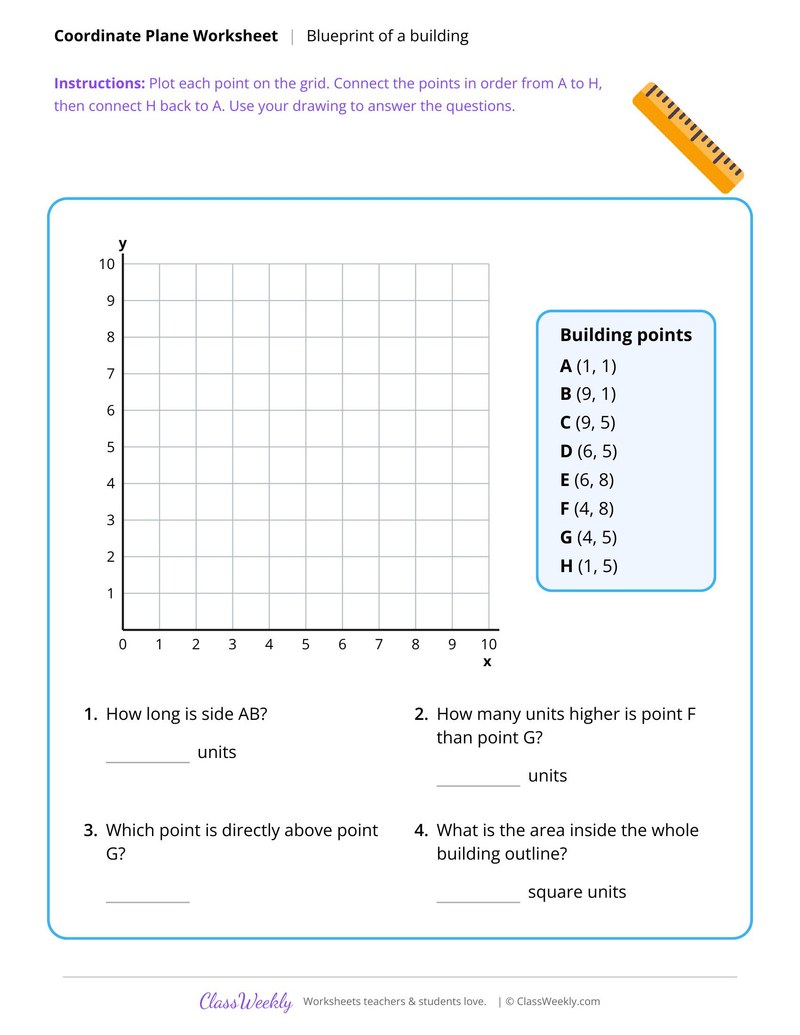
5th grade geometry worksheet: plot 8 points and connect them into a building outline, then answer 4 length and area questions. Answer key included. Part of our plot points on a coordinate grid geometry collection. Aligned to Common Core standards.
How do I use this worksheet?
Print the page and read the directions with your child: Plot each point on the grid. Connect the points in order from A to H, then connect H back to A. Use your drawing to answer the questions. When they finish, check the work together with the answer key.
What students will practice
- Students will plot ordered pairs on a coordinate grid.
- Students will find distances between points on a grid.
- Students will find the area of a shape drawn on the grid.
Curriculum Links
Common Core State Standards
Geometry · 5th Grade
Standard: Represent real world and mathematical problems by graphing points in the first quadrant of the coordinate plane, and interpret coordinate values of points in the context of the situation.
View all 5.G.A.2 worksheets →Find this in the curriculum
Browse the grade, subject, and topic this belongs to.
FAQ
How do I use this plot points on a coordinate grid worksheet?
⌄
Print the page and read the directions with your child: Plot each point on the grid. Connect the points in order from A to H, then connect H back to A. Use your drawing to answer the questions. When they finish, check the work together with the answer key.
What does this worksheet teach?
⌄
A first-quadrant grid from 0 to 10 and a list of eight building points, from A (1, 1) to H (1, 5). Children plot and connect the points to draw the outline of a building, then answer four questions, such as how long side AB is and what the area inside the whole outline is. The directions on the page read: Plot each point on the grid. Connect the points in order from A to H, then connect H back to A. Use your drawing to answer the questions. An answer key is included.
Can I use this plot points on a coordinate grid worksheet for homeschool or classroom?
⌄
Yes, both. We made it for 5th Grade geometry, and the page works the same whether it lands on a kitchen table or a center rotation. At home, most families go through it together and talk the answers out loud, and that talking is where most of the learning happens with plot points on a coordinate grid. In class it runs well as independent work while you pull a small group. Print one copy or thirty, whichever the day needs.
Which number in an ordered pair comes first?
⌄
The x-coordinate comes first and tells how far to move across. The y-coordinate comes second and tells how far to move up.
Is there an answer key?
⌄
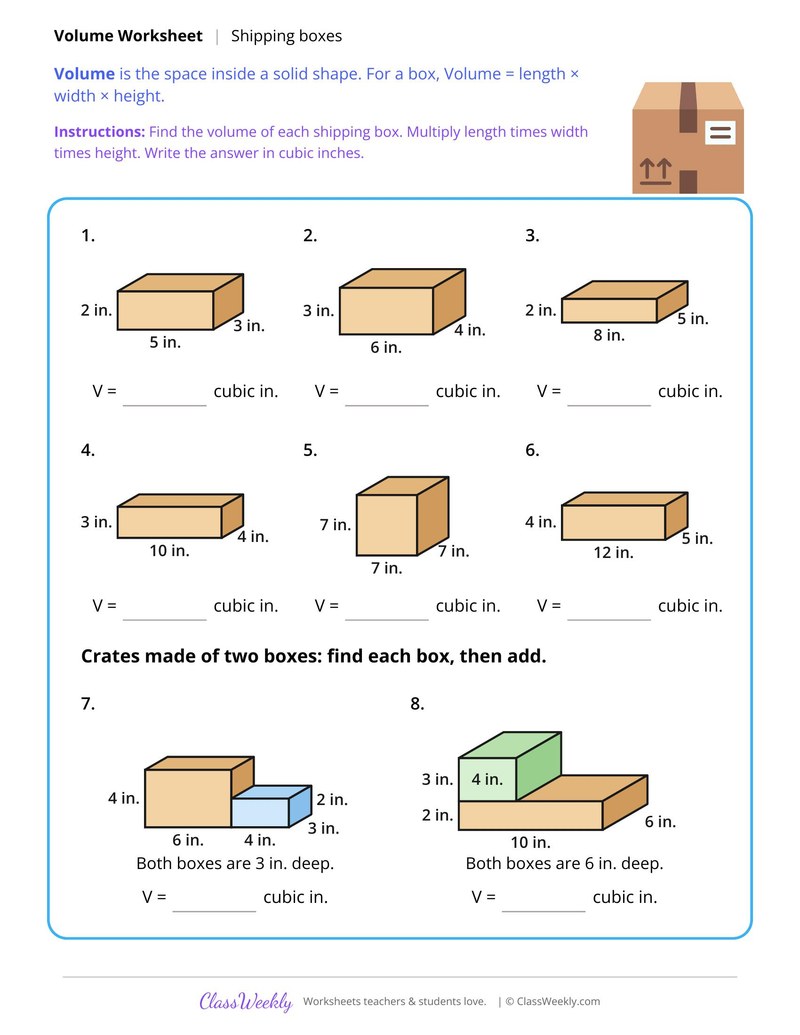
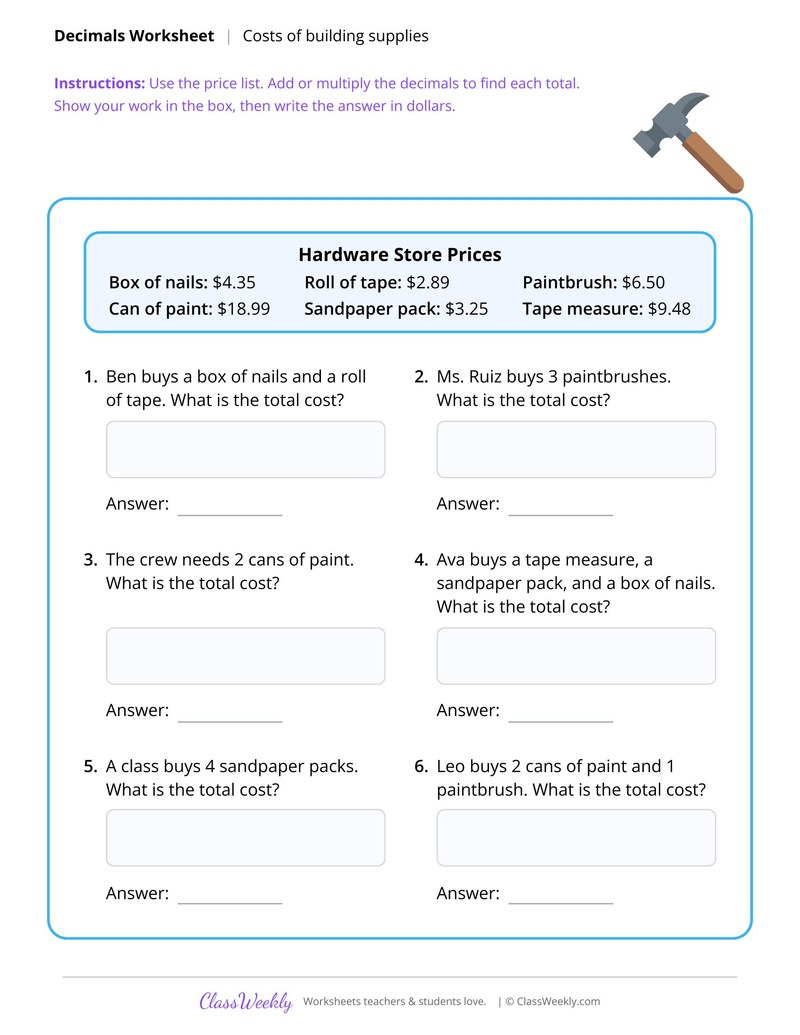
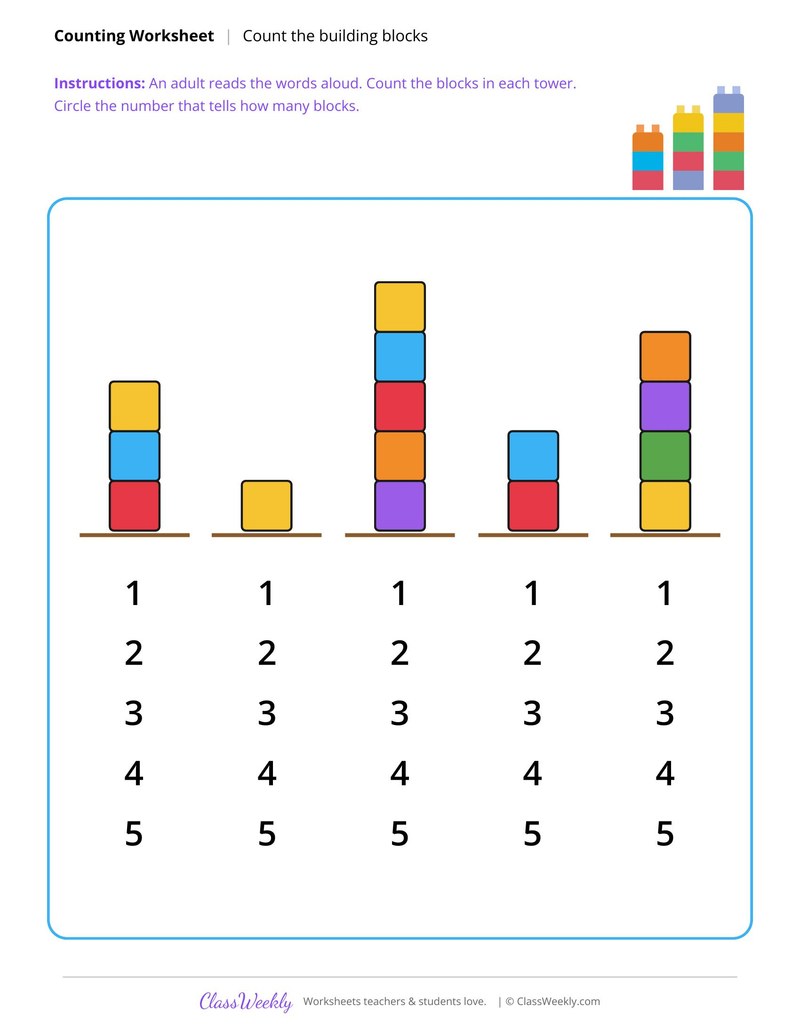
Yes. Both sheets have an answer key.
What geometry concepts do fifth graders study?
⌄
Fifth-grade geometry covers three major areas: coordinate planes, two-dimensional figure classification, and volume (CCSS 5.G and 5.MD). Students learn to plot ordered pairs in the first quadrant of a coordinate plane and use coordinates to solve problems, including simple graphing of function rules (5.G.A.1-2). They classify two-dimensional figures based on properties, understanding that categories form hierarchies (all rectangles are parallelograms, all squares are rectangles, 5.G.B.3-4). Volume of rectangular prisms is the major new measurement concept: students understand volume as filling with unit cubes and apply the formulas V equals l times w times h and V equals B times h, including for composite solid figures (5.MD.C.3-5). Worksheets in this domain should move between concrete tasks (how many cubes fill this box?) and abstract applications (find the volume of a figure with dimensions given as decimals) to build both conceptual and procedural understanding.
How do fifth graders calculate volume?
⌄
Volume is introduced through the concept of packing a rectangular prism with unit cubes (CCSS 5.MD.C.3). Each layer of unit cubes covering the base of the prism has the same number of cubes as the area of the base (length times width). Stacking layers equal in number to the height gives the total volume. This leads directly to the formula V equals l times w times h or equivalently V equals B times h (where B is base area). Fifth graders apply this formula to whole-number dimensions and extend it to problems where one dimension is unknown (if a box has volume 60 cubic cm, length 5 cm, and width 4 cm, what is the height?). Composite prisms (an L-shaped solid) are solved by splitting into two rectangular prisms, computing each volume, and adding. Worksheets should include both finding volume from given dimensions and finding a missing dimension from given volume and two sides. Unit labeling (cubic centimeters, cubic inches, cubic feet) must be required, since labeling errors on assessments commonly result in point deductions.
What coordinate plane skills are expected in fifth grade?
⌄
Fifth graders work in the first quadrant of the coordinate plane (positive x and y coordinates only; negative quadrants are a sixth-grade extension). They learn to plot ordered pairs by starting at the origin, moving right by the x-coordinate, then moving up by the y-coordinate (CCSS 5.G.A.1). Students read coordinates of plotted points, identify the coordinates of vertices of polygons, and apply coordinates to solve real problems (finding the distance between two points that share the same x or y coordinate). They also graph simple rules (plot all points where y equals x plus 2) and recognize that the resulting set of points forms a line (5.G.A.2). A common error is reversing the coordinates: (3, 4) means 3 right and 4 up, not 4 right and 3 up. Worksheets that require students to label which coordinate is x and which is y before plotting, and that include tasks where reversing coordinates gives a clearly wrong result (a polygon vertex that falls outside the figure), help students internalize the correct convention.
Ratings & Reviews
No reviews yet. Be the first to share what you think.
Reviews are for ClassWeekly members.
Make a Request
Spotted something to fix, or want a worksheet we don't have yet? Tell us and we'll make it.
What is ClassWeekly?
ClassWeekly offers free worksheets and printable learning resources for kids, from preschool up. All worksheets are aligned to Common Core, NGSS, and C3 Framework standards and designed by educators. Become a member to access the full library and download unlimited PDFs.