Color Code a Root Hair Cell
Written by Adi Ackerman, Head Teacher
"Color Code a Root Hair Cell" is written for 7th Grade (Ages 12-13), and it covers NGSS MS-LS1-2. A 6th grader who is already steady on living things can use it too, and an older student can use it as a short review.
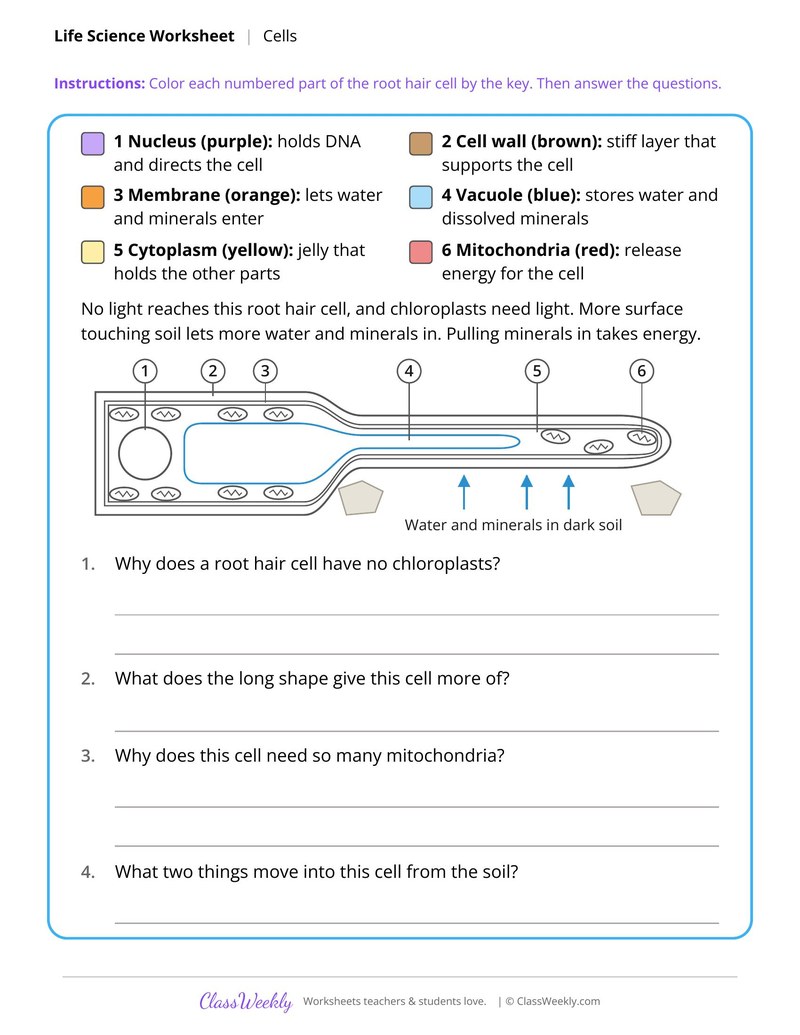
7th grade science worksheet: color code the parts of a root hair cell and explain why it has mitochondria but no chloroplasts. Answer key included. Part of our cells living things collection. Aligned to NGSS standards.
How do I use this worksheet?
Begin with the color code sheets and the lifestyle sheet, then use the case studies and mystery cells for application. Close with the mitosis group of sheets.
What students will practice
- Students will color the six parts of a root hair cell by a key.
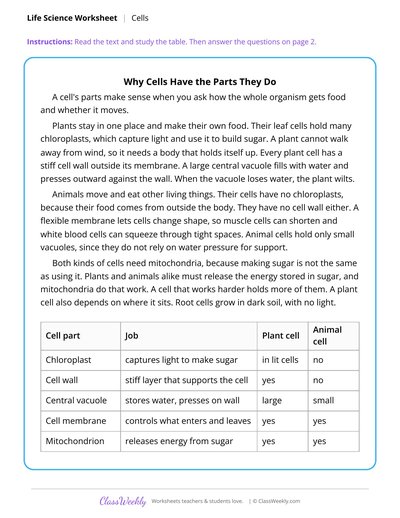
- Students will explain why the cell has mitochondria but no chloroplasts.
- Students will explain how the shape of a root hair helps it take in water and minerals.
Curriculum Links
Next Generation Science Standards
Science · 7th Grade
Find this in the curriculum
Browse the grade, subject, and topic this belongs to.
FAQ
How do I use this cells worksheet?
⌄
Begin with the color code sheets and the lifestyle sheet, then use the case studies and mystery cells for application. Close with the mitosis group of sheets.
What does this worksheet teach?
⌄
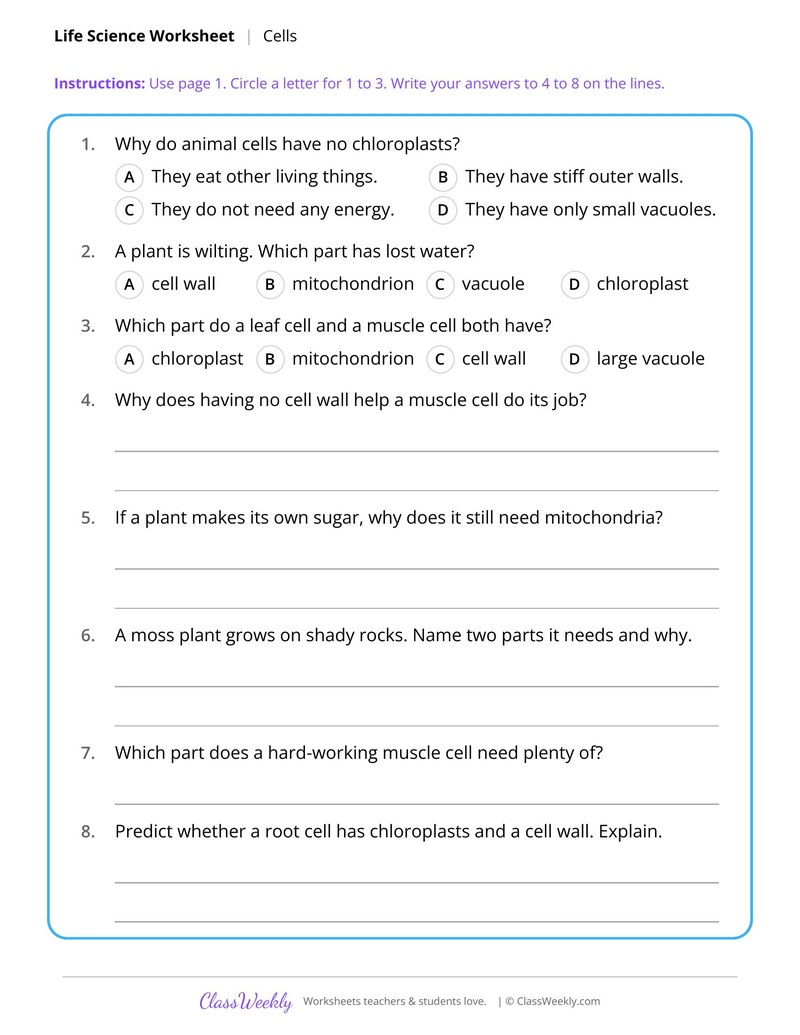
Color code the parts of a root hair cell and explain why it has mitochondria but no chloroplasts. The directions on the page read: Color each numbered part of the root hair cell by the key. Then answer the questions. An answer key is included.
Can I use this cells worksheet for homeschool or classroom?
⌄
Yes, both. We made it for 7th grade living things, and it works the same at home or at school. At home, a student can work through it alone and then go over it with you, which shows quickly what is solid and what needs another look. In class it works as independent practice, homework or a warm-up, and you can print one copy or a full set.
What do organelles do?
⌄
The nucleus holds DNA, mitochondria release energy, chloroplasts capture light, lysosomes hold digestive enzymes and the endoplasmic reticulum makes proteins.
How do plant cells react to water?
⌄
In fresh water a plant cell becomes turgid as the vacuole swells and presses against the wall. The potato strip data shows how mass changes in salt solutions.
What are the stages of mitosis?
⌄
Interphase, prophase, metaphase, anaphase, telophase and cytokinesis. Each new cell gets a full copy of the DNA.
How does a cell membrane control what enters?
⌄
It is a phospholipid bilayer that lets small uncharged molecules pass, needs channels for ions and blocks large molecules.
Ratings & Reviews
No reviews yet. Be the first to share what you think.
Reviews are for ClassWeekly members.
Make a Request
Spotted something to fix, or want a worksheet we don't have yet? Tell us and we'll make it.
Worksheet Details
| Grade | 7th Grade |
| Subject | Science |
| Topic | Living Things |
| Standard | MS-LS1-2 |
| Pages | 1 page |
| Difficulty | Medium |
Learn More
What is ClassWeekly?
ClassWeekly offers free worksheets and printable learning resources for kids, from preschool up. All worksheets are aligned to Common Core, NGSS, and C3 Framework standards and designed by educators. Become a member to access the full library and download unlimited PDFs.