Gas Exchange in the Alveoli
Written by Adi Ackerman, Head Teacher
"Gas Exchange in the Alveoli" is written for 7th Grade (Ages 12-13), and it covers NGSS MS-LS1-3. A 6th grader who is already steady on living things can use it too, and an older student can use it as a short review.
2 pages in this set
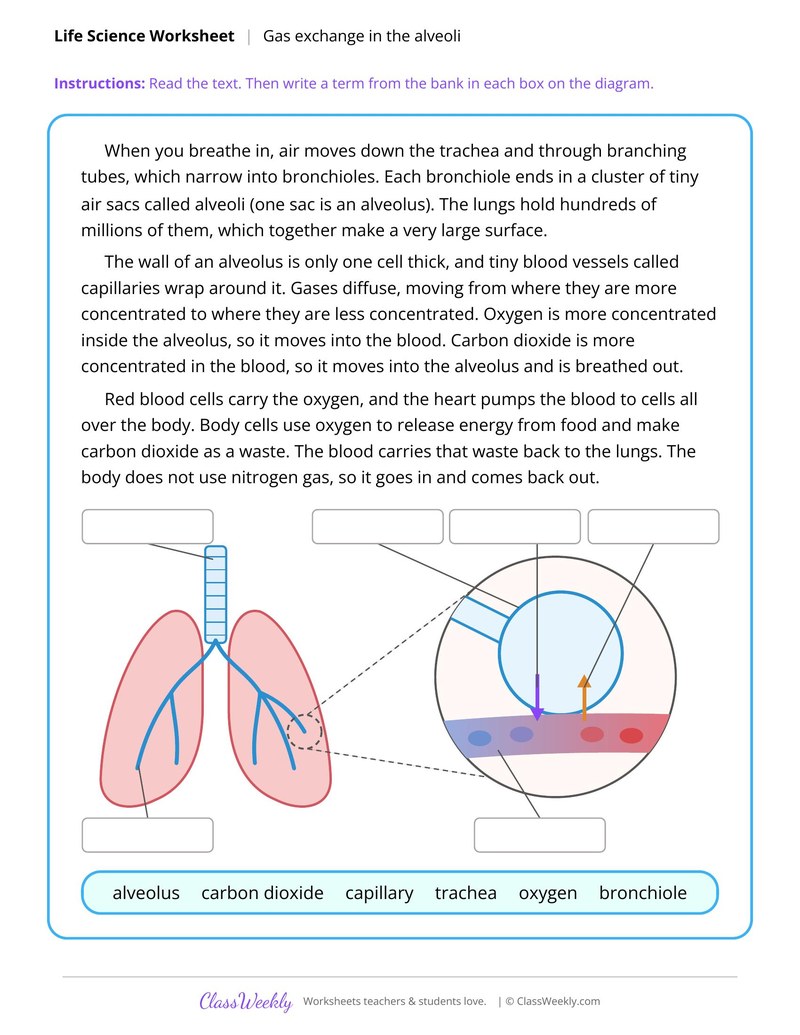
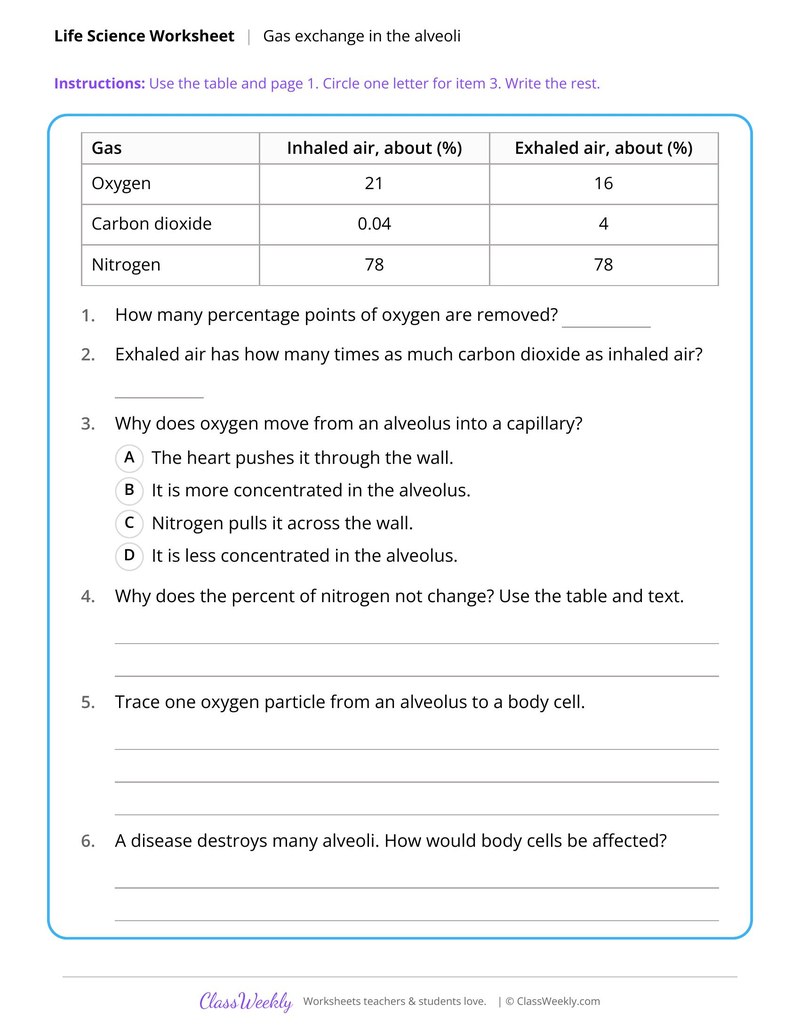
7th grade science worksheet: label the alveoli and capillaries, then compare oxygen and carbon dioxide in inhaled and exhaled air. Answer key included. Part of our human body systems living things collection. Aligned to NGSS standards.
How do I use this worksheet?
Use Neurons and Nerve Signals first, then Reflex Arcs and Reaction Time Data, which builds on the same cells. Gas Exchange in the Alveoli stands alone and works well beside a lesson on the respiratory system.
What students will practice
- Students will label the trachea, bronchioles, alveoli and capillaries on a diagram using a term bank.
- Students will use a table of gas percentages to find how much oxygen is removed from inhaled air.
- Students will describe how gases diffuse between the alveoli and the capillaries around them.
Curriculum Links
Next Generation Science Standards
Science · 7th Grade
Find this in the curriculum
Browse the grade, subject, and topic this belongs to.
FAQ
How do I use this human body systems worksheet?
⌄
Use Neurons and Nerve Signals first, then Reflex Arcs and Reaction Time Data, which builds on the same cells. Gas Exchange in the Alveoli stands alone and works well beside a lesson on the respiratory system.
What does this worksheet teach?
⌄
Label the alveoli and capillaries, then compare oxygen and carbon dioxide in inhaled and exhaled air. The directions on the page read: Read the text. Then write a term from the bank in each box on the diagram. An answer key is included.
Can I use this human body systems worksheet for homeschool or classroom?
⌄
Yes, both. We made it for 7th grade living things, and it works the same at home or at school. At home, a student can work through it alone and then go over it with you, which shows quickly what is solid and what needs another look. In class it works as independent practice, homework or a warm-up, and you can print one copy or a full set.
How does a signal travel through a neuron?
⌄
Dendrites receive the signal and pass it to the cell body. It then travels along the axon, where myelin lets it jump between gaps, and chemicals carry it across a synapse to the next cell. Neurons and Nerve Signals has students number these steps.
What is a reflex arc?
⌄
A reflex arc is the path of a fast, automatic response. A receptor detects the stimulus, a sensory neuron carries the signal to the spinal cord, an interneuron passes it to a motor neuron and a muscle contracts. Reflex Arcs and Reaction Time Data has students name each part.
How does gas exchange work in the lungs?
⌄
Oxygen and carbon dioxide diffuse, moving from where they are more concentrated to where they are less concentrated. The wall of an alveolus is one cell thick and capillaries wrap around it. Gas Exchange in the Alveoli compares gas percentages in inhaled and exhaled air.
Ratings & Reviews
No reviews yet. Be the first to share what you think.
Reviews are for ClassWeekly members.
Make a Request
Spotted something to fix, or want a worksheet we don't have yet? Tell us and we'll make it.
Worksheet Details
| Grade | 7th Grade |
| Subject | Science |
| Topic | Living Things |
| Standard | MS-LS1-3 |
| Pages | 2 pages |
| Difficulty | Medium |
Learn More
What is ClassWeekly?
ClassWeekly offers free worksheets and printable learning resources for kids, from preschool up. All worksheets are aligned to Common Core, NGSS, and C3 Framework standards and designed by educators. Become a member to access the full library and download unlimited PDFs.