Newton's First Law
Written by Adi Ackerman, Head Teacher
"Newton's First Law" is written for 6th Grade (Ages 11-12). If your student is a year younger but already steady on forces and motion, the page still works. You may just need to read the instructions out loud. And if they are older and newton's laws never quite stuck, this is a short review rather than busywork.
2 pages in this set
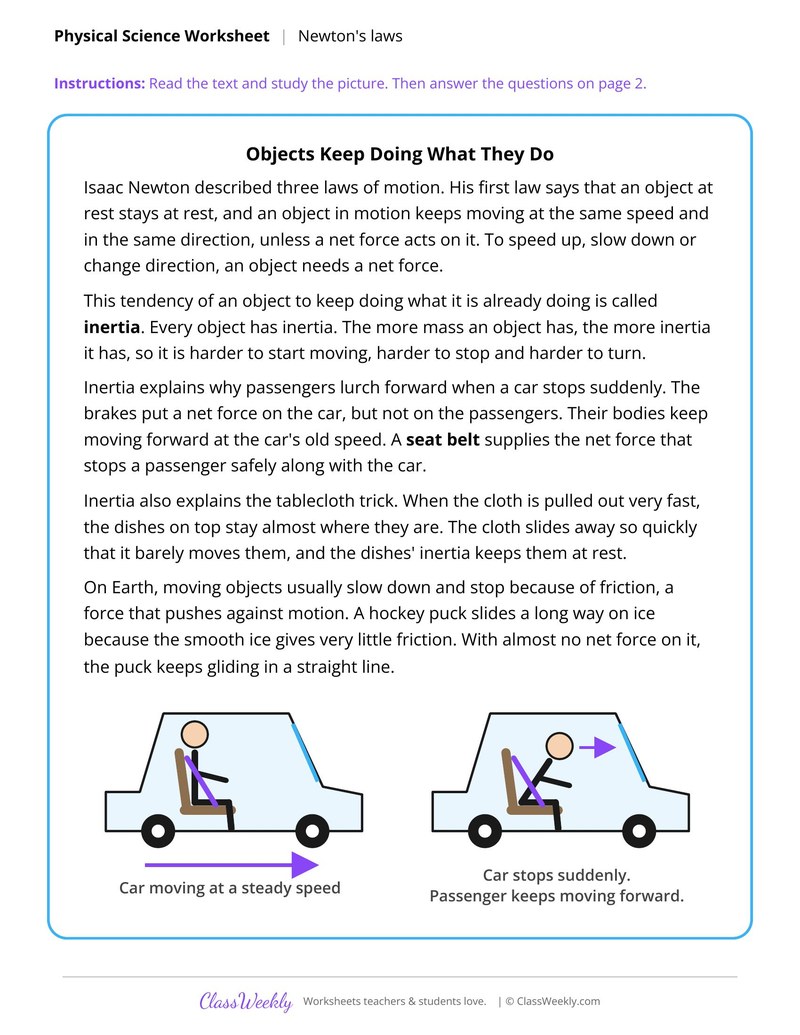
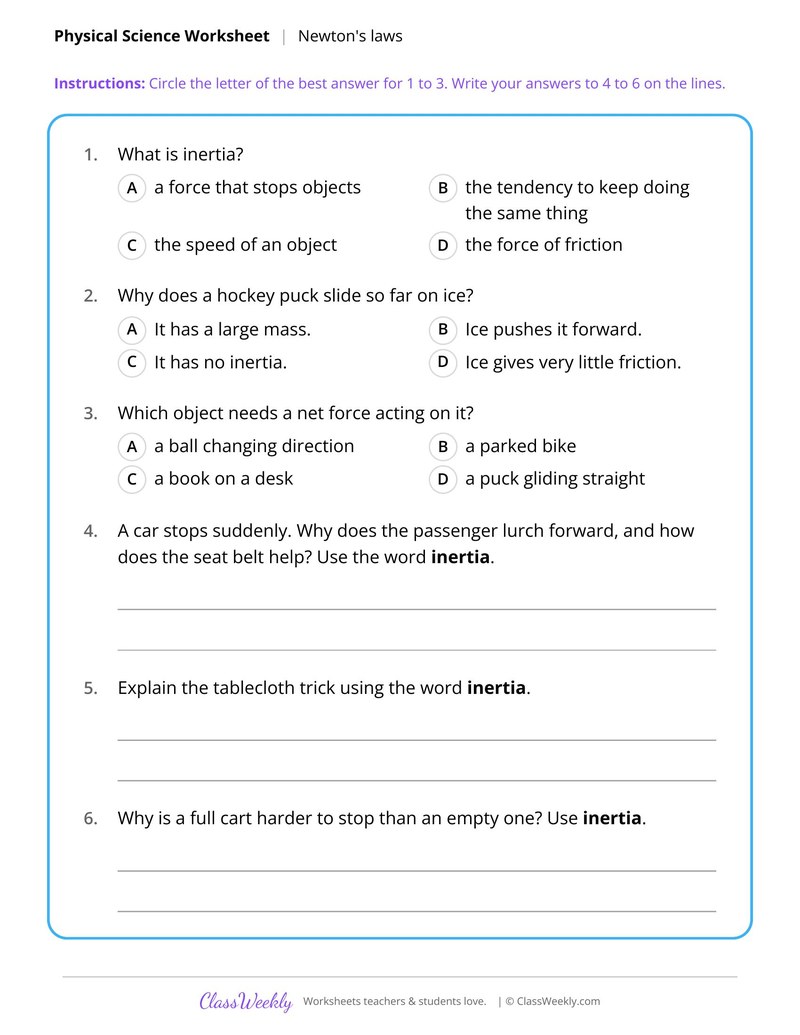
6th grade science worksheet: read about inertia, then explain seat belts and the tablecloth trick with Newton's first law. Answer key included. Part of our newton's laws forces and motion collection.
How do I use this worksheet?
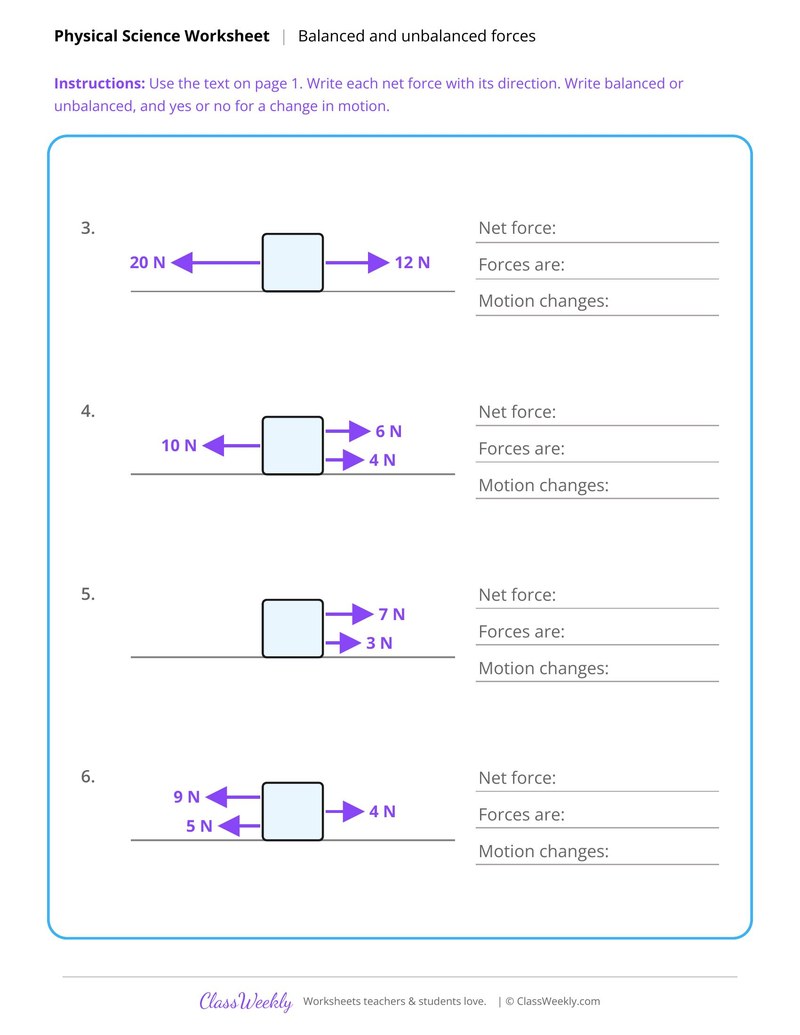
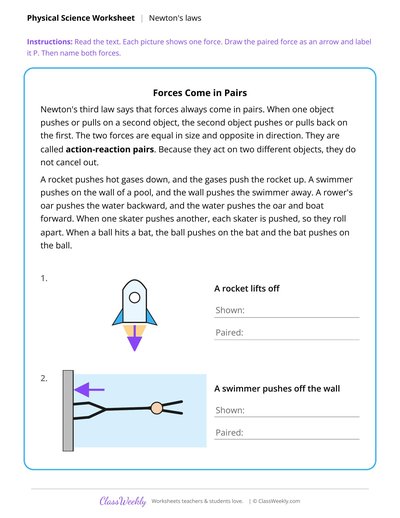
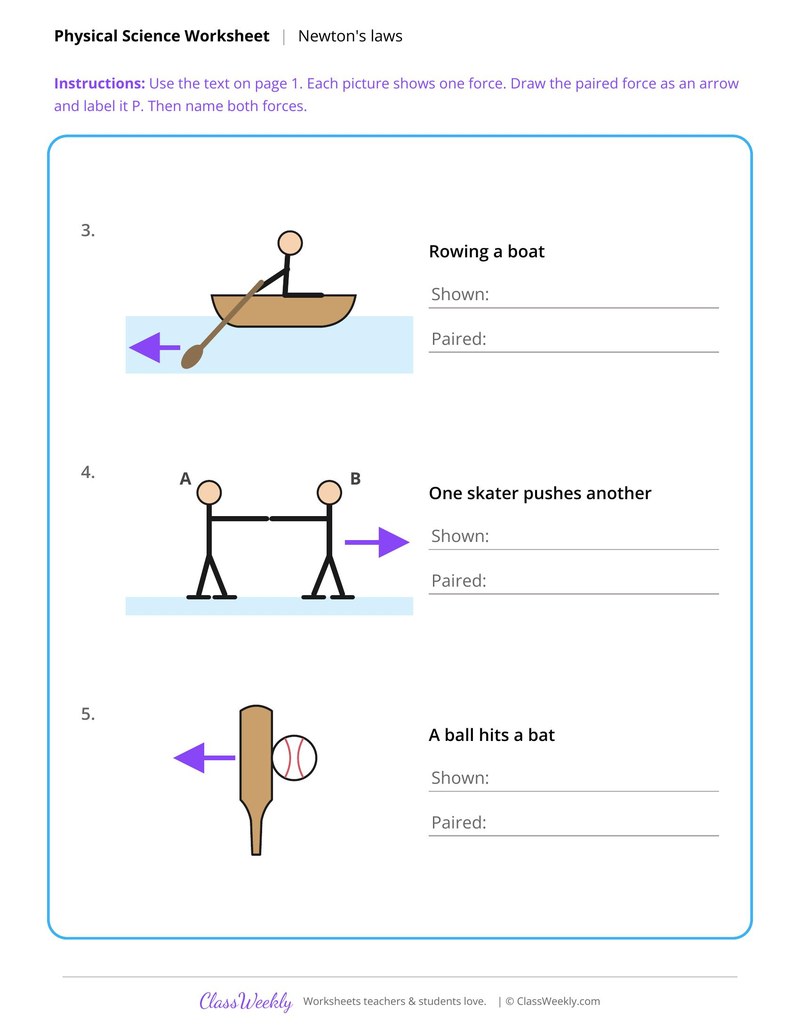
Teach the laws in order and ask students to say which law explains each example. On the third law sheet, have students name both objects before they draw the arrow.
What students will practice
- Students will state Newton's first law and define inertia.
- Students will explain with inertia why a passenger lurches forward and how a seat belt helps.
- Students will relate mass to inertia by comparing a full cart and an empty cart.
Curriculum Links
Find this in the curriculum
Browse the grade, subject, and topic this belongs to.
FAQ
How do I use this newton's laws worksheet?
⌄
Teach the laws in order and ask students to say which law explains each example. On the third law sheet, have students name both objects before they draw the arrow.
What does this worksheet teach?
⌄
Read about inertia, then explain seat belts and the tablecloth trick with Newton's first law. The directions on the page read: Read the text and study the picture. Then answer the questions on page 2. An answer key is included.
Can I use this newton's laws worksheet for homeschool or classroom?
⌄
Yes, both. We made it for 6th Grade forces and motion, and the page works the same whether it lands on a kitchen table or a center rotation. At home, most families go through it together and talk the answers out loud, and that talking is where most of the learning happens with newton's laws. In class it runs well as independent work while you pull a small group. Print one copy or thirty, whichever the day needs.
What is inertia?
⌄
Inertia is the tendency of an object to keep doing what it is already doing. The more mass an object has, the more inertia it has, so it is harder to start, stop or turn.
What is the formula for Newton's second law?
⌄
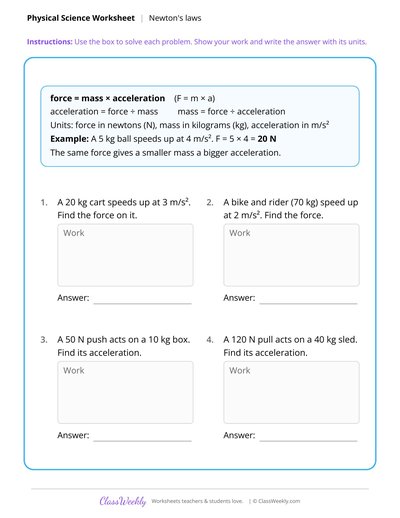
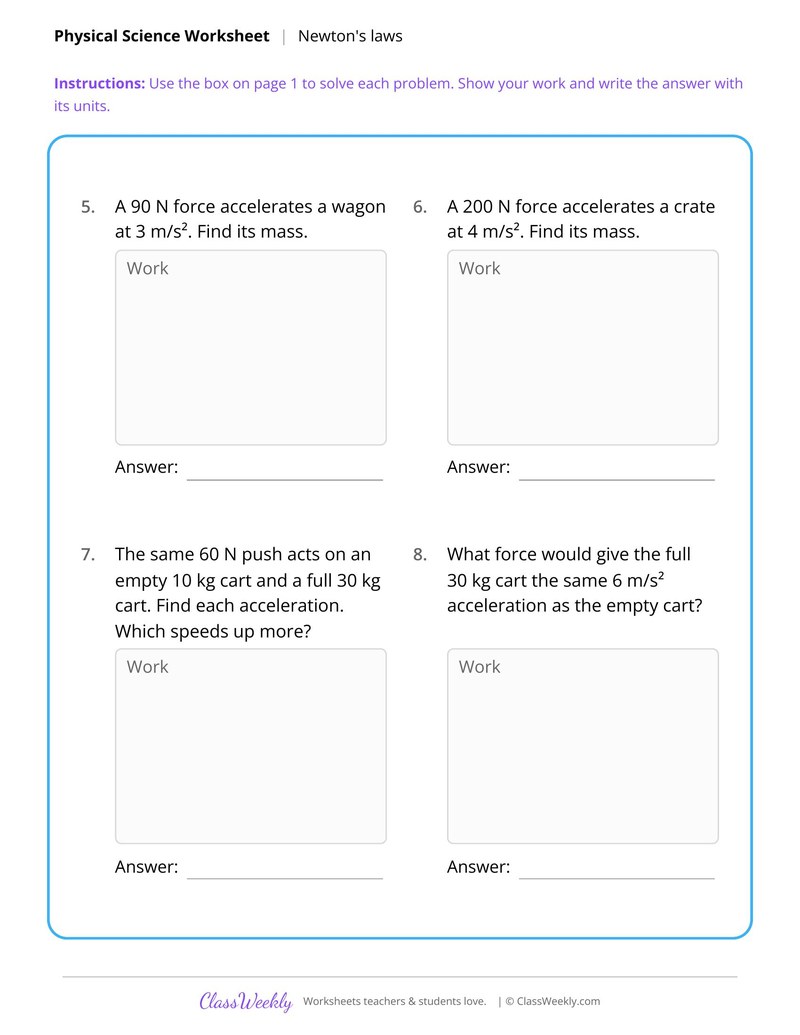
Force equals mass times acceleration, or F = m × a. A 5 kg ball that speeds up at 4 m/s² has a force of 20 N acting on it, the example on the sheet.
Why don't action and reaction forces cancel out?
⌄
The two forces in a pair are equal and opposite, but they act on two different objects. A rocket pushes hot gases down and the gases push the rocket up.
Ratings & Reviews
No reviews yet. Be the first to share what you think.
Reviews are for ClassWeekly members.
Make a Request
Spotted something to fix, or want a worksheet we don't have yet? Tell us and we'll make it.
Worksheet Details
| Grade | 6th Grade |
| Subject | Science |
| Topic | Forces and Motion |
| Pages | 2 pages |
| Difficulty | Medium |
What is ClassWeekly?
ClassWeekly offers free worksheets and printable learning resources for kids, from preschool up. All worksheets are aligned to Common Core, NGSS, and C3 Framework standards and designed by educators. Become a member to access the full library and download unlimited PDFs.