Linear or Exponential Growth in Context
Written by Adi Ackerman, Head Teacher
"Linear or Exponential Growth in Context" is written for 8th Grade (Ages 13-14). A 7th grader who is already steady on algebra can use it too, and an older student can use it as a short review.
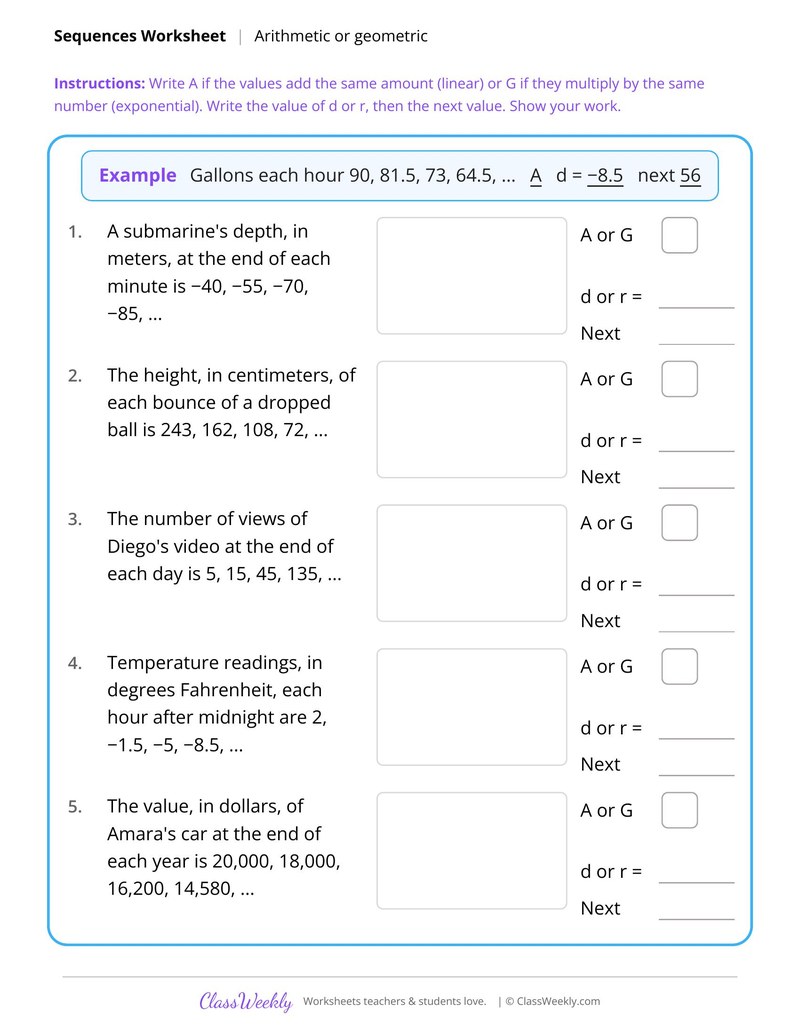
8th grade math worksheet: label 5 situations linear or exponential and give d or r and the next value, such as a car's value. Answer key included. Part of our arithmetic and geometric sequences algebra collection.
How do I use this worksheet?
Start with Classify Sequences With Negative Terms, then move to the arithmetic and geometric sheets. Use the mazes, the card sort and the riddle as self-checking review, and finish with Sequences as Functions Review.
What students will practice
- Students will label a list of values in a situation as linear (A) or exponential (G).
- Students will find a common difference such as −15 meters each minute or a ratio such as 3 for daily views.
- Students will use d or r to write the next value in the list.
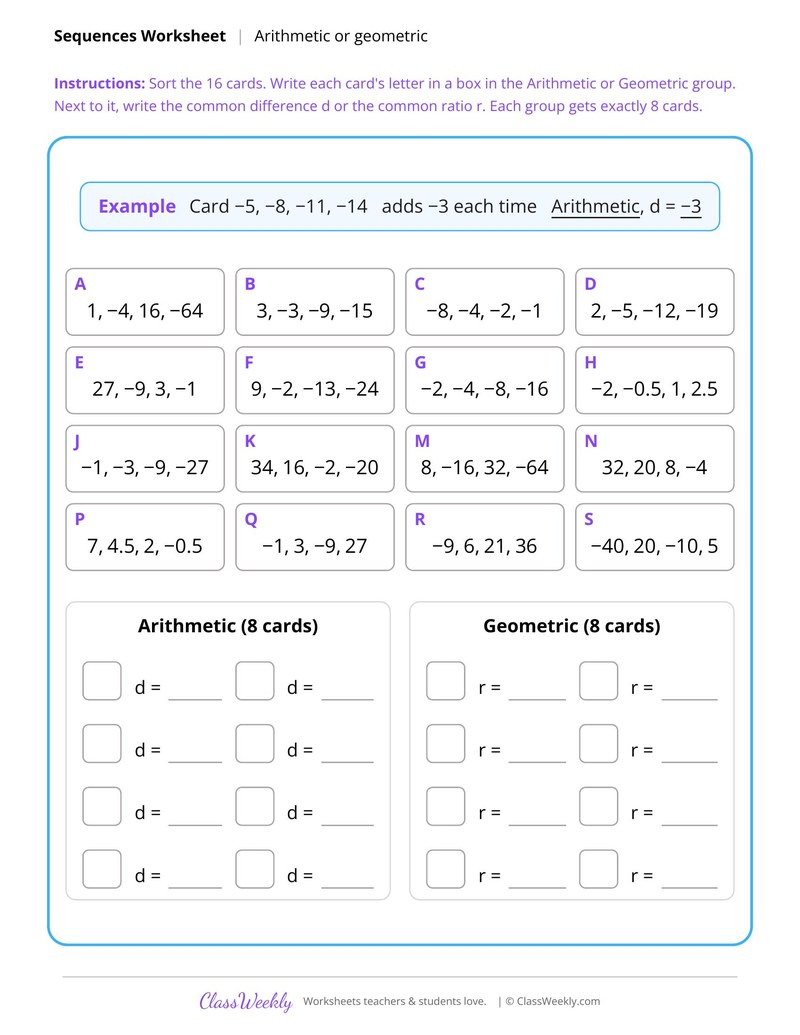
Arithmetic or Geometric Card Sort With Negatives
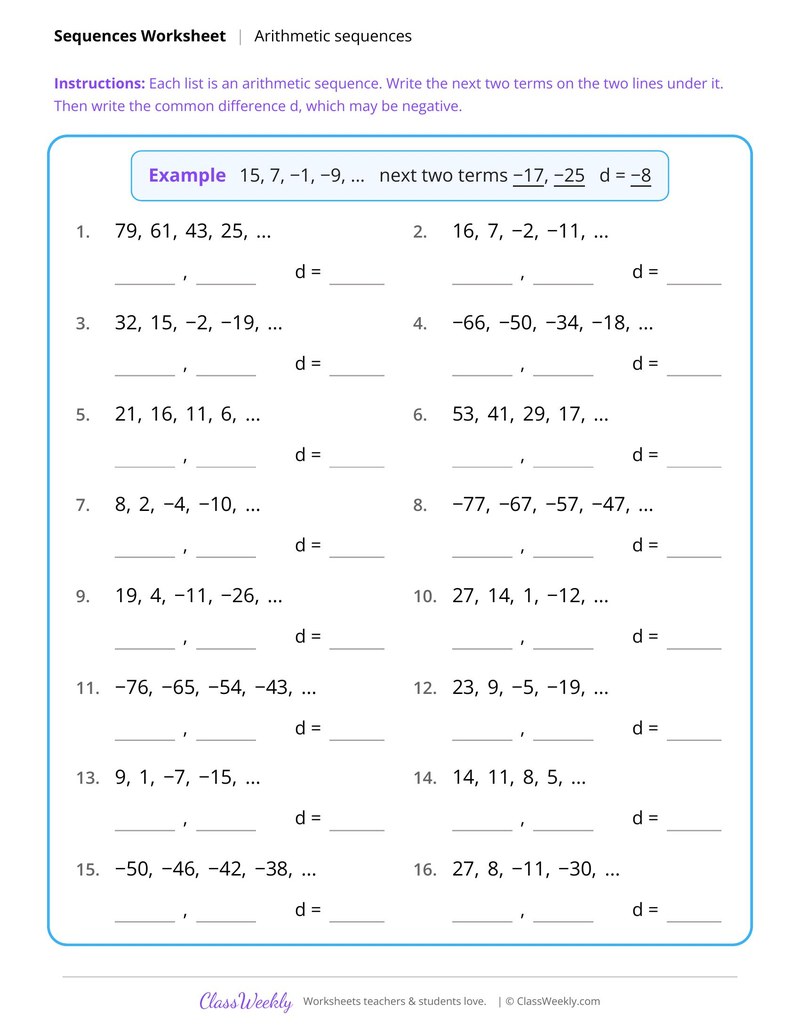
Arithmetic Sequences With Negative Differences
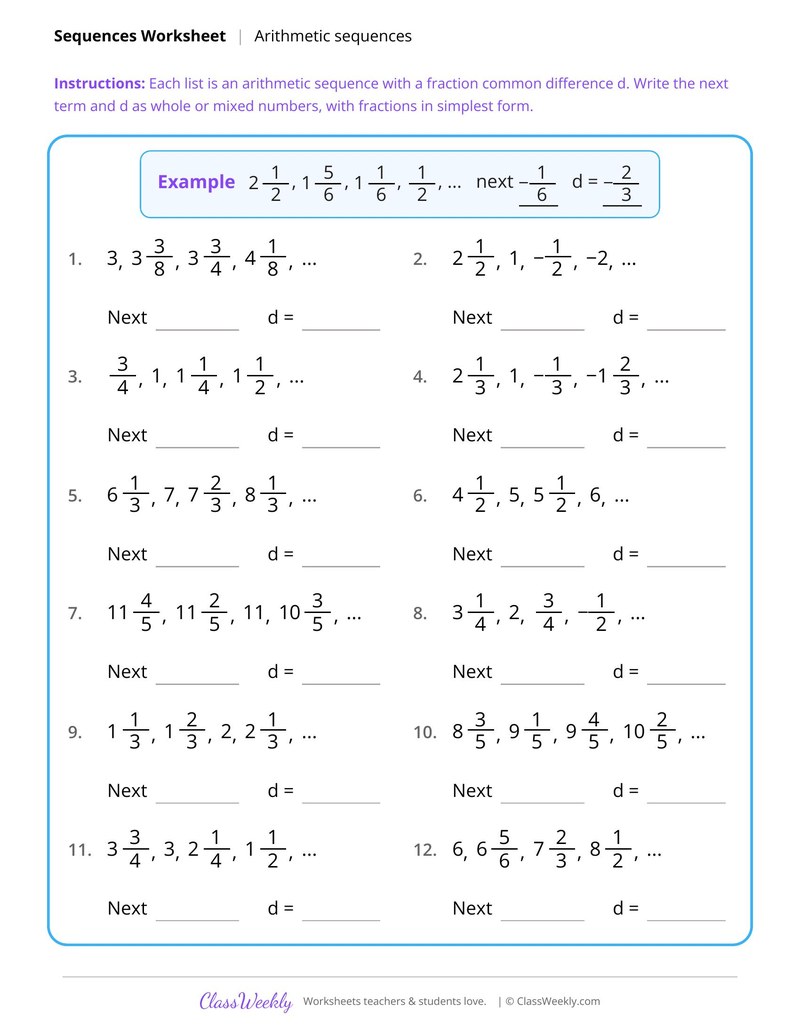
Arithmetic Sequences With Fraction Differences
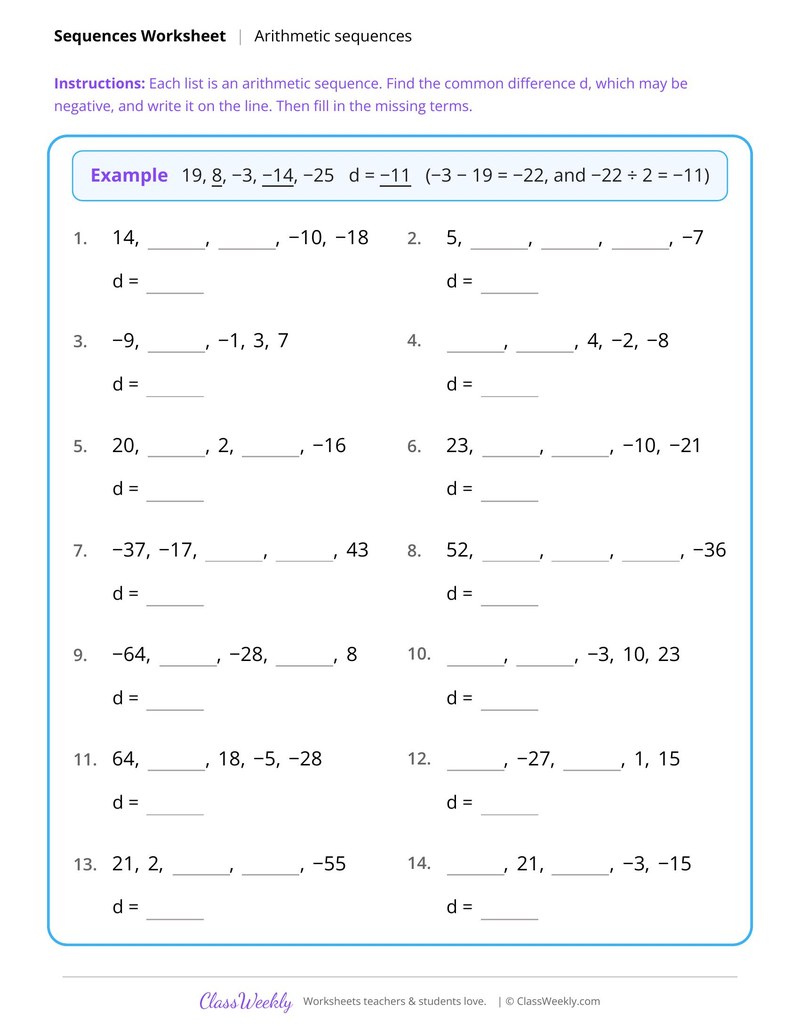
Missing Terms in Arithmetic Sequences With Negatives
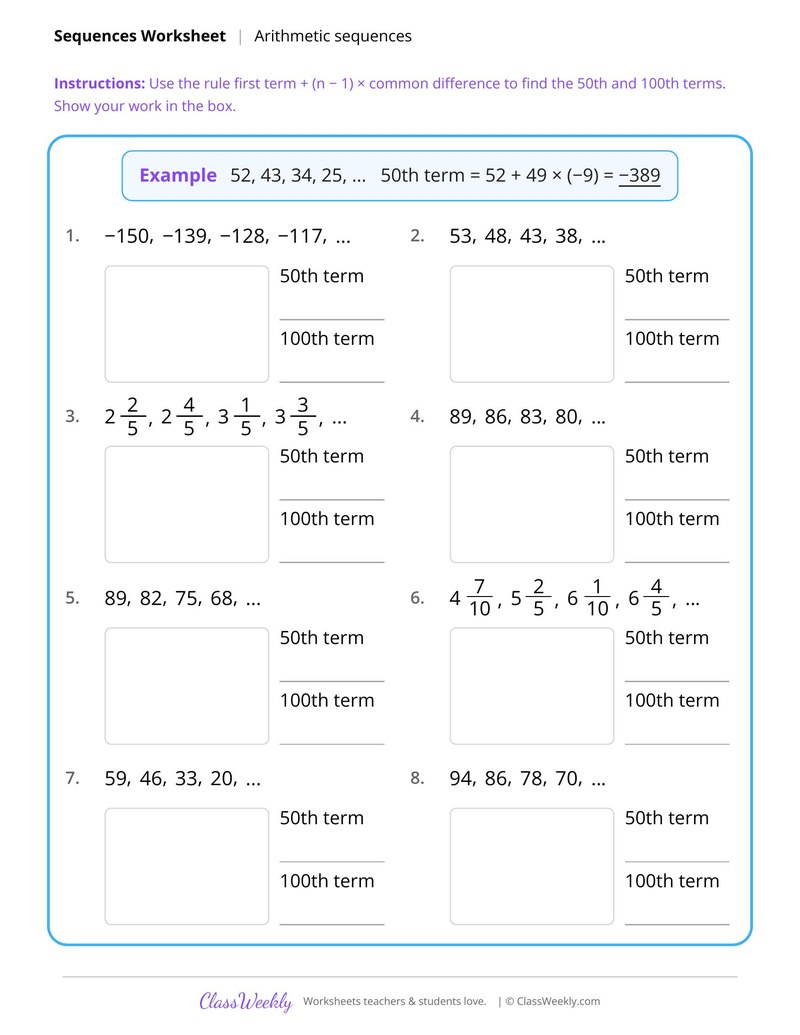
Find the 50th and 100th Terms
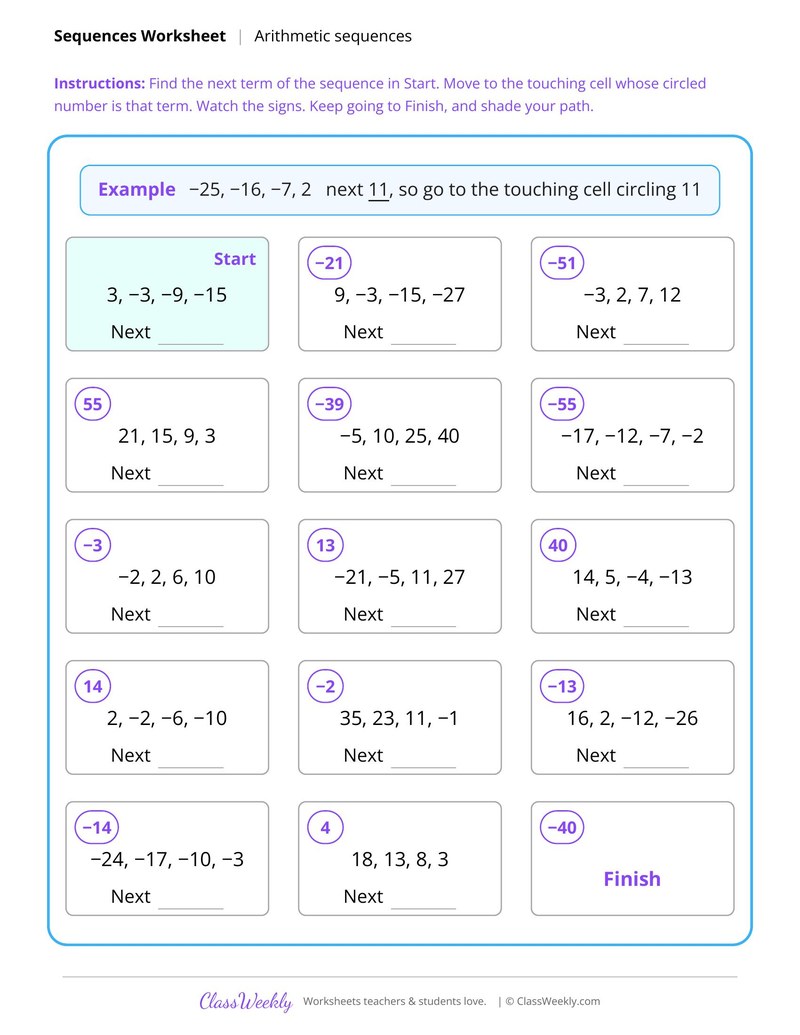
Arithmetic Sequences Maze With Negatives
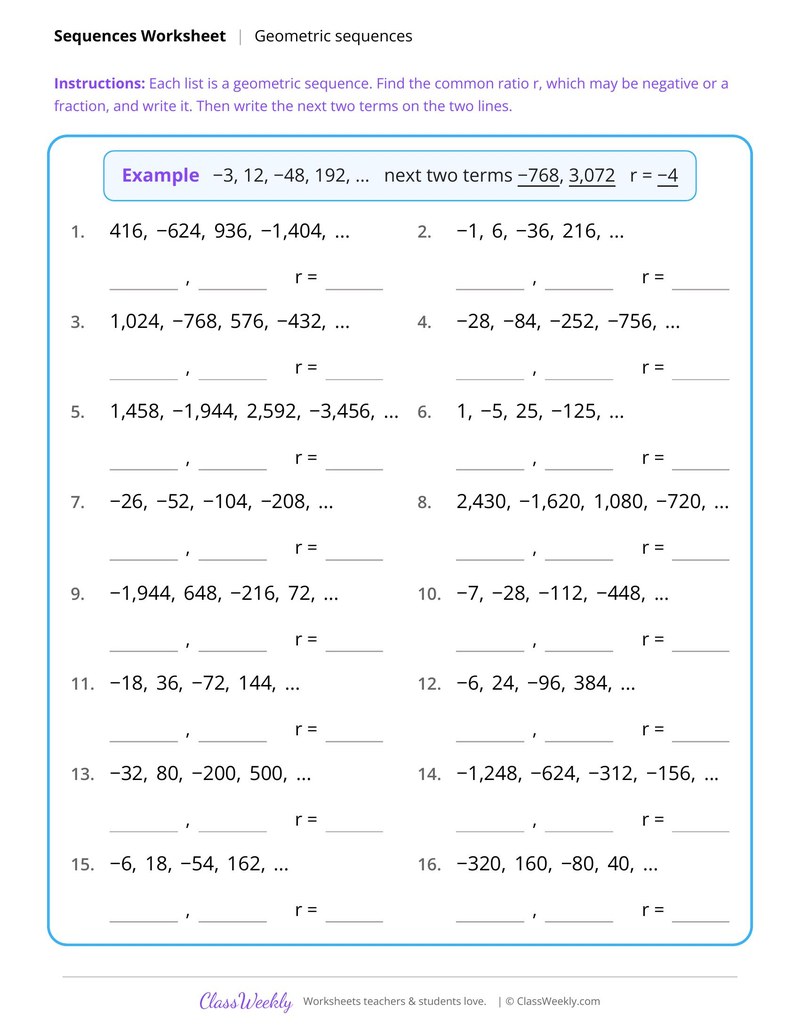
Geometric Sequences With Negative Ratios
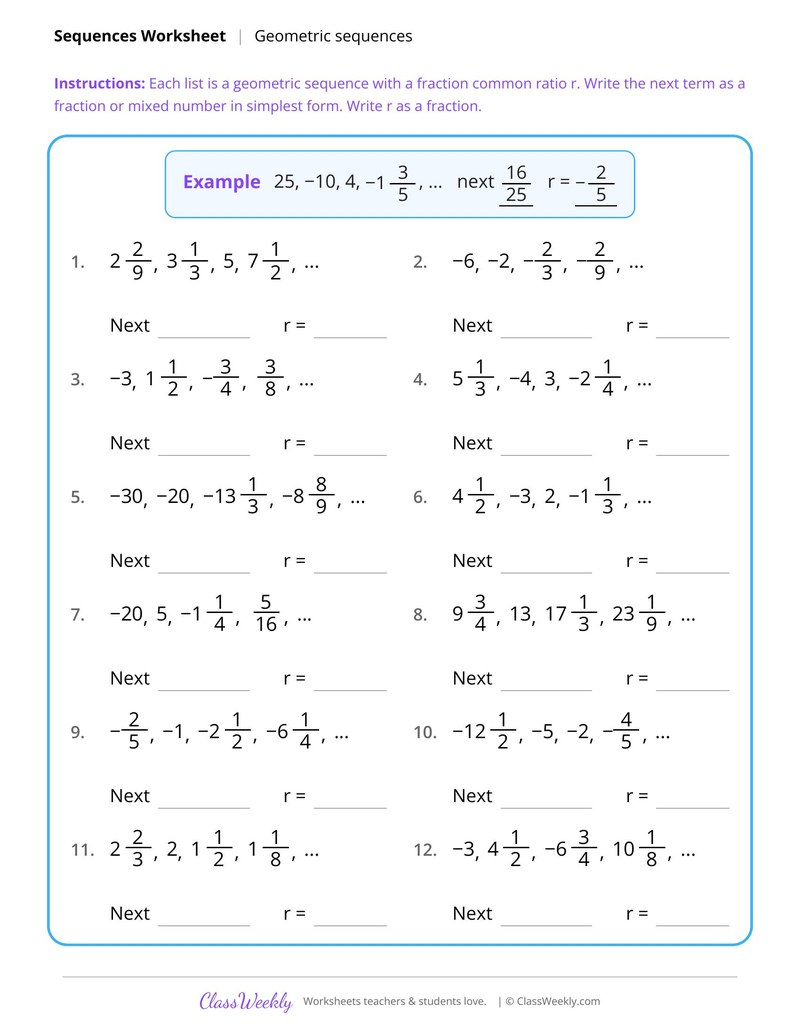
Geometric Sequences With Fraction Ratios
Curriculum Links
Find this in the curriculum
Browse the grade, subject, and topic this belongs to.
FAQ
How do I use this arithmetic and geometric sequences worksheet?
⌄
Start with Classify Sequences With Negative Terms, then move to the arithmetic and geometric sheets. Use the mazes, the card sort and the riddle as self-checking review, and finish with Sequences as Functions Review.
What does this worksheet teach?
⌄
Label 5 situations linear or exponential and give d or r and the next value, such as a car's value. The directions on the page read: Write A if the values add the same amount (linear) or G if they multiply by the same number (exponential). Write the value of d or r, then the next value. Show your work. The page opens with a worked example, and an answer key is included.
Can I use this arithmetic and geometric sequences worksheet for homeschool or classroom?
⌄
Yes, both. We made it for 8th grade algebra, and it works the same at home or at school. At home, a student can work through it alone and then go over it with you, which shows quickly what is solid and what needs another look. In class it works as independent practice, homework or a warm-up, and you can print one copy or a full set.
How do you tell if a sequence is arithmetic or geometric?
⌄
Subtract each term from the next one. If the difference is always the same, the sequence is arithmetic. If dividing each term by the one before gives the same number, it is geometric. A list like 1/4, 1/5, 1/6, 1/7 passes neither test.
Can a common ratio be negative?
⌄
Yes. A negative ratio makes the signs alternate, so −3, 12, −48, 192 has r = −4. Geometric Sequences With Negative Ratios has 16 lists like this.
How do you find the 100th term of an arithmetic sequence?
⌄
Use first term + (n − 1) × d. For 52, 43, 34, 25, the 50th term is 52 + 49 × (−9) = −389. Find the 50th and 100th Terms practices this on 8 sequences.
How do you fill in missing terms in a sequence?
⌄
Find d or r from two known terms, then work forward or backward. In 19, blank, −3, the change is −22 over two steps, so d = −11 and the missing term is 8.
Ratings & Reviews
No reviews yet. Be the first to share what you think.
Reviews are for ClassWeekly members.
Make a Request
Spotted something to fix, or want a worksheet we don't have yet? Tell us and we'll make it.
What is ClassWeekly?
ClassWeekly offers free worksheets and printable learning resources for kids, from preschool up. All worksheets are aligned to Common Core, NGSS, and C3 Framework standards and designed by educators. Become a member to access the full library and download unlimited PDFs.
Arithmetic or Geometric Card Sort With Negatives
Arithmetic Sequences With Negative Differences
Arithmetic Sequences With Fraction Differences
Missing Terms in Arithmetic Sequences With Negatives
Find the 50th and 100th Terms
Arithmetic Sequences Maze With Negatives
Geometric Sequences With Negative Ratios
Geometric Sequences With Fraction Ratios