Solutions With Negative Numbers and Fractions
Written by Adi Ackerman, Head Teacher
"Solutions With Negative Numbers and Fractions" is written for 8th Grade (Ages 13-14). A 7th grader who is already steady on algebra can use it too, and an older student can use it as a short review.
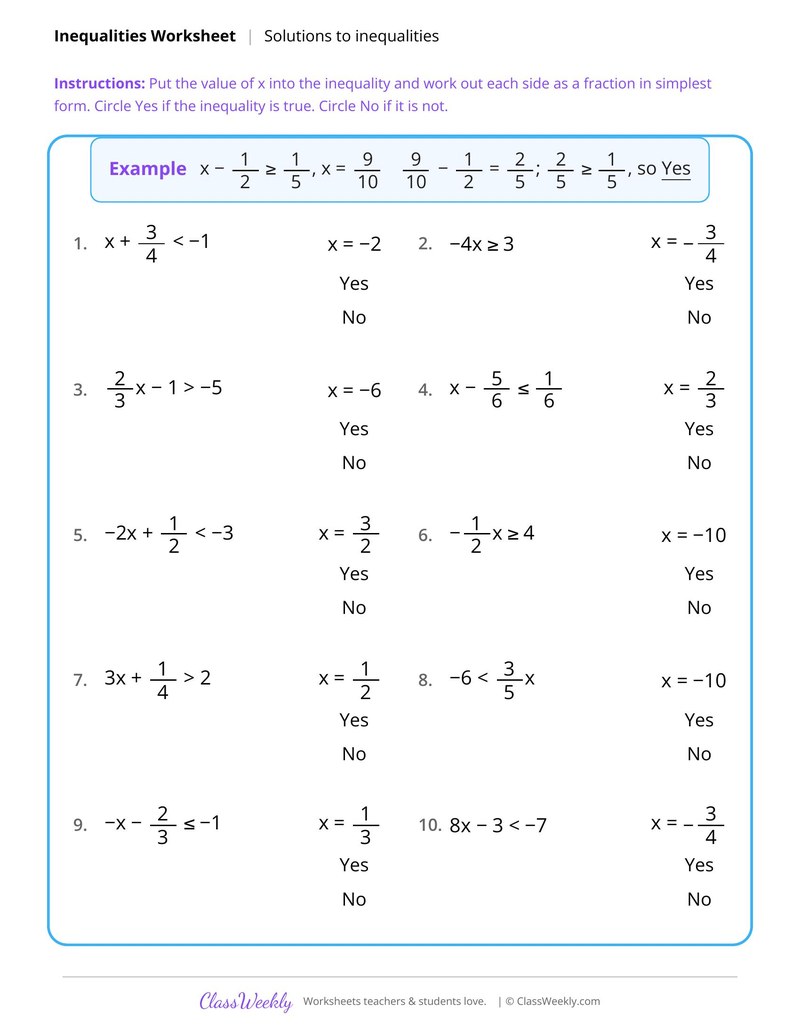
8th grade math worksheet: check fraction values in 10 inequalities, such as x + 3/4 < −1 at x = −2, and circle Yes or No. Answer key included. Part of our graphing inequalities algebra collection.
How do I use this worksheet?
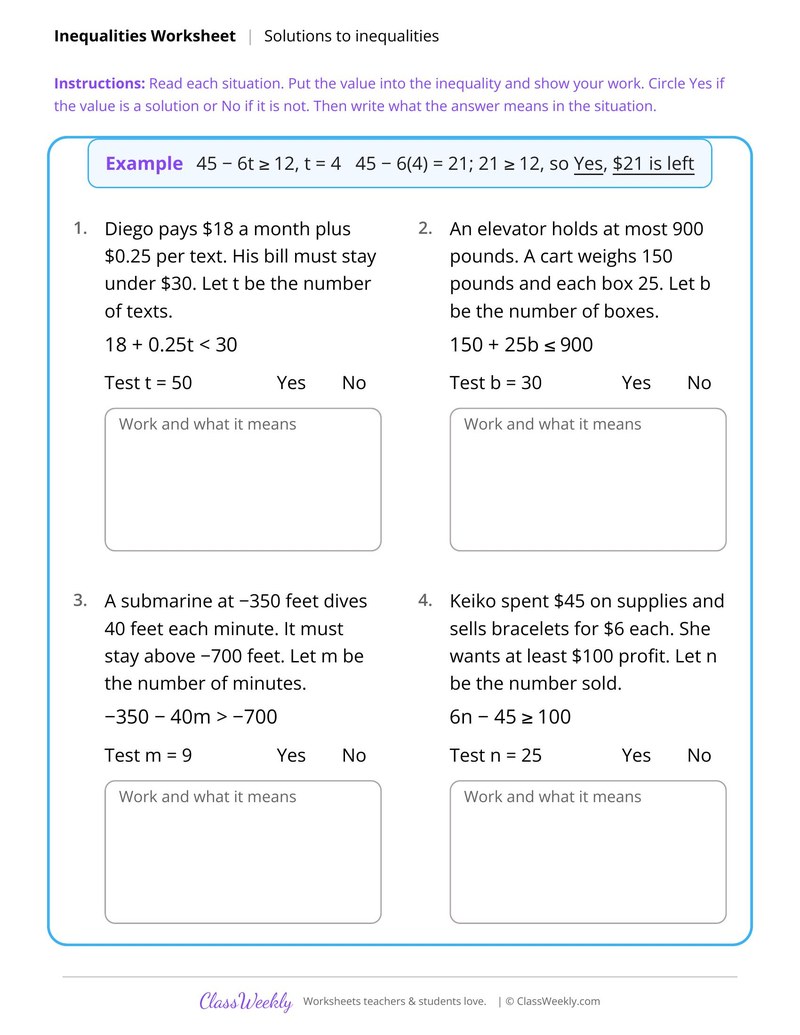
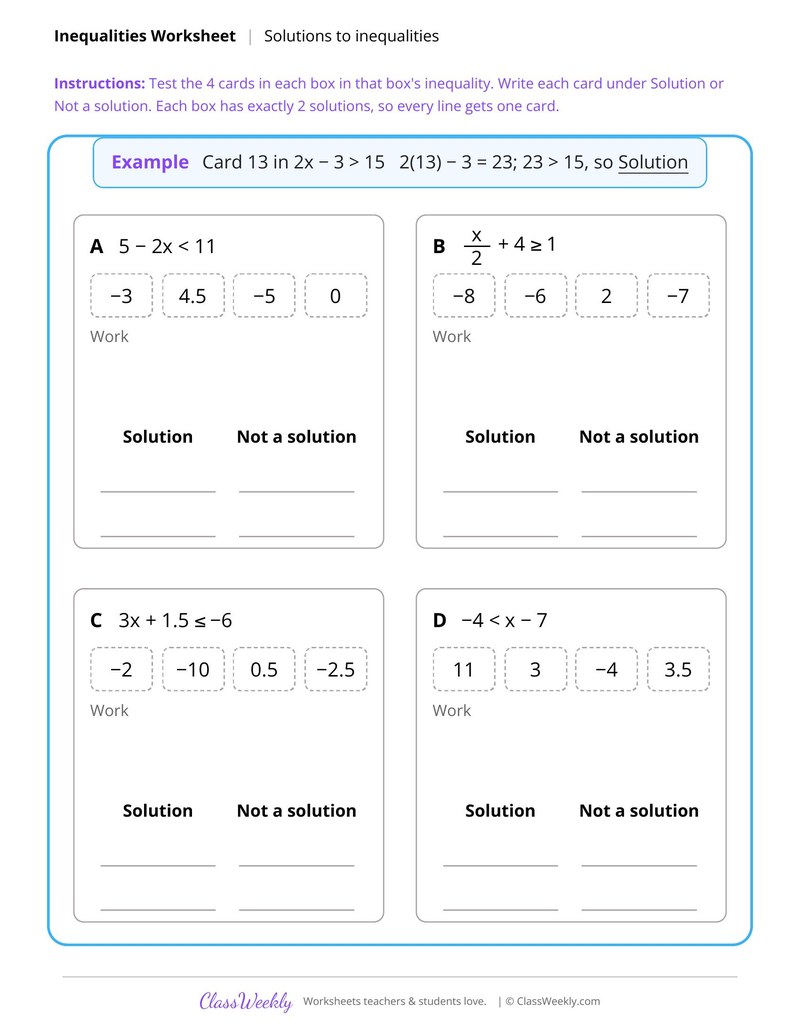
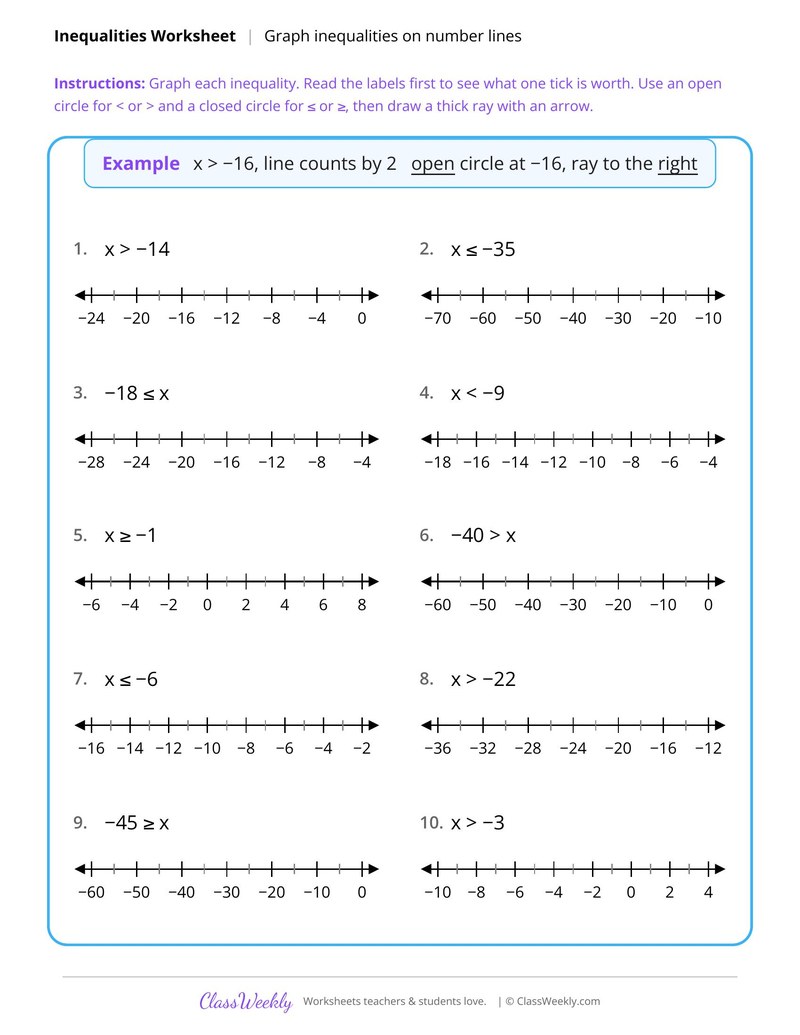
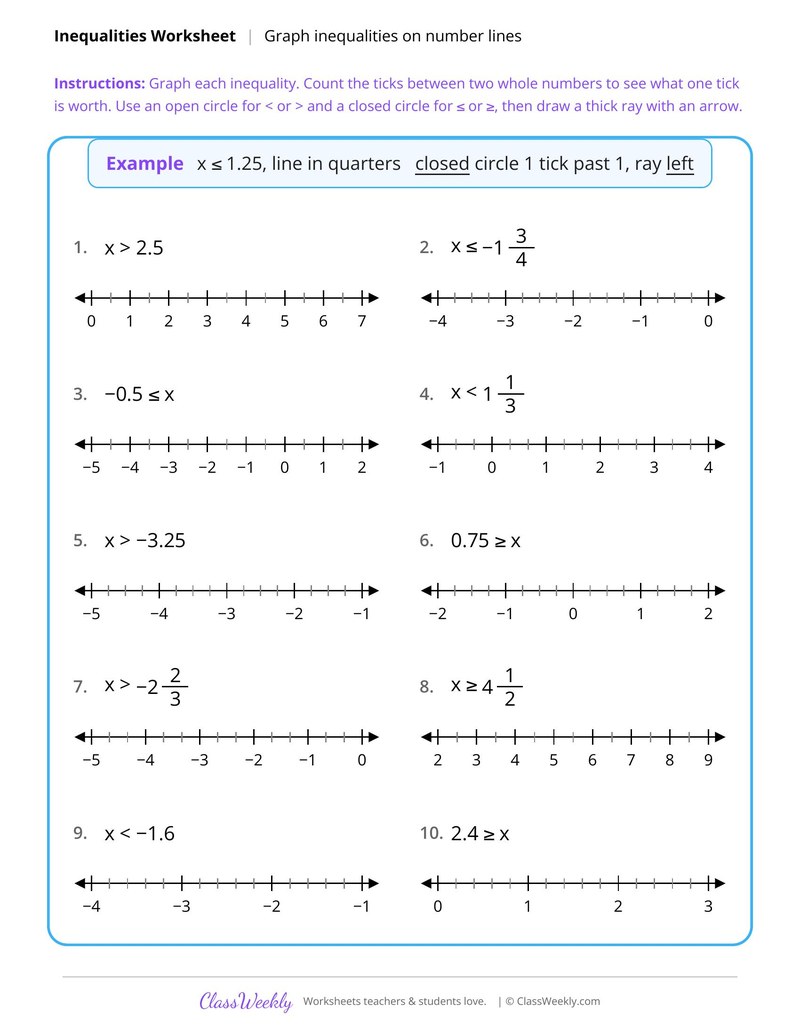
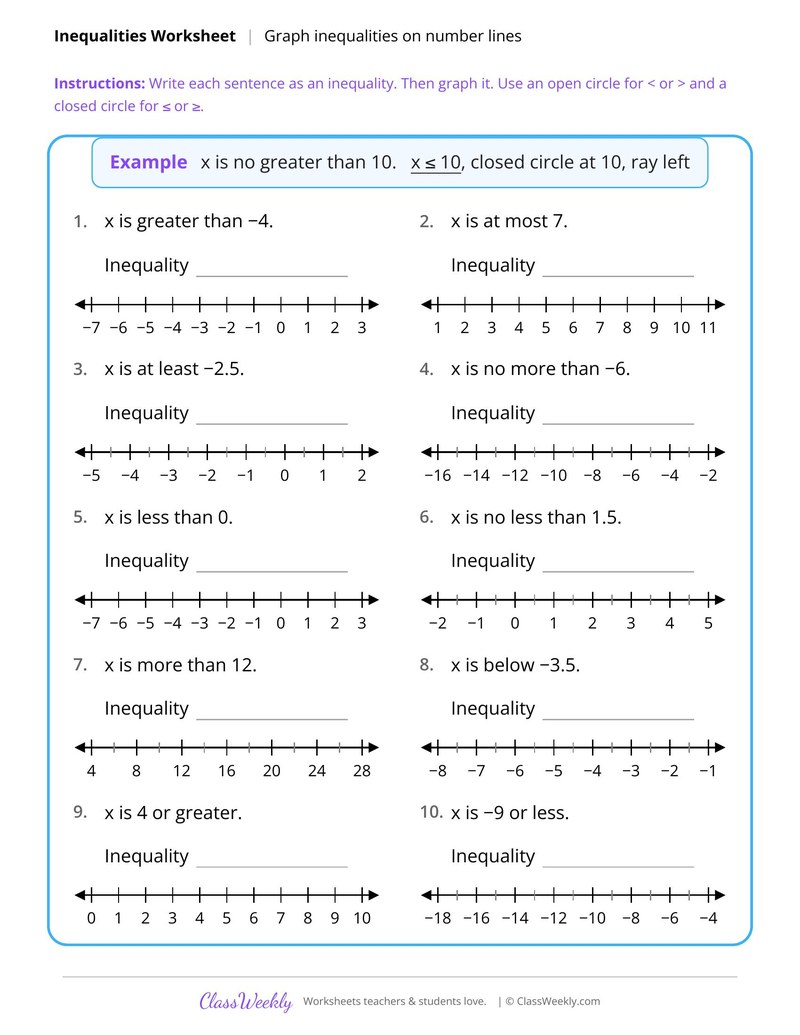
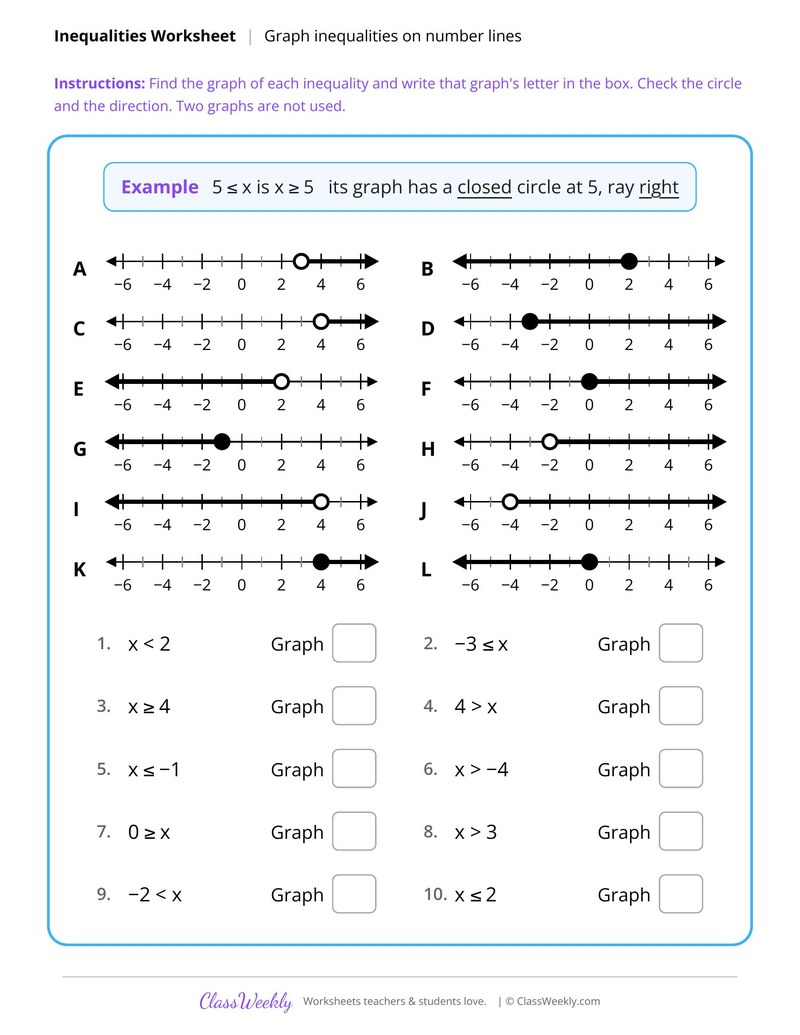
Start with Is It a Solution to the Inequality, then move to the graphing sheets. Use the card sorts and Match Inequalities to Graphs as a check or review, since each answer can only go in one place.
What students will practice
- Students will substitute fraction and negative values into inequalities.
- Students will work out each side as a fraction in simplest form.
- Students will decide if each of 10 inequalities is true for the given value.
Curriculum Links
Find this in the curriculum
Browse the grade, subject, and topic this belongs to.
FAQ
How do I use this graphing inequalities worksheet?
⌄
Start with Is It a Solution to the Inequality, then move to the graphing sheets. Use the card sorts and Match Inequalities to Graphs as a check or review, since each answer can only go in one place.
What does this worksheet teach?
⌄
Check fraction values in 10 inequalities, such as x + 3/4 < −1 at x = −2, and circle Yes or No. The directions on the page read: Put the value of x into the inequality and work out each side as a fraction in simplest form. Circle Yes if the inequality is true. Circle No if it is not. The page opens with a worked example, and an answer key is included.
Can I use this graphing inequalities worksheet for homeschool or classroom?
⌄
Yes, both. We made it for 8th grade algebra, and it works the same at home or at school. At home, a student can work through it alone and then go over it with you, which shows quickly what is solid and what needs another look. In class it works as independent practice, homework or a warm-up, and you can print one copy or a full set.
How do you know if a number is a solution to an inequality?
⌄
Substitute the number for x and work out each side. If the statement is true, the number is a solution. In the opening example, 4(11) − 9 is 35, and 35 ≤ 27 is false, so 11 is not a solution.
When do you use an open circle or a closed circle?
⌄
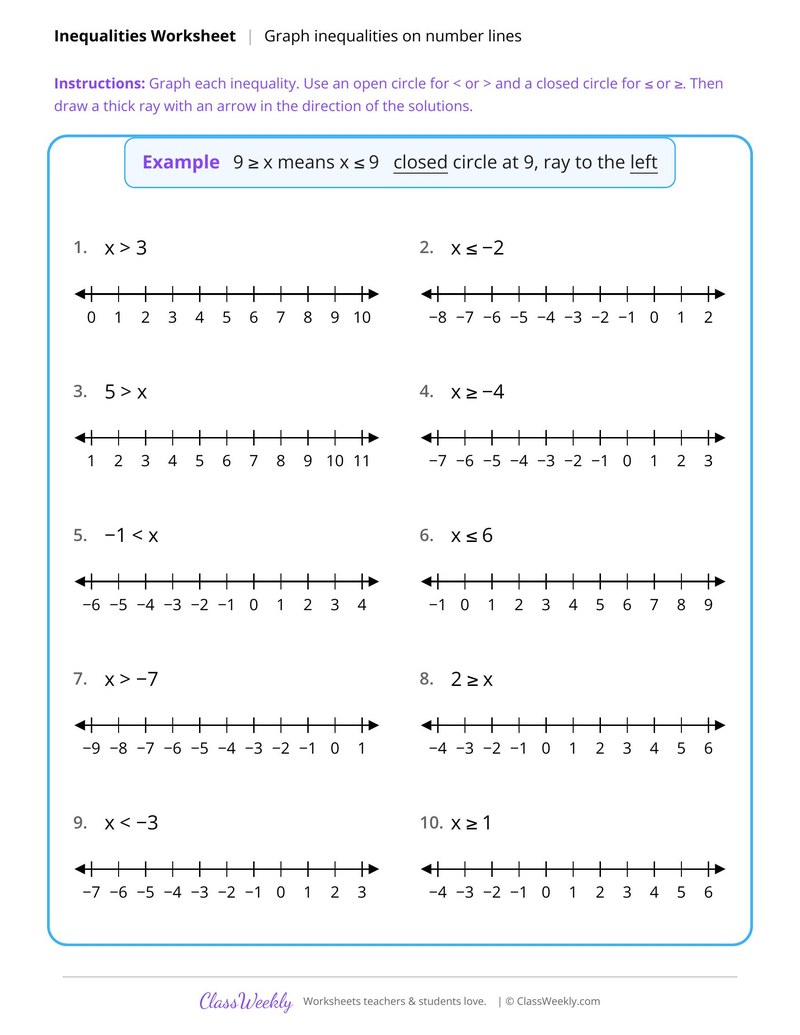
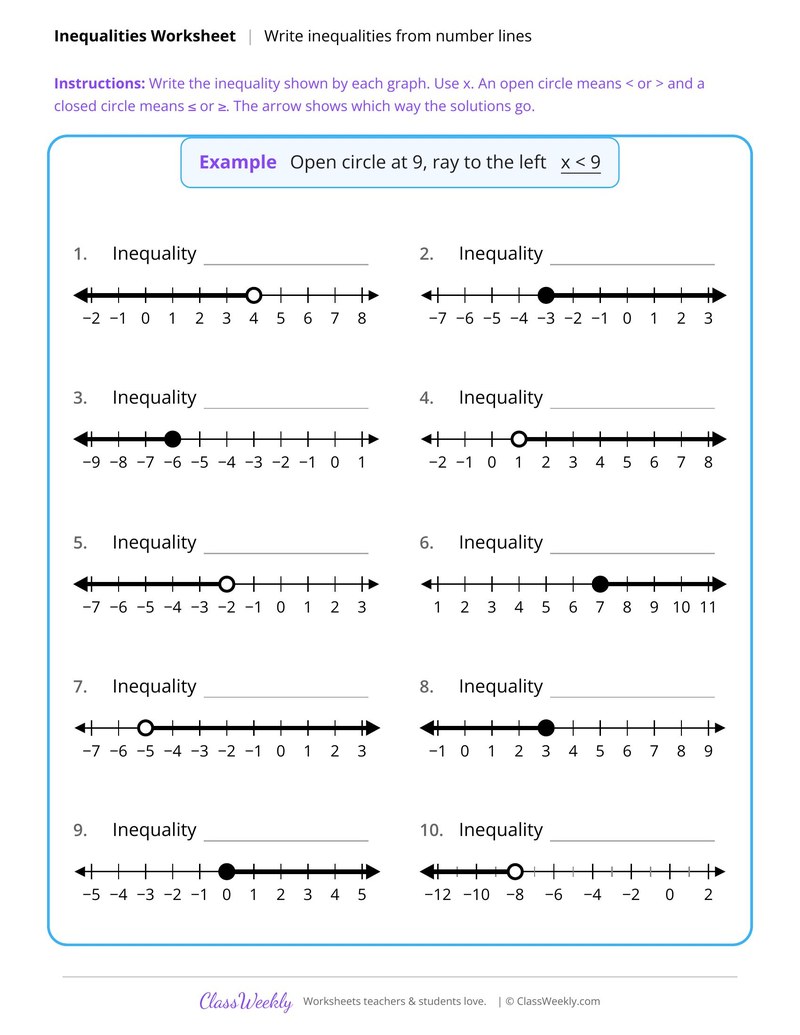
Use an open circle for < or >, because the endpoint is not a solution. Use a closed circle for ≤ or ≥, because the endpoint is included. The ray then points toward the rest of the solutions.
How do you graph an inequality written like 9 ≥ x?
⌄
Rewrite it with x first. 9 ≥ x means x ≤ 9, so draw a closed circle at 9 and a ray to the left. Several sheets mix both forms so students practice this step.
How do you write an inequality from a number line?
⌄
Read the endpoint, then check the circle and the arrow. An open circle at 9 with a ray to the left is x < 9. When the endpoint sits between labels, count the ticks to find its value first.
Ratings & Reviews
No reviews yet. Be the first to share what you think.
Reviews are for ClassWeekly members.
Make a Request
Spotted something to fix, or want a worksheet we don't have yet? Tell us and we'll make it.
What is ClassWeekly?
ClassWeekly offers free worksheets and printable learning resources for kids, from preschool up. All worksheets are aligned to Common Core, NGSS, and C3 Framework standards and designed by educators. Become a member to access the full library and download unlimited PDFs.