Which Takes Longer
Written by Adi Ackerman, Head Teacher
"Which Takes Longer" is written for 1st Grade (Ages 6-7). If your little one is a year younger but already steady on telling time, the page still works. You may just need to read the instructions out loud. And if they are older and units of time never quite stuck, this is a short review rather than busywork.
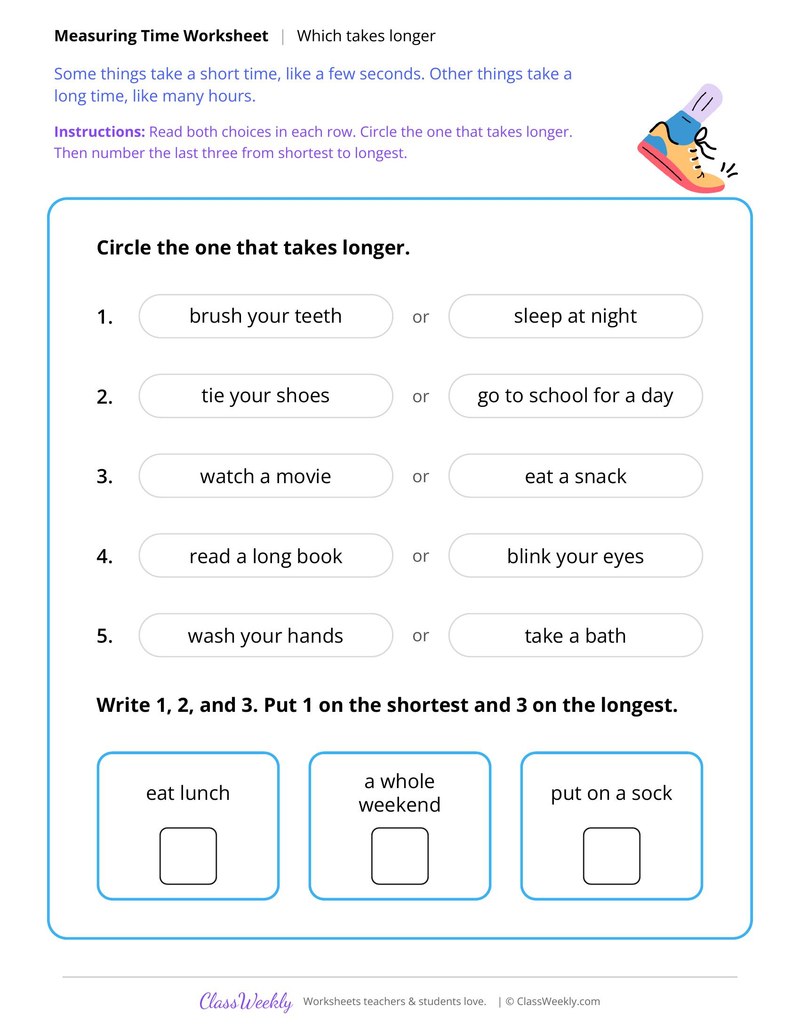
1st grade time worksheet: circle the activity that takes longer in 5 pairs, then order 3 activities from shortest to longest. Answer key included. Part of our units of time collection.
How do I use this worksheet?
Print the page and read the directions with your child: Read both choices in each row. Circle the one that takes longer. Then number the last three from shortest to longest. When they finish, check the work together with the answer key.
What students will practice
- Students will compare how long everyday activities take.
- Students will circle the activity that takes longer.
- Students will order three activities from shortest to longest.
Curriculum Links
Find this in the curriculum
Browse the grade, subject, and topic this belongs to.
FAQ
How do I use this units of time worksheet?
⌄
Print the page and read the directions with your child: Read both choices in each row. Circle the one that takes longer. Then number the last three from shortest to longest. When they finish, check the work together with the answer key.
What does this worksheet teach?
⌄
Five pairs of activities to compare, such as brush your teeth or sleep at night, and read a long book or blink your eyes. Children circle the one that takes longer, then number three activities (eat lunch, put on a sock and a whole weekend) from shortest to longest. The directions on the page read: Read both choices in each row. Circle the one that takes longer. Then number the last three from shortest to longest. An answer key is included.
Can I use this units of time worksheet for homeschool or classroom?
⌄
Yes, both. We made it for 1st Grade telling time, and the page works the same whether it lands on a kitchen table or a center rotation. At home, most families go through it together and talk the answers out loud, and that talking is where most of the learning happens with units of time. In class it runs well as independent work while you pull a small group. Print one copy or thirty, whichever the day needs.
What is a good first way to teach units of time?
⌄
Start with things children do every day. Clapping once takes seconds, eating lunch takes minutes and a night of sleep takes hours, so the units connect to real routines before clocks.
Is there an answer key?
⌄
Yes. Both units of time sheets have an answer key.
What time-telling skills should first graders have?
⌄
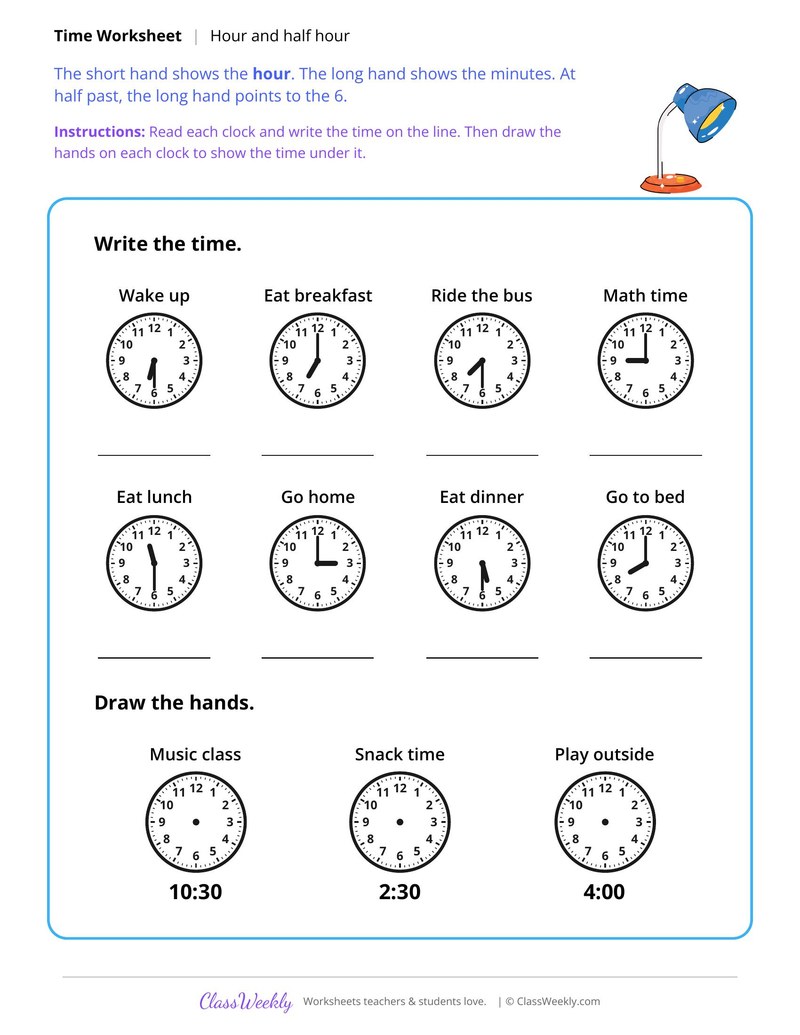
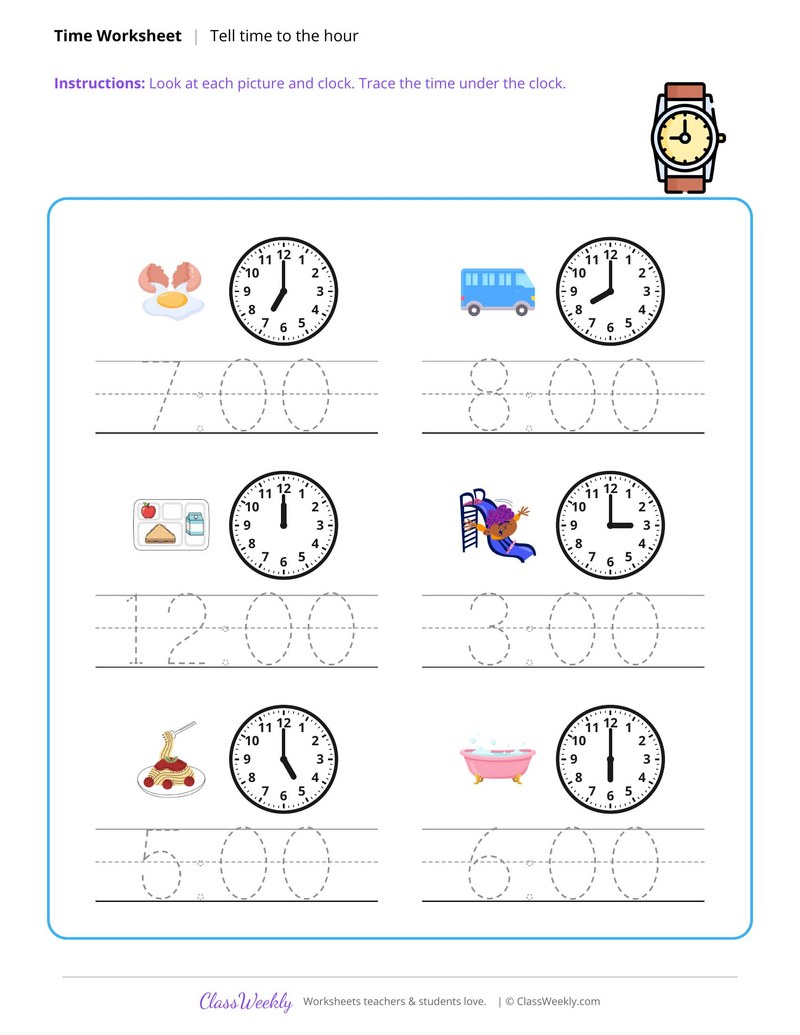
First graders should tell and write time in hours and half hours using analog and digital clocks (CCSS 1.MD.B.3). They should know that the short hand shows the hour and the long hand shows the minutes. For o'clock times, the minute hand points to 12. For half-past times, the minute hand points to 6 and the hour hand is between two numbers. Students should also connect times to daily routines and understand the sequence of hours in a day. Worksheets with large, clear clock faces that show o'clock and half-hour times, alongside matching digital time formats, help children read both clock types. This dual-format practice prepares them for telling time to the nearest five minutes in second grade.
How do you teach half past the hour to first graders?
⌄
Start by reviewing o'clock times, then show a clock at 3:30. Explain that the minute hand has gone halfway around the clock (pointing to the 6), so we say it is half past 3. Demonstrate how the hour hand moves between numbers as the minutes pass: at 3:30, it is between the 3 and the 4. Use a demonstration clock with movable hands so children can see both hands moving together. Worksheets that show the progression from 3:00 to 3:30 help children understand the movement. Practice matching analog clocks showing half-hour times to digital displays. The phrase "half past" connects to the fraction concept of halves, so referencing the minute hand traveling half the circle reinforces both time and fraction understanding.
Why is telling time difficult for first graders?
⌄
Telling time combines several challenging concepts at once: reading two hands that move at different rates, understanding that the hour hand moves gradually between numbers rather than jumping, working in a base-60 system (60 minutes per hour) unlike the base-10 counting they are used to, and interpreting a circular number line (the clock face) rather than a straight one. Many children also have limited experience with analog clocks at home, where digital displays are more common. Worksheets that isolate each skill, first reading the hour hand only, then the minute hand at 12 and 6, help break the complexity into manageable steps. Daily clock-reading practice during the school day connects this abstract skill to real, recurring moments.
Ratings & Reviews
No reviews yet. Be the first to share what you think.
Reviews are for ClassWeekly members.
Make a Request
Spotted something to fix, or want a worksheet we don't have yet? Tell us and we'll make it.
Worksheet Details
| Grade | 1st Grade |
| Subject | Math |
| Topic | Telling Time |
| Pages | 1 page |
| Difficulty | Medium |
Learn More
What is ClassWeekly?
ClassWeekly offers free worksheets and printable learning resources for kids, from preschool up. All worksheets are aligned to Common Core, NGSS, and C3 Framework standards and designed by educators. Become a member to access the full library and download unlimited PDFs.