Tell Time to the Hour
Written by Adi Ackerman, Head Teacher
"Tell Time to the Hour" is written for Kindergarten (Ages 5-6). If your little one is a year younger but already steady on time, the page still works. You may just need to read the instructions out loud. And if they are older and telling time never quite stuck, this is a short review rather than busywork.
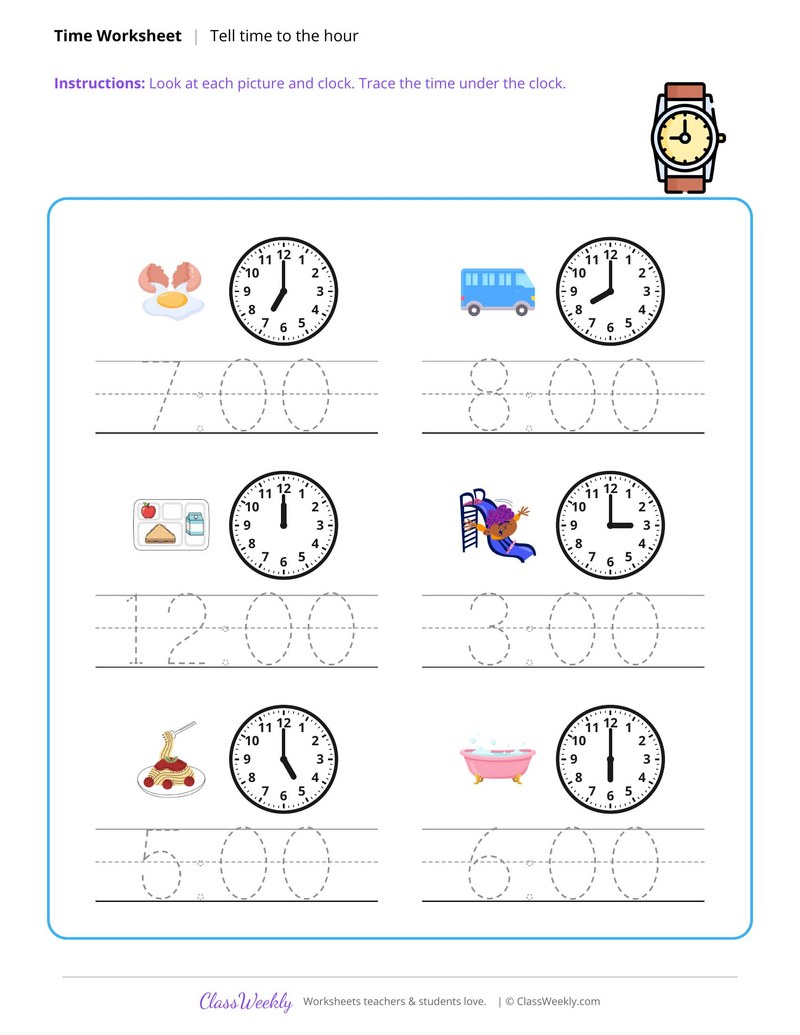
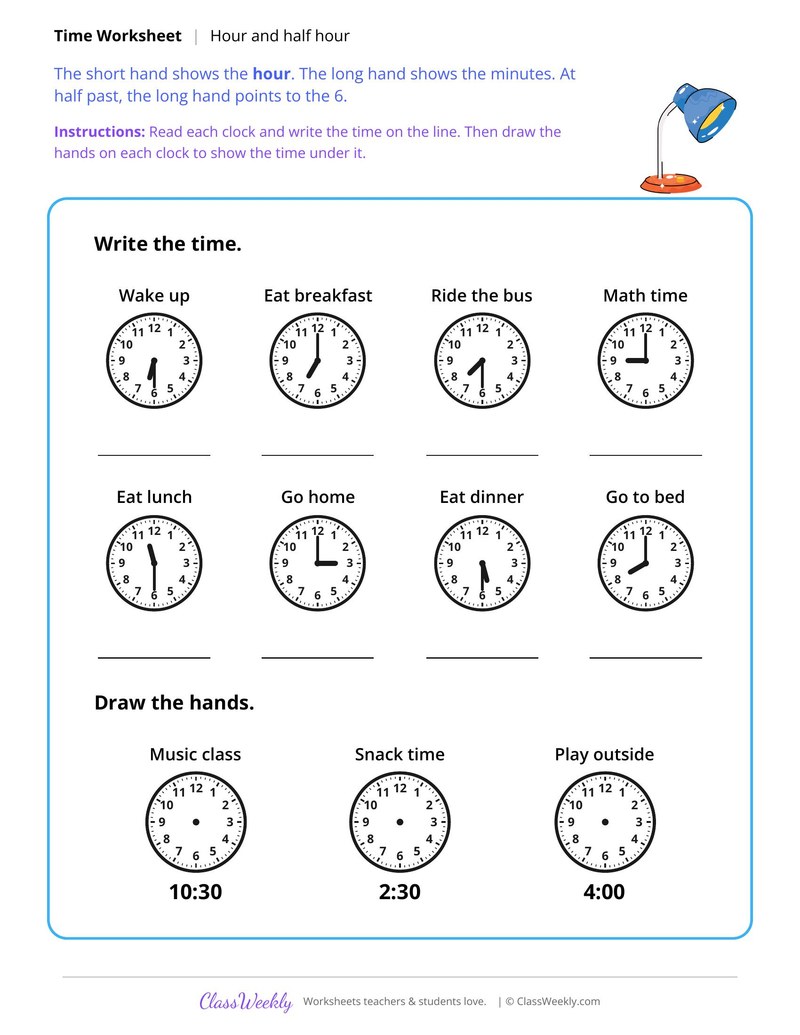
Kindergarten time worksheet: read 6 clocks set to the hour, from 7:00 to 6:00, and trace each time under its routine picture. Answer key included. Part of our telling time collection.
How do I use this worksheet?
Print the page and read the directions with your child: Look at each picture and clock. Trace the time under the clock. When they finish, check the work together with the answer key.
What students will practice
- Students will read clocks set to the hour.
- Students will trace times written as 7:00.
- Students will connect times on a clock to parts of the day.
Curriculum Links
Find this in the curriculum
Browse the grade, subject, and topic this belongs to.
FAQ
How do I use this telling time worksheet?
⌄
Print the page and read the directions with your child: Look at each picture and clock. Trace the time under the clock. When they finish, check the work together with the answer key.
What does this worksheet teach?
⌄
Six clocks, each beside a routine picture and set to an o'clock time: 7:00, 8:00, 12:00, 3:00, 5:00 and 6:00. Children look at where the hands point and trace the time printed in gray under each clock. The directions on the page read: Look at each picture and clock. Trace the time under the clock. An answer key is included.
Can I use this telling time worksheet for homeschool or classroom?
⌄
Yes, both. We made it for Kindergarten time, and the page works the same whether it lands on a kitchen table or a center rotation. At home, most families go through it together and talk the answers out loud, and that talking is where most of the learning happens with telling time. In class it runs well as independent work while you pull a small group. Print one copy or thirty, whichever the day needs.
What time concepts do kindergarteners learn?
⌄
Kindergarteners develop an informal understanding of time through daily routines: morning, afternoon, evening, and night; days of the week; yesterday, today, and tomorrow. CCSS K.MD.B is the measurement and data domain, but formal clock reading begins in first grade (1.MD.B.3). Kindergarten time work is primarily about sequencing and vocabulary.
How do you teach time concepts to kindergarteners?
⌄
Anchor time vocabulary to classroom routines: we have morning meeting, then reading, then snack. Use a daily schedule chart with pictures. Read books that follow a character through a day. Calendar time is also valuable for days of the week and months. Worksheets that ask students to sequence pictures of daily events build temporal reasoning without requiring clock reading.
When do kindergarteners start reading clocks?
⌄
Formal clock reading - telling time to the hour and half-hour - is a first-grade standard (CCSS 1.MD.B.3). In kindergarten, exposure to analog clocks through classroom display and discussion is appropriate, but students are not expected to independently tell time. If a kindergartener is interested in reading clocks, on-the-hour times are an appropriate introduction.
Ratings & Reviews
No reviews yet. Be the first to share what you think.
Reviews are for ClassWeekly members.
Make a Request
Spotted something to fix, or want a worksheet we don't have yet? Tell us and we'll make it.
Worksheet Details
| Grade | Kindergarten |
| Subject | Math |
| Topic | Time |
| Pages | 1 page |
| Difficulty | Medium |
What is ClassWeekly?
ClassWeekly offers free worksheets and printable learning resources for kids, from preschool up. All worksheets are aligned to Common Core, NGSS, and C3 Framework standards and designed by educators. Become a member to access the full library and download unlimited PDFs.