Sequences Mixed Review With Rules
Written by Adi Ackerman, Head Teacher
"Sequences Mixed Review With Rules" is written for 7th Grade (Ages 12-13). A 6th grader who is already steady on algebra can use it too, and an older student can use it as a short review.
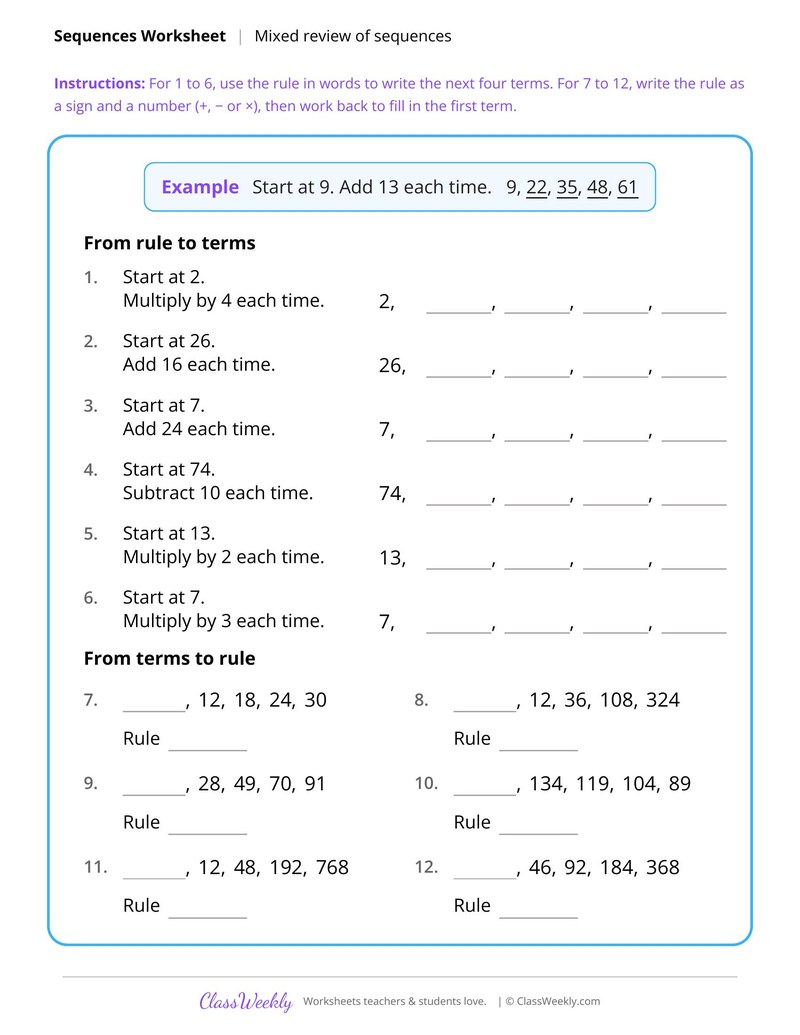
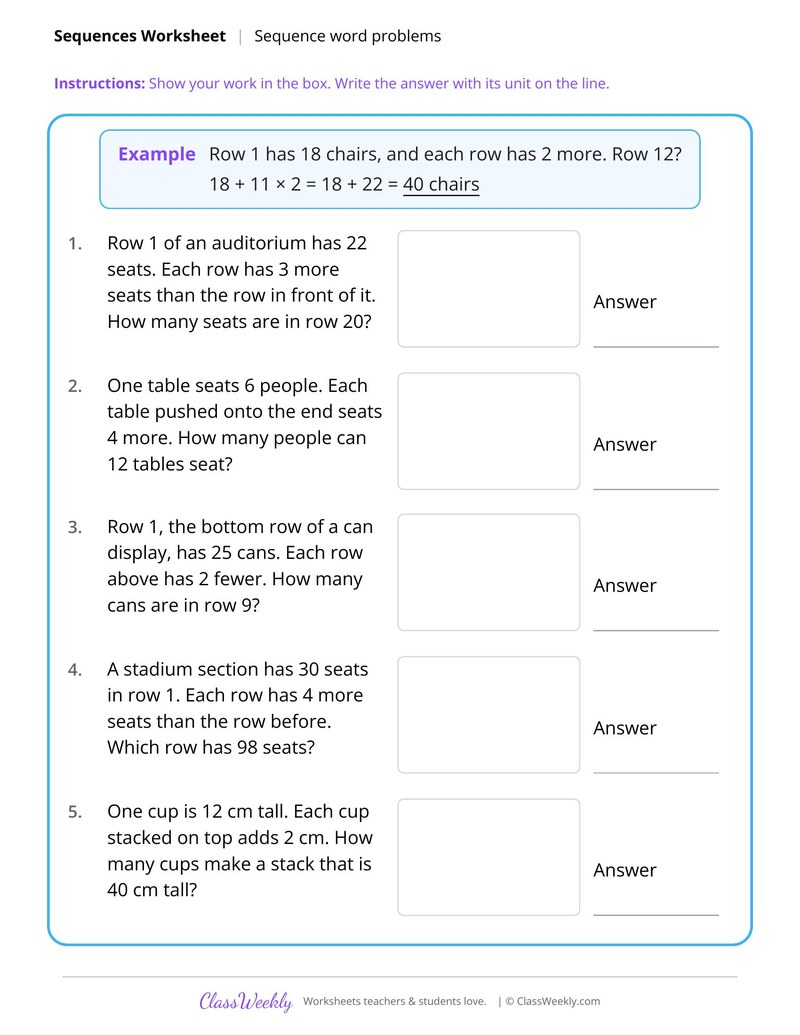
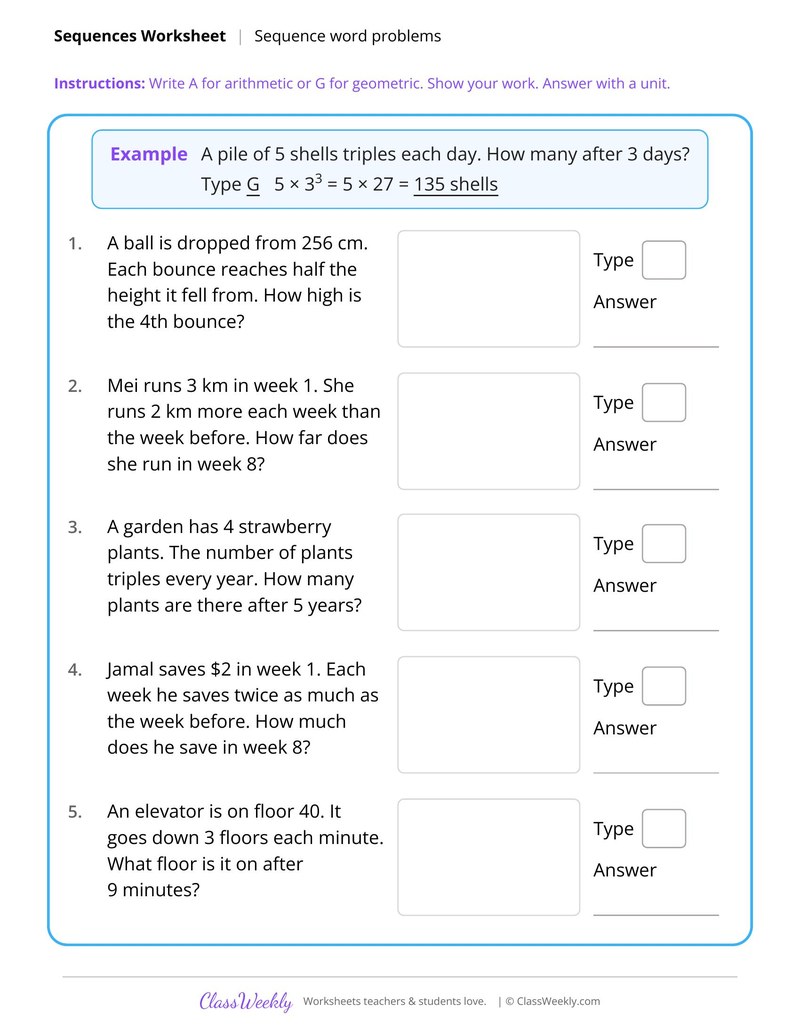
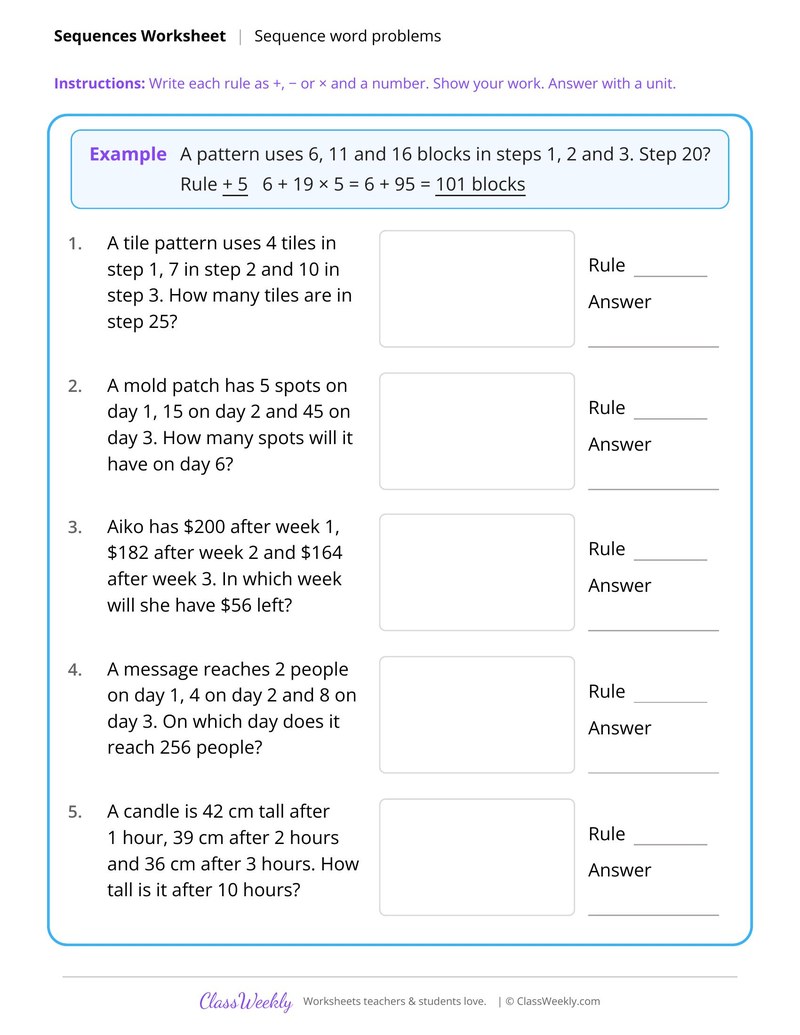
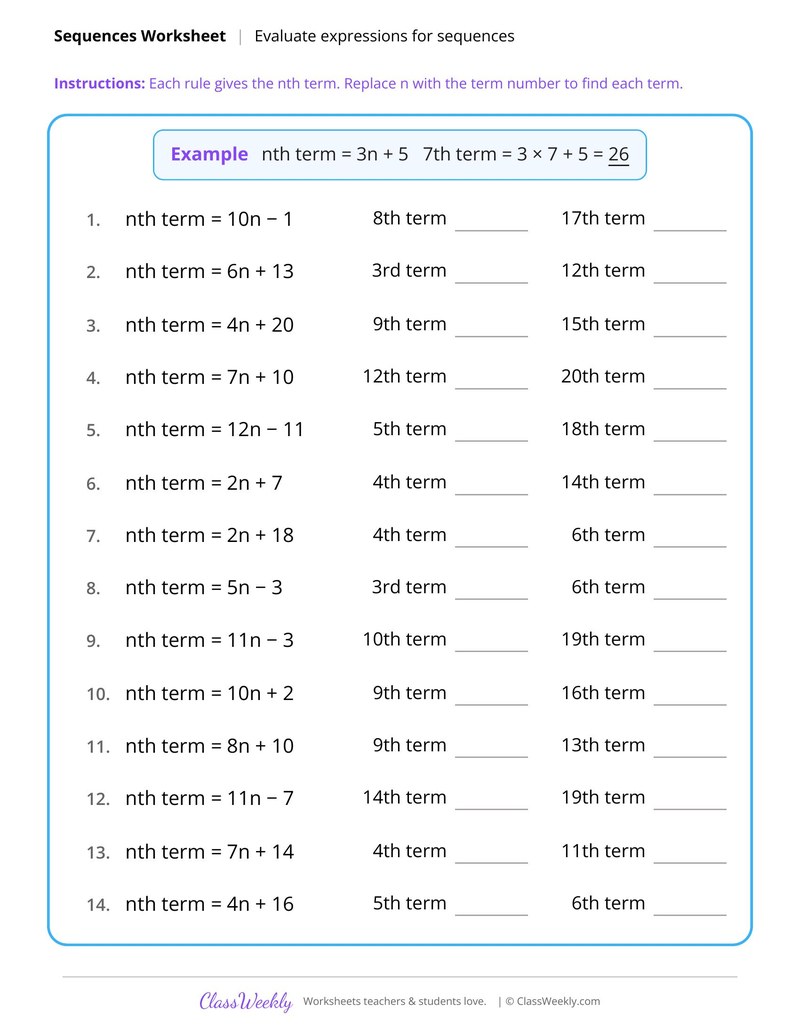
7th grade math worksheet: use word rules like start at 2 and multiply by 4 to write terms, then work back to 6 missing first terms. Answer key included. Part of our arithmetic and geometric sequences algebra collection.
How do I use this worksheet?
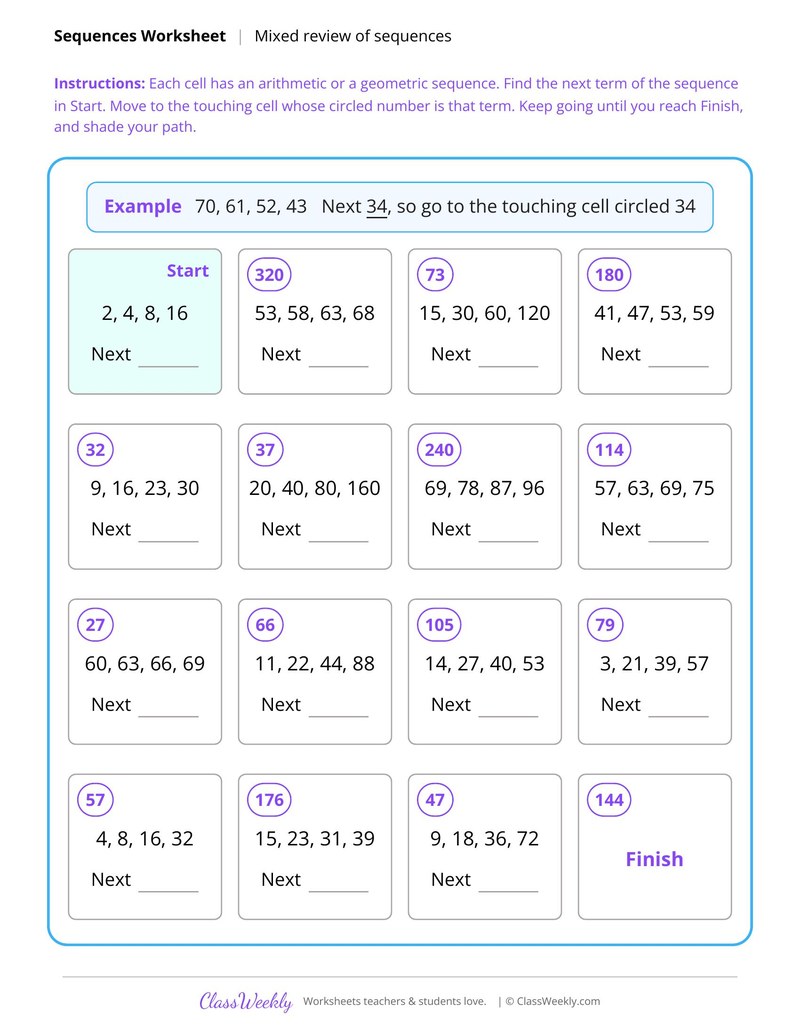
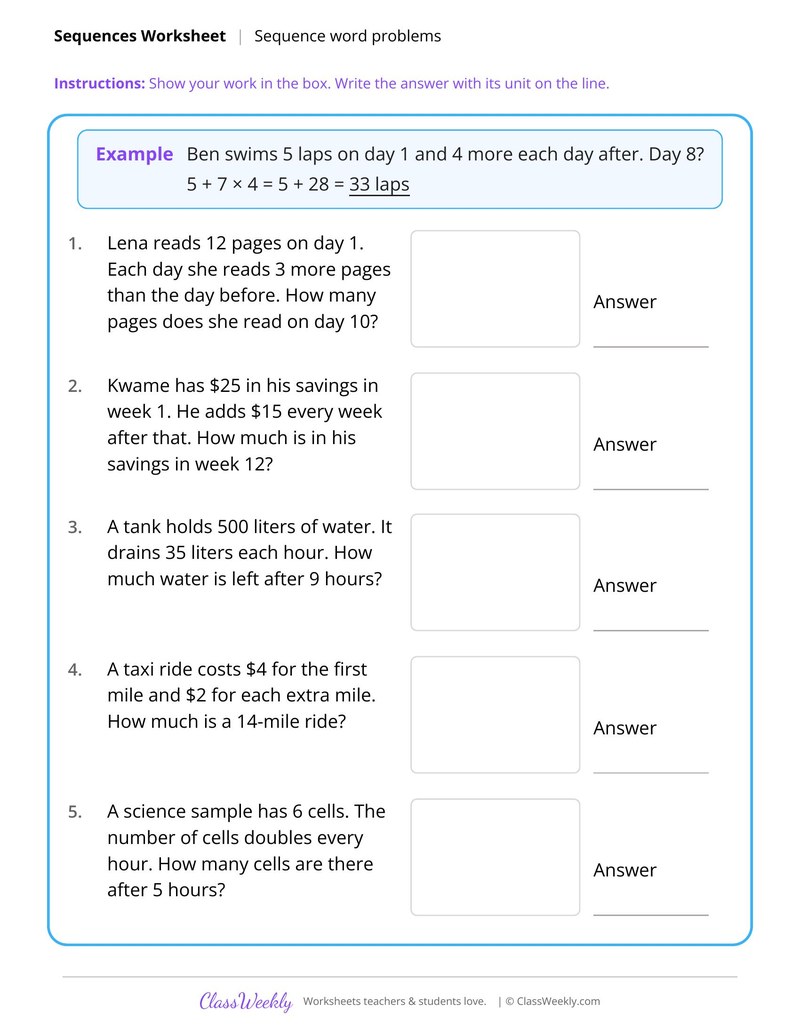
Start with Arithmetic or Geometric to build the idea, then move to the arithmetic and geometric practice sheets. Use the mixed review sheets, the card sort and the mazes for review, since students can check their own paths before the answer key.
What students will practice
- Students will use a rule in words to write the next four terms.
- Students will write the rule of a sequence as a sign and a number.
- Students will work backward from the rule to find the first term.
Curriculum Links
Find this in the curriculum
Browse the grade, subject, and topic this belongs to.
FAQ
How do I use this arithmetic and geometric sequences worksheet?
⌄
Start with Arithmetic or Geometric to build the idea, then move to the arithmetic and geometric practice sheets. Use the mixed review sheets, the card sort and the mazes for review, since students can check their own paths before the answer key.
What does this worksheet teach?
⌄
Use word rules like start at 2 and multiply by 4 to write terms, then work back to 6 missing first terms. The directions on the page read: For 1 to 6, use the rule in words to write the next four terms. For 7 to 12, write the rule as a sign and a number (+, − or ×), then work back to fill in the first term. The page opens with a worked example, and an answer key is included.
Can I use this arithmetic and geometric sequences worksheet for homeschool or classroom?
⌄
Yes, both. We made it for 7th grade algebra, and it works the same at home or at school. At home, a student can work through it alone and then go over it with you, which shows quickly what is solid and what needs another look. In class it works as independent practice, homework or a warm-up, and you can print one copy or a full set.
How do you tell if a sequence is arithmetic or geometric?
⌄
Compare each term with the one before it. If you add or subtract the same number each time, the sequence is arithmetic. If you multiply by the same number each time, it is geometric. Arithmetic or Geometric gives 18 sequences to sort this way.
What is a common difference?
⌄
It is the number added to each term of an arithmetic sequence to get the next term. In 39, 53, 67, 81 the common difference is 14. Find the Next Terms in Arithmetic Sequences has students find it and write the next two terms.
What is a common ratio?
⌄
It is the number each term of a geometric sequence is multiplied by to get the next term. In 17, 51, 153, 459 the common ratio is 3. When a geometric sequence shrinks, each term is divided instead, as on Geometric Sequences That Halve.
How do you find the 20th term of an arithmetic sequence?
⌄
Use the first term plus (n minus 1) times the common difference. For 3, 11, 19, 27 the 20th term is 3 + 19 times 8, which is 155. Find the 10th and 20th Terms practices this with 8 sequences.
Ratings & Reviews
No reviews yet. Be the first to share what you think.
Reviews are for ClassWeekly members.
Make a Request
Spotted something to fix, or want a worksheet we don't have yet? Tell us and we'll make it.
What is ClassWeekly?
ClassWeekly offers free worksheets and printable learning resources for kids, from preschool up. All worksheets are aligned to Common Core, NGSS, and C3 Framework standards and designed by educators. Become a member to access the full library and download unlimited PDFs.