Outfit and Menu Choices
Written by Adi Ackerman, Head Teacher
"Outfit and Menu Choices" is written for 6th Grade (Ages 11-12). If your student is a year younger but already steady on probability, the page still works. You may just need to read the instructions out loud. And if they are older and sample spaces and counting never quite stuck, this is a short review rather than busywork.
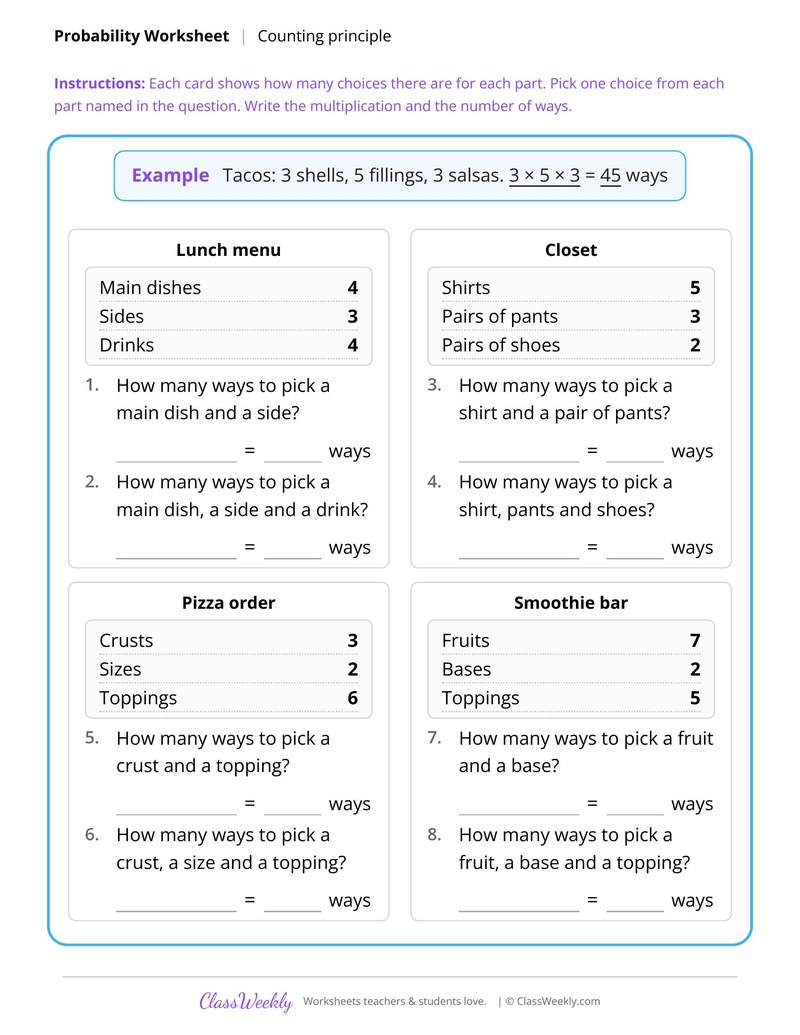
6th grade math worksheet: use menu and closet cards to count ways to pick 2 or 3 parts, from tacos to smoothie toppings. Answer key included. Part of our sample spaces and counting probability collection.
How do I use this worksheet?
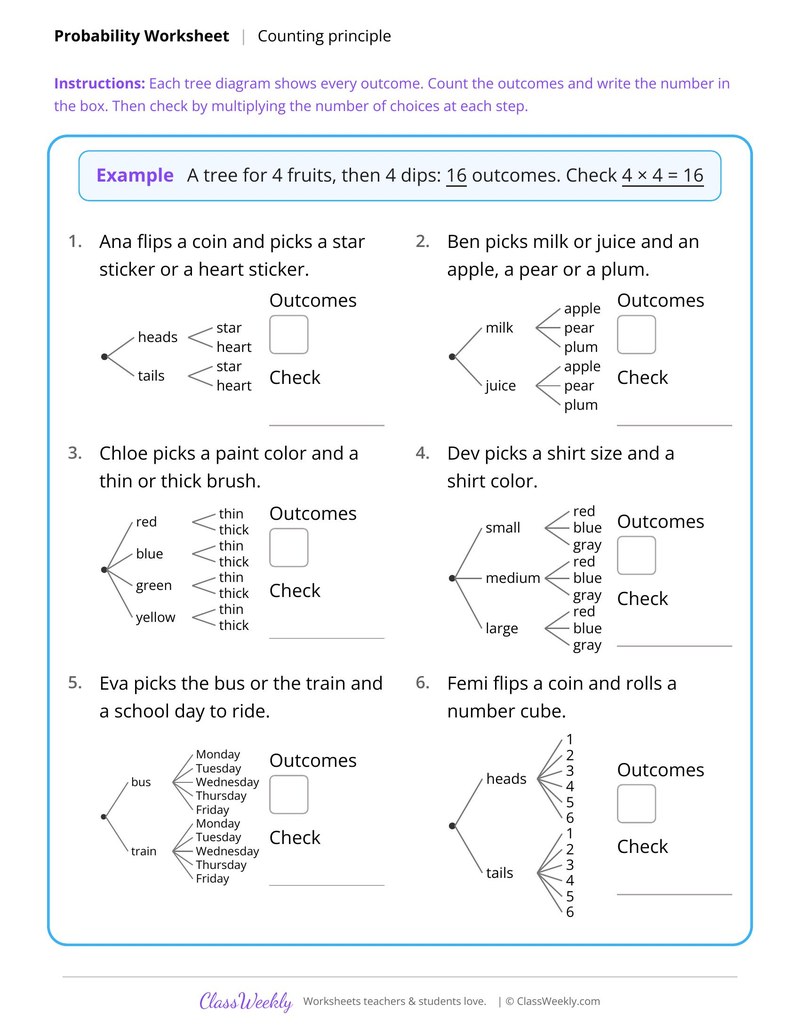
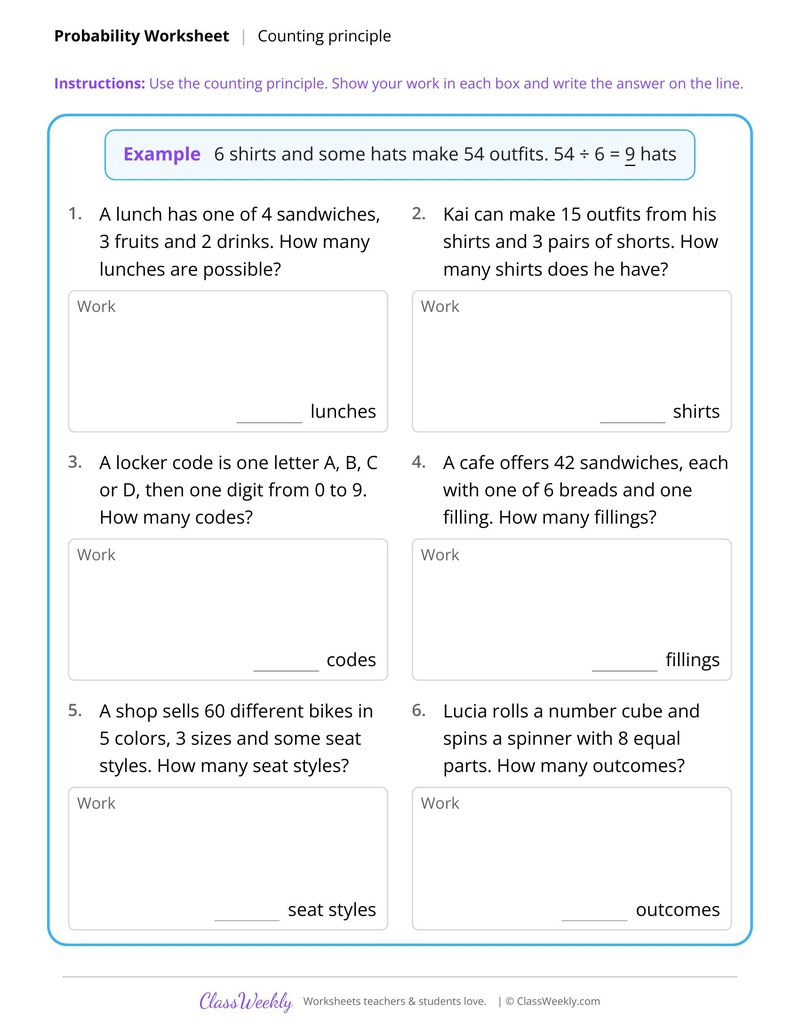
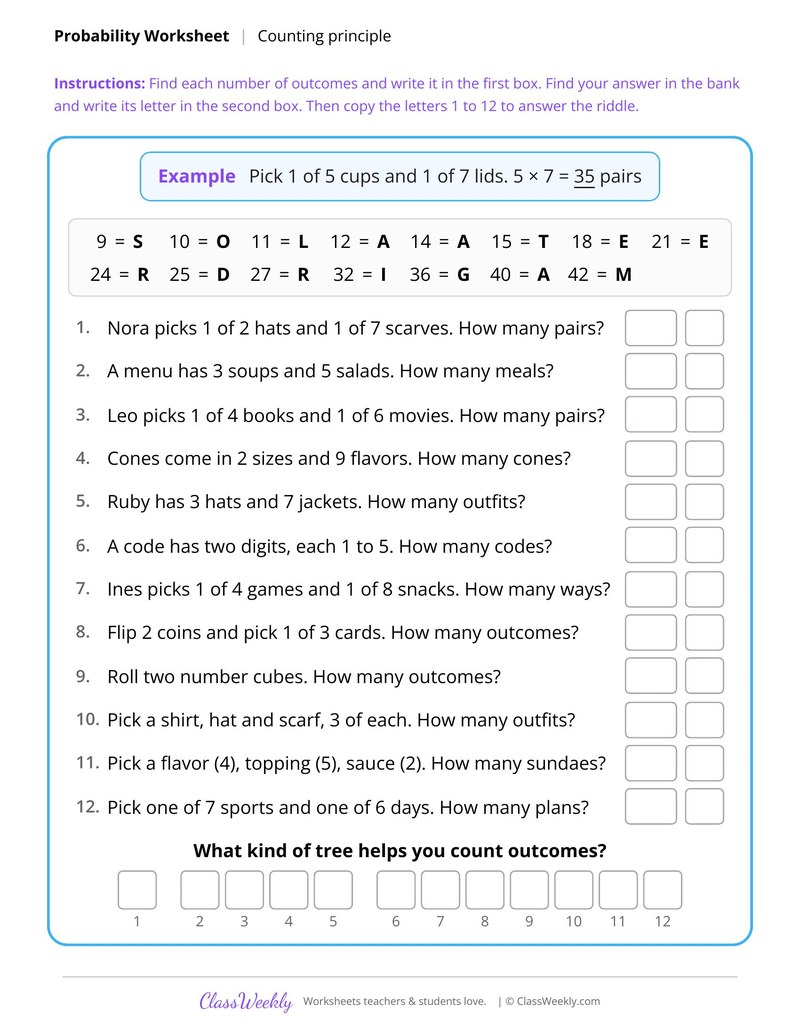
Begin with List the Sample Space and Count the Outcomes in the Sample Space before moving to Count the Choices. Tree Diagrams to Count Outcomes links the two ideas, and Counting Principle Riddle checks answers with a hidden message.
What students will practice
- Students will read the number of choices for each part from a card.
- Students will multiply two or three counts to find the number of ways.
- Students will compare the number of ways with two parts and with three parts.
Curriculum Links
Find this in the curriculum
Browse the grade, subject, and topic this belongs to.
FAQ
How do I use this sample spaces and counting worksheet?
⌄
Begin with List the Sample Space and Count the Outcomes in the Sample Space before moving to Count the Choices. Tree Diagrams to Count Outcomes links the two ideas, and Counting Principle Riddle checks answers with a hidden message.
What does this worksheet teach?
⌄
Use menu and closet cards to count ways to pick 2 or 3 parts, from tacos to smoothie toppings. The directions on the page read: Each card shows how many choices there are for each part. Pick one choice from each part named in the question. Write the multiplication and the number of ways. The page opens with a worked example, and an answer key is included.
Can I use this sample spaces and counting worksheet for homeschool or classroom?
⌄
Yes, both. We made it for 6th Grade probability, and the page works the same whether it lands on a kitchen table or a center rotation. At home, most families go through it together and talk the answers out loud, and that talking is where most of the learning happens with sample spaces and counting. In class it runs well as independent work while you pull a small group. Print one copy or thirty, whichever the day needs.
How do you write a sample space?
⌄
List each different outcome once inside braces, with commas between outcomes. A letter card from the word NOON has the sample space N and O.
What is the counting principle?
⌄
If one choice has m options and a second has n options, there are m times n possible outcomes. Leah's 7 hats and 4 scarves make 7 x 4 = 28 outfits.
How does a tree diagram help you count outcomes?
⌄
Each branch shows one choice, and each path from start to end is one outcome. Count the paths, then check by multiplying the number of choices at each step.
Do these worksheets have answer keys?
⌄
Yes. All 10 worksheets in this group have answer keys.
Ratings & Reviews
No reviews yet. Be the first to share what you think.
Reviews are for ClassWeekly members.
Make a Request
Spotted something to fix, or want a worksheet we don't have yet? Tell us and we'll make it.
Worksheet Details
| Grade | 6th Grade |
| Subject | Math |
| Topic | Probability |
| Pages | 1 page |
| Difficulty | Medium |
What is ClassWeekly?
ClassWeekly offers free worksheets and printable learning resources for kids, from preschool up. All worksheets are aligned to Common Core, NGSS, and C3 Framework standards and designed by educators. Become a member to access the full library and download unlimited PDFs.