Math Vocabulary Posters
Written by Adi Ackerman, Head Teacher
"Math Vocabulary Posters" is written for 1st Grade to 5th Grade (Ages 6-11). It also works a grade below or above: younger children can use it with an adult reading it aloud, and older ones as a quick refresher.
6 pages in this set
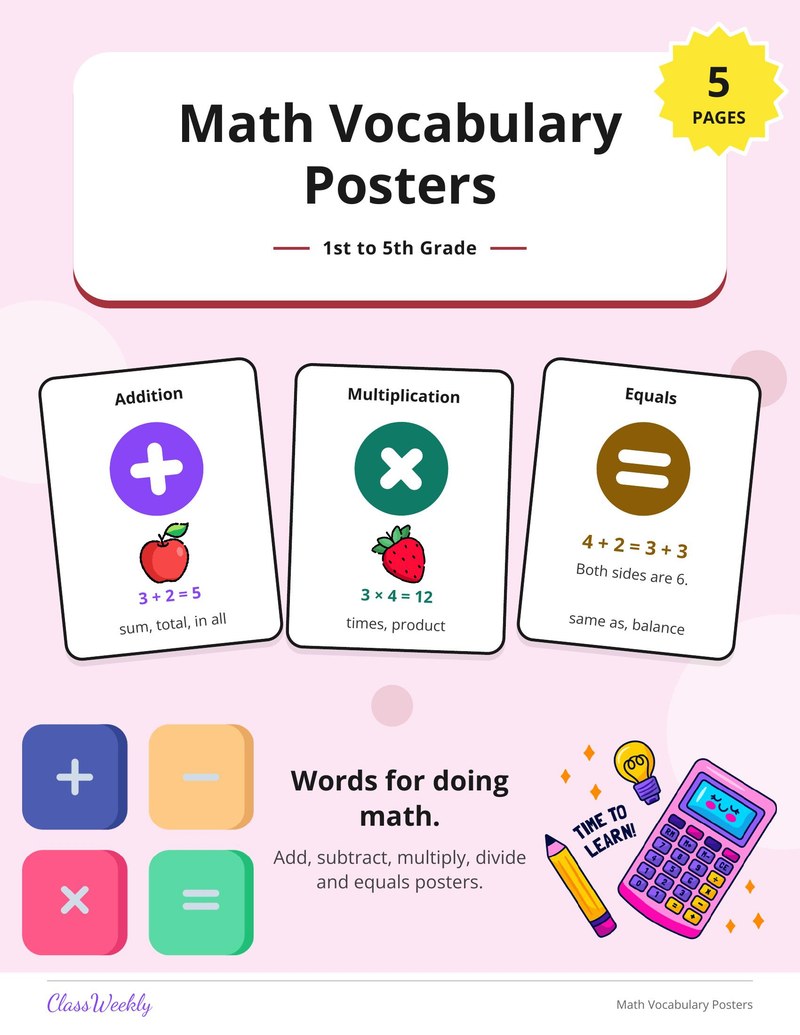
Math vocabulary posters for 1st to 5th grade: 5 posters on addition, subtraction, multiplication, division and equals, with words and examples. Part of our math vocabulary collection.
How do I use this resource?
Hang the posters in your math area. Students point to the words they see in word problems, and can use them as a quick reference.
What students will practice
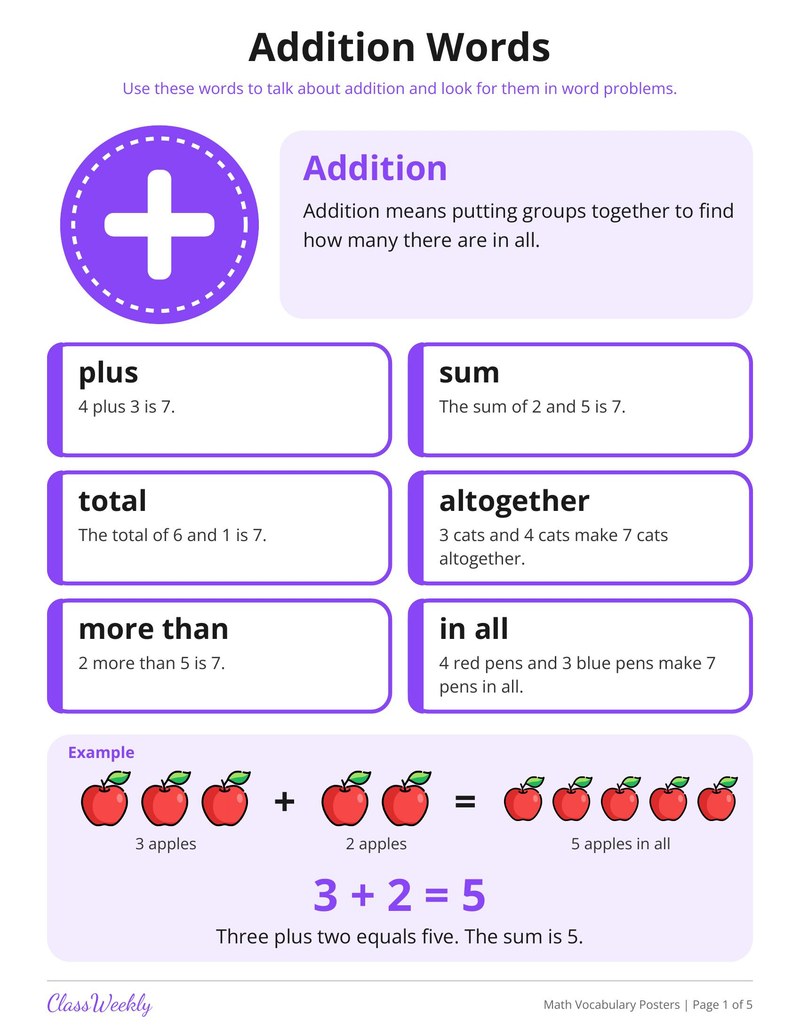
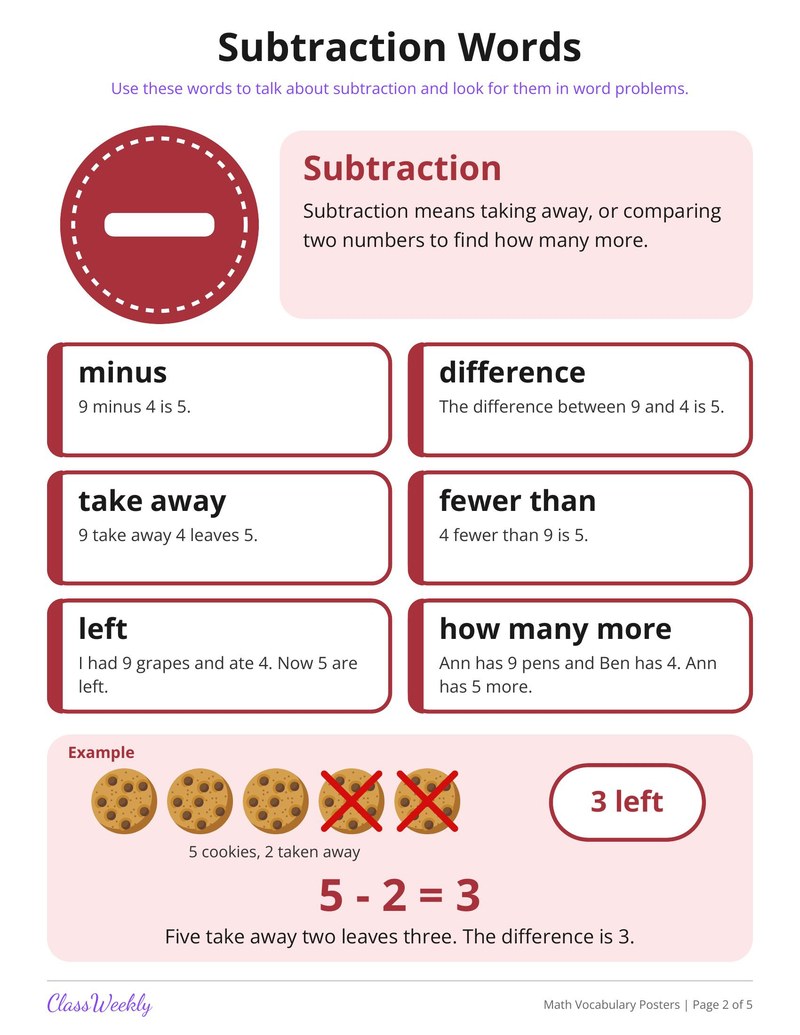
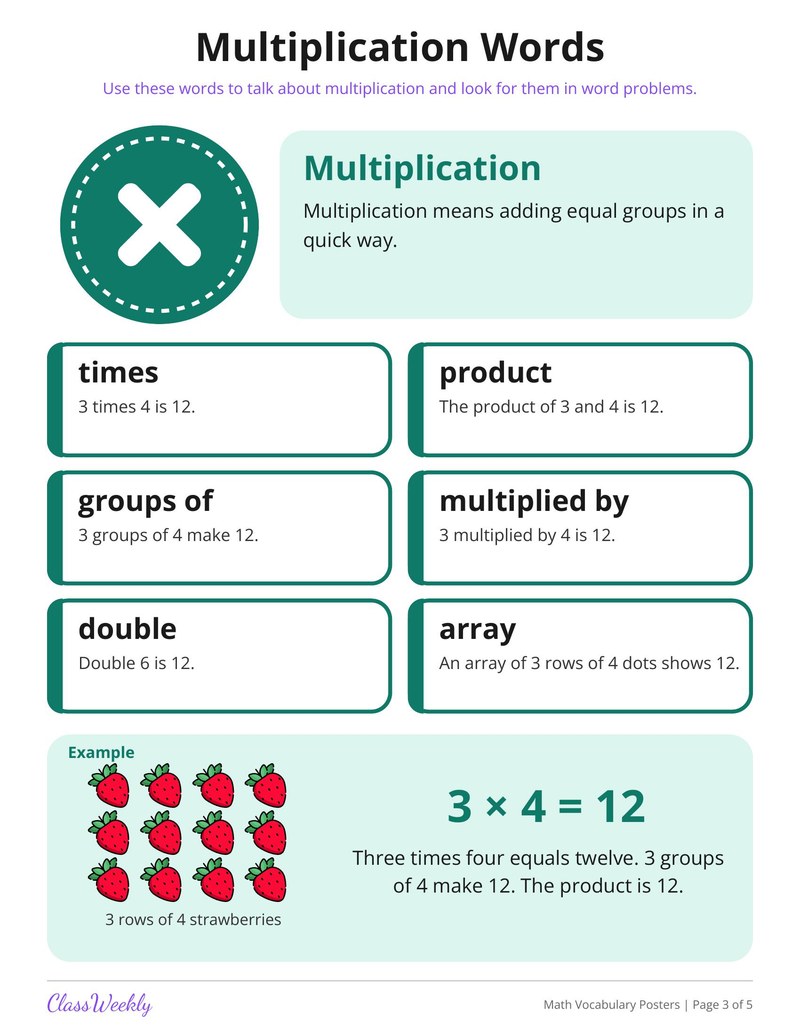
- Teaches key math words, such as plus, sum, minus, difference, times, product and array, on five posters.
- Pairs each word with a sentence and a worked example like 3+2=5, plus an equals poster with a balanced seesaw.
- Works for 1st to 5th grade on a math wall, where students point to the words they find in word problems.


Curriculum Links
Find this in the curriculum
Browse the grade, subject, and topic this belongs to.
FAQ
How do I use the Math Vocabulary Posters?
⌄
Hang the posters in your math area. Students point to the words they see in word problems, and can use them as a quick reference.
What are the Math Vocabulary Posters?
⌄
Five pages after the cover, one poster each: Addition Words, Subtraction Words, Multiplication Words, Division Words and an equals poster with a balanced seesaw example. Each lists key words, such as plus, sum, total, minus, difference, times, product, double and array, with a sentence for each word and a worked example like 3+2=5.
Can I use the Math Vocabulary Posters at home and in the classroom?
⌄
Yes. We made it for 1st Grade to 5th Grade math tools, and it works the same at home or at school. Families print it for one child and keep it where they will use it every day. Teachers print a copy per student or one for the whole room, whichever the day needs.
What printable math tools are included?
⌄
The set includes number lines, place-value charts, multiplication grids, fraction strips, blank clocks, shape sheets, and data templates. These are the visual references and manipulatives that make abstract math concrete for students to see, point to, and use.
How do I use math tools in the classroom?
⌄
Print the tool that matches the skill and model how to use it first. Number lines and place-value charts work as desk mats during independent practice, fraction strips and shape sheets can be cut apart for sorting and building, and blank clocks let students set and read times you call out. Laminate the ones you use often so they last all year.
What is a fraction strip and how does it help?
⌄
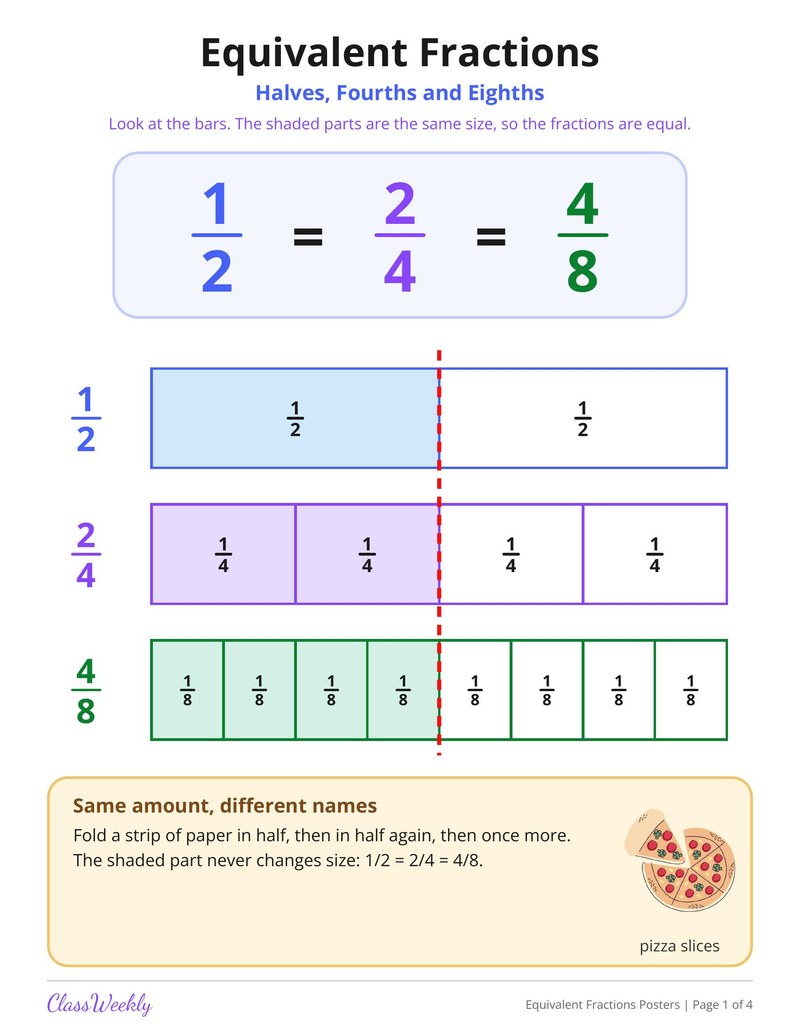
A fraction strip is a printed bar divided into equal parts that lets students see and compare fractions like halves, thirds, and quarters side by side. Physically lining up strips helps students understand equivalence and comparison far better than numbers alone. It is one of the most useful tools for making fractions click.
Can parents use these math tools at home?
⌄
Yes. Keep a number line or times-table grid on the fridge or in a homework folder for quick, no-stress support. Having the right tool within reach helps a child work through homework more independently.
Ratings & Reviews
No reviews yet. Be the first to share what you think.
Reviews are for ClassWeekly members.
Make a Request
Spotted something to fix, or want a resource we don't have yet? Tell us and we'll make it.
Resource Details
| Grade | 1st Grade to 5th Grade |
| Subject | Resources |
| Topic | Math Tools |
| Pages | 6 pages |
| Difficulty | Medium |
What is ClassWeekly?
ClassWeekly offers free worksheets and printable learning resources for kids, from preschool up. All worksheets are aligned to Common Core, NGSS, and C3 Framework standards and designed by educators. Become a member to access the full library and download unlimited PDFs.