Peppered Moth Data
Written by Adi Ackerman, Head Teacher
"Peppered Moth Data" is written for 6th Grade (Ages 11-12), and it covers NGSS MS-LS4-6. If your student is a year younger but already steady on living things, the page still works. You may just need to read the instructions out loud. And if they are older and natural selection and adaptations never quite stuck, this is a short review rather than busywork.
2 pages in this set
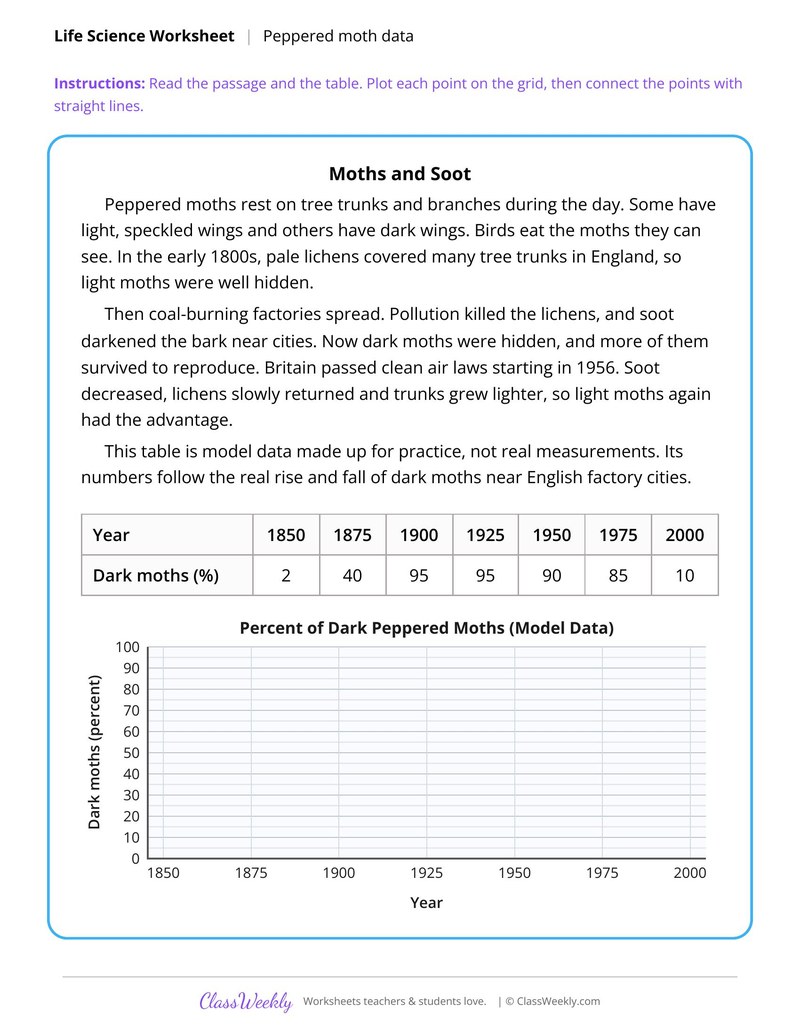
6th grade science worksheet: graph model data on dark peppered moths from 1850 to 2000 and explain the rise and fall. Answer key included. Part of our natural selection and adaptations living things collection. Aligned to NGSS standards.
How do I use this worksheet?
Read Natural Selection together and have students apply each of the four steps to the finches. Use the peppered moth graph next, and point out that its numbers are model data made up for practice.
What students will practice
- Students will plot model data for the percent of dark peppered moths from 1850 to 2000.
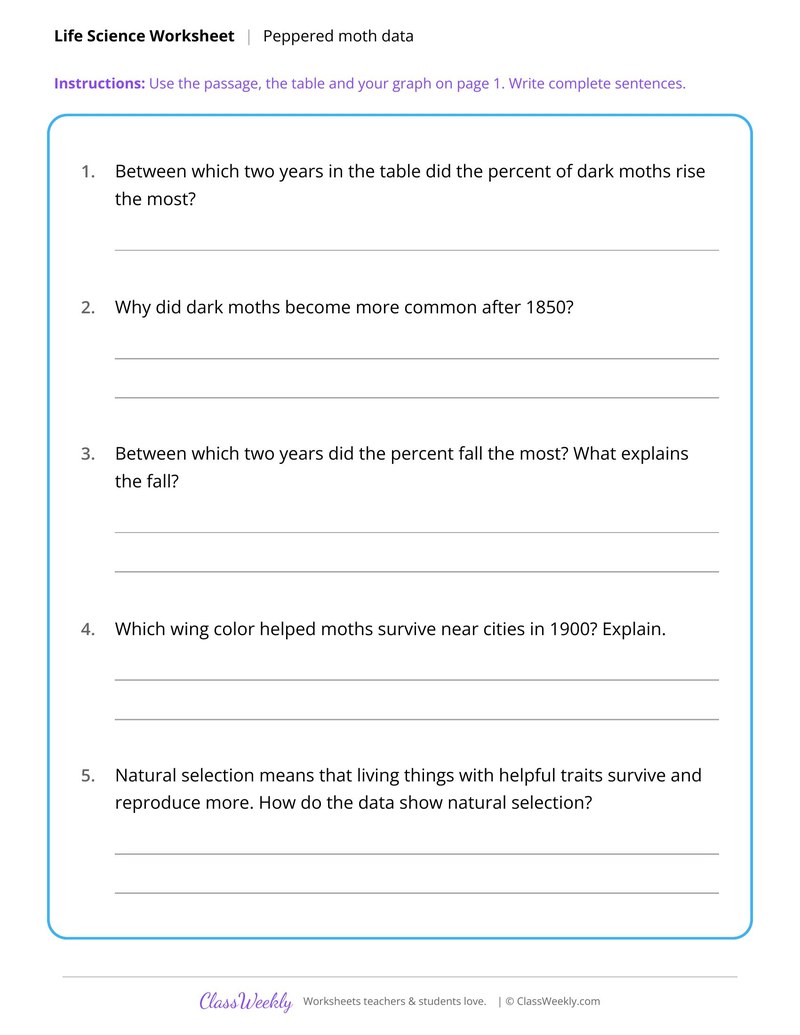
- Students will find the periods when the percent rose the most and fell the most.
- Students will use soot, lichens and clean air laws to explain how the data show natural selection.
Curriculum Links
Next Generation Science Standards
Science · 6th Grade
Find this in the curriculum
Browse the grade, subject, and topic this belongs to.
FAQ
How do I use this natural selection and adaptations worksheet?
⌄
Read Natural Selection together and have students apply each of the four steps to the finches. Use the peppered moth graph next, and point out that its numbers are model data made up for practice.
What does this worksheet teach?
⌄
Graph model data on dark peppered moths from 1850 to 2000 and explain the rise and fall. The directions on the page read: Read the passage and the table. Plot each point on the grid, then connect the points with straight lines. An answer key is included.
Can I use this natural selection and adaptations worksheet for homeschool or classroom?
⌄
Yes, both. We made it for 6th Grade living things, and the page works the same whether it lands on a kitchen table or a center rotation. At home, most families go through it together and talk the answers out loud, and that talking is where most of the learning happens with natural selection and adaptations. In class it runs well as independent work while you pull a small group. Print one copy or thirty, whichever the day needs.
What is a simple example of natural selection?
⌄
During the 1977 drought on Daphne Major, finches with large, deep beaks could crack the hard seeds that were left, and finches with small beaks struggled. The survivors passed on their beak size, so the next generation had larger beaks, on average.
How do peppered moths show natural selection?
⌄
Soot darkened tree bark near English factory cities, so dark moths were hidden from birds and more of them survived to reproduce. After clean air laws reduced soot, light moths again had the advantage. Peppered Moth Data uses model numbers that follow this rise and fall.
What is the difference between structural and behavioral adaptations?
⌄
A structural adaptation is a body part or feature, such as a duck's webbed feet. A behavioral adaptation is something an animal does, such as a groundhog hibernating. A quick test on the sheet asks whether you could see it in a photo of a resting animal.
Ratings & Reviews
No reviews yet. Be the first to share what you think.
Reviews are for ClassWeekly members.
Make a Request
Spotted something to fix, or want a worksheet we don't have yet? Tell us and we'll make it.
Worksheet Details
| Grade | 6th Grade |
| Subject | Science |
| Topic | Living Things |
| Standard | MS-LS4-6 |
| Pages | 2 pages |
| Difficulty | Medium |
Learn More
What is ClassWeekly?
ClassWeekly offers free worksheets and printable learning resources for kids, from preschool up. All worksheets are aligned to Common Core, NGSS, and C3 Framework standards and designed by educators. Become a member to access the full library and download unlimited PDFs.