Relative Adverbs When Where Why
Written by Adi Ackerman, Head Teacher
"Relative Adverbs When Where Why" is written for 4th Grade (Ages 9-10), and it covers Common Core L.4.1.A. If your little one is a year younger but already steady on adverbs, the page still works. You may just need to read the instructions out loud. And if they are older and relative adverbs never quite stuck, this is a short review rather than busywork.
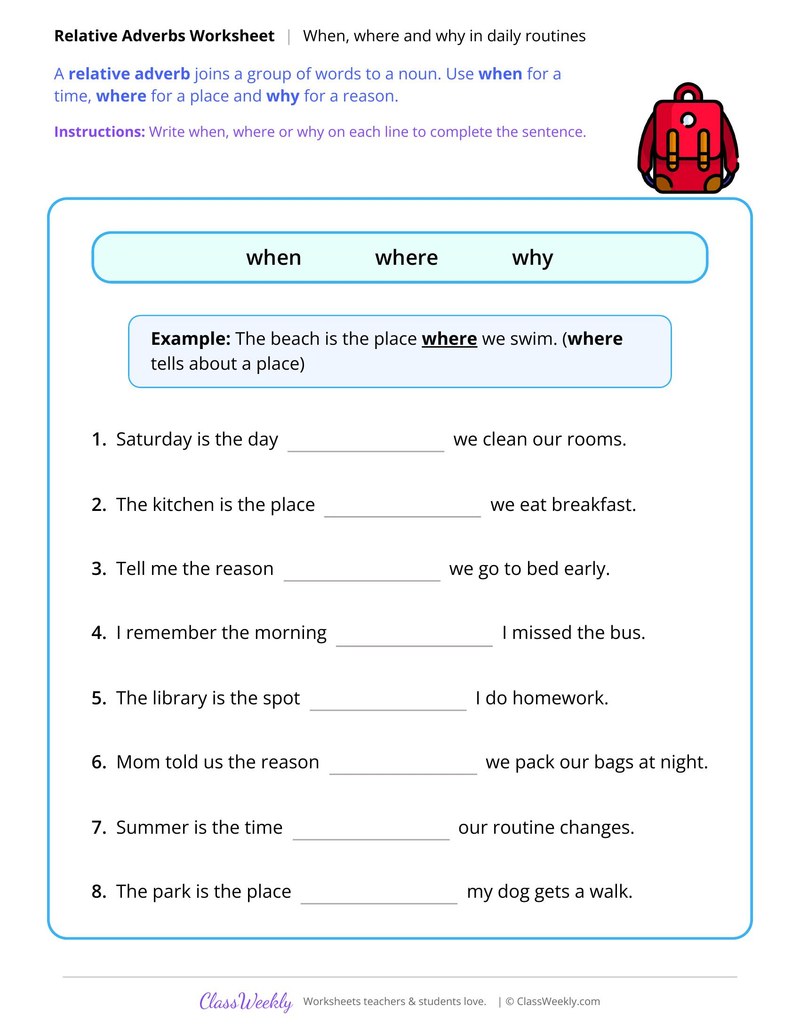
4th grade grammar worksheet: complete 8 sentences about daily routines with the relative adverb when, where or why. Answer key included. Part of our relative adverbs collection. Aligned to Common Core standards.
How do I use this worksheet?
Print the page and read the directions with your child: Write when, where or why on each line to complete the sentence. When they finish, check the work together with the answer key.
What students will practice
- Students will use the relative adverbs when, where and why.
- Students will match each adverb to a time, a place or a reason.
- Students will complete 8 sentences correctly.
Curriculum Links
Common Core State Standards
Language · 4th Grade
Standard: Use interrogative, relative pronouns (who, whose, whom, which, that) and relative adverbs (where, when, why).
View all L.4.1.A worksheets →Find this in the curriculum
Browse the grade, subject, and topic this belongs to.
FAQ
How do I use this relative adverbs worksheet?
⌄
Print the page and read the directions with your child: Write when, where or why on each line to complete the sentence. When they finish, check the work together with the answer key.
What does this worksheet teach?
⌄
A note explains that a relative adverb joins a group of words to a noun: when for a time, where for a place and why for a reason. After an example about the beach, eight sentences about routines, such as Saturday is the day we clean our rooms, each need when, where or why. The directions on the page read: Write when, where or why on each line to complete the sentence. An answer key is included.
Can I use this relative adverbs worksheet for homeschool or classroom?
⌄
Yes, both. We made it for 4th Grade adverbs, and the page works the same whether it lands on a kitchen table or a center rotation. At home, most families go through it together and talk the answers out loud, and that talking is where most of the learning happens with relative adverbs. In class it runs well as independent work while you pull a small group. Print one copy or thirty, whichever the day needs.
How do you choose when, where or why?
⌄
Look at the noun the clause describes. A time, like day or morning, takes when; a place, like kitchen or park, takes where; and the word reason takes why.
Is there an answer key?
⌄
Yes. The relative adverbs sheet has an answer key.
What adverb skills are covered in fourth grade?
⌄
Fourth graders work on using adverbs to modify verbs, adjectives, and other adverbs (CCSS L.4.1). They practice forming adverbs from adjectives (quick/quickly), identifying relative adverbs (where, when, why), and using adverbs effectively in their own writing. They should also understand that adverbs answer how, when, where, and to what extent.
How do you teach adverbs to fourth graders?
⌄
Start with manner adverbs (quickly, loudly, carefully) since they are the most intuitive. Use sentence expansion: The dog ran → The dog ran quickly across the yard. Introduce the concept that adverbs can modify not just verbs but also adjectives (very tall) and other adverbs (quite quickly). Worksheets that ask students to identify what the adverb modifies build deeper understanding.
What is the difference between an adjective and an adverb?
⌄
An adjective modifies a noun or pronoun (the quick fox) while an adverb modifies a verb, adjective, or another adverb (the fox runs quickly, a very quick fox). The most common confusion is between adjective and adverb forms after linking verbs: The soup smells good (adjective, describes soup) vs. She sang well (adverb, describes how she sang). CCSS L.4.1 addresses correct usage.
Ratings & Reviews
No reviews yet. Be the first to share what you think.
Reviews are for ClassWeekly members.
Make a Request
Spotted something to fix, or want a worksheet we don't have yet? Tell us and we'll make it.
Worksheet Details
| Grade | 4th Grade |
| Subject | Grammar & Writing |
| Topic | Adverbs |
| Standard | L.4.1.A |
| Pages | 1 page |
| Difficulty | Medium |
Learn More
What is ClassWeekly?
ClassWeekly offers free worksheets and printable learning resources for kids, from preschool up. All worksheets are aligned to Common Core, NGSS, and C3 Framework standards and designed by educators. Become a member to access the full library and download unlimited PDFs.