Routine Nouns and Verbs
Written by Adi Ackerman, Head Teacher
"Routine Nouns and Verbs" is written for 1st Grade (Ages 6-7). If your little one is a year younger but already steady here, the page still works. You may just need to read the instructions out loud. And if they are older and parts of speech never quite stuck, this is a short review rather than busywork.
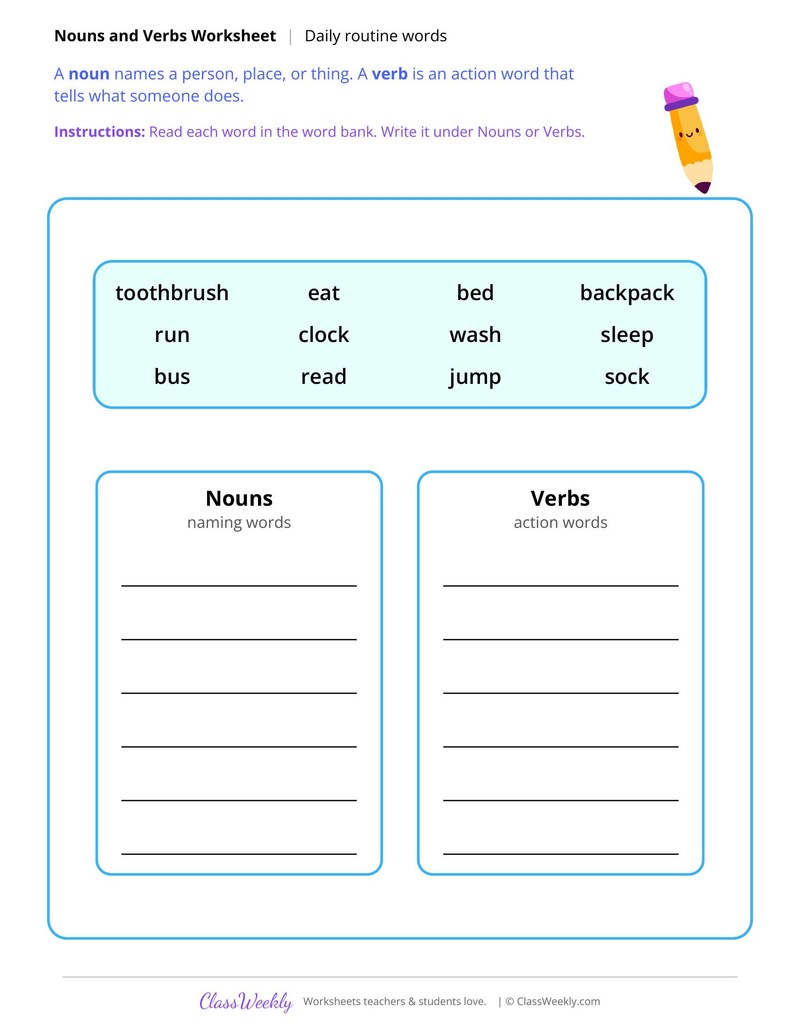
1st grade grammar worksheet: sort 12 daily routine words like toothbrush, eat, bed and run into Nouns and Verbs columns. Answer key included. Part of our parts of speech collection.
How do I use this worksheet?
Print the page and read the directions with your child: Read each word in the word bank. Write it under Nouns or Verbs. When they finish, check the work together with the answer key.
What students will practice
- Students will tell nouns from verbs.
- Students will sort 12 routine words into two columns.
- Students will write each word in the correct column.
Curriculum Links
Find this in the curriculum
Browse the grade, subject, and topic this belongs to.
FAQ
How do I use this parts of speech worksheet?
⌄
Print the page and read the directions with your child: Read each word in the word bank. Write it under Nouns or Verbs. When they finish, check the work together with the answer key.
What does this worksheet teach?
⌄
A note explains that a noun names a person, place or thing and a verb is an action word. A word bank of 12 routine words (toothbrush, eat, bed, backpack, run, clock, wash, sleep, bus, read, jump and sock) goes into two columns, Nouns (naming words) and Verbs (action words). The directions on the page read: Read each word in the word bank. Write it under Nouns or Verbs. An answer key is included.
Can I use this parts of speech worksheet for homeschool or classroom?
⌄
Yes, both. We made it for 1st Grade parts of speech, and the page works the same whether it lands on a kitchen table or a center rotation. At home, most families go through it together and talk the answers out loud, and that talking is where most of the learning happens. In class it runs well as independent work while you pull a small group. Print one copy or thirty, whichever the day needs.
What parts of speech are covered in 1st grade?
⌄
1st grade grammar introduces nouns (naming words), verbs (action/being words), adjectives (describing words), and basic pronouns and articles - the core categories used in everyday sentence structure.
How do students learn parts of speech without getting confused by context-dependent words?
⌄
Initial instruction focuses on clear-cut examples of each category before introducing words that can shift roles - building a solid foundation before addressing ambiguous cases.
Why is learning parts of speech important in 1st grade?
⌄
Understanding parts of speech gives students a metalinguistic vocabulary to talk about language, which helps them understand grammar lessons and writing feedback throughout their education.
What parts of speech do first graders learn?
⌄
First graders are introduced to nouns (people, places, things), verbs (action words), and adjectives (describing words) as the core parts of speech (CCSS L.1.1). They learn to identify these in sentences they read and use them in their own writing. Pronouns, prepositions, and conjunctions are introduced but mastered in later grades.
How do you teach parts of speech to first graders?
⌄
Use concrete, hands-on categorization activities: noun sorts (Is it a person, place, or thing?), verb charades (act out the action word), and adjective sensory descriptions (describe an object using color, size, shape). Worksheets that ask students to identify and label words in context sentences reinforce the concepts more than isolated definitions.
When should first graders be able to identify nouns vs. verbs?
⌄
By mid-year in first grade, most students should reliably identify common nouns and action verbs in simple sentences. CCSS L.1.1a requires use of common, proper, and possessive nouns, and L.1.1e requires use of verbs. Being able to label parts of speech supports both reading comprehension and the revision process in writing.
Ratings & Reviews
No reviews yet. Be the first to share what you think.
Reviews are for ClassWeekly members.
Make a Request
Spotted something to fix, or want a worksheet we don't have yet? Tell us and we'll make it.
Worksheet Details
| Grade | 1st Grade |
| Subject | Grammar & Writing |
| Topic | Parts of Speech |
| Pages | 1 page |
| Difficulty | Medium |
What is ClassWeekly?
ClassWeekly offers free worksheets and printable learning resources for kids, from preschool up. All worksheets are aligned to Common Core, NGSS, and C3 Framework standards and designed by educators. Become a member to access the full library and download unlimited PDFs.