Shaded Area With Triangles
Written by Adi Ackerman, Head Teacher
"Shaded Area With Triangles" is written for 8th Grade (Ages 13-14). A 7th grader who is already steady on geometry can use it too, and an older student can use it as a short review.
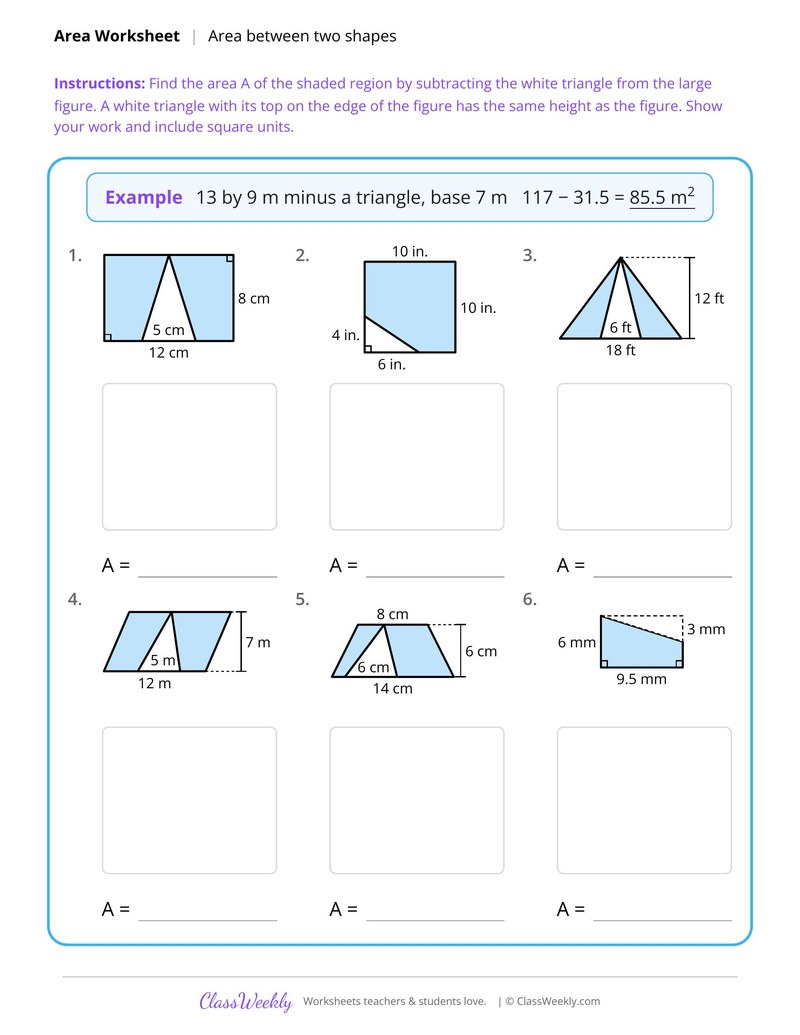
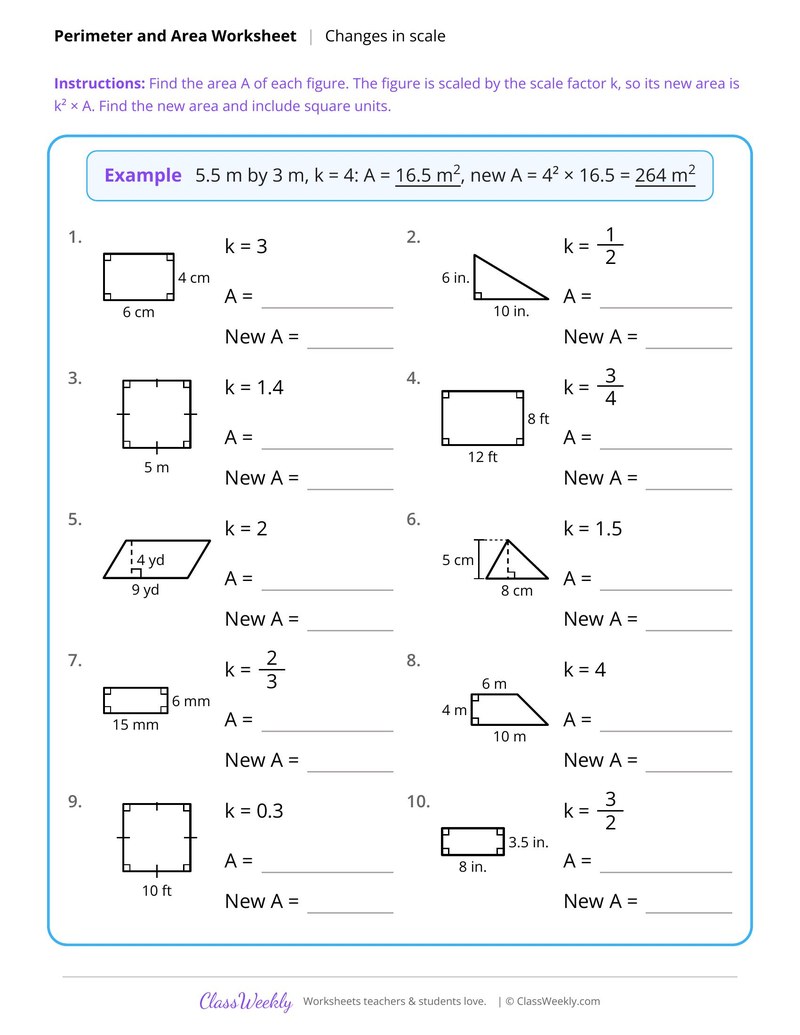
8th grade math worksheet: find 6 shaded areas by subtracting a white triangle, such as a 13 by 9 m rectangle less a 7 m base triangle. Answer key included. Part of our composite figures and scale changes geometry collection.
How do I use this worksheet?
Teach shaded area first with Shaded Area Between Rectangles, then add circles and triangles. Move to Scale Changes and Perimeter before Scale Changes and Area so students see k and k² side by side.
What students will practice
- Students will find the area of a large figure and of the white triangle inside it.
- Students will use the height of the figure as the height of a triangle whose top touches its edge.
- Students will subtract to find the shaded area in square units.
Curriculum Links
Find this in the curriculum
Browse the grade, subject, and topic this belongs to.
FAQ
How do I use this composite figures and scale changes worksheet?
⌄
Teach shaded area first with Shaded Area Between Rectangles, then add circles and triangles. Move to Scale Changes and Perimeter before Scale Changes and Area so students see k and k² side by side.
What does this worksheet teach?
⌄
Find 6 shaded areas by subtracting a white triangle, such as a 13 by 9 m rectangle less a 7 m base triangle. The directions on the page read: Find the area A of the shaded region by subtracting the white triangle from the large figure. A white triangle with its top on the edge of the figure has the same height as the figure. Show your work and include square units. The page opens with a worked example, and an answer key is included.
Can I use this composite figures and scale changes worksheet for homeschool or classroom?
⌄
Yes, both. We made it for 8th grade geometry, and it works the same at home or at school. At home, a student can work through it alone and then go over it with you, which shows quickly what is solid and what needs another look. In class it works as independent practice, homework or a warm-up, and you can print one copy or a full set.
How do you find the area of a shaded region?
⌄
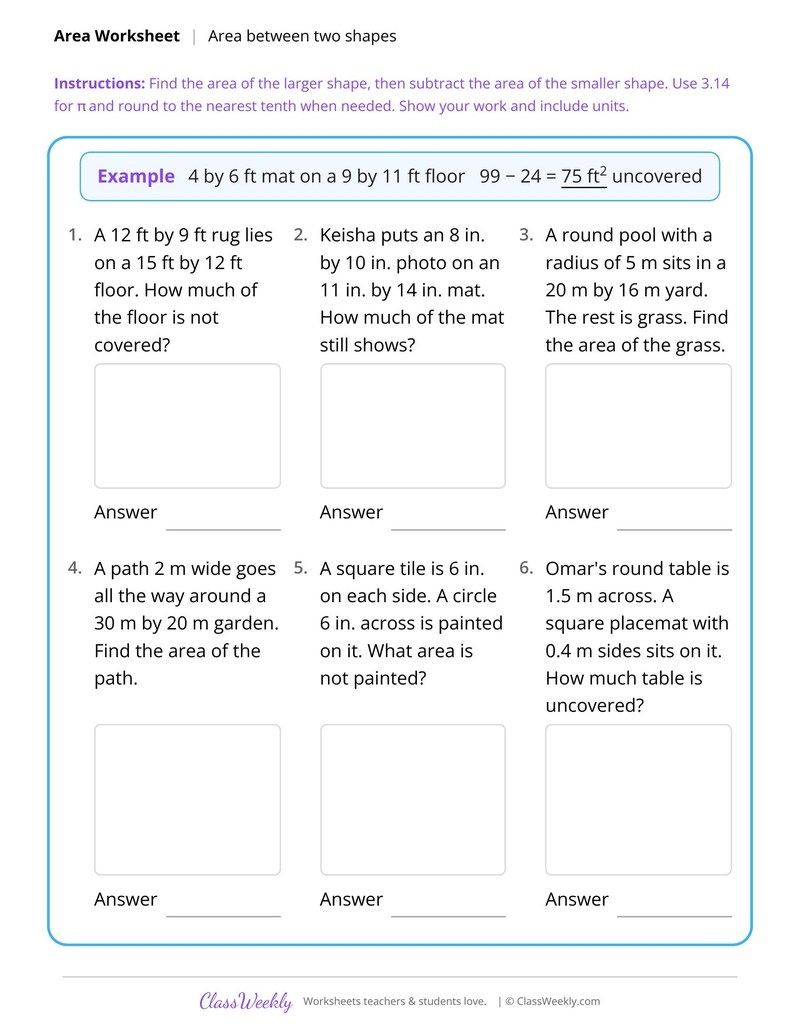
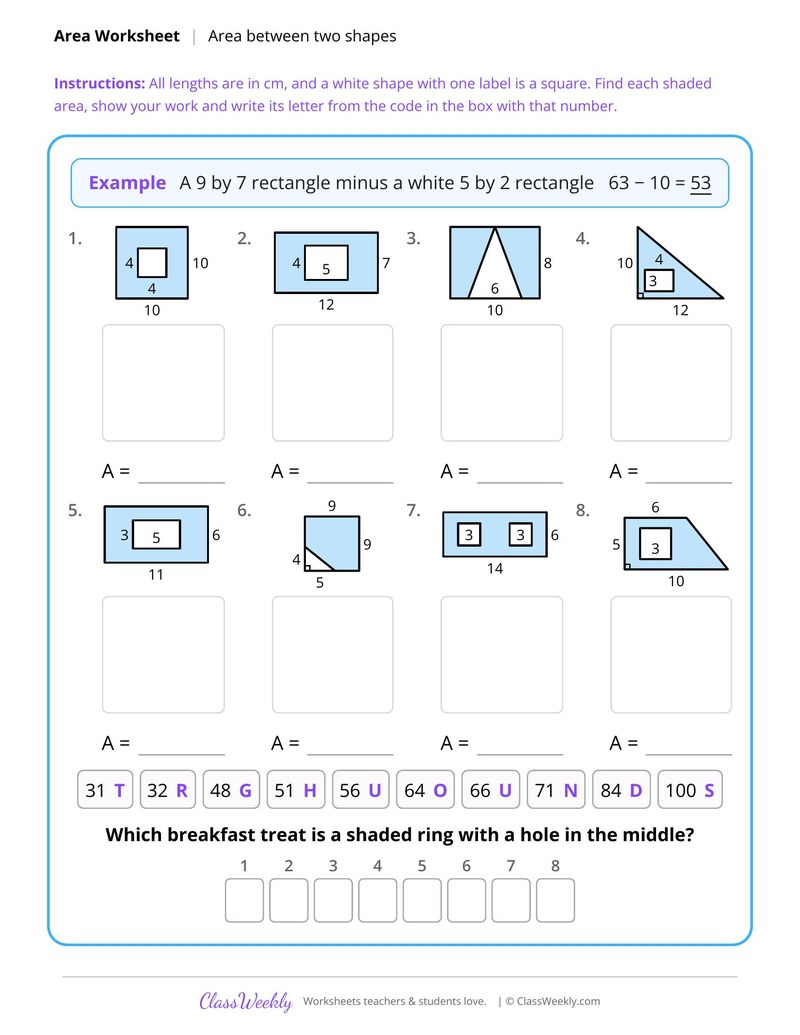
Find the area of the whole figure, then subtract the area of the white part. A 9 by 6 m rectangle with a 4 by 2.5 m white part has a shaded area of 54 minus 10, or 44 m². Shaded Area Between Rectangles has 6 figures like this.
What happens to the area when a figure is scaled by a factor of 3?
⌄
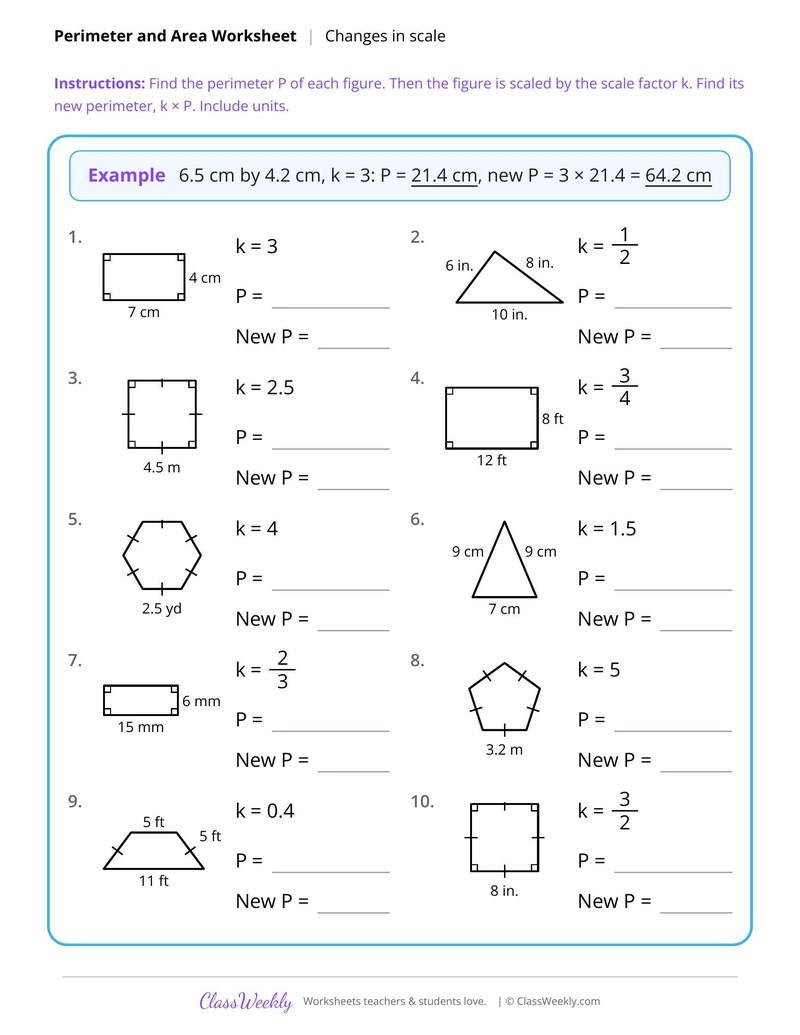
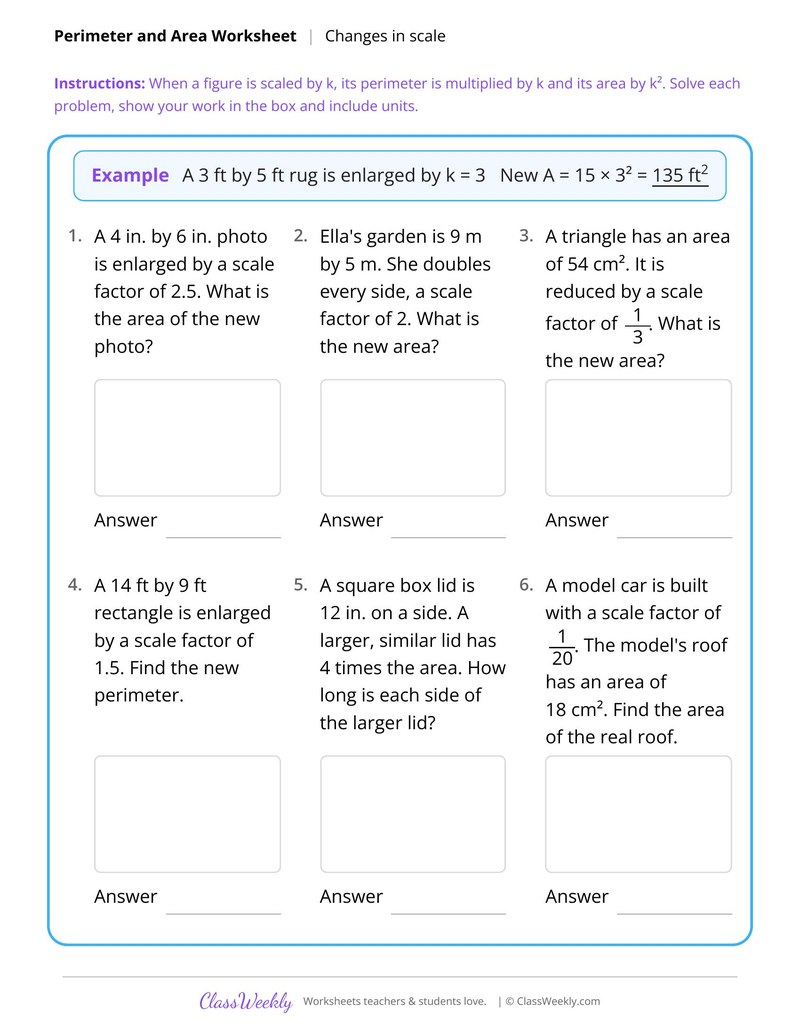
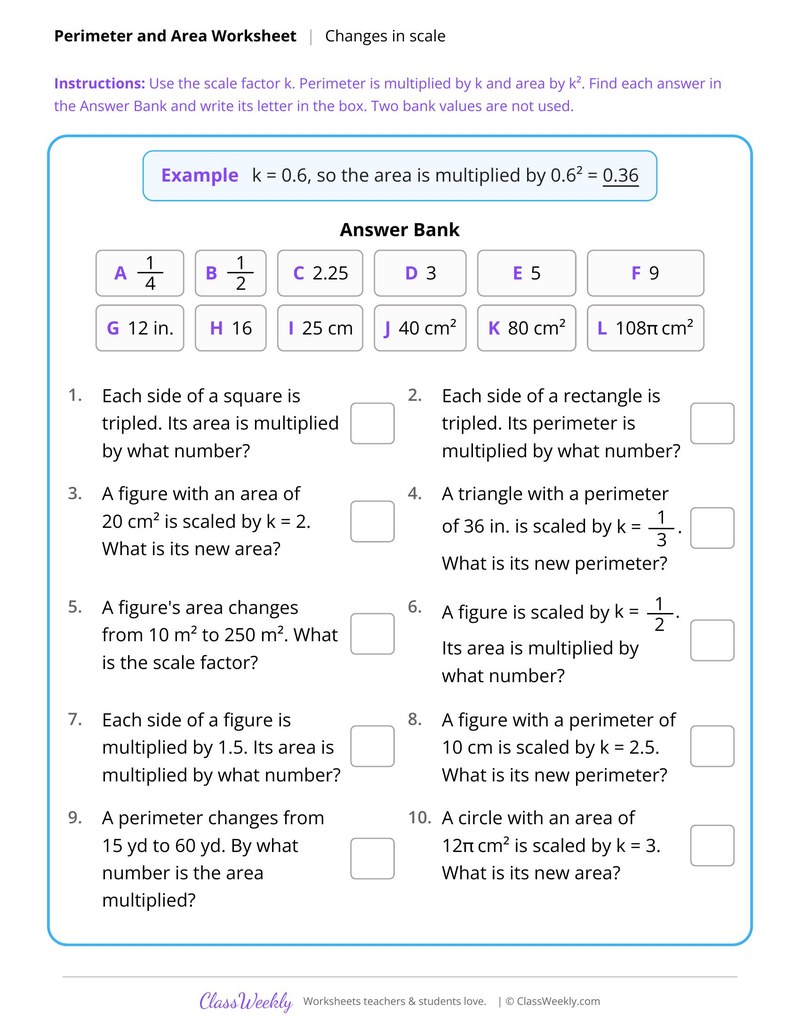
The area is multiplied by 3², or 9, while the perimeter is multiplied by 3. A 3 ft by 5 ft rug enlarged by k = 3 grows from 15 ft² to 135 ft². Scale Change Word Problems opens with this example.
How do you find the scale factor from two areas?
⌄
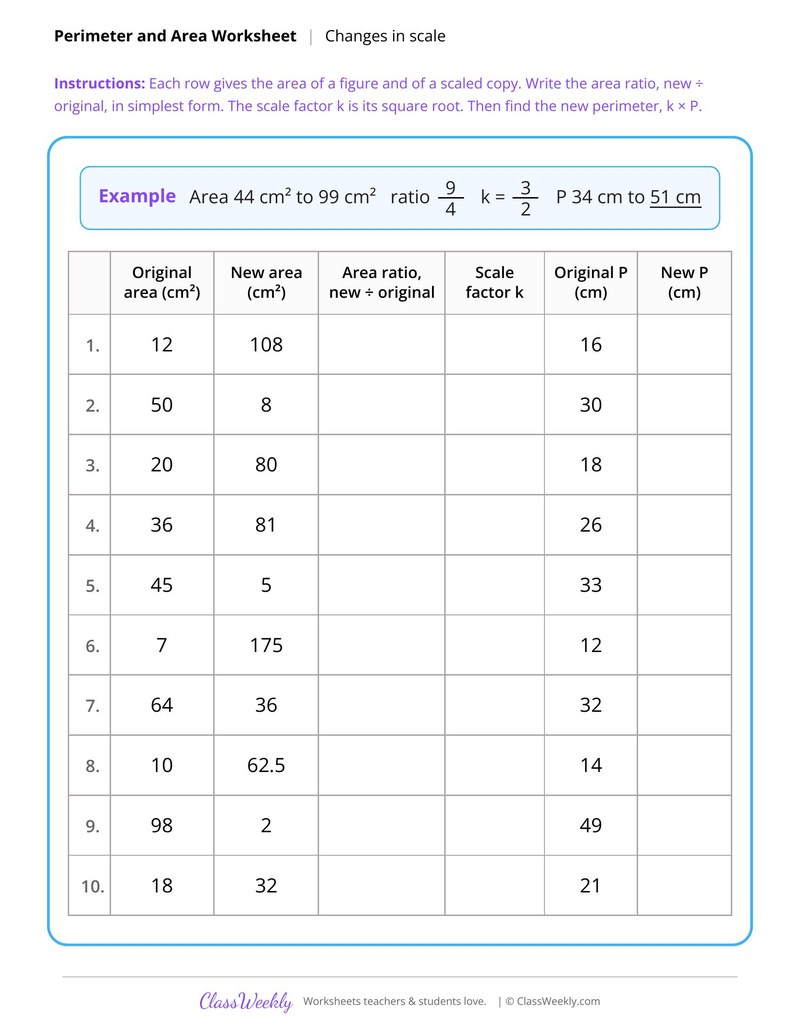
Write the ratio of the new area to the original area in simplest form, then take its square root. Areas of 44 cm² and 99 cm² give a ratio of 9/4, so k = 3/2. Find the Scale Factor From Area has 10 rows to complete.
Ratings & Reviews
No reviews yet. Be the first to share what you think.
Reviews are for ClassWeekly members.
Make a Request
Spotted something to fix, or want a worksheet we don't have yet? Tell us and we'll make it.
What is ClassWeekly?
ClassWeekly offers free worksheets and printable learning resources for kids, from preschool up. All worksheets are aligned to Common Core, NGSS, and C3 Framework standards and designed by educators. Become a member to access the full library and download unlimited PDFs.