Which Spot Is Warmer
Written by Adi Ackerman, Head Teacher
"Which Spot Is Warmer" is written for 1st Grade (Ages 6-7). If your little one is a year younger but already steady on energy, sound and light, the page still works. You may just need to read the instructions out loud. And if they are older and sunshine and shade never quite stuck, this is a short review rather than busywork.
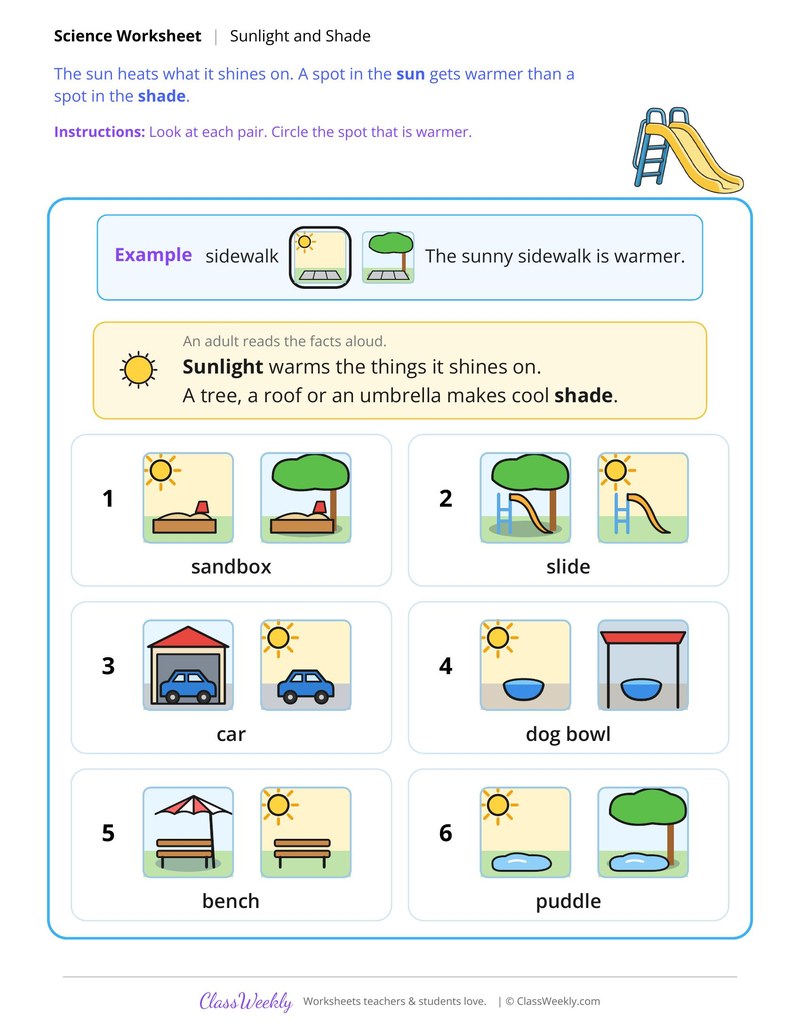
1st grade science worksheet: circle the warmer spot in pairs like a sunny or shady sandbox, slide, bench and dog bowl. Answer key included. Part of our sunshine and shade energy, sound and light collection.
How do I use this worksheet?
Start with something students can look at or think about: a photo, a short video, a jar on the windowsill, or a question like "what do you already know about sunshine and shade?" Then let them work through the first item together as a class, then finish the rest independently or with a partner, keeping a word bank or anchor chart in view so the vocabulary stays available. When you review, ask students how they knew, and let them point to the part of the diagram or reading that told them. These sunshine and shade worksheets work well as a lead in before an investigation, as a way to capture what students noticed afterward, or as review before an assessment.
What students will practice
- Students will tell that sunlight warms the things it shines on.
- Students will tell that a tree, a roof or an umbrella makes cool shade.
- Students will circle the warmer spot in pairs like a slide and a puddle.


Curriculum Links
Find this in the curriculum
Browse the grade, subject, and topic this belongs to.
FAQ
How do I use this sunshine and shade worksheet?
⌄
Start with something students can look at or think about: a photo, a short video, a jar on the windowsill, or a question like "what do you already know about sunshine and shade?" Then let them work through the first item together as a class, then finish the rest independently or with a partner, keeping a word bank or anchor chart in view so the vocabulary stays available. When you review, ask students how they knew, and let them point to the part of the diagram or reading that told them. These sunshine and shade worksheets work well as a lead in before an investigation, as a way to capture what students noticed afterward, or as review before an assessment.
What does this worksheet teach?
⌄
Circle the warmer spot in pairs like a sunny or shady sandbox, slide, bench and dog bowl. The directions on the page read: Look at each pair. Circle the spot that is warmer. The page opens with a worked example, and an answer key is included.
Can I use this sunshine and shade worksheet for homeschool or classroom?
⌄
Yes, both. We made it for 1st Grade energy, sound and light, and the page works the same whether it lands on a kitchen table or a center rotation. At home, most families go through it together and talk the answers out loud, and that talking is where most of the learning happens with sunshine and shade. In class it runs well as independent work while you pull a small group. Print one copy or thirty, whichever the day needs.
What does sunshine and shade teach first graders?
⌄
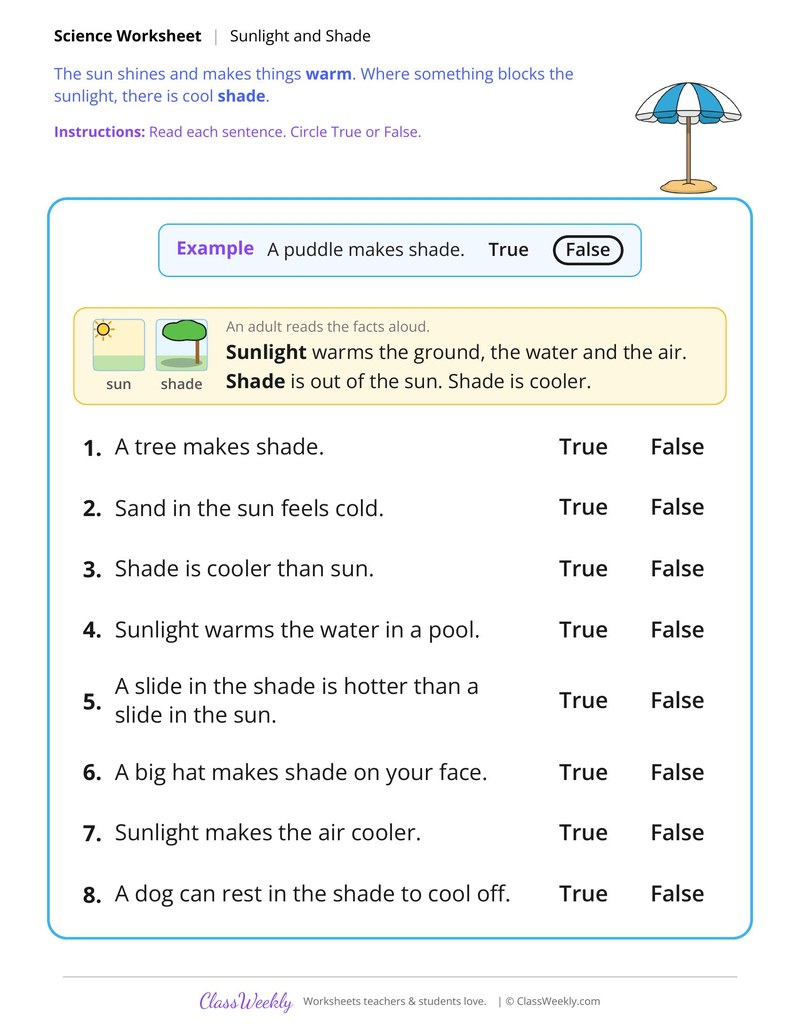
First graders learn that areas in direct sunlight receive more of the sun's heat and light energy, making them warmer than shaded areas where an object blocks the sun's rays. They explore how people, animals, and plants respond differently to sunshine and shade.
When do first graders learn about sunshine and shade?
⌄
Sunshine and shade are typically explored in Grade 1 during a light, energy, or weather unit, often with an outdoor investigation that gives students direct experience of the temperature difference between sun and shade.
How can I use these worksheets at home?
⌄
On a warm day, measure how warm the ground or a surface feels in direct sun versus in the shade. Ask your child to predict and observe where it's warmer and why. Complete the worksheet to record findings and discuss why shade feels cooler.
What do 1st graders learn about light?
⌄
Children learn that clear things like glass let all light through, cloudy things like wax paper let some through and thick things like wood block it. They also see that a shadow forms where a thing blocks light and falls on the side away from it.
How do light and sound send messages?
⌄
A signal is a light or a sound that sends a message. Children match signals like a red light, a fire alarm and a lighthouse to what they mean, sort signals into light and sound, and plan their own secret signal with a flashlight or a drum.
What is the difference between sun and shade?
⌄
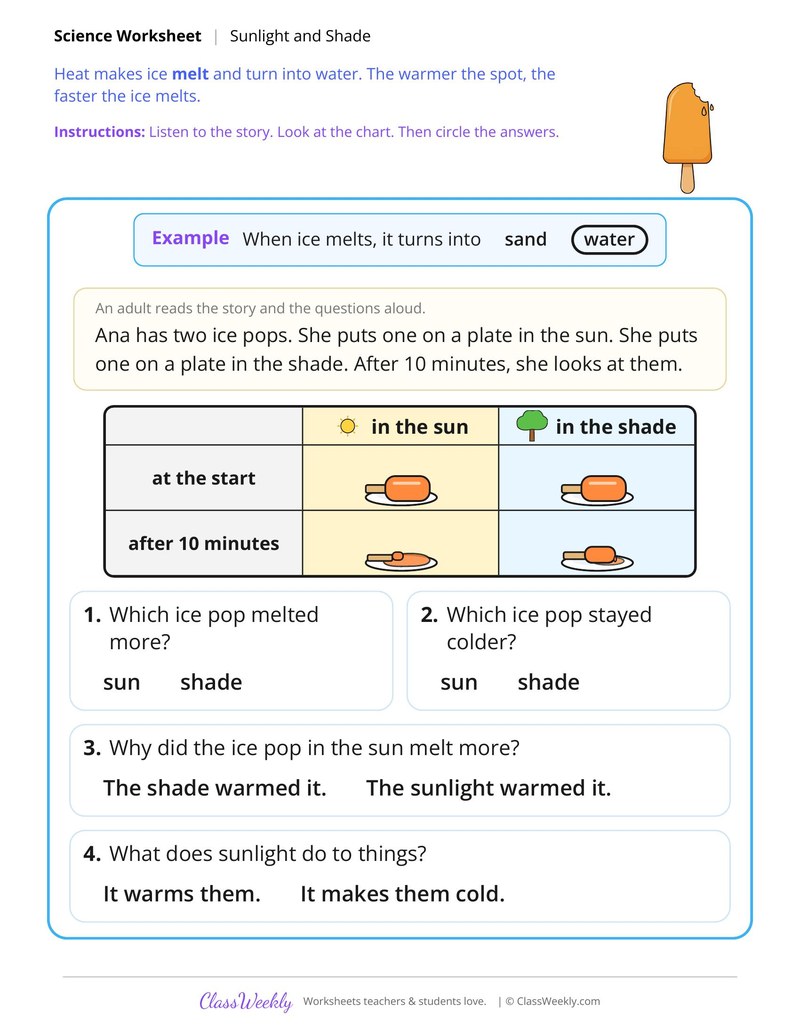
Sunlight warms the ground, the water and the air, so a spot in the sun gets warmer than a spot in the shade. Children compare thermometers and ice pops in the sun and the shade to see this for themselves.
Who reads the stories on these sheets?
⌄
Many sheets have a short fact box or test story that an adult reads aloud, and the page says so. Children then circle, sort, match or write their answers, and most sheets come with an answer key.
Ratings & Reviews
No reviews yet. Be the first to share what you think.
Reviews are for ClassWeekly members.
Make a Request
Spotted something to fix, or want a worksheet we don't have yet? Tell us and we'll make it.
Worksheet Details
| Grade | 1st Grade |
| Subject | Science |
| Topic | Energy, Sound and Light |
| Pages | 1 page |
| Difficulty | Medium |
Learn More
What is ClassWeekly?
ClassWeekly offers free worksheets and printable learning resources for kids, from preschool up. All worksheets are aligned to Common Core, NGSS, and C3 Framework standards and designed by educators. Become a member to access the full library and download unlimited PDFs.