Perfect Verb Tenses in a Daily Planner
Written by Adi Ackerman, Head Teacher
"Perfect Verb Tenses in a Daily Planner" is written for 5th Grade (Ages 10-11), and it covers Common Core L.5.1.B. If your little one is a year younger but already steady on verbs, the page still works. You may just need to read the instructions out loud. And if they are older and perfect tenses never quite stuck, this is a short review rather than busywork.
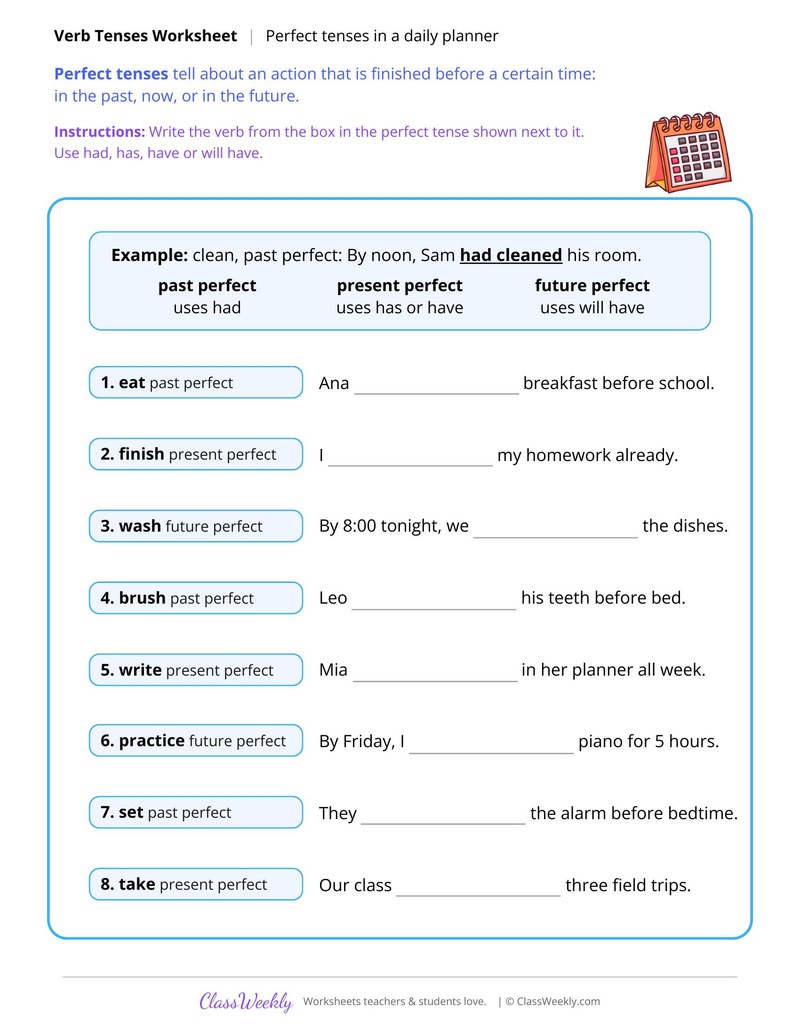
5th grade grammar worksheet: write 8 verbs like eat, finish and practice in the past, present or future perfect tense. Answer key included. Part of our perfect tenses verbs collection. Aligned to Common Core standards.
How do I use this worksheet?
Print the page and read the directions with your child: Write the verb from the box in the perfect tense shown next to it. Use had, has, have or will have. When they finish, check the work together with the answer key.
What students will practice
- Students will form the past, present and future perfect tenses.
- Students will choose had, has, have or will have.
- Students will write verbs correctly in 8 sentences.
Curriculum Links
Common Core State Standards
Language · 5th Grade
Standard: Form and use the perfect (e.g., I had walked; I have walked; I will have walked) verb tenses.
View all L.5.1.B worksheets →Find this in the curriculum
Browse the grade, subject, and topic this belongs to.
FAQ
How do I use this perfect tenses worksheet?
⌄
Print the page and read the directions with your child: Write the verb from the box in the perfect tense shown next to it. Use had, has, have or will have. When they finish, check the work together with the answer key.
What does this worksheet teach?
⌄
A note explains that perfect tenses tell about an action finished before a certain time, with boxes showing that past perfect uses had, present perfect uses has or have and future perfect uses will have. After an example, eight planner sentences each give a verb and the tense to use, such as By 8:00 tonight, we (wash, future perfect) the dishes. The directions on the page read: Write the verb from the box in the perfect tense shown next to it. Use had, has, have or will have. An answer key is included.
Can I use this perfect tenses worksheet for homeschool or classroom?
⌄
Yes, both. We made it for 5th Grade verbs, and the page works the same whether it lands on a kitchen table or a center rotation. At home, most families go through it together and talk the answers out loud, and that talking is where most of the learning happens with perfect tenses. In class it runs well as independent work while you pull a small group. Print one copy or thirty, whichever the day needs.
How do students practice the perfect tenses on these worksheets?
⌄
Activities typically include identifying the tense in a given sentence, choosing the correct auxiliary verb (have/has/had/will have), and completing or writing sentences using each perfect tense form correctly.
What is the grammatical structure of each perfect tense?
⌄
All perfect tenses combine a form of 'have' (present: have/has, past: had, future: will have) with the past participle of the main verb - students must know both the pattern and the irregular past participles of common verbs.
How does practice with perfect tenses improve student writing?
⌄
Using perfect tenses correctly allows writers to express nuanced time relationships - showing that one event preceded another, or that a past action has current relevance - which adds sophistication and precision to 5th-grade writing.
What verb skills are expected in fifth grade?
⌄
Fifth graders are expected to use verb tense consistently across a piece of writing, recognize and correct inappropriate shifts in verb tense (CCSS L.5.1d), and use perfect tenses (past perfect, present perfect, future perfect). They should also understand modal auxiliaries and active versus passive voice.
How do you teach verb tense to fifth graders?
⌄
Focus on the perfect tenses (I had eaten, I have eaten, I will have eaten) and the difference between simple and perfect tenses. Use timelines to show when actions occur relative to other events. Worksheets that ask students to identify or rewrite sentences using a specified tense help solidify understanding.
What is passive voice and should fifth graders learn it?
⌄
In passive voice the subject receives the action rather than performing it (The ball was kicked by Maria vs. Maria kicked the ball). CCSS L.5.1b introduces the concept. Fifth graders should recognize passive voice and understand when active voice is usually preferred for clarity and directness in their own writing.
What is noun-verb agreement?
⌄
A singular subject takes a singular verb and a plural subject takes a plural verb, as in The cookies in the jar smell sweet. Four pages practice it with subjects followed by a phrase, compound subjects joined by and, or and neither nor, and a garden report with 8 verbs to fix (CCSS L.5.1).
Ratings & Reviews
No reviews yet. Be the first to share what you think.
Reviews are for ClassWeekly members.
Make a Request
Spotted something to fix, or want a worksheet we don't have yet? Tell us and we'll make it.
Worksheet Details
| Grade | 5th Grade |
| Subject | Grammar & Writing |
| Topic | Verbs |
| Standard | L.5.1.B |
| Pages | 1 page |
| Difficulty | Medium |
Learn More
What is ClassWeekly?
ClassWeekly offers free worksheets and printable learning resources for kids, from preschool up. All worksheets are aligned to Common Core, NGSS, and C3 Framework standards and designed by educators. Become a member to access the full library and download unlimited PDFs.