Count Forward by Tens With Ten Frames
Written by Adi Ackerman, Head Teacher
"Count Forward by Tens With Ten Frames" is written for Kindergarten (Ages 5-6), and it covers Common Core K.CC.A.1. If your little one is a year younger but already steady on counting, the page still works. You may just need to read the instructions out loud. And if they are older and skip counting by 10s never quite stuck, this is a short review rather than busywork.
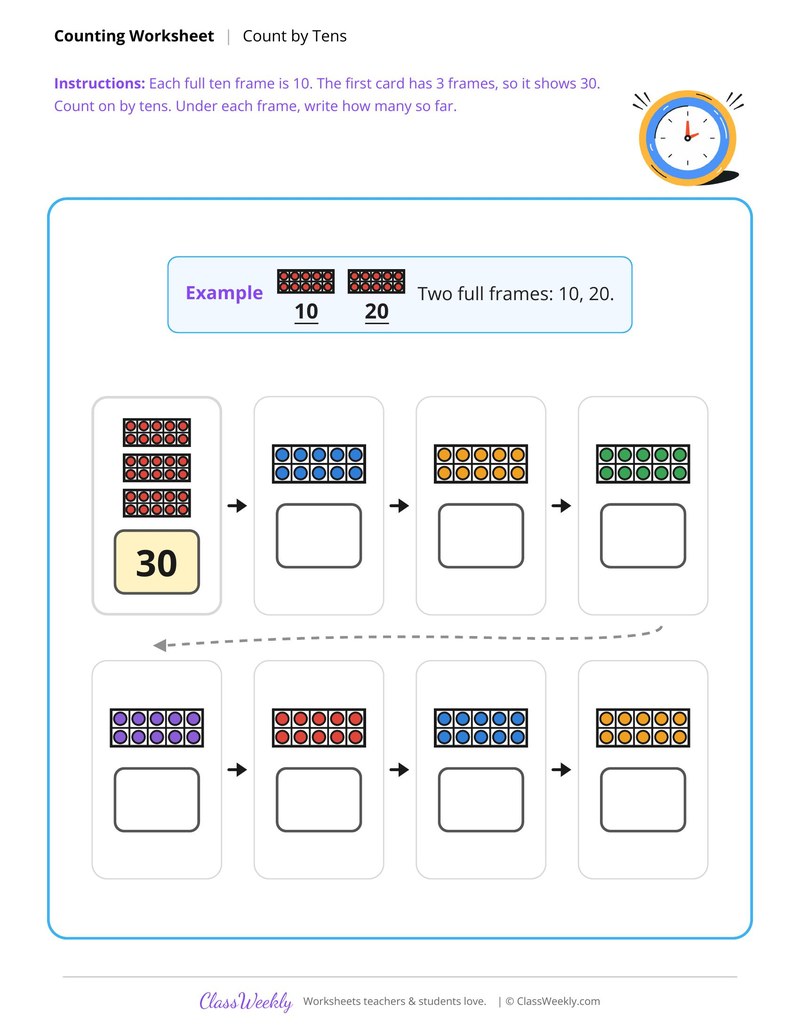
Kindergarten math worksheet: count on by tens with full ten frames, starting at 30, and write how many so far under each frame. Answer key included. Part of our skip counting by 10s collection. Aligned to Common Core standards.
How do I use this worksheet?
Before handing out the worksheet, briefly introduce the concept with a short oral warm-up or a visual model on the board. Let students work through it with your modeling first (do the first item together on the board), then try the rest with a partner, encouraging them to talk through their thinking: "What strategy are you using? How do you know that is right?" After completing the worksheet, review any missed problems together and discuss the reasoning rather than just the answer. For extra support, let students use manipulatives or draw pictures alongside the written problems. These skip counting by 10s worksheets work well as daily practice, homework, or a focused review activity.
What students will practice
- Students will know that each full ten frame shows 10.
- Students will count on by tens starting at 30.
- Students will write how many so far under each frame.
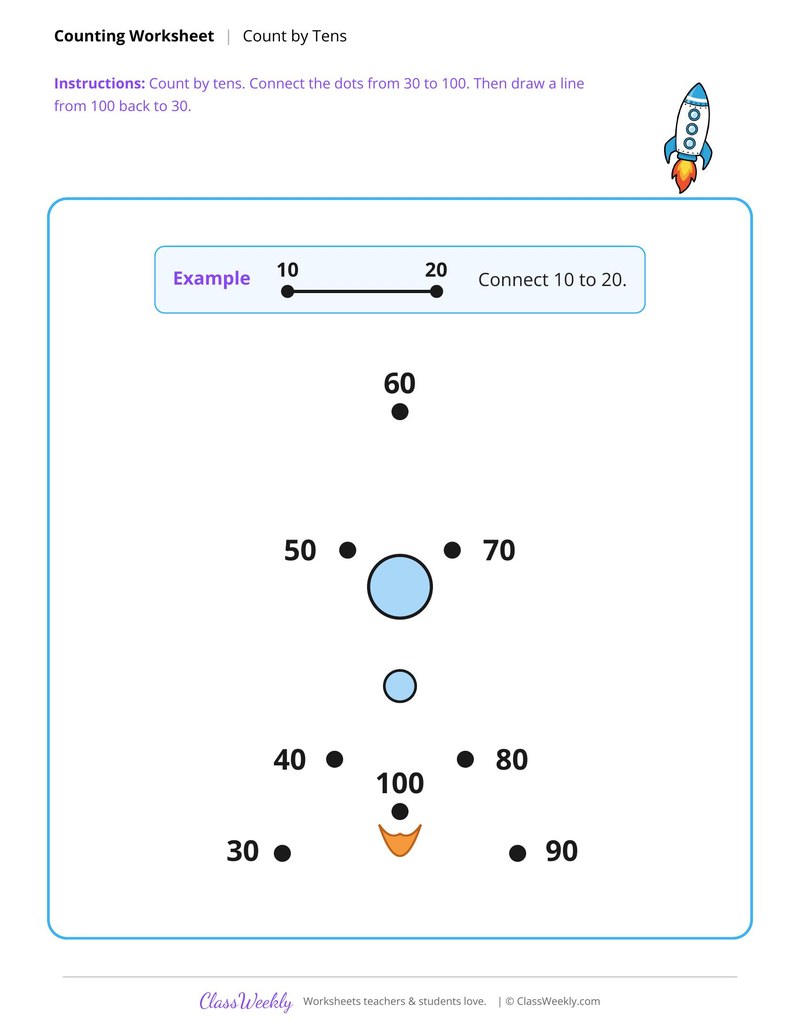
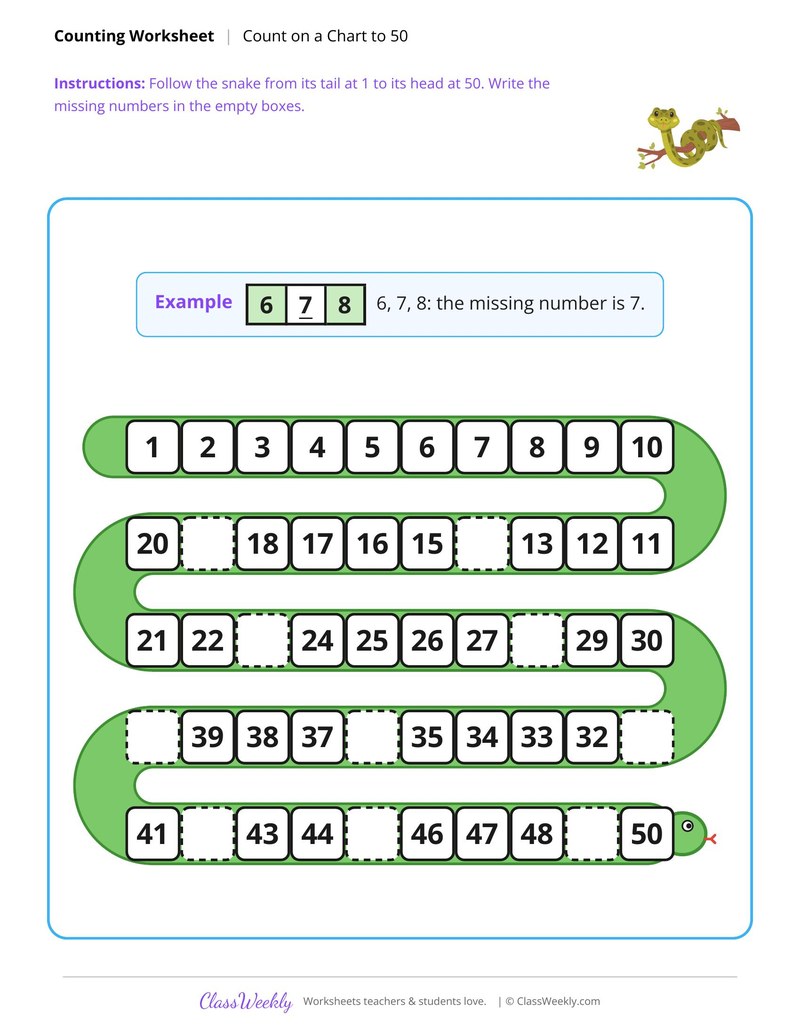
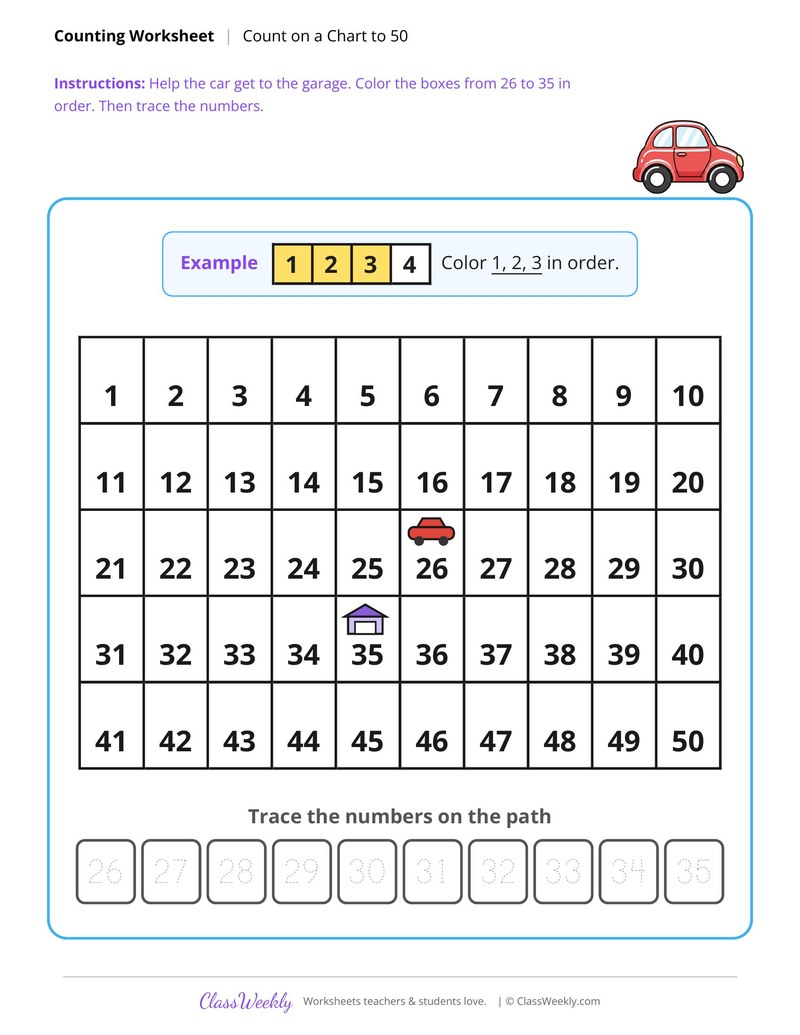
Curriculum Links
Common Core State Standards
Counting and Cardinality · Kindergarten
Standard: Count to 100 by ones and by tens.
View all K.CC.A.1 worksheets →Find this in the curriculum
Browse the grade, subject, and topic this belongs to.
FAQ
How do I use this skip counting by 10s worksheet?
⌄
Before handing out the worksheet, briefly introduce the concept with a short oral warm-up or a visual model on the board. Let students work through it with your modeling first (do the first item together on the board), then try the rest with a partner, encouraging them to talk through their thinking: "What strategy are you using? How do you know that is right?" After completing the worksheet, review any missed problems together and discuss the reasoning rather than just the answer. For extra support, let students use manipulatives or draw pictures alongside the written problems. These skip counting by 10s worksheets work well as daily practice, homework, or a focused review activity.
What does this worksheet teach?
⌄
Count on by tens with full ten frames, starting at 30, and write how many so far under each frame. The directions on the page read: Each full ten frame is 10. The first card has 3 frames, so it shows 30. Count on by tens. Under each frame, write how many so far. The page opens with a worked example, and an answer key is included.
Can I use this skip counting by 10s worksheet for homeschool or classroom?
⌄
Yes, both. We made it for Kindergarten counting, and the page works the same whether it lands on a kitchen table or a center rotation. At home, most families go through it together and talk the answers out loud, and that talking is where most of the learning happens with skip counting by 10s. In class it runs well as independent work while you pull a small group. Print one copy or thirty, whichever the day needs.
What is a ten frame?
⌄
A grid of ten boxes, two rows of five, filled from the top left. Its value is that amounts become recognizable shapes: a full top row is always five, and eight always looks like a full row plus three. Children start seeing quantities instead of counting them one at a time.
What does this ten frame worksheet ask?
⌄
Part of the frame is filled and your child works out how many more are needed to make 10. Because the empty boxes are visible, the answer can be seen before it is counted, which is exactly the bridge from counting to knowing.
Why is making 10 such a focus in early math?
⌄
Our number system is built on tens, so the pairs that make 10 turn up everywhere later. A child who knows 6 and 4 instantly can handle 16 plus 4, and later 26 plus 4, without counting. It is one of the highest value facts to have automatic.
Why is skip counting by 10s important for kindergartners?
⌄
Counting by tens helps children understand the base-ten structure of our number system and prepares them for place value, addition, and multiplication. It also builds mental math efficiency-children who can skip count quickly have a head start on adding tens in first and second grade.
When do kindergartners typically learn to skip count by 10s?
⌄
Skip counting by 10s is usually introduced in the spring of kindergarten after children are comfortable counting to 100 by ones. Many teachers use a hundreds chart so children can see the visual pattern of landing on every row's last number.
How can parents practice skip counting by 10s at home?
⌄
Count coins together-a stack of dimes is perfect for practicing tens. You can also chant '10, 20, 30...' during car rides or while clapping. Making it rhythmic helps children memorize the sequence faster.
Which Common Core standard does skip counting by 10s address?
⌄
This skill aligns with CCSS.MATH.CONTENT.K.CC.A.1, which requires kindergartners to count to 100 by ones and by tens.
When do kindergarteners learn to count to 100?
⌄
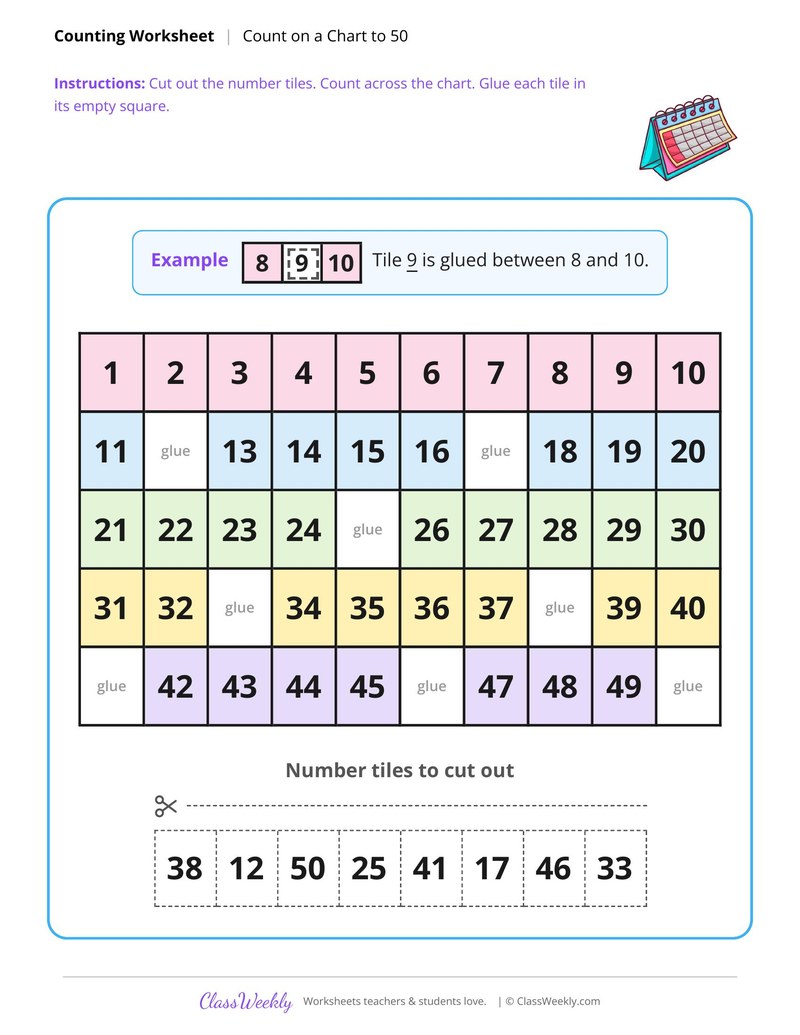
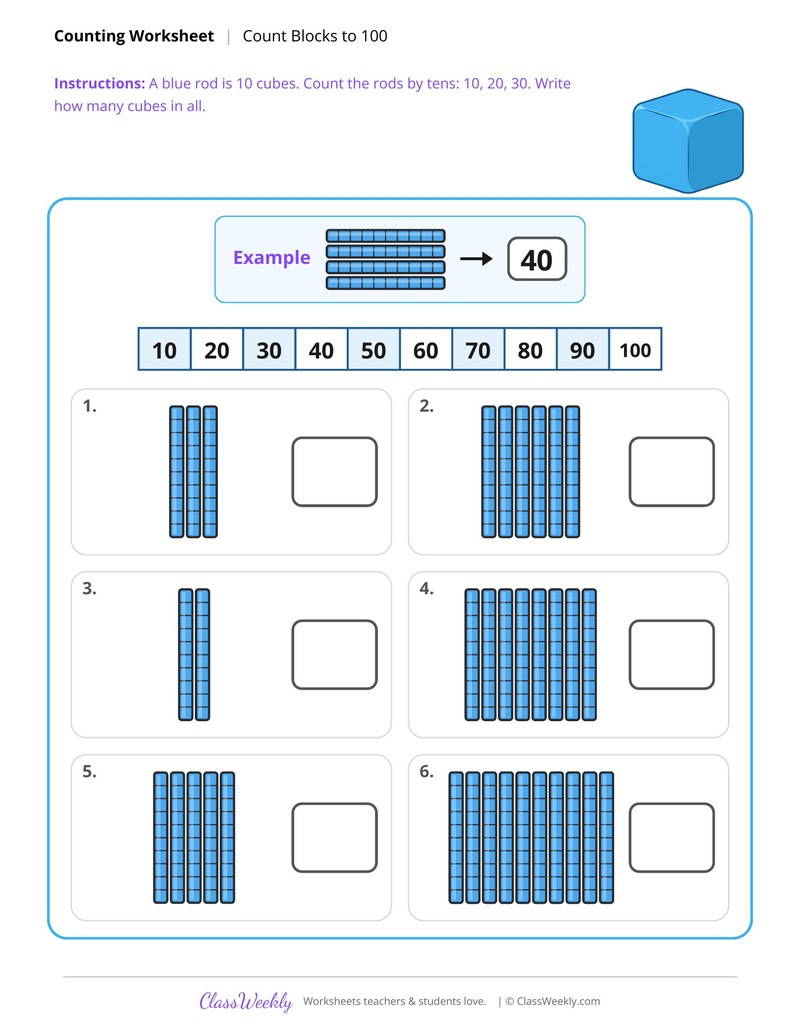
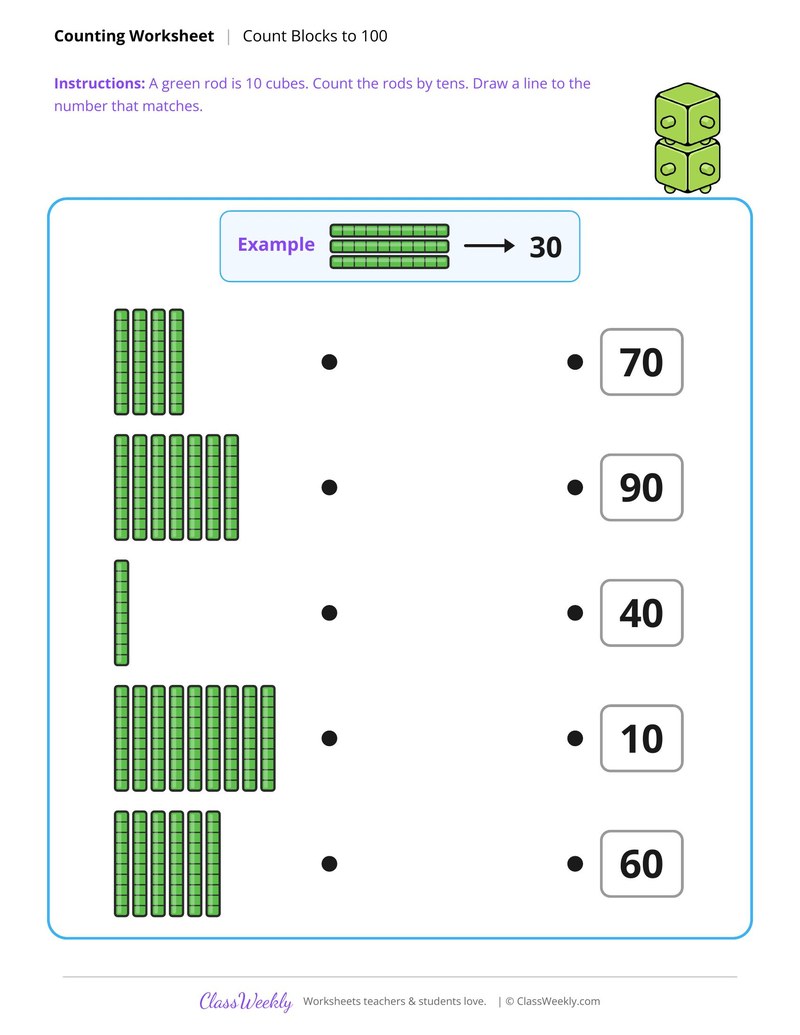
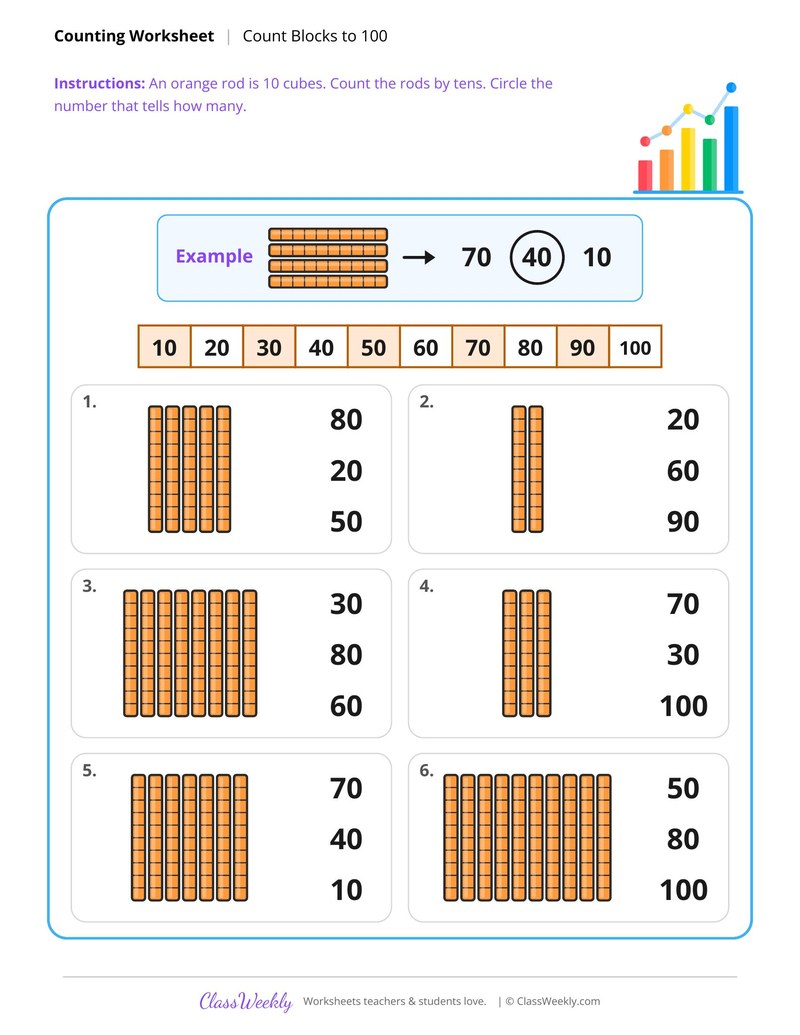
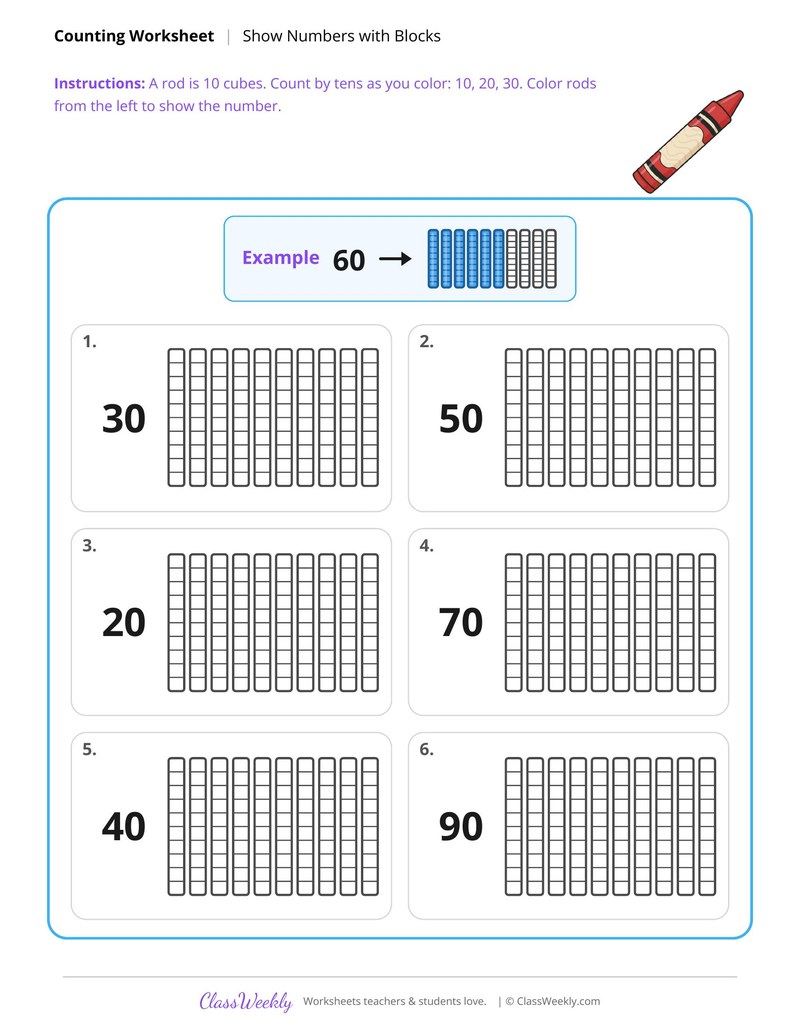
Counting to 100 by ones and by tens is the Common Core standard K.CC.A.1, expected by the end of kindergarten. Many children count reliably to 20 or 30 by midyear, then use counting by tens as a bridge to 100. Our block pages, where a rod is 10 cubes, let children count the rods by tens and then the loose cubes.
What is one-to-one correspondence, and why does it matter?
⌄
One-to-one correspondence means saying one number for each object counted (CCSS K.CC.B.4). It turns counting from a memorized chant into an understanding of how many. Pages like Count the Flowers in a Circle ask children to put a dot on one flower to start, so they know where they began.
How do kindergarteners learn teen numbers?
⌄
Kindergarteners learn that a teen number is 10 ones and some more ones (CCSS K.NBT.A.1). Our teen pages show this with two ten frames, a ten rod and cubes, and egg cartons, then move to sentences like 16 = 10 + 6. Children color, circle, match, cut and glue before writing the sentence themselves.
Do kindergarteners learn tens and ones?
⌄
Yes, as an early look at place value. Tens and ones pages show a rod as 1 ten and a cube as 1 one, and children write or circle the tens and ones for numbers up to 30, then count rods by tens up to 100. It builds on the teen number idea of 10 ones and some more.
How can I tell if my kindergartener needs more counting practice?
⌄
Watch whether your child counts a small group without skipping or counting an object twice, and can write the number to match. A child who says numbers quickly but loses track while counting objects needs more practice with small groups, such as the dot cards and cube towers to 10.
Ratings & Reviews
No reviews yet. Be the first to share what you think.
Reviews are for ClassWeekly members.
Make a Request
Spotted something to fix, or want a worksheet we don't have yet? Tell us and we'll make it.
Worksheet Details
| Grade | Kindergarten |
| Subject | Math |
| Topic | Counting |
| Standard | K.CC.A.1 |
| Pages | 1 page |
| Difficulty | Medium |
Learn More
What is ClassWeekly?
ClassWeekly offers free worksheets and printable learning resources for kids, from preschool up. All worksheets are aligned to Common Core, NGSS, and C3 Framework standards and designed by educators. Become a member to access the full library and download unlimited PDFs.