Daytime Sky Picture Hunt
Written by Adi Ackerman, Head Teacher
"Daytime Sky Picture Hunt" is written for 1st Grade (Ages 6-7), and it covers NGSS 1-ESS1-1. If your little one is a year younger but already steady on Earth, sun and moon, the page still works. You may just need to read the instructions out loud. And if they are older and day and night never quite stuck, this is a short review rather than busywork.
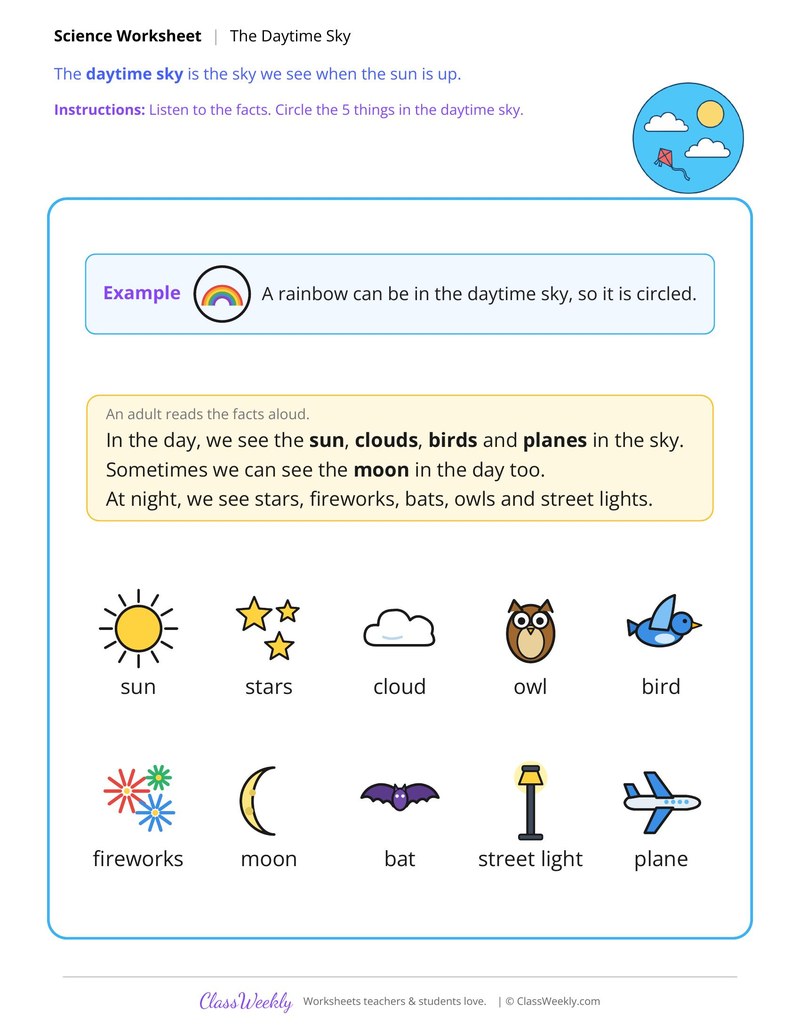
1st grade science worksheet: listen to facts about the sky, then circle the 5 things like the sun and a plane you can see by day. Answer key included. Part of our day and night earth, sun and moon collection. Aligned to NGSS standards.
How do I use this worksheet?
Start with something students can look at or think about: a photo, a short video, a jar on the windowsill, or a question like "what do you already know about day and night?" Then let them work through the first item together as a class, then finish the rest independently or with a partner, keeping a word bank or anchor chart in view so the vocabulary stays available. When you review, ask students how they knew, and let them point to the part of the diagram or reading that told them. These day and night worksheets work well as a lead in before an investigation, as a way to capture what students noticed afterward, or as review before an assessment.
What students will practice
- Students will listen to facts about the daytime sky read aloud by an adult.
- Students will circle five things seen in the daytime sky.
- Students will tell daytime things like the sun and clouds from night things like stars and bats.


Curriculum Links
Next Generation Science Standards
Science · 1st Grade
Find this in the curriculum
Browse the grade, subject, and topic this belongs to.
FAQ
How do I use this day and night worksheet?
⌄
Start with something students can look at or think about: a photo, a short video, a jar on the windowsill, or a question like "what do you already know about day and night?" Then let them work through the first item together as a class, then finish the rest independently or with a partner, keeping a word bank or anchor chart in view so the vocabulary stays available. When you review, ask students how they knew, and let them point to the part of the diagram or reading that told them. These day and night worksheets work well as a lead in before an investigation, as a way to capture what students noticed afterward, or as review before an assessment.
What does this worksheet teach?
⌄
Listen to facts about the sky, then circle the 5 things like the sun and a plane you can see by day. The directions on the page read: Listen to the facts. Circle the 5 things in the daytime sky. The page opens with a worked example, and an answer key is included.
Can I use this day and night worksheet for homeschool or classroom?
⌄
Yes, both. We made it for 1st Grade Earth, sun and moon, and the page works the same whether it lands on a kitchen table or a center rotation. At home, most families go through it together and talk the answers out loud, and that talking is where most of the learning happens with day and night. In class it runs well as independent work while you pull a small group. Print one copy or thirty, whichever the day needs.
What does day and night teach first graders?
⌄
First graders learn that Earth spins on its axis, causing one side to face the sun (day) while the other faces away (night). They discover that this cycle repeats every 24 hours and explore how living things, including humans, follow daily rhythms tied to day and night.
When do first graders learn about day and night?
⌄
Day and night is typically introduced in Grade 1 as part of an earth science or space unit. Teachers often use globes and flashlights to model the concept kinesthetically, making the abstract rotation of the Earth something students can see and feel.
How can I use these worksheets at home?
⌄
Do a simple flashlight and globe demonstration at home to show how the Earth rotates, then complete the worksheet to reinforce what your child observed. Ask your child to describe what they notice about the sky in the morning versus at night.
What can you see in the daytime sky?
⌄
In the day we see the sun, clouds, birds and planes, and sometimes the moon too. At night we see stars, and bats and owls come out.
Why are summer days longer than winter days?
⌄
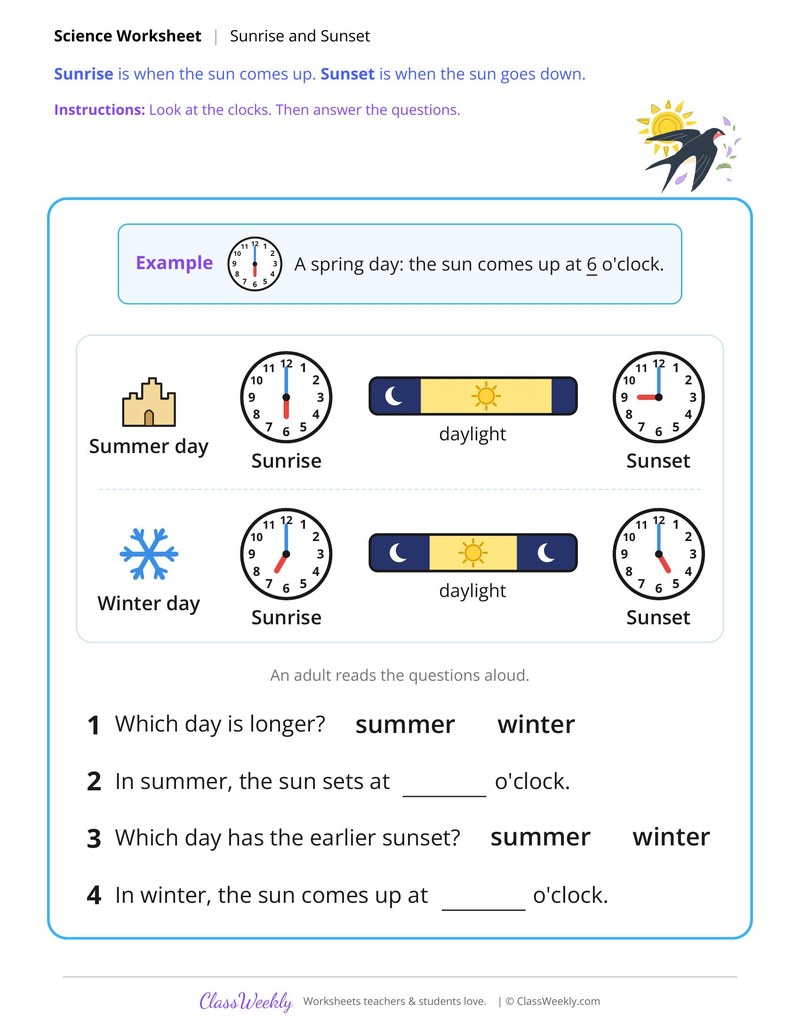
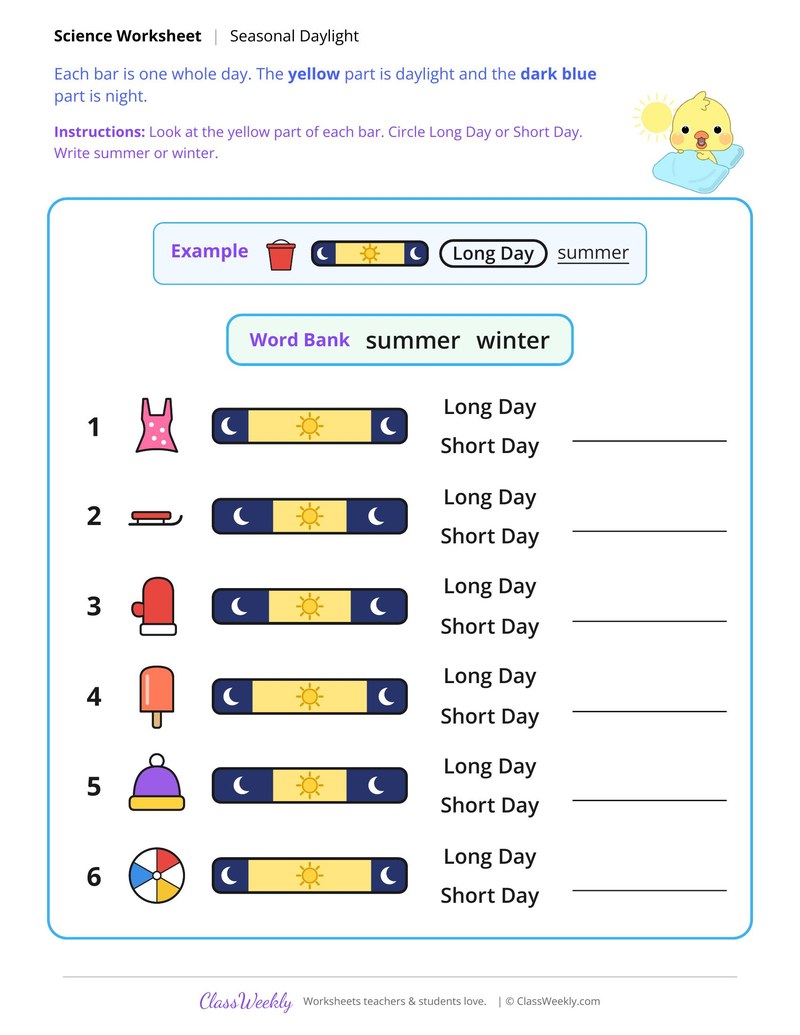
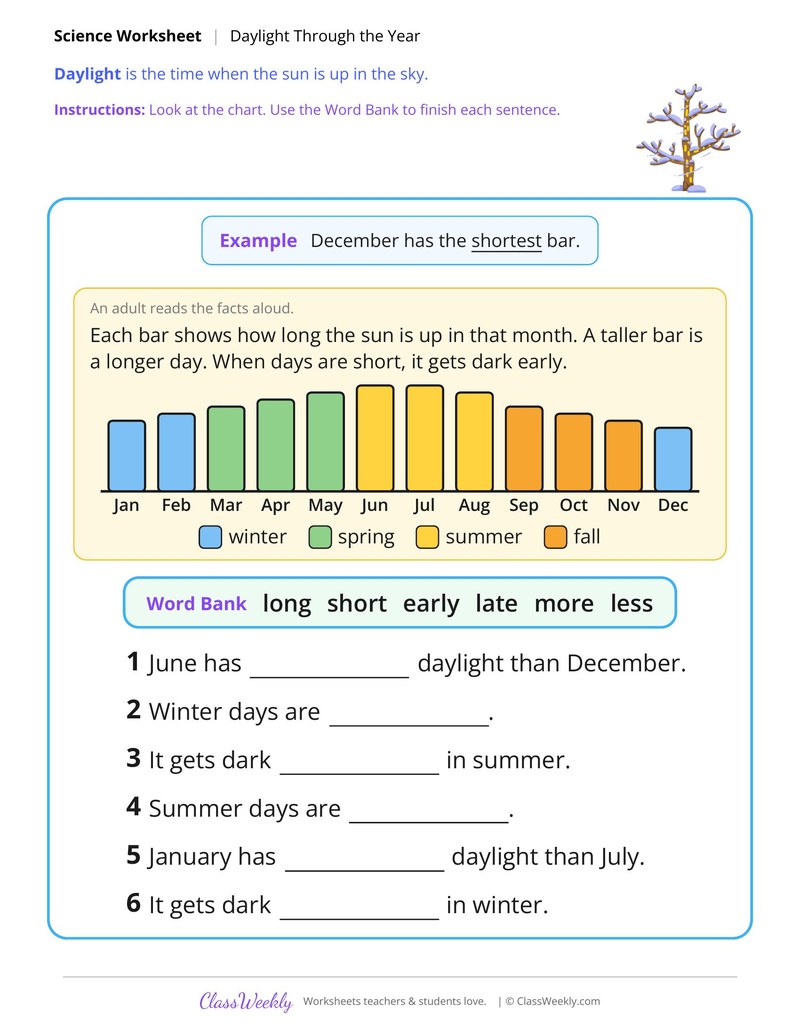
In summer the sun comes up earlier and sets later, so there is more daylight. In winter the sun is up for less time, so it gets dark early. The daylight sheets show this with clocks and bar charts.
What is the difference between sunrise and sunset?
⌄
Sunrise is when the sun comes up and sunset is when the sun goes down. Children read clock faces to find the hour of each on a summer day and a winter day.
Ratings & Reviews
No reviews yet. Be the first to share what you think.
Reviews are for ClassWeekly members.
Make a Request
Spotted something to fix, or want a worksheet we don't have yet? Tell us and we'll make it.
Worksheet Details
| Grade | 1st Grade |
| Subject | Science |
| Topic | Earth, Sun and Moon |
| Standard | 1-ESS1-1 |
| Pages | 1 page |
| Difficulty | Medium |
Learn More
What is ClassWeekly?
ClassWeekly offers free worksheets and printable learning resources for kids, from preschool up. All worksheets are aligned to Common Core, NGSS, and C3 Framework standards and designed by educators. Become a member to access the full library and download unlimited PDFs.